Friday Links

So, we thought we would escape from the world a bit this past weekend and revisit Superman Returns, the 2006 reboot of the Man of Steel film franchise directed by Bryan Singer and starring Brandon Routh as Supes.  Well, before we even reached the halfway point of the film, we bristled at a very basic legal mistake.  Villian Lex Luthor is a free man because Superman “missed a court date.”  Well, that’s an interesting procedurla twist.  Specifically, though, a character remarks that “the appellate court” called Superman as a witness, and Superman – whose extended absence from the Earth is a key plot point of the film – didn’t appear when summoned.  Thus, Luthor goes free.  But appellate courts don’t call witnesses!  (Note: We’re obviously not the first ones to point this out, but we are the most recent bloggers to be irked by it.).  By the way, that’s the cover of the DC Comics Superman Returns comic adaptation depicted above.

The wonderful, wonderful Etta James will be missed by us.  May she rest in peace.

Katherine Frye of the North Carolina Law Blog asks: “Should I Delete My Facebook Account?”  She’s not asking whether she, the lawyer, should delete her own Facebook account, but how she, as an advocate, should address her clients concerns about their own social media profiles.

If you follow Zoey Deschanel’s litigation choices, then you must see here.

Read this 1985 letter from Roger Enrico, the chief executive officer of PepsiCo, on the release of New Coke. (Hat Tip: Letters of Note).

Friday Links

Depicted above is the cover of Batman Gotham Adventures #27, published not so long ago in 2000.  Here’s our question: If Batman has been, as the cover suggests,  “wrongfully accused” and jailed, why have his jailers permitted him to remain in costume? Surely it is a violation of the Gotham City Detention Center’s policies and procedures to permit a criminal defendant to remain in costume.  We suspect that Batman ultimately escapes this predicament, but we also surmise that if he had been revealed to be Bruce Wayne during his confinement his flight from justice would have been much, more difficult.  By the way, this is not the first time we’ve looked at a cover from this series.  See here for a similarly puzzling cover.

According to this tweet by our own Stuart Mauney, the South Carolina Bar House Delegates debated the rule against perpetuities yesterday.  There’s something we never thought we’d hear of again.  What next? The rule in Shelley’s case?

For years and years, we’ve loved The Onion.  This week, that satirical paper published a piece entitled, “Supreme Court Overturns ‘Right v. Wrong.’”  That’s big news.

Lawyerist asks its lawyer readers: “Is Facebook ruining your life?” We’ll get back to you on that one.

Jeremy Grabill of The Product Liability Monitor pauses to comment upon the release of Susan Saladoff’s “Hot Coffee” documentary on DVD.  Grabill notes: “[F]or every sympathetic plaintiff that Ms. Saladoff (the film’s producer/director) presents, there are no doubt an equal (if not greater) number of truly frivolous claims that could be chronicled, especially in the mass tort context.” As you know, you can follow our continuing coverage of that film and the fabled Stella Liebeck McDonald’s hot coffee case here.

The Abnormal Use Community

As 2011 draws to a close, we here at Abnormal Use have looked back on the year and shared with you both our favorite posts of 2011 and the Abnormal Interviews we published in the preceding twelve months.  One thing that we have not yet addressed is our great fondness of your reader comments and feedback.  We have received all sorts of comments this year, from congratulations, to praise, to vitriol.  (We certainly opened a can of worms with our discussion of the McDonald’s hot coffee case and our review of a plaintiff’s attorney’s documentary on same).

So, in the coming year, we humbly request that you please keep your thoughts and comments coming.  Even if you disagree with us, we hope you will share your opinions and observations (and judging by the past year, none of you are shy about doing so).

We also remind you that there are several ways to get a hold of us.  We are all into this social media thing and offer such outlets.

The blog itself:  First and foremost, you can comment and communicate with us directly right here on the blog itself. Don’t forget, too, that in the right hand column we feature a complete list of our writers and contributors. If you click on one of those names, you will be taken to that individual’s official biography on our law firm’s website, where you contact that writer directly via email if you wish.

Twitter:  We here at Abnormal Use love Twitter, and we tweet links to each blog post. We also try to interact with our friends and legal colleagues in the Twittersphere.  You can reach us on Twitter at @gwblawfirm.  So, if you like Twitter as much as we do, tweet us!

Facebook:  This year, we finally set up a Facebook page for Abnormal Use.  If you are a sporadic visitor to our website, but a frequent visitor to Facebook, you can follow our updates there without ever having to leave your favorite social network.  Click here to reach us there.

Now that you know all of the ways to reach us, please drop us a line in 2012!

30th Anniversary: “Absence of Malice”

[Editor’s Note: Thirty years ago this week, on December 18, 1981, the film Absence of Malice was released to theatres.  If you’ve not seen it, go rent it immediately. Written by Kurt Luedtke and David Rayfiel, and directed by Sydney Pollack, the film starred Paul Newman and Sally Field.  But it was the cameo of Wilford Brimley in the film’s final scenes that really resonates with us all these years later.  So, we asked our fearless leader, Mills Gallivan, to share his thoughts on the film’s thirtieth anniversary, and he has done so in the piece below he calls “Abnormal Malice.”]

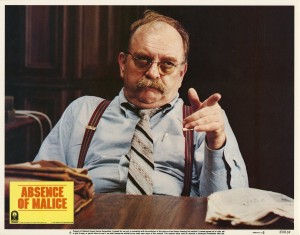
Even though Wilford Brimley’s portrayal of James J.Wells, U.S. Assistant Attorney General, in Absence of Malice is not a courtroom scene, it remains one of the truly great legal scenes in movie history. Brimley’s character appears late in the movie and steals the show from superstars Paul Newman and Sally Field. This Sunday marks the thirtieth anniversary of the film’s release and prompts reflection on the ongoing morality play occurring within the story

Anyone who has seen Absence of Malice could not forget Wells’ gravely southern drawl and down home demeanor when he says:

“Tell you what we’re gonna do. We’re gonna sit right here and talk about it. Now if you get tired of talking here, Mr. Marshal Elving Patrick there will hand you one of them subpoenas he’s got stuck down in his pocket and we’ll go downstairs and talk in front of the grand jury. Elliot? Jim? Fine. All right, Elving, hand whichever one of these fellas you like a subpoena and we’ll go on downstairs and talk in front of the grand jury.”

It is not just his suspenders that give Wells instant credibility, it is also his laser like focus and targeted approach to get to the bottom of a botched government investigation that has been compounded by press leaks. We are immediately drawn to Wells’ dedication to the truth; his character appeals to our natural morality and sense of fair play. This scene comes at the end of a twisting plot that takes protagonist, Michael Gallagher, played by Paul Newman, on a journey of manipulation by third parties who have destroyed his life.

Gallagher’s odyssey begins when over-zealous federal prosecutor Elliot Rosen leaks false information about Gallagher to Megan Carter, a young, naive and impetuous reporter played by Sally Field. Rosen hopes that the news story, albeit false, alleging that Gallagher is the target of an investigation into the murder of a local union official will lead him to a real suspect.  Megan seems to have no compunction about printing a story that has not been verified. Megan, like many people, does not learn from her mistakes. She continues putting out unverified stories and heaping more and more misery upon Gallagher, who quickly learns that absent actual malice, there is no legal recourse.

Realizing that he must do something, Gallagher takes Mark Twain’s advice not to start a war with the newspaper, which he knows “buys ink by the barrel.” Instead, he decides to get even; and with his own clever deceptions, orchestrates the events that culminate in the meeting with Assistant Attorney General Wells.

Near the end of the movie, Megan admits that there are no rules to direct when she should or should not print a story. When pressed by Wells to reveal the source for one of her stories she finally defaults to her own sense of right and wrong. Ultimately, she refuses to reveal additional sources in order to avoid further harm coming to others. Conversely, there are a myriad of rules relating to products liability law. We have statutes, case law, rules of civil procedure, local Federal Rules, product safety rules and regulations, and, most importantly for lawyers, the Rules of Professional Conduct.

So what has this to do with products liability and what the heck is Abnormal Malice? The gist of Abnormal Malice was best expressed by Assistant Attorney General Wells when he said to the assembled cast of guilty parties:

“Now we’ll talk all day if you want to. But, come sundown, there’s gonna be two things true that ain’t true now. One is that the United States Department of Justice is goin’ to know what in the good Christ – e’scuse me, Angie – is goin’ on around here. And the other’s I’m gonna have somebody’s ass in muh briefcase.”

This is a seminal moment for any lawyer; it is the instant when you know that you are getting the truth, and when you know “somebody’s ass” is in your briefcase. In today’s litigious society, lawyers often have to guard against abusive tactics aimed at putting our clients in precarious positions for the purpose of leveraging unreasonable settlements. We think of underhanded tactics as Abnormal Malice: attempts to direct the court and fact finders away from the truth through discovery abuses, frivolous motions, sanctions, and biased press coverage.

The current economic and political environments have created a high level of distrust for Corporate America. Americans are very unsettled due to the Great Recession, TARP Bailouts, high unemployment and Congressional gridlock. Occupy Wall Street is just one example of the level of frustration and distrust. Nevertheless, it is incumbent upon us as attorneys to represent our clients to the best of our ability in the relentless pursuit of truth. We do this through zealous but fair advocacy to achieve a just result for our clients. Knowing the rules of the road is essential to the advocate seeking judicial decisions based upon the law and the facts on the record. Most cases do not go to trial, but fair and reasonable settlements are based on a good understanding of where the truth lies and the chips will fall.

Wells sums up the procedural essence of the search for truth: “Wonderful thing, a subpoena.”

In the last 30 years, the information age has all but killed newspapers. Instead, we are deluged 24/7 by information and misinformation. Even beyond the news channels and talk radio, we are just now seeing the potential for adverse impact on juries by social media outlets such as Google, Facebook and Twitter. As lawyers we must be ever vigilant against the omnipresent threat that Abnormal Malice may improperly influence the jury. At the end of the day, our juries are the factor that most distinguishes our civil justice system as the best in the world. In fact, our civil justice system is the best tool we have for seeking the truth, and it is all that protects us from the mayhem of no rule of law.

As lawyers we have a duty to make sure that our system of civil justice is fair and accessible to all. The citizens of our country and our potential jurors must have faith that our system works. They must believe that our courts are level playing fields and that all the players are abiding by the rules and being held accountable for any Abnormal Malice. Our courts must be seen as the place where things are made right in the eyes of the law. Assistant Attorney General Wells clarifies our expectations quite nicely:

“We can’t have people go around leaking stuff for their own reasons. It ain’t legal. And worse than that, by God, it ain’t right.”

The 2011 ABA Journal Blawg 100

As we briefly mentioned this past Friday, we here at Abnormal Use were honored last week by being named to the 2011 ABA Journal Blawg 100 for the second year in a row. We couldn’t be more pleased, and we thank you all for your support. We’re very excited about it, so much so that we wanted to take this brief opportunity to share our thoughts.

This project would certainly not have been possible without the support of our firm. We have a handful of different writers, all with different styles and interests, and we think that is at least part of what makes this site successful. Kudos go to our two principal authors Phil Reeves and Stephanie Flynn, as well as our associate contributors: Steve BuckinghamNick Farr, and Frances Zacher.  We also thank former contributors Laura Simons and Mary Giorgi for their work on the site.  Without that group, there would be no blog here.

As a part of the ABA’s list, we’ve been placed in the Torts category with five other stellar legal blogs, including our friends Walter Olson of Overlawyered, J. Russell Jackson of Jackon on Consumer Class Actions and Mass Torts, and Jim Beck, Will Sachse and Steve McConnell of the Drug and Device Law blog.  That’s great company, adding to the honor.

We were pleased to see some of our other favorite sites make the list in some other categories, as well, including:

Stephanie Kimbro’s Virtual Law Practice blog

Keith Lee’s Associate Mind blog

Rick Hasen’s Election Law Blog

James Daily and Ryan Davidson’s The Law and the Multiverse blog

Kevin Underhill’s Lowering the Bar blog

The Volokh Conspiracy

Jeff Richardson’s iPhone J.D. blog

Eric Goldman’s Technology & Marketing Law Blog

In his own post commenting on his well deserved receipt of the award, Jeff Richardson remarked: “[O]ne of the best parts of this annual list is that it always helps me discover great sites that I had not run across before . . . .”  This is so true. There are always new blogs to be discovered on the list, as well as familiar sites we are long overdue in revisiting.

Finally, a bit of electioneering.

The editors of the ABA Journal have asked that their readers vote upon their favorite blogs in each category.  As noted above, we have been placed in the Torts category with five other excellent blogs. They are all great sites, and we encourage you to read them regularly.  But the editors have asked people to vote, so we must bring that your attention, right?

If you enjoy what we do here at Abnormal Use, we would greatly appreciate your support and humbly request that you cast your vote for us.  Here’s how:

Plug this website into your browser:

http://www.abajournal.com/blawg100

You will be prompted to register with the ABA Journal website.  It’s takes just a moment, as all you need to do is create a username and  password.

Once you have completed the registration, you will be taken to a page with a large logo at the top with twelve categories of blogs listed below it.

Click on the category labeled “Torts.”

Scroll down and find the entry for Abnormal Use.  Click the “Vote Now!” next to the Abnormal Use logo entry.

We’ll let you know how that turns out for us. In the meantime, remember that you can follow Abnormal Use on Twitter here and Facebook here.

Social Media Discovery – Timing is Key

As we’ve previously mentioned, our editor Jim Dedman is now contributing one monthly post to the North Carolina Law Blog.  Yesterday morning, his second submission was published at that site.  The topic: “Social Media Discovery – Timing is Key.” Jim’s post is a response to an earlier blog entry by Ernest Svenson at his Ernie the Attorney blog, which you can find here.  Jim’s post begins:

Timing is everything in litigation. That’s certainly true in the discovery arena, even when dealing with the (still) relatively new field of social media.  Recently, Ernie Svenson a/k/a Ernie the Attorney wrote a fascinating post about the perils and pitfalls of subpoenaing Facebook for an individual’s social media profile and underlying private data.  According to Ernie, Facebook usually refuses to produce a meaningful subpoena response – the good stuff you’re hoping to get will likely not be in the company’s formal response. Accordingly, he offers some alternative approaches to obtaining that data through the formal discovery process. There’s not much to add to his very thorough post; but I would offer the following tips on timing such requests.

Read the rest of the post here.

Once you start issuing subpoenas for social media discovery, you’ve tipped your hand to your opponent.  In his post, Jim offers some suggestions on how to structure and time one’s social media discovery to maximize results and avoid potential spoliation.

Friday Links

Just in time for Halloween, we bring you the cover of The Witching Hour #51, published way, way back in 1975.  “Bring in the prisoner to face his judge and jury!” exclaims the skeletal judicial figure, while a menacing skeleton jury awaits.  We think this poor criminal defendant may have some constitutional arguments here (although we have our doubts as to whether this trial judge will sustain any such objections). And if this is the trial court judge, we’d hate to see the appellate panel!  Don’t forget, we’ve featured some other tough comic book cover juries here, here, and here.

Begins this recent piece in the Salem Eagle Tribune: “A Salem Superior Court jury has ordered Toys ‘R’ Us to pay more than $20 million to the family of a young mother who died five years ago after an inflatable pool slide sold by the national chain partially collapsed while she was using it during a pool party in Andover.” (Hat tip: Eric Nordstrom).

J. Benjamin Stevens, a/k/a The Mac Lawyer (who practices just down the road in Spartanburg, SC), appeared on the Lawyer2Lawyer podcast to discuss the impact of Steve Jobs on the legal profession.  To hear the podcast, click here.

Our own Stuart Mauney directs us to this piece in the Wall Street Journal Law Blog regarding alligators and the doctrine of “animals ferae naturae.” It’s probably been a while since you’ve referenced that legal doctrine in a brief, right? Yikes.

Our friends at The Law and The Multiverse are considering starting a second blog to discuss the application of law and legal principles in non-comic book fiction.  For more information, see this post (which includes a reader poll).

Don’t forget; you can become a fan of Abnormal Use on Facebook by clicking here! And we’re on Twitter here!

Friday Links

Superman appears to be cross examining Lois Lane on the cover of Superman’s Girlfriend Lois Lane #100, depicted above and published way, way back in 1970. “Lois, do you deny having had this fight with Lana Lang?,” asks Supes, as he holds a photograph of Lane fighting Lang. “And after it you killed her – in cold blood?” he exclaims. Lois replies: “No! No! I’m innocent!” Meanwhile, a police officer notes that the lie detector needle “jumped like crazy” and that Lane will be executed. Uh, first off, we don’t think that polygraph evidence is going to be heard by the jury. However, we suspect that this scene may be illustrative of some deeper problems that Lois and Supes are having in their relationship. Back in April 2010, we showed you the cover of Superman’s Girlfriend Lois Lane #99, which shows Lane on trial for this very crime. And earlier this year, in May, we showed you Superman confronting convict Lois about another series of crimes and her resulting imprisonment. What’s up with all that?

Bill Latham at The HyTechLaywer Blog alerts us to a campaign by Nancy Patterson of litigatortechnology.com to create a “Legal” category in the Apple iTunes App Store. Not a bad idea, that. As Patterson notes, there is a medical category, so why not a legal one? There’s certainly lots of legal apps. See here for more information.

Just when you thought Steve McConnell of the Drug and Device Law blog had topped himself with his post a few weeks back citing Nirvana, R.E.M., and The Beatles, he outdoes himself yet again. This past Monday, McConnell summarized a new Southern District of Ohio pain pump case using George Harrison song titles as a handy gazetteer. See here for the full post. (Although, we do wonder about the absence of “Got My Mind Set on You.”).

It’s off-topic for a law blog, but you might want to read this post The Signal Watch explaining why the author hates, above nearly all other things, talking about music. We are crestfallen.

Don’t forget; you can become a fan of Abnormal Use on Facebook by clicking here! And we’re on Twitter here!

Statutory Construction: What is a “Documentary” Film?

As lawyers, we are prickly curmudgeons with respect to definitions, and all of the talk this year about documentary filmmaking prompted much disdain on our part over the use of the term “documentary.”  That word suggests some type of objectivity; Merriam-Webster’s online dictionary uses words like “factual” and “objective” in its definition.  A documentary filmmaker takes his or her camera to the scene of a series of events or profiles a particular person or persons and provides the most objective view of the subject of the film.   A documentary film is successful, we think, when both the subject of the film and those who are critical of the film’s subject matter agree that it is an accurate representation.  Thus, that factual and objective depiction – complete with the proper context – can prompt serious debate and discussion about the events depicted without falling victim to cries of bias, improper editing, or other editorial tricks of the trade.  But that’s not what documentaries do these days.  Just this year, we’ve written about would-be documentaries by Plaintiff’s lawyers advancing a litigious agenda (that being Susan Saladoff’s Hot Coffee) and disgruntled former litigants making films advocating tort reform (that being Brian J. Kelly’s InJustice.). These are filmmakers with agendas; they seek to convince viewers of a point and call them to action.

These are not documentarians; they are editorialists. There is, of course, a place in film for subjective editorializing, just as there is a place in a newspaper for an editorial and op-ed page. Heck, we here at Abnormal Use engage in editorializing every day and would not purport to be objective reporters of fact (unless we tried really, really hard to do so and specifically made that claim).  However, we do not generally bill ourselves as reporters or documentarians, and thus, we free ourselves of the constraints of journalistic objectivity.

We think that Saladoff, the former trial lawyer and producer of Hot Coffee, and Kelly, the former litigant and maker of InJustice – are editorialists.  They admit that they have an agenda, and they concede that they are trying to change people’s minds by showing them things they may not have seen before.  Their films are the work of advocates.  Thus, the term “documentary” is misleading when applied to their films, especially in light of  Saladoff’s representation that she is offering “the truth behind the McDonald’s case.”  Saladoff is a plaintiff’s lawyer with an agenda who has turned film maker; Kelly is a citizen who had an unpleasant encounter with the legal system who has a Washington PR firm with Bush administration alumni promoting his film effort. There’s nothing wrong with their decisions to make films to express their opinions about the American civil justice system; it’s just wrong to call them documentaries.

We suspect there would be similar charges of bias if we here at Abnormal Use produced a documentary on the merits of tort reform – the first complaint we would expect to hear would be that defense lawyers at a large southeastern civil litigation firm were attempting to change the minds of potential jurors.  (Kelly faced similar criticism with InJustice, and in fact, those charges of “bias” were leveled against us when we criticized Saladoff’s film). Similarly, we pointed out the potential bias of Saladoff, whose Facebook page explicitly requests viewers to “take action” and write letters to the editor to advance the film’s mission. (We’ve included in this post a few screencaps from the Hot Coffee official Facebook page indicating how the documentary’s producers are calling for actions by viewers – not something you typically see from an objective reporter of facts).  Take a look:

We suppose there is some point where the public is aware that what is presented as a “documentary” is not, in fact, an objective narrative.  Michael Moore became know for such films as Roger & Me, Bowling for Columbine, and Fahrenheit 911, all of which were documentaries, in the sense that they were not narrative fiction, although they certainly had an editorial agenda not implied by the use of the term “documentary.”  There’s always a conservative would-be documentary popping up in response to Moore’s films, as well, but again, those too have agendas. Whatever the case, when the public learns of a new Moore film, they are not expecting an objective documentary. But when an unknown filmmaker like Saladoff or Kelly appears on the scene purporting to expose truth, we must be mindful of the term.

Incidentally, and perhaps ironically, we did attempt to make one objective piece of reporting on this very case.  Please direct your browser to our “Stella Liebeck McDonald’s Hot Coffee Case FAQ” for an editorial–free question and answer session about the underlying facts of the infamous hot coffee case, the trial thereof, and the post trial developments.  We thought it might be helpful if there was at least one place on the Internet where there was an objective retelling of that case using only the original documents from the trial and early 1990’s media coverage thereof.  If you want to learn the facts of the case, that is a good place to go.


Friday Links

Above, you’ll find the cover of Secrets of the Sinister House #17, published way back in 1974. As you can see, the prosecutor has called the murder victim himself to the stand to identify the criminal defendant as his killer. Is there precedent for that, we wonder? We suppose there is no confrontation clause issue if the defense lawyer gets to cross examine the dead guy.  However, everyone in the court room appears shocked by the testimony. Why is that?  They all just observed a  spectral figure walk into the courtroom, take the stand, receive the oath, and provide all of the relevant background information prior to the courtroom identification. Presumably, the corpse had to sit in the courtroom and wait while some other witnesses testified, as well. What’s so shocking about this particular moment taking place after all that? Oh, well.

Our own Frances Zacher’s recent post regarding legal issues prompted by driverless cars is getting some play in the blogosphere.  Max Kennerly of the Litigation & Trial Blog responded here, while friend of the blog Alan Crede of the Boston Personal Injury Lawyer Blog – whose original post here prompted Frances to respond – replies here. Want to hear something off topic but cool? In his post, Alan called us “the darling of The New York Times, National Public Radio and Jackie Chiles” and recipients of “well-deserved blogospheric celebrity.”  Aw, shucks.

Remember back in May when we remarked upon the controversy surrounding Superman’s renunciation of his U.S. citizenship? Well, according to this report, in the final issue of Action Comics – the series in which Superman first appeared in 1938 – Superman addresses the issue yet again. Click here to see the panel in question while you can read a review of that issue here. Oh, well. (By the way, Action Comics is ending its run of more than 900 issues and more than 70 years because DC Comics is rebooting its universe and relaunching all its series).

Well, we’ve previously mentioned that you can now access our blog content on Facebook, right?  Well, guess what? We’ve now got a fancy personalized Facebook URL! How about that? Check it out at http://www.facebook.com/abnormaluse and if you’ve not yet become a fan of Abnormal Use on Facebook, now is your chance.