Friday Links

  • If you didn’t see this past weekend’s “Saturday Night Live” parody of lawyer Gloria Allred, please see the clip above.
  • Alas, poor “Outlaw,” we hardly knew ye. Deadline Hollywood reported this week that NBC finally pulled the plug on the struggling drama just a week after it placed the show on “production hiatus.” (Incidentally, in the law firm world, “production hiatus” is probably a term the senior partners use to describe vacationing associates.). As for “Outlaw,” we were a bit confused by the show’s premise, which we noted in our review of the first episode. The terrible blow of this loss, though, is softened somewhat by the news of a forthcoming Napoleon Dynamite animated series.
  • Todd Zywicki of The Volokh Conspiracy notes that the Center for Class Action Fairness has objected to the Classmates.com class action proposed settlement, as the class will receive $117,374, while the lawyers have asked for $1.05 million.
  • We congratulate Texas Lawyer Roger G. “Bob” Vial who, according to this post at the Tex Parte Blog, recently spent his 85th birthday working in his law office. According to his Texas Bar profile, he was initially licensed in September of 1950, no doubt making him a temporal contemporary of Don Draper. After long hours of document review, we sometimes feel like we’re octogenarians, but we can’t imagine actually being eighty years old and choosing to come into the law office, or work of any kind, for that matter. Kudos to Mr. Vial for his commitment to the profession.
  • The Legal Blog Watch has its own commentary following up on our earlier post about the Wii class action litigation.
  • Earlier this week, we published our interview with criminal law professor Mark Osler of the University of St. Thomas School of Law. Here is a post from his blog linking to our post and offering a thought or two on the interview.

Who was Leo Klugherz?

This past Tuesday, Orin Kerr of The Volokh Conspiracy remarked upon the case of United States v. Kirschenblatt, 16 F.2d 202 (2d Cir. 1926), a notable Fourth Amendment case in which future U.S. Supreme Court Justice John Marshall Harlan II – then an Assistant U.S. Attorney – argued before a Second Circuit panel which included the famed Justice Learned Hand, who ultimately authored the opinion in that case. Kerr noted playfully: “Counsel for the defendant, a Mr. Leo Klugherz, is slightly less known.” Perhaps so.

But that prompted our diligent researchers here at Abnormal Use to do a bit of cybersleuthing and investigation into the past of Mr. Klugherz. Who was this unsung participant in this case who once stood in a room with a future U.S. Supreme Court Justice and one of the most famous jurists never to serve on that Court? What’s his story, and what became of him?

All we know from the Kirschenblatt opinion is that he was a criminal defense lawyer who represented those accused of doing those things that were illegal during Prohibition.

Klugherz is certainly not remembered on the Internet. A simple Google search of “Leo Klugherz” reveals very little, and in fact, the most prominent result is Kerr’s post.

So we dug deeper, and we learned a bit more about this “slightly less known” attorney.

Leo Henry Klugherz attended law school at New York University and was admitted to practice law in 1904. According to this 1919 law directory, for at least part of his career, Klugherz practiced out of New York’s Liberty Tower at 55 Liberty Street. A Westlaw search of his name reveals that he was counsel of record in nearly 80 reported opinions from 1918 to 1941 (the first of those being People v. Smorack, 119 N.E. 1065 (N.Y. 1918) (per curiam)). He was described as a “splendid lawyer and delightful companion” in Norman Levy’s 1958 book, My Double Life: Adventures in Law and Letters. He would live another fifteen years after the Kirschenblatt case.

His two paragraph obituary, published in The New York Times on October 19, 1941 (and only available through The New York Times subscription paywall archive), noted:

Leo H. Klugherz, a member of the New York bar for thirty-five years who had specialized in criminal law, died yesterday at his home, 1937 Eighty-first Street, Brooklyn, after a day’s illness of heart disease, at the age of 58.

Mr. Klugherz leaves a widow, the former Stella Schoenfeld, a daughter, Marjorie, two sons, Richard and Daniel, and a sister, Mrs. Blanche Rosen.

His son, Daniel, apparently became a documentary film-maker.

Klugherz seems to have had quite the legal career. The same year Kirschenblatt was released, Klugherz squared off against Harlan in another appeal, that being Horowitz v. United States, 11 F.2d 1009 (2d Cir. 1926) (per curiam). However, the facts of that case may be lost to history, as the Westlaw entry is simply an affirmance without an accompanying opinion.

Of further interest, Klugherz was no stranger to Learned Hand.

Aside from Kirschentblatt and its companion case, United States v. Kirsch, 16 F.2d 204 (2d Cir. 1926), Klugherz appeared before Learned Hand in the following reported cases:

  • United States v. Adamowicz, 82 F.2d 288 (2d Cir. 1936)
  • United States v. Busch, 64 F.2d 27 (2d Cir. 1933)
  • Grossberg v. Mulligan, 48 F.2d 93 (2d Cir. 1931)
  • United States v. Auerbach, 47 F.2d 1086 (2d Cir. 1931)
  • United States v. Grossberg, 47 F.2d 597 (2d Cir 1931)
  • Maqueo v. Hecht, 32 F.2d 1021 (2d Cir. 1929)
  • Picker v. United States, 28 F.2d 1017 (2d Cir. 1928)
  • Rouda v. United States, 10 F.2d 916 (2d Cir. 1926)

Most were per curiam opinions or affirmances without opinion (and it’s unclear whether he participated in oral argument, if any, in the cases), but the Rouda case resulted in a full opinion authored by Learned Hand who once again addressed Prohibition era facts.

It gets better: Klugherz also appeared before Justice Augustus Hand, Learned’s first cousin, on at least two occasions, those being:

  • Guterman v. Moore, 46 F.2d 1022 (2d Cir. 1931) (per curiam)
  • United States v. Rosenstein, 34 F.2d 630 (2d Cir. 1929) (Manton, J.)

According to Westlaw, on at least three occasions, the U.S. Supreme Court denied his petitions for cert.

The full transcript of a 1921 assault case defended by Klugherz is available at the Lloyd Sealy Library’s “Trial Transcripts of the County of New York 1883-1927” collection at the John Jay College of Criminal Justice. Alas, that transcript is on microfiche and not online in any form.

Klugherz never lived to see Harlan become an Associate Justice of the U.S. Supreme Court, a position to which he was appointed in 1955. However, in that court room in the 1920s, Klugherz surely knew that Harlan, his opponent, was the grandson of a U.S. Supreme Court justice.

Though he is not remembered today, it certainly seems that he had a long and storied career.

Abnormal Interviews: Law Professor Mark Osler

Today, Abnormal Use continues its series, “Abnormal Interviews,” in which this site will conduct brief interviews with law professors, practitioners and other commentators in the field. For the latest installment, we turn to criminal law professor Mark Osler of the University of St. Thomas Law School in Minneapolis, Minnesota. The interview is as follows:

1. What recent developments in criminal law and procedure would you recommend that civil litigators be aware of?

With the Supreme Court reconsidering the rights of corporations, it will be interesting to see how that affects an important criminal law rule—that the 5th Amendment right against self-incrimination does not apply to companies. If organizations have a general right to free speech, they may also be the beneficiaries of such rights, which could strongly affect the prosecution of white collar crime.

2. In your experience, what is the biggest misconception that civil litigators have of the criminal process?

In civil law, the defendant often is advantaged by an arduous and lengthy discovery process, which wears down the plaintiff. In criminal law, this simply does not apply. Discovery in the criminal case is a different beast, and much less important—for the government, the investigation is the discovery, and in many jurisdictions defense attorneys are then given open access to the government files. I went from corporate civil litigation to federal prosecution, and I remember being shocked to find that instead of waves of interrogatories and depositions, a simple search warrant executed by the FBI did the trick. It is brutally efficient.

3. What is your opinion of the expanding usage of the RICO statute as a theory of recovery in civil actions? What, if anything, do you foresee on this front?

The pairing of civil and criminal RICO was one of the worst ideas a law professor ever had (yes, one of us dreamed that one up). The extensive rule-making by courts in civil RICO cases has made interpretation and use of the statute so confusing and inefficient that prosecutors avoid it if they can, preferring to charge money laundering or something under the fraud statutes. Given the current state of the law, in which civil RICO is used to tie people up in endless litigation, we would be better off without RICO in the federal code.

4. What is the most significant federal appellate court opinion to come out in the last year?

Few would argue that the Citizens United case, through which the Supreme Court allowed free speech rights to organizations in the context of political campaigns, was anything less than a blockbuster. As I mentioned above, the expanding idea of corporations and other organizations as individuals could alter many current doctrines.

5. If you could offer young lawyers beginning their careers one piece of advice, what would it be?

Pick the right mentor. Find someone with enthusiasm for what they do, who views his or her work as a calling of some kind. Do not accept a jaded mentor, or cynicism about the practice of law. If there is no one like that in your firm, you are not in a good place. If that’s where you are, well, we have room for you in criminal law, where there are plenty of true believers on both sides of the bar.

BONUS QUESTION: What do you think is the best depiction of a criminal trial in popular culture? The worst?

Best: American Violet, because the filmmakers stayed true to the story and resolved the case without a trial—a very realistic outcome these days.

Worst: My Cousin Vinny. Ugh. If someone quotes that movie to me again, I may have a seizure.

BIOGRAPHY: A former federal prosecutor, Professor Osler teaches criminal law and sentencing at the University of St. Thomas School of Law, the faculty of which he joined in 2010. For the past ten years, he was a professor at the Baylor University School of Law in Waco, Texas. He is the author of Jesus on Death Row: The Trial of Jesus and American Capital Punishment, which was published in 2009. His blog, Osler’s Razor, can be found here.

Friday Links

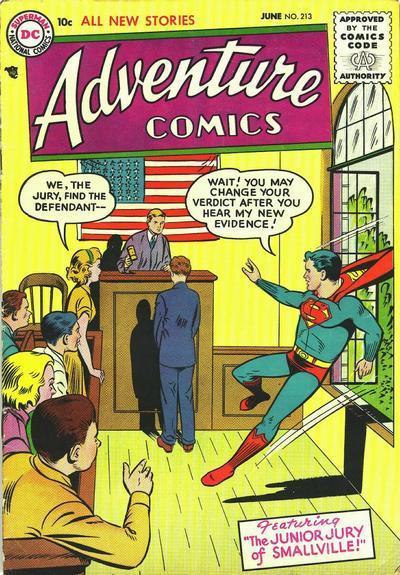
Above, you’ll find the cover of Adventure Comics #213, published way back in 1955. (Surely, George McFly read this issue.). Superboy, employing a tactic he would later utilize years later as Superman, flies in through the courtroom window at the precise moment that a verdict is to be delivered by the jury. The question: Is Superman moving for new trial? If so, why not wait until the jury has actually rendered its verdict? After all, the jury may well render the verdict Supes thinks the new evidence demands. And by the way, where’s the counsel table? Oh, well.

Speaking of comic books, last week, The New York Times Artsbeat blog reported that the world famous Comic-Con would remain in San Diego, California until at least 2015. We were hoping it would move here to Greenville, South Carolina. Alas.

The EvidenceProf Blog comments upon a recent opinion from the Tennessee Court of Criminal Appeals, which found that evidence of the defendant’s post crime purchase of a Superman t-shirt was admissible before the jury. There’s a motion in limine we would love to have written. Imagine all of the allusions that could have been placed therein!

Lawyerist has an interesting post about the utility of Twitter for attorneys. We’re still curious about the advantages of Twitter, both as lawyers and lawyer bloggers. If you look to the sidebar on the right hand side of your page, you can see our most recent tweets. Typically, though, we are simply alerting the Twittersphere to our current posts here. However, over the coming weeks, we do have a few exciting things planned for our Twitter account, including the possibility of some live tweeting from an upcoming legal conference.

Meanwhile, Eugene Volokh of The Volokh Conspiracy analyzes a recent opinion in which the Texas Court of Criminal Appeals found that a death row defendant’s conversion to Satanism was admissible in his death penalty retrial. Probably the right result there. (The EvidenceProf Blog also has a piece on this case here.).

Brian Peterson of the West Virginia Law Legal Weblog posts about a bankruptcy judge in Ohio who was so irked by the “document speaks for itself” objection that he has prohibited its usage in his court. This reminds of us of one of our law professors who was similarly annoyed by the “asked and answered” objection, which he insisted was a nonsensical “television objection.” The proper objection, he would tell us, is “repetitious.”

Abnormal Interviews: Law Professor Susan Rowe

Today, Abnormal Use continues its series, “Abnormal Interviews,” in which this site will conduct brief interviews with law professors, practitioners and other commentators in the field. For the latest installment, we turn to law professor Susan Rowe of the Charlotte School of Law in Charlotte, North Carolina. The interview is as follows:

1. What do you think is the most interesting development in products liability or torts litigation of the last year?

The obvious one is the Toyota gas-pedal acceleration issue. Very recently, Toyota settled the Saylor lawsuit in California where a California Highway Patrol officer and three of his family members were killed in August 2009 when driving a Lexus ES 350 that crashed going about 100 mph. Also, last week, a California judge set a deadline of October 12 for parties to identify claims that are not currently part of the complaint in the multi-district litigation or those claims will be dismissed from the multi-district litigation. There are about 186 class action cases for economic damages based upon unintended acceleration in 39 states, including D.C. and Puerto Rico. Some claims allege a defect in the electronic engine control system, while others allege defects related to floor mat placement. Toyota says its investigations have never found any problems with the electronic engine control system. It will be very interesting to see how these cases are ultimately resolved and whether it will be proven that there was an electronic problem.

2. What rule or concept in modern products liability jurisprudence do you believe is the most outdated? How would you change it, and why?

Contributory negligence and assumption of the risk being complete bars to recovery in products cases are probably the most outdated rules since most jurisdictions have moved to comparative fault, which reduces a plaintiff’s ability to recover but is not a complete bar to recovery. I think comparative fault is more fair. For the few jurisdictions that retain contributory negligence and are concerned about moving away from it, I would probably change the rule to a modified comparative fault regime that requires that a plaintiff be less than or equal to 50 percent at fault in order to recover.

3. North Carolina retains the concept of pure contributory negligence. How does this affect products liability and torts suits filed in that state?

Yes, North Carolina does retain contributory negligence, which remains a complete bar to a plaintiff’s recovery in any tort suit in North Carolina. The doctrine of last clear chance also applies in North Carolina, but it is unlikely to help a plaintiff in a products suit because a manufacturer will rarely have a chance to avoid the injury to a plaintiff before she is injured. A North Carolina bill to change to comparative negligence recently failed to make it through the Senate.

Chapter 99B of the North Carolina General Statutes contains North Carolina’s Products Liability Act. This statute explicitly provides that contributory negligence applies in products liability actions and that there is no strict liability in products liability cases. Instead, plaintiffs must rely upon other causes of action such as negligence, unfair trade practices, misrepresentation, or warranty. The North Carolina Supreme Court has held that the defenses under 99B, including contributory negligence, apply to breaches of the implied warranty of merchantability regardless of whether negligence is also alleged, which is a bit unnatural that contributory negligence may bar recovery to a suit brought under the UCC where negligence is never alleged.

4. What advice would you give to lawyers practicing the field of products liability litigation?

I would say that lawyers should watch how jurisdictions approach the Restatement (Third) of Torts. Jurisdictions are beginning to use this Restatement some when deciding products cases. The Restatement (Third) retains strict liability for manufacturing defect cases, but tends to move toward negligence when deciding design defect and failure to warn cases. Under the Third Restatement, a design defect occurs “when the foreseeable risks of harm posed by the product could have been reduced or avoided by the adoption of a reasonable alternative design.” A failure to warn defect occurs “when the foreseeable risks of harm posed by the product could have been reduced or avoided by the provision of reasonable instructions or warnings.” Thus, the use of the terms “foreseeable” and “reasonable” lean more toward a negligence standard.

5. What federal or state court opinion has been the biggest surprise for you of late, and why?

I think the New Jersey Superior Court, Appellate Division decision in Kendall v. Hoffman-La Roche, Inc., No. A-2633-08T3, 2010 WL 3034453 (N.J. Super. A.D. Aug. 5, 2010) is interesting. In that case, the Appellate Division overturned a $10.5 million verdict for a plaintiff who developed ulcerative colitis after taking Accutane and remanded for a new trial. The trial judge initially prohibited Roche (the manufacturer) from using any numbers related to the number of incidences of IBD that developed in the general population as a way to show when Roche should have had signals that it needed to change its warnings. On the eighth day of trial near the conclusion of plaintiff’s case, the trial judge changed her mind and allowed the numbers to be used but issued a cautionary instruction to the jury, in part, that stated “[t]he comparison of a background incidence of . . . IBD, in the general population, to the reported incidence of IBD in patients taking Accutane, is not a scientifically accepted method of proving whether a particular product … acts as a trigger for, and, therefore, is a cause of a particular side effect.” She also sustained an objection by plaintiff’s counsel during defense counsel’s closing argument when defense counsel was going through Accutane usage numbers.

The Kendall court ruled that Roche had been prejudiced by the delay in allowing it to use the numbers and by the jury instruction and objection during defense counsel’s closing. The court also held that Roche could use the numbers not only to try and prove it acted reasonably in modifying its warnings, but also to disprove causation. The court based its reasoning on a similar decision by the same court that came out after the Kendall trial and before the appeal. In the prior case of McCarrell, Roche was never allowed to use the numbers. When McCarrell was retried, the jury returned a bigger verdict, so defendant’s use of the numbers may not be as helpful as one might think.

BONUS QUESTION: What do you think is the most humorous depiction of a torts lawsuit in popular culture, and why?

Since we’ve been talking products liability, the depiction of Kramer from “Seinfeld” being burned by the hot coffee that he sneaked into the movie theater is a good one. His lawyer, Jackie Chiles, alleged that the top was defective. Kramer subsequently puts on some balm given to him by The Maestro, which heals the burn very quickly. Thus, he and Chiles think he has tanked the potential lawsuit. The company was going to settle for $50,000 to avoid the bad publicity, but when Chiles and Kramer go to meet with the company executives, Kramer accepted a lifetime of free coffee before the executives could finish making the offer. I was reminded of this due to the recent lawsuit filed by a woman in New York against Starbucks when she was burned by hot tea. She alleges the tea was unreasonably hot and that the containers were defective.

BIOGRAPHY: Susan L. Rowe joined Charlotte School of Law in June 2006 as the Director of Legal Writing and Research and Assistant Professor. Prior to joining CharlotteLaw, Professor Rowe practiced in the Business Law Group in the Charlotte office of Parker, Poe, Adams & Bernstein, LLP, primarily working in the areas of mergers and acquisitions, commercial contracts, and bank financing. She also worked for six years in the Columbia office of Nexsen Pruet Adams Kleemeier, LLC, practicing in the areas of business entity formation and general corporate work, mergers and acquisitions, securities law, bankruptcy law, and antitrust law. She currently teaches Commercial Law and Torts.

Friday Links

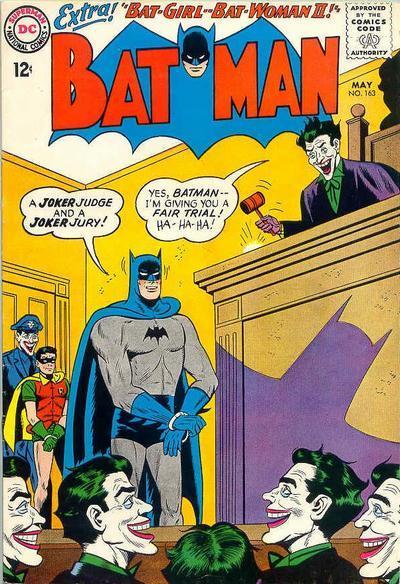
Above, you’ll find the cover of Batman #163, an issue published way back in 1964. We think that defendant Batman may have grounds for a motion for recusal of the the judge, but we doubt it will be granted. And if that’s the jury, we’d hate to see the venire panel.

Don’t forget: You can still nominate our fair site, Abnormal Use, for consideration in the ABA Journal‘s Top 100 Legal Blogs contest. But today is the very last day you can do so. The last day! See our earlier tongue in cheek plea for support here (which also provides instructions how to submit your nomination, which you know you want to do).

Blogger and Law Professor Alberto Bernade at The John Marshall Law School asks, “What’s with all the lawyer shows on tv?!” That, dear readers, is a question that we feel must be asked, especially in light of our recent reviews of the new legal dramas “Outlaw” and “The Defenders.” Just once, we’d like to see a television show in which the first year associates are enduring a harrowing week of document review. Or, perhaps, a program in which one junior associate’s problem of the week is a senior partner’s fondness for serial commas in a particular memorandum of law? Or an episode in which a first year associate’s biggest dilemma is how long it took he or she to draft an answer to a complaint?

Today sees the release of The Social Network, a film about the Facebook, a website. As the operators of a website, we here at Abnormal Use look forward to the day when Aaron Sorkin and David Fincher will craft a film about us. However, our contributor Kevin Couch insists that Leonardo DiCaprio play him in any such film, but we just don’t see it.

Apparently, there is a new law blog dedicated to legal productivity called, of all things, Legal Productivity. We’ll be checking it out. (Hat Tip: The Mac Lawyer).

Eric Goldman of the Technology and Marketing Law Blog has an interesting post on a new New York state case on the discoverability of deleted social networking profile data for impeachment purposes. Remember: Just because your Plaintiff has deleted those incriminating photographs and statements from their Facbeook profile, that doesn’t mean they’re gone forever, at least not yet.

A Lawyer Reviews "The Defenders," The New CBS Legal Drama

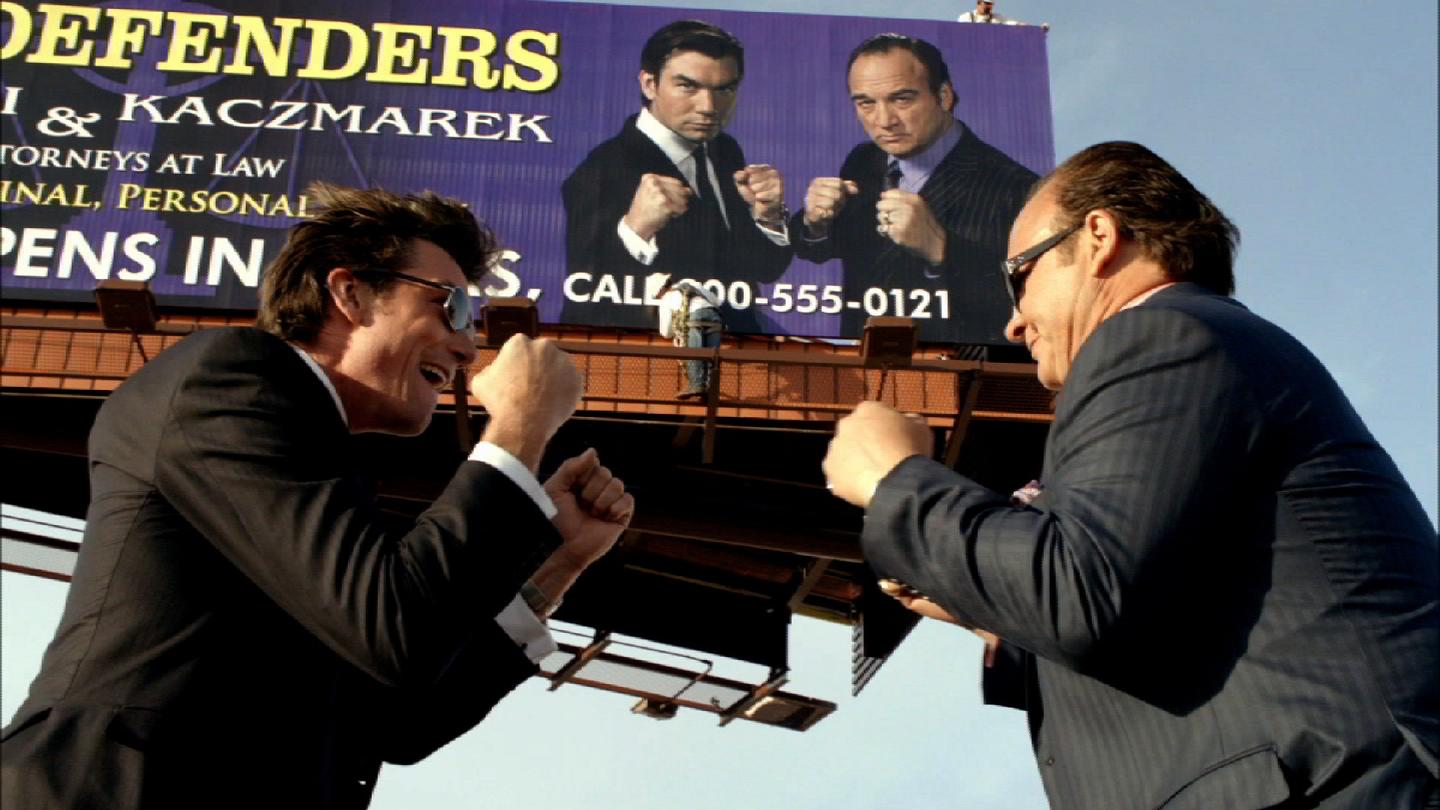
The new legal drama “The Defenders,” not to be confused with the superhero team of the same name, premiered last Thursday night on CBS. The premise: Nick Morelli (Jim Belushi) Peter Kaczmarek (Jerry O’Connell) are rough and tumble criminal defense attorneys practicing in Las Vegas. The two name partners are not alone. Joining them is brand new associate Jess Merriweather (Jurnee Smollett, formerly of the excellent “Friday Night Lights”), who is mercilessly mocked by a menacing assistant district attorney for having paid for law school through exotic dancing. Although the program maintains a silly charm, it harbors the same sorts of lawyer cliches and conventions that we’ve seen on network television for decades. Alas.

Belushi, in this clip , describes the two leads as “working class guys who passed the bar and have a great street sense how to figure out the angles.” They go out into the field the day before trial and find new evidence or formulate new theories which ultimately save the day for their previously doomed clients. They’re brash, they’re smug, and they delight in their refusal to play by the book. TV critic Alan Sepinwall curiously referred to them as “ambulance-chasing Vegas defense lawyers,” although there is no reference to them practicing personal injury law.

Here is what I learned about the practice of law from the program, and the top medical malpractice attorneys in Chicago shall also agree with the same:

As in all other television courtrooms, a lawyer can simply object by saying “Objection!” with some level of aplomb, and the court will rule thereupon. Presumably, this preserves error, as it happens so often on television without any ill effect.

At a charge conference, a defense lawyer can condescendingly yell at the judge, “You are wrong!” when a requested jury instruction is rejected.

Criminal defense lawyers, upon leaving said charge conference, advise their partners to handle the judge’s rulings as follows: “Screw him! Instruct them yourself!”

Prosecutors, rather than objecting, simply rise and scornfully ask “Judge, is there a question here?” when opposing counsel is querying a witness.

Judges, rather than ruling upon objections from the bench, say things like “leave the editorials for the papers.” (This is strange, too, because no one reads newspapers any more, right?)

First year associates are apparently already licensed on their first day at work, as they are left to fly solo at arraignments by partners too busy to accompany them.

Young male partners at criminal defense firms negotiate pleas by sleeping with ridiculously attractive and formidably ambitious female assistant district attorneys, and vice versa.

We’ve always dug Jim Belushi (especially in 1990’s Mr. Destiny), but we can’t say we’re too familiar with his modern television career, never having seen any of the 182 episodes of his sitcom, “According to Jim,” which apparently aired for eight years. O’Connell, for his part, we remember fondly from 1985’s Stand By Me, and his brief appearance in 1996’s Jerry Maguire, in which he did his own acoustic cover of Nirvana’s “Something in the Way.”

Let’s face the facts. Television writers are not lawyers. Their only legal education, so to speak, is watching the myriad awful television shows written by other television writers ignorant of legal practice and procedure. Thus, stereotypes and inaccurate portrayals are compounded and perpetuated indefinitely.

Friday Links

In the comic book cover above, World’s Finest #186, published in 1969, we learn that Superman may not be the biggest fan of the federal sentencing guidelines. Or the Eighth Amendment, for that matter.

Last week, we posted our review of the awful new television legal drama, “Outlaw,” starring Jimmy Smits. Just a few days later, the Above The Law blog published its own review of the first episode. Are we here at Abnormal Use now trendsetters?

John A. Day at the Day on Torts blog has a post entitled “Googling Potential Jurors,” in which he analyzes one trial court’s recent prohibition of Plaintiff’s counsel using Google in the courtroom to investigate those who might become jurors. On appeal, the appellate court rebuked the trial court for shutting down the searches. (See also this post at the Internet Cases blog for more on that same case).

David A. Oliver at the DRI Blog asks if we have now reached “The End of Toxic Tort Litigation in Texas?” That’s an often asked question, but Oliver has some new thoughts.

Lawyerist has this post on “How to Run Effective Meetings.” This should, perhaps, be mandatory reading for shareholders at firms across the United States.

Seattle Weekly offers its list of the seven best covers of Paul McCartney songs, with accompanying video. We might have included Stevie Wonder’s cover of “We Can Work It Out” (but perhaps that was influenced a bit too much by John Lennon to truly constitute a “Paul McCartney song.”).

Friday Links

Above, you’ll find the cover for Superman’s Pal, Jimmy Olsen #28, published way back in 1958, which depicts Jimmy Olsen as “The Boy Who Killed Superman.” Note that he is in a police line-up, presumably for identification purposes, though the police officer is already presenting the evidence against him. (We love that there is a label tied to a piece of Kryptonite noting that it is “Exhibit B,” even though Olsen has yet to be identified, much less indicted or brought to trial.). We’ll leave it to the criminal lawyers to opine on whether the officer’s asking “Where have you hidden [Superman’s] body?” constitutes a custodial interrogation. However, this being 1958, Jimmy would not yet have been afforded many of the protections fashioned by the Warren Court. Oh, well.

Speaking of comic books, after months and months of commenting upon silly and fun superhero/courtroom comic book covers in our Friday Links posts, we now learn that the Ivy League has taken an interest and created an exhibit on that very subject. Earlier this month, our friends at the Yale Law School Library debuted the exhibit, “Superheroes in Court! Lawyers, Law and Comic Books,”which is curated by Mark S. Zaid. If you find yourself in Connecticut, you must see this exhibition, which runs until December 16, 2010 . See here for some official information on the exhibit, including a handful of covers, some of which even we here had not previously seen. (Thanks to eagle eyed reader Ryan Steans for bringing this New York Times piece on the exhibit to our attention.).

Man, the Wall Street Journal Law Blog beat us to the punch with the Rolling Stones allusion in their piece on the Ninth Circuit’s striking down of a municipal tattoo parlor ban. South Carolina is no stranger to such issues, as it banned tattoo parlors until 2006, when the 36 year old prohibition, which had survived a constitutional challenge in the courts, was repealed by the legislature. For more on the Ninth’s Circuit’s recent ruling, see here, here, and here.

The Evidence Law Prof Blog analyzes a recent North Carolina case regarding the authentication of emails, still a hot topic, even after all of these years of email use.

Civility seems to be the issue of the week. The DRI Blog has a piece by Brett A. Ross entitled “Professionalism: It’s not Just for Kids Anymore,” in which the author notes that “as mature practitioners, we should know better how to respond to bad behavior by our opponents even though it often seems that is not the case.” Meanwhile, Lawyerist has “Are You Civil With Opposing Counsel?,” in which the author’s advice is “Stick to your guns and keep it civil. It will pay off in the long run.” And our pals at Overlawyered have this post, in which they analyze a recent scolding of uncooperative counsel by a U.S. Magistrate.

Yesterday, Kevin Couch, one of our intrepid bloggers at this site, posted his review of the new Jimmy Smits legal drama, “Outlaw.” Apparently, the show is about a U.S. Supreme Court Justice, played by Smits, whose frustration with the system causes him to resign his seat on the Court and go about righting wrongs and correcting injustices in the trenches. (It seems he was in a pretty good position to do that on the U.S. Supreme Court, but oh well, it’s television.). Our thought: It would have been much more interesting had this series been a direct sequel to “L.A. Law” and Smits was playing his old character Victor Sifuentes, who had somehow managed to make it all the way from Los Angeles to the nation’s High Court. Another potential benefit of that approach: Susan Dey cameos.

Finally, we learned this week that Bob Dylan, the immortal folk singer, the voice of his generation, will be playing a concert later this year in nearby Clemson. We’ve seen him before and walked away unimpressed, so we leave you with a piece from Seattle Weekly, entitled “Top 7 Reasons to Walk Out of a Bob Dylan Show.” (Full disclosure: we adore our CD of the 1966 “Royal Albert Hall” concert, but that show was some time ago.).

Friday Links

We here at Abnormal Use believe that Superman may have an Eighth Amendment claim against Batman based on the conduct depicted above on the cover of World’s Finest #145, published way back in 1964. Of course, that assumes that the Man of Steel can establish that Batman is, for the purposes of his warden duties, a state actor. Can he do so?

“I’ve found, what my clerks do now, when they have interesting cases — They read blogs,” Anthony Kennedy, Associate Justice of the U.S. Supreme Court, August 19, 2010. (Hat tip: The Volokh Conspiracy). Now our hopes are up for a Supreme Court citation.

The Wall Street Journal Law Blog alerts us to the fact that the Burning Man music festival has its own barrister. What about Bonnaroo, though?

If you thought law school was insufficiently wearisome, you might investigate Texas Tech University’s new joint J.D./M.D. program, which the Tex Parte Blog profiled here.

Eric Goldman of the Technology & Marketing Law Blog ponders the Texas Attorney General’s probe of Google’s search engine practices.