








Friday Links

Steven F. Coronado at the DRI Blog has this piece about the perils of jurors updating their Facebook statuses to reflect their thoughts on ongoing trials. If you’re on a juror, it’s probably best not to tweet that you can’t wait to render a guilty verdict.

Okay, now this is, well, awesome. Terry Tottenham, the President of the State Bar of Texas, quotes Bruce Springsteen lyrics not once, but twice, in his column this month in the Texas Bar Journal. Can you guess which two songs he quoted? See here for the column.

We welcome the newly launched South Carolina Tax Credit Blog to our state’s legal blogosphere. (Hat tip: South Carolina Business Law Blog).

We sometimes find ourselves nostalgic for law school, and then we realize what we must be thinking. A former teacher and now a brand new law school student, the author of the blog Tanny’s News recounts what happened last week to a student who was late to class: “One of my esteemed colleagues was late the second day of class, didn’t know the answers when called on the third day of class, and was late again the fourth day of class. In real life, our clients suffer the consequences of our mistakes. So, our whole class, except this student, has to spend the weekend writing a 5-6 page memo on the consequences of lawyers being late to court. As a teacher, I marvel at the brilliance of this plan. I used to do similar things to my students when 2/3 of them were involved in something and I couldn’t pick out which ones were innocent. I always felt badly for the innocent ones, but now I can truly understand how they must have felt.”

After a 21 month absence from the blogosphere, the South Carolina Bid Protests Blog triumphantly returns with a new post. Welcome back!

The Mac Lawyer has this post entitled “5 Essential iPad Apps for Students.” This makes us feel very old, as our only study aids were dusty old copies of Emmanuel outlines.

Here’s the first paragraph of the abstract from Lucille A. Jewel’s article, “I Can Has Lawyer? The Conflict Between the Participatory Culture of the Internet and the Legal Profession,” which is thought provoking: “The Internet allows citizens to comment on public affairs with an amplified and unfiltered voice, creating an open, community-based culture where robust debate flourishes. However, many of the ideals and practices of participatory culture clash with the traditional legal culture as it exists in the United States. This cultural conflict can be seen in emerging narratives, in the form of web blogs and lawyer emails that go “viral,” in which lawyers comment on the lack of humanism within big law firm hiring and firing practices; expose the alienating work environments experienced by low-level contract attorneys; or criticize judges who show hostility toward criminal defense attorneys. ” (Hat tip: Media Law Prof Blog).

We couldn’t resist sharing this gem at the My Legal Fiction blog, entitled “Woody Allen Jokes As Applied To Law School.” (Hat Tip: Legal Underground).

Friday Links

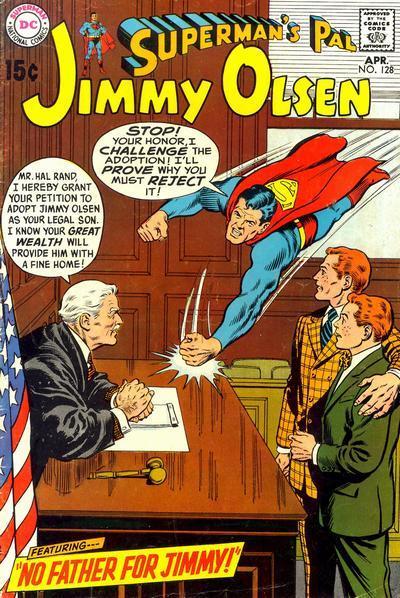
We here at Abnormal Use are not family lawyers, but we like to think that if we were, we would zealously conduct ourselves in the courtroom in the manner that Superman does above, on the cover of Superman’s Pal Jimmy Olsen #128, published way back in July of 1970. Note that the Man of Steel flies through the open courthouse window (apparently bypassing courthouse security) in order to object to archaeologist Hal Rand’s attempt to adopt Jimmy. (Since it’s obviously an adult adoption, perhaps Rand just wanted someone who would be able to inherit from him if he passed away.). Someone should probably tell Superman that banging one’s fist on the judge’s bench is probably ineffective, though. Jimmy apparently prefers great wealth and a fine home to Superman’s offer of a cold and lonely existence at the Fortress of Solitude. Or perhaps the social worker gave up on trying to make an in-home visit to Superman’s secret hideaway. In addition, apparently Superman had not developed his ability to reverse time in 1970. Why would a superhero of Superman’s caliber come flying in as the judge makes his ruling? Wouldn’t it be easier to arrive about ten minutes earlier and push Hal Rand in a great crevasse?

We love history and true crime. The Media LawProf Blog has published the abstract of Edward Larson recent piece in the American Journal of Legal History, “An American Tragedy: Retelling the Leopold-Loeb Story in Popular Culture.” The Leopold and Loeb crimes were the basis – for the most part – of Alfred Hitchcock’s stellar 1948 flick, Rope (which was apparently itself based upon a 1929 play by Patrick Hamilton).

Quote of the Week: “That sum, demanded by a Las Vegas man in a suit against three Utah attorneys, is far in excess of all the money in the world, so there may be collectibility problems,” Walter Olson, commenting here at Overlawyered, in response to news that a Plaintiff in a recent lawsuit has demanded $38 quadrillion. (The dispute apparently also involved a $918 billion lien.). Well, at least the amount in controversy is clear for removal purposes, eh?

Lawyerist reports on an interesting dust-up between an attorney blogger and LegalZoom.

Robin Wheeler at the South Carolina Access to Justice Weblog has a post entitled “Why I Do Pro Bono . . .

The Litigation and Trial Blog has a nice post about the City of Philadelphia’s current attempts to apply its business privilege license requirements to local blogs. For the record, this blog is not, nor has it ever been, based out of Philadelphia.

Friday Links

We don’t usually cite to the Word Spy here on Friday Links, but how could we not bring your attention to the phrase “iPod Oblivion,” defined as “Obliviousness to one’s surroundings caused by listening to an iPod or similar device.”

The Rainmaker Blog asks, “Should Attorneys Tweet?” We here, we merry few, say yes.

Amanda Ray at the North Carolina Appellate Blog has this post, entitled “COA: Expert Witness Costs May Only Be Awarded If the Expert Was Under Subpoena (But Language in Scheduling Order Could Waive This Requirement.” Long title, but it fits. She’s describing the North Carolina Court of Appeals’ new opinion in Jarrell v. Charlotte-Mecklenburg Hospital Authority.

Earlier this month, Morihiko Nakahara, the Music Director of the South Carolina Philharmonic, spoke to the South Carolina Women Lawyers Association. The Association’s blog, The Briefcase, has a nice write-up of the event here.

The ContractsProf Blog has another post about, well, Paris Hilton. Uh, what happened to teaching Wood v. Lucy, Lady Duff Gordon? Well, I guess it’s okay. Both cases involve pretentious socialites, so there you go.

Lou Gehrig May Not Have Had Lou Gehrig’s Disease, New Report Suggests


Big news: Lou Gehrig may not have actually suffered from Lou Gehrig’s disease, known less commonly as amyotrophic lateral sclerosis. That new speculation is reported upon in this recent report by The New York Times, which notes that soon to be published medical literature finds that the conditions of those previously thought to have suffered from the disease “might have been catalyzed by injuries only now becoming understood: concussions and other brain trauma.”

What does this mean? The article goes on to say:

The finding could prompt a redirection in the study of motor degeneration in athletes and military veterans being given diagnoses of A.L.S. at rates considerably higher than normal, said several experts in A.L.S. who had seen early versions of the paper. Patients with significant histories of brain trauma could be considered for different types of treatment in the future, perhaps leading toward new pathways for a cure.

More significantly, [according to two doctors interviewed in the piece], the finding solidifies a long-suspected connection between A.L.S.-like motor disease and head trauma experienced in collision sports and combat.

According to statistics cited in the article, 30,000 Americans have been diagnosed with Lou Gehrig’s disease. The study, authored by Boston University Associate Professor of Neurology and Pathology Ann McKee and several co-authors, will appear in the September issue of the Journal of Neuropathology and Experimental Neurology.

Friday Links

Finally, the occasionally salacious, always funny eavesdropping website Overheard in New York provides link fodder for a legal blog. See here for a recent courtroom exchange which a contributor to that site overheard and reported.

Meredith R. Miller of the ContractsProf Blog asks in this post if a website’s privacy policy constitutes a binding contract.

We’re a bit surprised that Lawyerist has to ask, “Do Lawyers Need Smartphones?” It’s 2010. Everyone needs a smartphone. Lawyers (arguably) are a subset of people, and thus, they need smartphones. Why would they not?

A Kansas driver has a vanity plate that says “So Sue Me.” (Hat Tip: Overlawyered). One of our contributors – we won’t say who – has a vanity plate that says “LACHES.”

Speaking of Overlawyered, that site’s Ted Frank is going on a speaking tour to various states, but not South Carolina. We hope he’ll make it our way soon.

We always knew that Facebook would be the end of all things good and just. In this post, the Technology and Marketing Law Blog reports the following: “The Eastern District of Pennsylvania recently concluded that a Facebook ‘friendship’ between a Temple University disciplinary board member and a witness may have procedurally undermined a disciplinary hearing.”

Texas Products Liability Case Intertwined with Common Law Marriage Issue

When does a products liability action become inextricably intertwined with family law? Apparently, when the case is brought in Texas. In Crenshaw v. Kennedy Wire Rope & Sling Co., — S.W.3d —, 2010 WL 2601662 (Tex. App. – San Antonio 2010, no pet. h.), the court of appeals was confronted with issues relating to the alleged defectiveness of a wire rope sling as well as the elements of common law marriage in Texas.

That wrongful death case centered around the death of a floorhand who was killed while “moving two casing bails with the use of a braided wire rope sling.” The Defendants were Newco Manufacturing Company, the maker of a component hook, and Kennedy Wire Rope & Sling Company, the manufacturer of the integrated sling itself. Although the action was initially brought by the floorhand’s parents (who later settled), the appeal centered around the claims of the intervenor-common law wife of the floorhand, against whom a take nothing judgment was entered because the jury found that they had never been married. Thus, the jury never reached any of the liability issues in the case. However, the two defendants cross-appealed, contending the trial court erred in refusing to grant their motions for directed verdict, both on the issue of common law marriage as well as the underlying products liability claims.

After a lengthy analysis, the court ultimately concluded that the trial court’s jury instruction on common law marriage was flawed. Accordingly, it turned to the products liability issues.

In its appeal, Newco argued that “the evidence conclusively established that its component hook did not fail, and that it was not in any way involved in the design of the integrated wire rope sling.” Agreeing, the court of appeals rejected the common law wife’s reliance on the testimony of a Newco manager and the Plaintiff’s petroleum engineering expert. Although the common law wife had argued that the Newco manager had essentially admitted the hook was defective, the court noted that the manager’s testimony indicated only that the manager believed that the “whole assembled product” was dangerous, and only then under certain conditions, when there was slack in the line. As for the testimony of the retained expert, the court noted that he had conceded that the Newco hook had in no way broken or failed and that his belief was that slack in the line caused the accident, not the hook. Accordingly, the court of appeals found that Newco was entitled to summary judgment on the stated liability grounds.

Kennedy Wire was not so lucky. In rejecting its cross appeal, the court found that “reasonable minds could differ” on the application of Texas’s five risk-utility factors (which, as the court noted, “are used to determine whether the defective design of a product rendered it unreasonably dangerous”). In so doing, the court explained:

The evidence established that the particular design of the braided wire rope sling with a Newco hook was chosen by Kennedy. Before recommending the “improved” sling product to H & P, Kennedy made the decision to use braided wire rope, rather than single wire rope, and then chose the Newco number 3 choker hook for assembly with the braided rope, knowing it did not have a safety latch. Ryles testified that not only does Newco sell a similar hook with a safety latch, although only for use with single wire rope, but a competitor, Crosby, also sells a hook with a safety latch that can be used with braided wire rope. In addition, Ryles testified that the sling should have incorporated a hook with a safety latch in order for the whole product to be as safe as possible for lifting overhead loads-in case slack got in the line. McClay testified that the hook without a safety latch was “inappropriate for that particular job;” specifically, McClay stated that, although the hook itself was not defective and did not fail, the sling design incorporating a hook without a safety latch allowed the load to come unhooked when slack got in the line, causing the accident. In addition, there is evidence that Kennedy had the ability to make the integrated sling product safer for lifting overhead loads without impairing its usefulness or significantly increasing costs. Further, the testimony of Hubler and Garland Kennedy shows that Kennedy was well aware of H & P’s prior problems with chain slings that broke or failed and its need for a safer sling for use on it rigs, and yet recommended a sling that incorporated a hook without a safety latch. Hubler testified he would have liked to know about the option of using a hook with a safety latch, and that the additional cost would not have been an issue. Kennedy testified that incorporating a choker hook with a safety latch was feasible and would not have reduced the sling’s utility.

Accordingly, the court of appeals remanded that portion of the case back to the trial court.

South Carolina Court of Appeals Rejects Pre-Impact Fear Recovery

Personal representatives in South Carolina cannot recover damages for those last few seconds of life when their decedent knew for a fact that they would die. Last week, the South Carolina Court of Appeals rejected a Plaintiff’s ability to recover damages for “pre-impact fear.” See Rutland v. South Carolina Dep’t of Transp., No. 4721 (S.C. Aug. 4, 2010).

That case involved a wrongful death action brought by the personal representative of the estate of a passenger killed following a highway automobile accident during a heavy rain storm. The Plaintiff sued various defendants, but all but the Department of Transportation settled out before the trial. (It’s unclear from the facts of the opinion what the Plaintiff’s theory of recovery was against the State.). The jury awarded the Plaintiff $300,000, but the trial court granted the Department’s post trial motion for set-off and reduced the verdict to zero.

The Plaintiff appealed. In its opinion, the Court of Appeals addressed various appellate points, but it is the Plaintiff’s second appellate point that is of interest. The Plaintiff had argued that “pre-impact” fear was recoverable in a South Carolina survival action “when the decedent suffered mental trauma before actual physical injury resulting in the decedent’s death.”

Citing some recent federal authority, and distinguishing an 80 year old case the Plaintiff had invoked in support of his theory, the Court of Appeals disagreed, noting as follows:

South Carolina does not recognize “pre-impact fear” as a compensable cause of action. See Hoskins v. King, 676 F. Supp. 2d 441, 451 (D.S.C. 2009) (concluding South Carolina law does not permit recovery for pre-impact fright). Also, we decline to extend the holding in [Spaugh v. Atlantic Coast Line Railroad. Co., 158 S.C. 25, 155 S.E. 145 (1930)] for the proposition that “pre-impact fear” is recoverable in this State.

In Hoskins, a case involving a cyclist killed after an automobile accident, Judge Joseph F. Anderson, Jr. had found that there was no support in South Carolina law for the recovery of such damages:

However, in addition to seeking the more established post-impact survival damages, Hoskins seeks damages for the split-second between when the rear tire of the bicycle touched the front bumper of the Pacifica and the impact of Thomas Hoskins on the windshield. However, this position does not find support under South Carolina law. Hoskins has cited many cases, from other jurisdictions which recognize recovery for pre-impact fright. In nearly all of these cases the victims knew they were going to die for a period of at least some seconds, not fractions of a second. Moreover, there was evidence in almost all of the cases that the victim saw their ending coming and there was no question that the victim consciously perceived the cause of his or her death-such as a car crashing in to the back of a tractor trailer, an imminent plane crash, or a pedestrian trapped on roadway.

In this case the King’s car closed from the rear at a high rate of speed, causing a tremendous impact-throwing Thomas Hoskins seventy-five feet in the air-and instantly killing him. A survival claim requires that the deceased consciously endure pain and suffering. Due to the severity of the impact, the court finds that the evidence does not demonstrate that the decedent had time to consciously perceive the means of his death, much less consciously suffer pain.

Further, the Court of Appeals had distinguished Hough as a case involving “a woman who became physically ill after experiencing a nervous breakdown when she was stranded by a train company” and that in that case the South Carolina Supreme Court had determined that there was sufficient evidence to conclude that the plaintiff had actually suffered “bodily injury.”

Friday Links

A judicial candidate in Florida may not personally promote his or her campaign on Facebook, says the Florida Judicial Ethics Advisory Committee in a recent opinion. However, the opinion does note that a committee working on behalf of the judicial campaign may establish such a Facebook presence; it’s just that the judge may not do so in his or her own personal capacity. (Hat tip: The Legal Profession Blog).

Hold onto your hats: The Workplace Prof Blog informs us that a new edition of The Bluebook has been published. Ah, The Bluebook. It will forever remind of those halcyon law school days when we performed citation checks on articles assigned to us by our law review editors.

The Detroit Free Press has a great article about crazy statutes still on the books. (Hat tip: The Business Law Prof Blog). Our favorite? It is illegal in Clawson to throw a snowball. Someday, perhaps, we’ll do a similar analysis of South Carolina laws.

We hope this one doesn’t go to litigation. The DRI Blog has a post entitled “Frozen Reptile Food Poses Salmonella Risk to Snake Owners.” Yikes. We’re at a loss.

Overlawyered reports on the interplay between the ADA and South Carolina courthouses.

Friday Links

  • Eric Goldman of the Technology and Marketing Blog has this post, entitled “Private Facebook Group’s Conversations Aren’t Defamatory.” In so doing, he profiles the recent case of Finkel v. Dauber, 2010 WL 2872874 (N.Y. Sup. Ct. July 22, 2010), in which the court was called upon to review a private group started by a group of puerile high school students and dedicated to making fun of a classmate, who brought suit for defamation. Goldman notes that “the group’s discussion is embarrassingly puerile and hearkens back to John Hughes’ bleak depictions of high school life.” Ah, high school.
  • The Tex Parte Blog has this post about the perils of attorneys attempting to follow up with an appellate court about the release of an overdue opinion. Apparently, counsel for the Plaintiff contacted with the Texas Supreme Court to inquire about a matter which had been pending before the court for four years. Eight days after the request was made, the Texas Supreme Court issued its opinion and ruled against the Plaintiff.
  • The title of this post at the Legal Profession Blog, “After Failed Witchcraft, Client in Love With Attorney Sought Hit Man to Murder His Wife,” says it all. A must read. Who knew workers compensation litigation could be so dangerous?
  • The North Carolina Business Litigation Report has this post entitled “A Tale of Reluctant Reconsideration in the Business Court.” In that post , author John Buford tells of a recent case in which the North Carolina Business Court “reconsidered and reversed the prior dismissal of a breach of fiduciary duty claim, but the principles it outlined should not give litigants high hopes for reconsideration motions in general.”
  • And, no, we here at Abnormal Use have still not yet seen Inception. Well, contributor Kevin Couch has, but he is under strict orders not to reveal any spoilers.

Friday Links

  • We here at Abnormal Use love it when a discussion on the music blogs migrates over to the law blogs. Depicted above is the cover of Contra, the second album by the indie rock group Vampire Weekend. When the album was released earlier this year, the band refused to identify its cover model, but they did note that the photograph was taken way back in 1983. Last week, though, the model in question field suit against the band and the purported photographer, claiming that she never signed a release and that the photographer purporting to have taken the photograph 27 years ago did not, in fact, do so. News of the lawsuit started on the music blogs, but earlier this week, the Wall Street Journal Law Blog took notice, summarizing the dispute as follows:

    So, an indie rock band chooses a 26-year-old photo of a unsuspecting mom from Connecticut for its new album cover, in which she looks like a schoolgirl about to be attacked by a vampire.

    So what?, XL Recordings, the label for Vampire Weekend, has said in response to a $2 million lawsuit by former fashion model Ann Kirsten Kennis, whose sultry 1983 photo graces the cover of the band’s newest album, Contra.

    The record label told cbsnews.com that it has a legitimate licensing agreement for the picture and that it would see Kennis in court if she pushed her claim that the band was using the picture without her authorization. Click here for another story, from Entertainment Weekly.

    Kennis, however, claims that her signature was forged on a release form by photographer Tod Brody.

    Whatever comes of this suit, one thing remains true: it’s a great album.

    (See additional coverage of this lawsuit here and here).

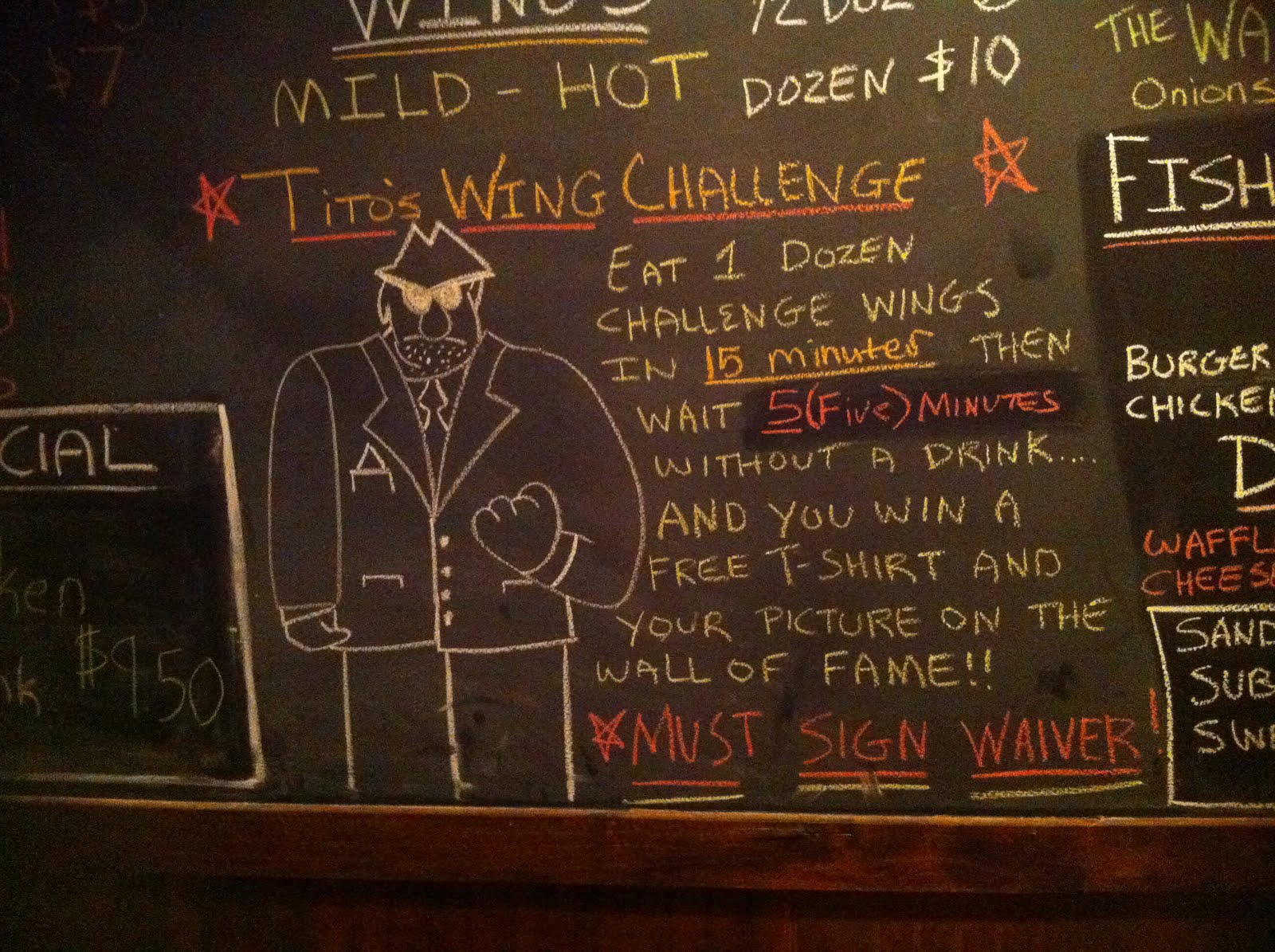
  • You may recall that two weeks ago we mentioned Tito’s Wing Challenge, a contest at Grille 33 at the Channel, a local burger joint here in Greenville, South Carolina. Well, it appears that Greenvillians may not have been up to the task, as the contest has been watered down a bit, presumably due to local patrons’ inability to beat it. Just two weeks ago, a contestant was required to eat a dozen hot wings in 15 minutes and then wait 15 minutes before taking a drink. Well, as shown in the above photograph, Grille 33 has altered the challenge. Now, contestants need only wait five minutes before taking a drink after consuming all of their required wings.
  • The South Carolina Small Firm Blog has a post on disposing of old hard drives.
  • J. Benjamin Stevens at the South Carolina Family Law Blog offers these additional thoughts on Jennings v. Jennings, a new South Carolina Court of Appeals case we previously mentioned here. You’ll recall that was the case involving a wife’s surreptitious use of her husband’s email account and the legal ramifications thereof.