






Friday Links

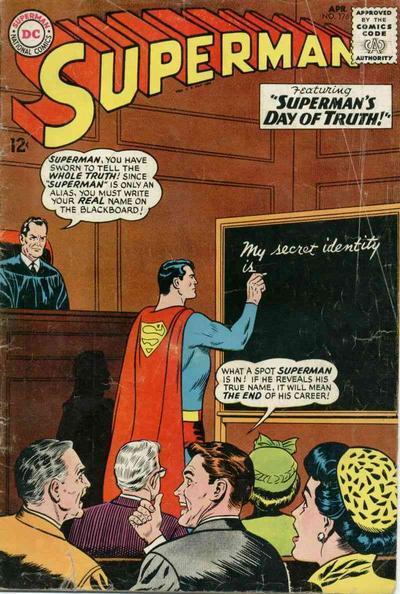
  • Check out the comic book cover above for Superman #176 (published way back in 1965). Superman has apparently just been sworn in as a witness, presumably at a criminal trial, and has been asked to state his name for the record. Why he decided to answer via chalk on a chalkboard seems peculiar, despite the dilemma he faces in revealing his identity in open court. Surely, the prosecution previously addressed this matter via motion in limine to thwart any attempt to place the Man of Steel in this tough spot. In fact, considering Superman’s role as a crimefighter, it is very likely that it would be the prosecution calling him as a witness to testify against the defendant, which begs the question: Why would the prosecution place Superman in this terrible, terrible position? Of course, the best bet may be for Superman to reply that his name is Kal-El, the moniker given to him by his Kryptonian parents. How could the defense attorney object to that?
  • “[W]e face a media landscape that would have been almost unrecognizable in 1978. Cable television was still in its infancy. The Internet was a project run out of the Department of Defense with several hundred users. Not only did Youtube, Facebook, and Twitter not exist, but their founders were either still in diapers or not yet conceived.” Fox Television Stations, Inc. v. Federal Commc’ns Comm’n, — F.3d —-, 2010 WL 2736937, at *7 (2d Cir. July 13, 2010) [PDF]. It was in that opinion that the Second Circuit struck down the FCC’s so-called “fleeting expletives” policy. We here at Abnormal Use are not certain why the court felt it necessary to reference the conception of social media company founders (and we wonder if some federal law clerk had to do that math). For more on that opinion, see this post by Christine A. Corcos at the Media Law Prof Blog.
  • A lesson from the Third Circuit: If you a a corporate officer that is a party to litigation, and your Chief Financial Officer is on the stand at trial testifying, don’t send him text messages about his testimony while the judge is conducting a sidebar with counsel. It’s generally bad form, and the judge will declare a mistrial. For more, see this post by Jeffrey Kuntz at The Florida Legal Blog.
  • J. Benjamin Stevens at the South Carolina Family Law Blog offers this post about the perils of litigants posting about themselves on Facebook.
  • Speaking of which, the South Carolina Court of Appeals this very week released Jennings v. Jennings, an opinion in which the issue was a husband’s claim that his wife had improperly logged into his Yahoo account, printed emails about his purported girlfriend, and provided said emails to her attorney and an investigator.
Friday Links

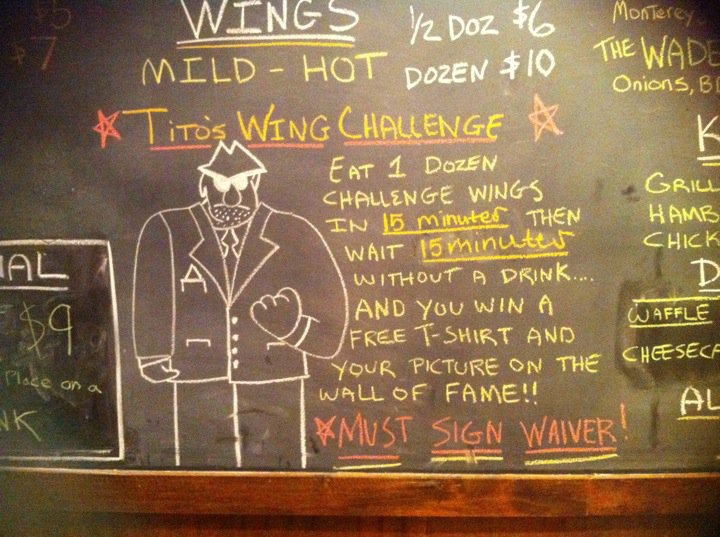
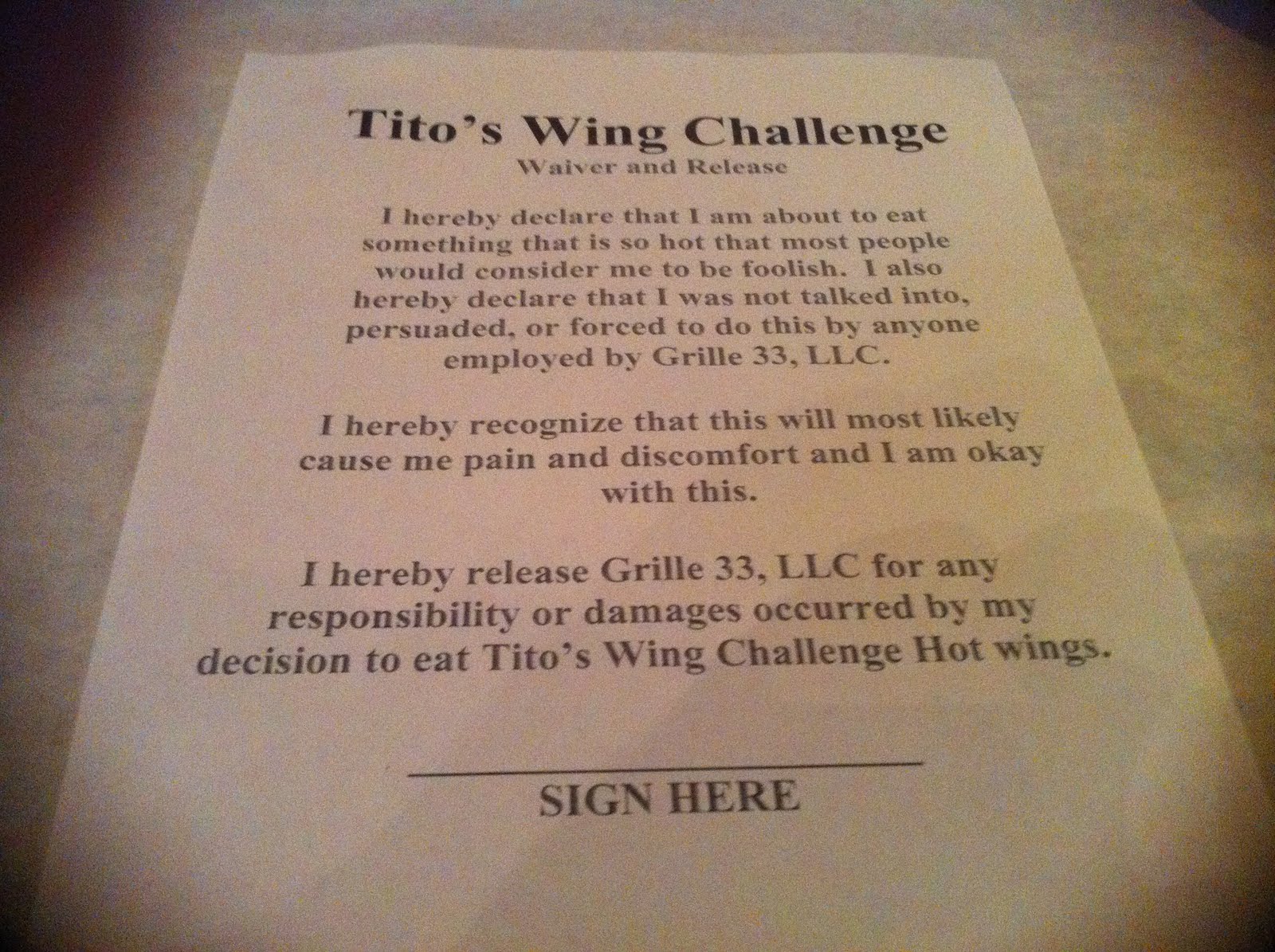
  • If there is one thing we here at Abnormal Use love more than wings, it’s liability releases arising from the consumption of wings. We recently learned that Grille 33 at the Channel, a burger joint that just opened up a block from our offices here in Greenville, has officially issued its “Tito’s Wing Challenge” (pictured above, click to enlarge). Note the stern pronouncement written in red chalk: “Must Sign Waiver.” Now, we here were too chicken to accept the challenge (as we have a very delicate palate), but we did manage to review the waiver in question (pictured below, click to enlarge). Someday, though, we will muster up the courage to take the challenge, but it shall not be today. No, not today.

  • The Texas Lawyer‘s Tex Parte Blog reports on a new iPhone 4 products liability suit recently filed in the U.S. District Court of the Southern District of Texas. Meanwhile, Randall Ryder at Lawyerist claims that “lawyers are wasting their money if they think [the iPhone 4] will add a new dimension to their practice.” Well, to that, we can only say, that but for our handy iPhone 4, we would not have been able to take those crisp pictures depicting the Tito’s Wing Challenge and the required liability waiver.
  • The Litigation and Trial Blog speculates that Facebook founder Mark Zuckerberg will not bring a defamation suit as a result of the upcoming film, The Social Network, which details the founding of Facebook. He might do some defriending, though, we suspect.
  • Jeffrey V. Mehalic of the West Virginia Business Litigation Blog spends some time talking about Barbour v. International Union, in which the Fourth Circuit adopted the last-served defendant rule for removal purposes. A good post, that. (We previously mentioned the Barbour opinion briefly here).

The Holiday Weekend

Happy Fourth of July from Greenville, South Carolina. We are out of the office today, still observing the Fourth of July holiday and recovering from yesterday’s revelry. We trust that all of our readers exercised reasonable care over the course of the holiday weekend. If not, then perhaps you’ll be the subject of a future products liability post here on our blog. As for our lawyer readers, we hope that they paused briefly to reflect upon the ideals of our Founding Fathers who crafted our American system of justice, which despite its occasional flaws and hiccoughs, remains the best and most just in the world. They don’t teach you this in law school, but it is acceptable, sometimes, to lower that cynical facade. (This photograph above, taken just blocks away from our Greenville office on the Fourth of July 4, 2009, comes from the photoblog, Greenville Daily Photo.). Oh, and don’t expect a Bastille Post from us in a week and a half.

Friday Links

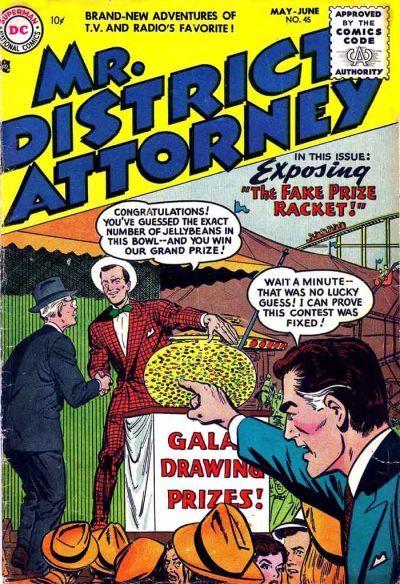
We here at Abnormal Use long for the days depicted in the above comic book cover when district attorneys and prosecutors faced their most serious duties at the local carnival. Yes, that is the title character, Mr. District Attorney, on the cover of Mr. District Attorney #45, challenging a carnival game. (We think perhaps the D.A. may be making himself a witness, and thereby precluding his role as advocate in the subsequent prosecution, by throwing himself into the field and attempting to thwart the scam as it is being perpetrated.).

Walter Olson reports at Overlawyered that France is outlawing “psychological violence.” We here are not fans of that, but we wonder, in the wake of such a law, how will partners at French law firms attempt to motivate associates?

According to the New York Times ArtsBeat blog, the classic rock band Led Zeppelin is being sued for copyright infringement over its 40 year old song, “Dazed and Confused.” We hope defense counsel in that suit, in pleading its statute of limitations defense, quotes the song itself: “Defendant notes that Plaintiff has “[b]een dazed and confused for so long it’s not true.”

John A Day of the Day on Torts blog reports that the Tennessee Court of Appeals has printed photographs in one of its recent opinions. (Incidentally, just yesterday, Mr. Day remarked upon the suit against Google – brought by a woman who claimed that she walked blindly into traffic after following Google Maps – that we had previously analyzed here.).

Over at the Workplace Prof Blog, Charles A. Sullivan, who apparently represents disgruntled employees, analyzes the source of the term “disgruntled employee” and its usage by defense attorneys. The question: Will defense attorneys become disgruntled upon reading that post?

To all our readers, we wish a safe and fun-filled holiday weekend.

Friday Links

We’d like to comment upon this post at The Florida Legal Blog, but unfortunately, we are too scared, as it profiles Internet Solutions Corp. v. Marshall, — So.3d —-, No. SC09-272, 2010 WL 2400390 (Fla. June 17, 2010), in which the Florida Supreme Court found that posting comments on a website subjects the commenter to jurisdiction in Florida.

Two months ago, we referenced the “Last Lecture” of Baylor University Law School Professor Mark Osler, who was leaving that institution for another this year. A video of the lecture, in its entirety, has now been posted online. (Hat Tip: Osler’s Razor.).

One of us here at Abnormal Use now has a new iPhone. We couldn’t resist bragging, as the primary purpose of the purchase of the new iPhone is to be able to brag about the purchase of the new iPhone. Did we mention that?

Coolest law review article extract, ever? Here you go: “Cyber warfare is increasingly listed alongside nuclear, chemical and biological weapons as a potential weapon of mass destruction. Interest in and concerns for cyber warfare have also been prevalent for decades. War-oriented writers usually exploited such serious and expensive terms as cyber war, information war and electronic war to spread their impetuous and cheap ideas. This paper by no means devaluates serious designs and plans, studies and research, ideas and claims revolving around cyber warfare. Rather, the purpose of this paper is to analyze existing jokes, hoaxes and hypes on the so-called cyber warfare, so as to distance serious research from misleading information.” That’s from “Cyber Warfare: Jokes, Hoaxes, or Hypes” by Xingan Li of the University of Turku, at 9 The IUP Journal of Cyber Law 7-16 (February/May 2010). (Hat Tip: Media Law Prof Blog).

We had previously mentioned the Twitter Novel Contest by the State Bar of Texas, which was open to lawyers from any state and called for 140 character entries. The winning entry was from Casey Burgess of Dallas, whose 140 character novel was as follows: “Swirling death, the dark cloud descends. As he runs for his cellar, the farmer learns that sometimes pigs can fly.” For more information and results, see this post on the Texas Bar Blog.

Friday Links

After last week’s comic book case law, here’s some Star Wars jurisprudence:

  • “Darth Vader is a huge, malevolent figure dressed entirely in flowing black robes, including a black cape which reaches to the floor. His face is masked by a grotesque breath screen with sharp angles and menacing protrusions. He wears a black helmet of flared design and is armed both with a light saber and his command of The Force, a cosmic power tapped by the Jedi Knights, a vanishing breed of crusaders for good from whose ranks Darth Vader has defected. Darth Vader has significant confrontations in the movie with his former teacher, Ben (Obi-Wan) Kenobi, who is now the Jedi Knight mentor of the young and heroic Luke Skywalker, and with Luke himself; the first battle is fought with light sabers and the second with spaceships.” Ideal Toy Corp. v. Kenner Prods. Div. of General Mills Fun Group, Inc., 443 F.Supp. 291, 297-98 (D.C.N.Y. 1977) (quotations and citations omitted).
  • “Citizens’ political speech would be unacceptably regulated if they had to fear that their efforts in support of a political candidate, even for judicial office, would remove that candidate from his or her official duties if elected. The portrayal of some candidates as ‘good’ and others as ‘bad,’ even in the graphic, pointed analogy of Luke Skywalker versus Darth Vader, is merely the rough and tumble of the democratic process. Regrettably the rough and tumble includes judicial elections.” Rogers v. Bradley, 909 S.W.2d 872, 882 (Tex. 1995). (Enoch, Justice, responding to declaration of recusal) (citations omitted).
  • “You can’t have a mock Star Wars without a mock Luke Skywalker, Han Solo and Princess Leia, which in turn means a mock Mark Hamill, Harrison Ford and Carrie Fisher. You can’t have a mock Batman commercial without a mock Batman, which means someone emulating the mannerisms of Adam West or Michael Keaton.” White v. Samsung Electronics Am., Inc., 989 F.2d 1512, 1518 (9th Cir. 1993) (Kozinski, J., dissenting from the order rejecting the suggestion for rehearing en banc).
  • “One example is the nurturing of the gifted Luke Skywalker by Obi-Wan (‘Ben’) Kenobi in Star Wars, of which the Court takes judicial notice.” Twentieth Century Fox Film Corp. v. Marvel Enters., Inc., 155 F.Supp.2d 1, 41 and n.71 (S.D.N.Y. 2001) (noting also that”Star Wars is one of the most well-known and widely viewed science fiction films.”).

Friday Links

For this week’s edition of Friday Links, we present comic book case law:

  • “Captain America, a.k.a. Steve Rogers, was an army-reject turned superhero who was charged with protecting America from all enemies, especially Nazi spies.” Marvel Characters, Inc. v. Simon, 310 F.3d 280, 282 (2d Cir. 2002).
  • “Too often we are prone to forget the admonition so ably expressed by Judge Batman. We feel that after forty years it is well to again call it to the attention of the bench and bar.” Todd v. Ehresman, 175 N.E.2d 425, 431 (Ind. Ct. App. 1961). We wouldn’t want to be held in contempt by this jurist.
  • It’s not really a surprising why the following defendant wasn’t acquitted by the jury:

    At trial defendant admitted the robbery but explained that he had committed the crime to convince the owner of the 7-11 store of the need for additional security and specifically to induce the owner to resubscribe to the security service offered by defendant’s employer, a service which the owner had recently terminated. Defendant testified that he thought the gun he had used was inoperable and that he had specifically chosen to commit the robbery when the particular clerk in question was on duty because that clerk had been robbed on previous occasions and would not be unduly frightened. Defendant maintained that at all times he intended to return the stolen money to the store owner, but that he was apprehended before he could do so. Finally, in response to his counsel’s questioning, defendant related his participation in mock crime detection dramas in the past, describing how 10 years earlier, when he and his brother were in their late teens, they had dressed up as Batman and Robin and had roamed the streets “climbing on rooftops, swinging over . . . doing somersaults off of roofs (and) (t)hings like that.”

    Despite defendant’s testimony, the jury returned a verdict finding defendant guilty of first degree robbery and also finding that he had used a firearm in the commission of the offense.

    People v. Tanner, 151 Cal. Rptr. 299, 302 (Cal. 1978) (emphasis added).

  • “The Punisher is an ‘antihero,’ created by Marvel Comics in 1974 as an antagonist to Spider-Man. The Punisher ‘is a vigilante who considers killing, kidnapping, extortion, coercion, threats of violence, and torture to be acceptable crime fighting tactics.'” Sitzes v. City of West Memphis, — F.3d —-, 2010 WL 2219034, at *8 n.8 (8th Cir. June 4, 2010) (citing http:// en.wikipedia.org/wiki/Punisher).
  • “The attributes and antics of Superman and Wonderman are closely similar. Each at times conceals his strength beneath ordinary clothing but after removing his cloak stand revealed in full panoply in a skintight acrobatic costume. The only real difference between them is that Superman wears a blue uniform and Wonderman a red one. Each is termed the champion of the oppressed. Each is shown running toward a full moon off into the night, and each is shown crushing a gun in his powerful hands. Superman is pictured as stopping a bullet with his person and Wonderman as arresting and throwing back shells. Each is depicted as shot at by three men, yet as wholly impervious to the missiles that strike him. Superman is shown as leaping over a twenty story building, and Wonderman as leaping from building to building. Superman and Wonderman are each endowed with sufficient strength to rip open a steel door. Each is described as being the strongest man in the world and each as battling against evil and injustice.” Detective Comics v. Bruns Publications, 111 F.2d 432, 433 (2d. Cir. 1940) (quotations omitted).

CPSC v. Facebook?

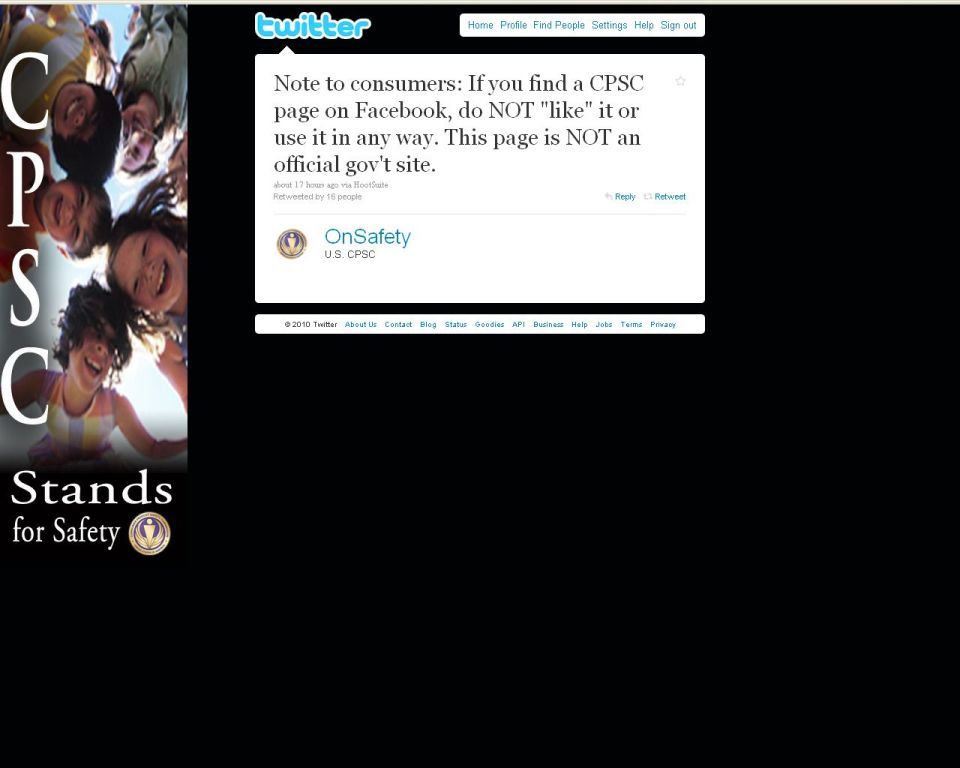
Strange things are afoot with respect to the Internet presence of the Consumer Product Safety Commission (“CPSC“). Earlier this week, the government agency issued a formal tweet warning users not to “like” or “use” in “any way” any unofficial Facebook pages dedicated to or representing themselves as the CPSC. (See above for a screen capture of the tweet in question.). Curiously, the tweet reads like a formal directive forbidding any participation in Facebook’s unofficial CPSC fora. (Yes, we said “fora,” not forums. Get over it.). This stern pronouncement prompted some investigation on the part of our investigative reporters here at Abnormal Use, a site often covering the CPSC.

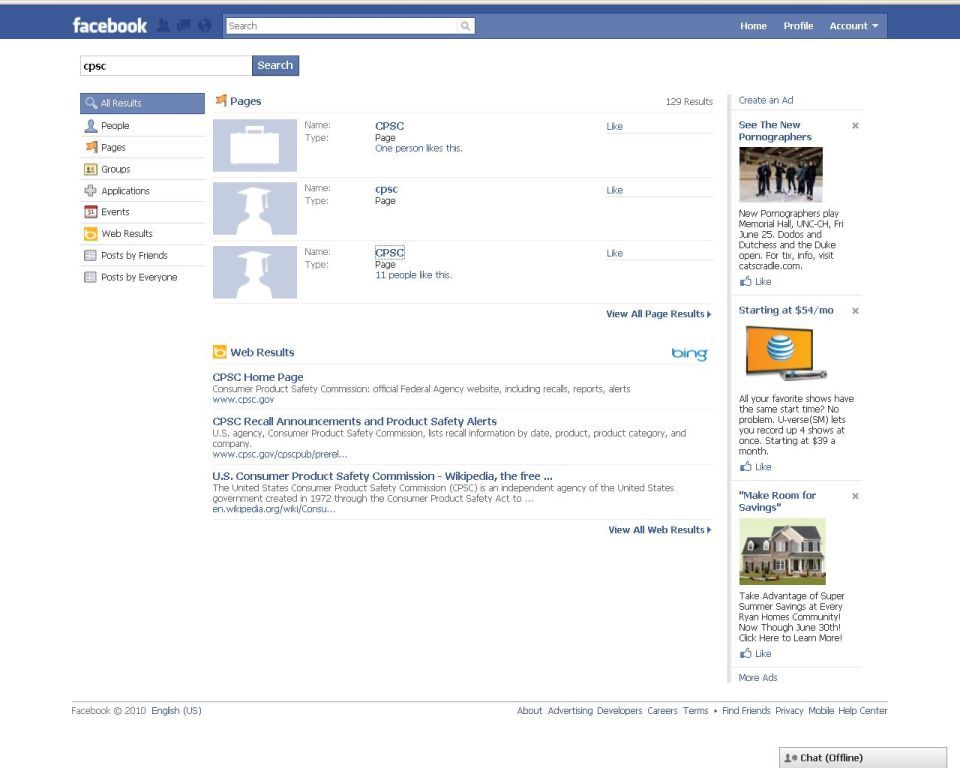
First, we logged into our Facebook account and input “CPSC” into the search field. Apparently, there is not one, but five unofficial Facebook pages with the titles referencing the agency. (The search results for “CPSC” are depicted above.). Note that collectively, the three unofficial Facebook pages in that initial search result have a total of twelve followers or admirers or likers or whatever they’re called on Facebook. Note also that the “Web Results,” depicted at the bottom of the page, return two links to the official CPSC site and a third to the agency’s Wikipedia entry (which, as far as we know, the CPSC has not yet warned us against).

We decided to investigate further.


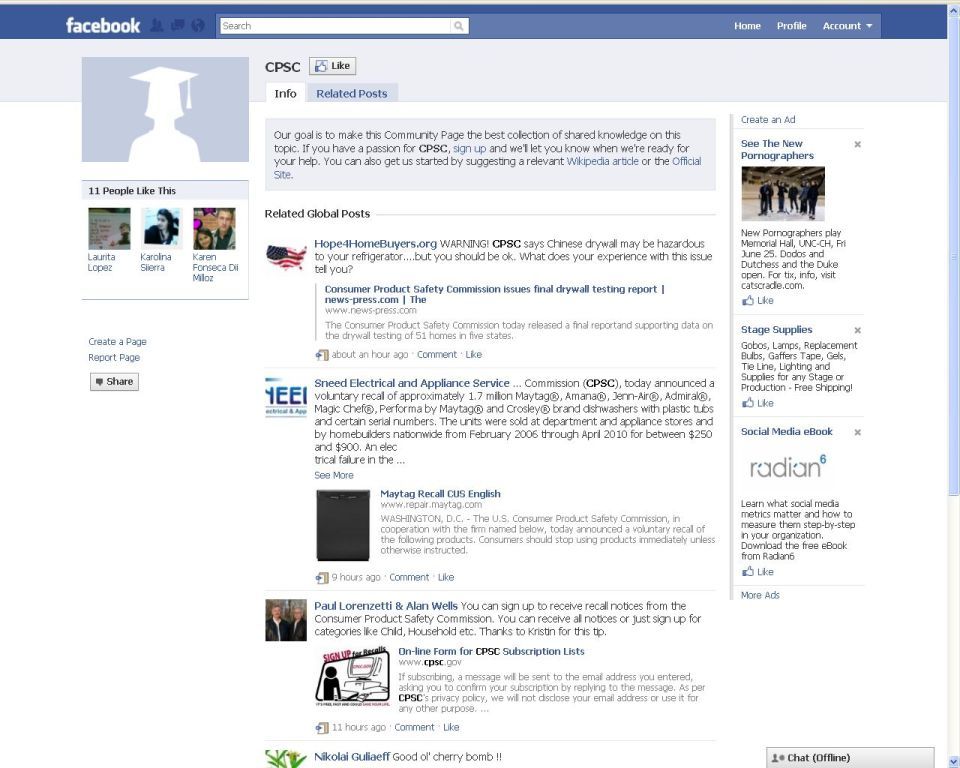
The first Facebook Community Page (depicted above) boasts eleven followers. It appears to be some type of automated page which collects various Facebook status updates and posts which reference the search term “CPSC.” Facebook users who update their status or posts links including the acronym for the agency will find their posts collected on this community page.


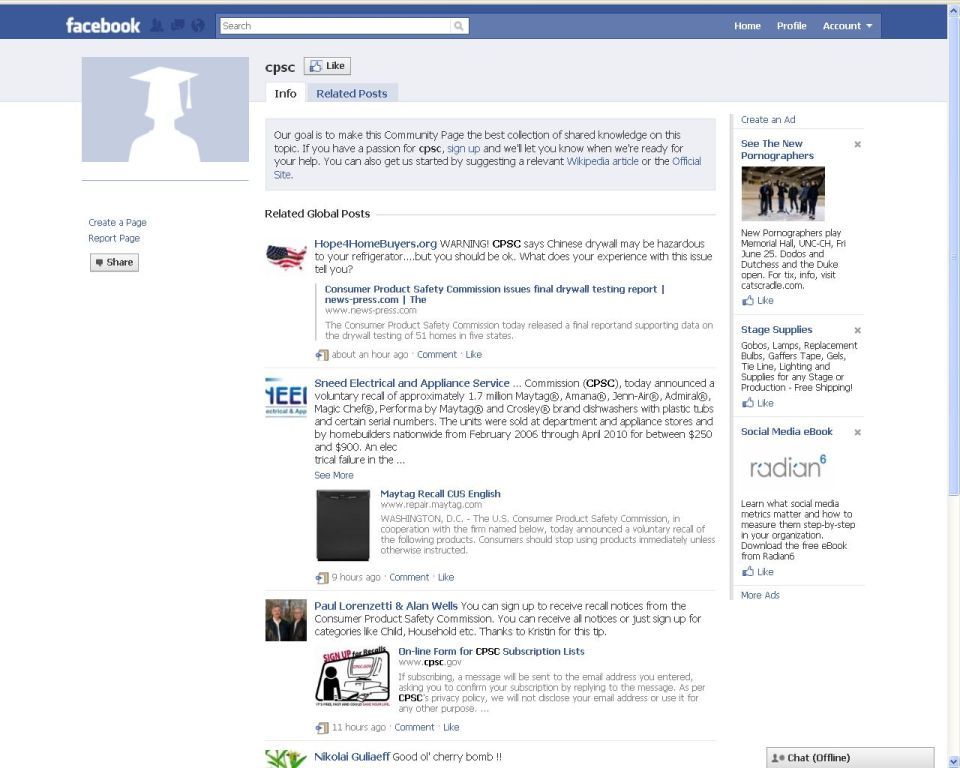
The next Facebook Community Page is only slightly different (but it has no admirers, or perhaps it did, but the agency shooed them away with its austere tweet). Note that this second Community Page (depicted above) is dedicated to the “cpsc” (in all lower case). It’s collection of links and status updates is identical to that of the first page, but it’s group title features no capital letters. An interesting quirk in Facebook’s new Community Page system, or anti-government conspiracy? We here at Abnormal Use remain on the case.


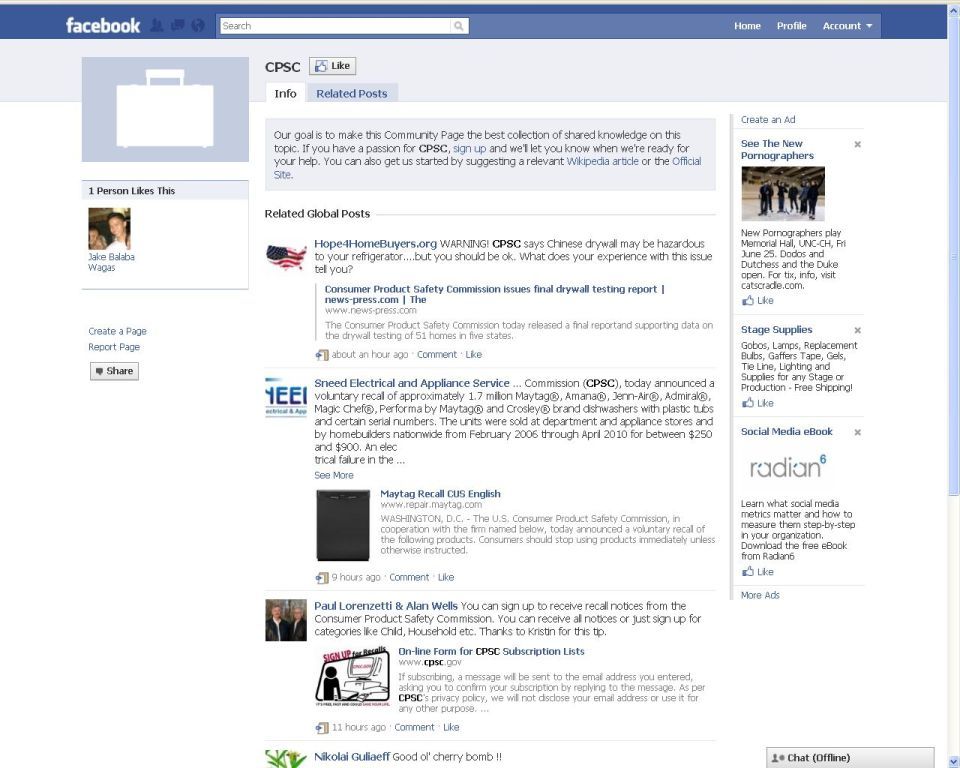
The third Facebook Community Page (depicted above) is titled “CPSC” (in all caps) and is identical in all respects to the first Community Page save for two things: it has but one admirer and its default icon appears to be a suitcase rather than a student in a graduation cap and gown.


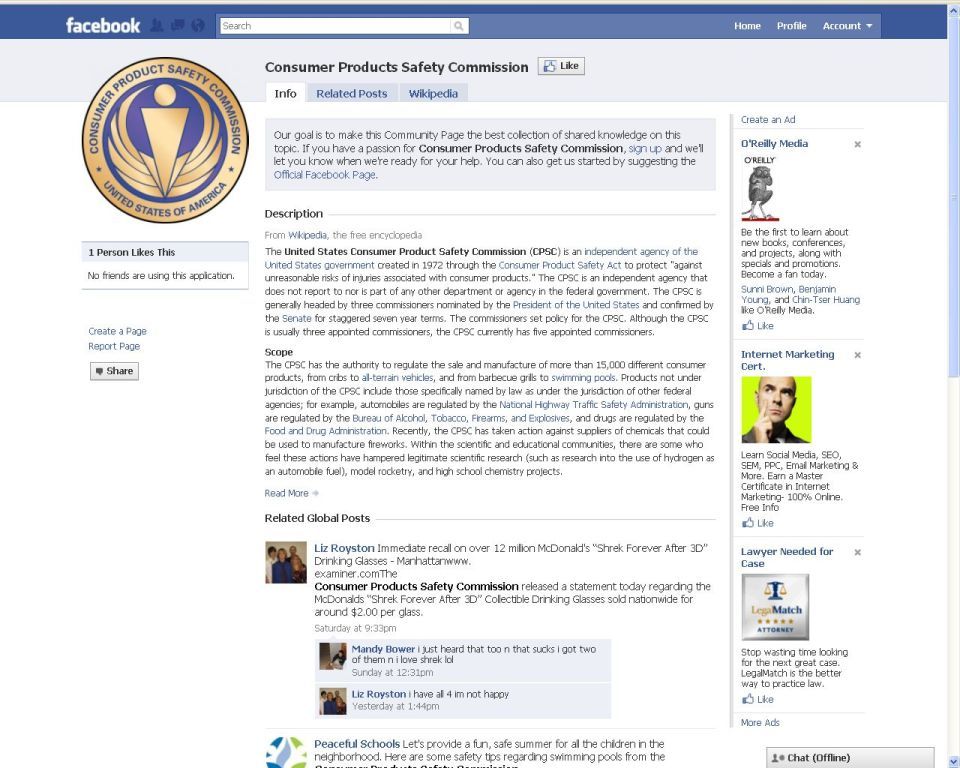
We also input the full name of the CPSC into Facebook’s search field and found the page depicted above, complete with a more official looking profile picture in the form of a seal. The content seems to be primarily derived from Wikipedia’s CPSC entry, though, and only one person “likes” this unofficial incarnation of the CPSC on Facebook.

Finally, we uncovered an unofficial page for the Consumer Products Safety Commission Injury Coder (Nationwide Children’s Hospital), which features no admirers or content of any kind.

And that, dear readers, is all that we uncovered.

It seems like the culprit is not some sinister villain but instead some type of automated page creation system at Facebook. Interestingly, while the CPSC has certainly dipped its toe into the social media pond, it has not established any official presence on Facebook. We see on the landing page of the agency’s official website that it maintains accounts on YouTube, Flickr, and of course, Twitter. (It even has a page dedicated to its official Podcasts, although the agency has not recorded one in some time.).

We are puzzled and perplexed.

Why the hate for Facebook? Why no official presence there?

What’s the beef against Facebook creating a Community Page for discussion of CPSC issues?

Why can’t we “like” or use an unofficial page collecting links to unofficial CPSC information?

Where on Facebook should we go for our CPSC fix?

All kidding aside, one of the advantages of using Facebook to promote one’s own agenda is that much of your audience is already there using the site for other reasons. One would think that the CPSC would want to use that site in order to reach as many people as possible about potential recalls and product information. By using that site, too, CPSC essentially deputizes other users, who have the option to forward along items posted by the CPSC to their friends.

All screen captures were taken on the morning of Tuesday, June 8.

Friday Links

The California Commission on Judicial Performance suspended a judge for two years for using his office computer to look at dirty pictures and then lying about it later during television interviews. For more, see this story at the Legal Profession Blog.

Lawyerist has this post entitled “Top 5 Social Media Ethics Concerns for Lawyers.”

The South Carolina Business Law Blog summarizes the recent South Carolina Supreme Court case of Blackburn v. TKT & Assocs., in which that court addressed the appropriate application of the “income approach” valuation in an action of dissolution.

The Legal Ethics Forum reminds us that next month sees the fiftieth anniversary of the publication of Harper Lee’s “To Kill a Mockingbird.” We expect to see a lot of coverage in the legal blogosphere commemorating that occasion.

Words of Wisdom: “As the ‘Star Trek’ era is ushered into our lives, this Court must be prepared to keep its perspectives progressive and its definitions flexible, or else this Commonwealth will fail to acquire modern, technological manufacturing operations.” Golden Triangle Broadcasting, Inc. v. City of Pittsburgh, 397 A.2d 1147, 1153 (Pa. 1979) (Manderino, J., dissenting).

Words of Wisdom II: “We are unable to find where the defendant-appellant could have been prejudiced by remarks about Superman and Batman.” Palmer v. State, 288 N.E.2d 739, 754 (Ind. Ct. App. 1972).

Ninth Circuit Affirms Exclusion of Two Experts in Products Case in Eight Paragraphs

We here at Abnormal Use adore concise, get-to-the point jurisprudence, which is why we pause today to reflect upon the Ninth Circuit’s recent eight paragraph memorandum opinion in Shalaby v. Newell Rubbermaind, Inc., No. 09-56331 (9th Cir. May 17, 2010) (unpublished) [PDF]. To reduce the disposition of a products liability action to eight paragraphs is sublime.

In that case, the Plaintiffs, apparently from California, filed a products liability action after Mr. Shalabay was allegedly injured “when a handheld, gas-powered torch that he had purchased from a Home Depot store exploded.” Ever so briefly and succinctly, the Ninth Circuit observed that expert testimony is required in products liability matters to establish causation when the theory is “beyond common experience,” and because the Plaintiffs’ two proffered experts had been properly excluded by the trial court, the Plaintiff had no case. Thus, the Ninth Circuit affirmed the ruling of the district court, which had initially excluded both experts.

The money paragraphs were:

The court excluded the testimony of one of those witnesses, Dr. Anderson, a metallurgy expert, as unreliable and irrelevant. To support his theory that a design defect in the torch caused the explosion, Dr. Anderson conducted two tests on exemplar torches to demonstrate the flaw. The district court concluded that because Dr. Anderson had performed only two non-standardized tests, on torches that may have been different from the one here at issue, and did not adequately explain the results of or discuss the possible rate of error for such tests, his testimony would be unreliable. It would also be unreliable because he did not address certain contradictory evidence. Finally, he did not present adequate evidence that the design flaw caused Shalaby’s injuries, rendering his testimony irrelevant.

The district court excluded the testimony of the other witness, Dr. Vredenburgh, because she was not a qualified expert and, even if she were, her testimony was unreliable and irrelevant. Dr. Vredenburgh’s field of expertise was not torches; she had some experience in the formulation of warning instructions for various devices. When asked whether a different or larger warning would have helped in Shalaby’s case, Dr. Vredenbugh testified that “I don’t know why [the torch] failed, so I don’t know that a warning would have helped.” She stated that she had never operated a handheld torch and had not seen one operated in seventeen years. She had not spoken to any users of handheld torches in many years, and she had incorrectly testified about how such a torch is used. Dr. Vredenburgh admitted that she did not collect any empirical data, did not conduct any testing, did not conduct any surveys, did not seek data from manufacturers, did not review any peer-reviewed literature, did not conduct any other kind of research prior to forming her opinion, and did not follow her own typical process for developing product warnings.

Sure, maybe the conclusion was so easily reached that it only merited an eight paragraph opinion. But it’s nice to see such a case given short shrift.