Friday Links

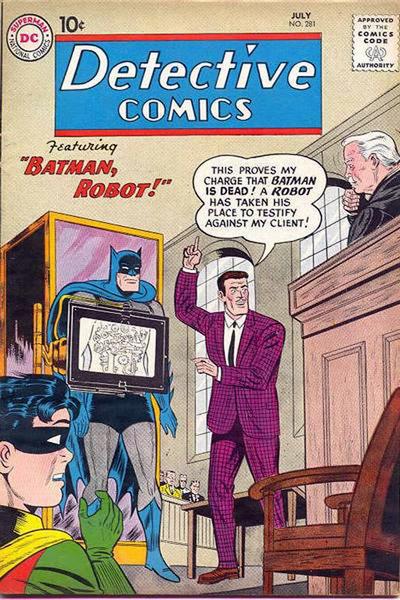
We think that there may be some junk science in the courtroom in the comic book cover depicted above, but unfortunately, Detective Comics #281 was published 33 years before Daubert. We’re not sure why Batman’s death is being litigated or why Robin is in the courtroom, but we would have advised some simple discovery requests on the Batman-as-robot issue, perhaps a request for admission along the lines of “Please admit whether you are a robot.” At least then a denial would have entitled the opponent to fees and costs.

South Carolina attorney J. Benjamin Stevens at The Mac Lawyer has this post, entitled “Top 10 Resources for Mac Junkies.” On a related note, the partners at our firm have still not supplied we few, we happy few, we band of bloggers with our own iPads.

Begins this New York Times article: “The singer and former Talking Heads frontman David Byrne has sued Gov. Charlie Crist of Florida, saying he used the Talking Heads’ song “Road to Nowhere” in a Senate campaign ad without permission.” We have nothing else to add to the news of this litigation, although it does provide us yet another opportunity to link to the fabled and extraordinary Fifth Circuit Talking Heads opinion.

James Parton has a post entitled “Obtaining Records from Facebook, LinkedIn, Google and Other Social Networking Websites and Internet Service Providers” at the DRI For the Defense blog. It’s worth a read, especially considering how challenging it is to actually obtain information from those types of entities in civil litigation.

Although it’s a bit out of our subject matter, we here at Abnormal Use are closely following the case of Justin Kurtz v. T&J Towing. Read more about it here. Based on the accounts of that dispute, how can you not be on Team Kurtz?

Jeffrey V. Mehalic at the West Virginia Business Litigation blog has this in-depth post on the recent Fourth Circuit opinion, In re: Abrams & Abrams, P.A., about which we blogged very briefly in last week’s edition of Friday Links.

As seen in the ABA Journal, a “new study finds that less attractive defendants fare worse in criminal cases when the jurors have an ‘experiential’ style of judging.” The author of the article, Debra Cassens Weiss, finds a nice way to say that “experiential” means not listening to the evidence and judging on legally irrelevant information. We would like to go on record that not all persons sporting a unibrow and English-style overbite are criminals. We would also like to see a study on how attractive lawyers fare versus less physically appealing advocates. Would you find for the ugly defendant represented by an objectively attractive counsel?

We are disappointed to learn that W. Lawrence Wescott of the Electronic Discovery Blog decided this week to end his blog. We enjoyed reading it.

The new South Carolina Business Law Blog celebrates its first two months of existence next week. Congratulations to them on that milestone, which is no small feat in the legal blogging world.

Friday Links

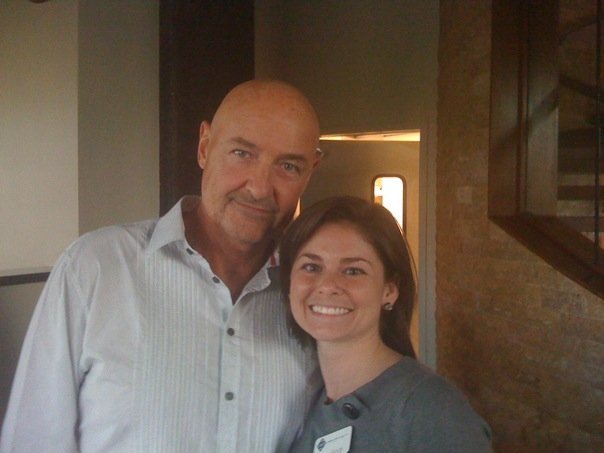
  • We are quite saddened to report that the very final episode of TV’s “Lost” airs this coming Sunday. We here at Abnormal Use (particularly myself and contributor Mary Giorgi) are big fans of the show. In fact, we simply must mention that we once met the actor who plays Locke immediately after, of all things, a firm function. The picture above was taken by yours truly, just over a year ago, on May 12, 2009, right here in Greenville, South Carolina, at the Lazy Goat restaurant. Terry O’Quinn, who plays John Locke on “Lost,” was at the same restaurant, which was also playing host to a firm recruiting event. The picture, of course, features O’Quinn and Giorgi (who insists that I tell you that she is only wearing a name tag because it was a firm function). O’Quinn said at the time that he was in town to play golf. Here’s the best part: We met him the day before the Season 5 finale, “The Incident,” aired. How about that? Goodbye “Lost.” We will miss you.
  • This week, our own Fourth Circuit released In re: Abrams & Abrams, P.A., No. 09-1283 (4th Cir. May 18, 2010), a very interesting opinion in which an individual was severely injured after his drunk friend ran over him in an automobile. Here’s what happened next: the insurance carrier for the friend’s employer denied coverage and refused to defend the friend. Thus, the friend had to defend himself in the ensuing lawsuit pro se, and eventually, he had a $75 million judgment entered against him when he failed to appear for trial. Ultimately, the insurance company was sued for bad faith. The insurance company later settled that matter for $18 million, but the district court would not approve the one-third contingency fee for the lawyers, awarding instead only 3 percent. The Fourth Circuit reversed, finding that the fee award was too low. Yikes. (You can find the official Findlaw.com case brief here.).
  • We have often posted legal themed comic book covers on Fridays (although we’re not doing so today just so you’ll have something to look forward to). But get this: Last week, the Wall Street Journal Law Blog reported that DC Comics, which has long been in a dispute with the heirs of the creators of Superman, has now sued the attorney of those heirs, suggesting that he provoked his clients into, er, taking actions with which DC Comics apparently disagreed. Not sure how this one is going to pan out, but DC Comics is playing hardball. Actually, suing the attorney seems like something Lex Luthor might do.

Friday Links

We believe the attorney on the cover of the comic book cover depicted above is making a good objection, although it may be untimely. Surely he was aware that Batman was invisible before he took the stand to testify. (There may also be a confrontation clause objection.). Such was the dilemma in Detective Comics #199 from September 1953. To be honest, we’re not certain Robin is dressed in appropriate courtroom attire.

We are disappointed to learn that Bobby G. Frederick, the author of the South Carolina Criminal Defense Blog, may be taking down his other site, Trial Theory, a blog dedicated to trial practice. (See here for his post on the stressors of the profession.).

If you haven’t read “Trout in the Milk,” last Friday’s post at the Drug and Device Law blog, do yourself a favor and check it out.

In this post, the Legal Ethics Forum directs our attention to this article (registration required) suggesting that male lawyers are overconfident about outcomes. Surely that is not correct, and we know for a fact that we would win an argument on that issue.

Ted Frank at Point of Law points us to some news suggesting that some consumers are drinking their Benadryl Extra-Strength Itch-Stopping Gel. Gross.

South Carolina Supreme Court Brings Down the Hammer on Discovery Abuse

Last week, the South Carolina Supreme Court indicated that it would no longer tolerate impermissible fishing expeditions during the discovery process. In so doing, the court took the extraordinary measure of granting a writ of certiorari to review an administrative law court’s discovery orders and then vacating those orders and remanding the case back to that court. See Oncology & Hematology Assocs. of S.C., LLC v. South Carolina Dep’t of Health & Envtl. Control, — S.E.2d —-, No. 26814., 2010 WL 1756850 (S.C. May 3, 2010). The court described the case as between two “fiercely competitive healthcare providers” involved in a dispute over the “vying for cancer patients in Greer, South Carolina.” The specific facts of the dispute are irrelevant to the cautionary point offered by the case: be careful what you ask for in discovery.

This is a case with which litigators should be familiar. At issue in the opinion were the discovery requests sent by Spartanburg Regional Healthcare System (“SRHS”) to Oncology and Hematology Associates of South Carolina, d/b/a Cancer Centers of the Carolinas (“CCC”), several of which the court quoted in their entirety in the opinion. The central issue in the case, as noted by the Court, was “whether the 2004-2005 South Carolina Health Plan standards applied to the relocation of SRHS’s linear accelerator.” That was a relatively narrow issue, though the discovery requests at issue were quite broad. Indeed, the specific proceeding arose after SRHS submitted a Certificate of Need application to the South Carolina Department of Health and Environmental Control to relocate the linear accelerator from one facility to another. That request was granted by the governmental authorities, but CCC sought a contested case hearing before an administrative judge on the issue. Ultimately, the Court concluded that SRHS “took a shotgun approach and sought virtually all information concerning every facet of CCC’s operation.”

Nothing good can follow that statement if it was your discovery at issue.

Pausing to quote the rules, and expound upon its scope, the Court observed:

We are keenly aware that the scope of discovery is broad. Rule 26(b)(1), SCRCP, provides:

Parties may obtain discovery regarding any matter, not privileged, which is relevant to the subject matter involved in the pending action . . . [and] [i]t is not ground for objection that the information sought will be inadmissible at the trial if the information sought appears reasonably calculated to lead to the discovery of admissible evidence.

Yet, there are limits, which we see trial courts generally unwilling to recognize and enforce. SRHS’s discovery requests of CCC and its business partners are abusive and beyond the pale.

Our willingness to review a discovery order by way of a writ of certiorari will be as rare as the proverbial “hen’s tooth.” We have no desire to micromanage discovery orders. It is our hope that in resolving this matter, we will speak to trial courts generally. While discovery serves as an important tool in the truth-seeking function of our legal system, we are concerned that “discovery practice” has become a cottage industry and the merits of a claim are being relegated to a secondary status.

In finding that SRHS had abused the discovery rules, the Court further noted:

SRHS’s discovery requests are not remotely relevant to a resolution of the issue concerning the relocation of the linear accelerator. A challenge to relocation of the linear accelerator does not entitle SRHS to the information it seeks from CCC and affiliated entities. SRHS abused the discovery process with its scorched-earth approach.

We decline to rewrite and narrowly tailor SRHS’s oppressive discovery requests so as to make them proper. That would reward improper conduct. Where, as here, a party abuses discovery, the proper remedy is to vacate the requests and require the party to start over. As a result, we vacate the five discovery orders before us.

Ouch.

If you file motions to compel in South Carolina, or elsewhere, you will likely see the case cited in any responses to your motions. (This opinion could be persuasive authority elsewhere, and in fact, the Court itself invoked a 2003 Texas Supreme Court opinion in support of its conclusion.). If you respond to many such motions, it’s time to update your form response.

New York High Court Affirms Plaintiff’s Verdict in Lift Case

In the summer of 1997, Walter Adams, a maintenance man, climbed into a personnel lift (a device which a basket into which a person enters and presses a button, which causes the basket to rise or lower depending upon the operator’s preference). After he had taken the basket to a height of approximately twelve feet, the lift tipped to one side and Adams fell from the basket. Adams later brought suit against Genie Industries, Inc., the designer, manufacturer, and seller of the lift at issue. Following a trial, a jury found that the lift had been defectively designed. Yesterday, nearly thirteen years after the accident at issue, the New York Court of Appeals, that state’s highest court, affirmed that verdict in Adams v. Genie Industries, Inc., No. 67, 2010 WL 1849325 (N.Y. May 11, 2010) [PDF].

The Plaintiff’s principal theory was that the lift at issue did not have interlocking outriggers. The device actually came with outriggers, but sometime between the purchase of the lift in 1986 and the accident in 1997, Plaintiff’s employer lost them. That didn’t affect Plaintiff’s employer’s use of the equipment, though, and the lift remained in service despite a warning on the equipment advising that “[a]ll outriggers must be installed before using.” Plaintiff theorized that the lift was unsafe because the outriggers at issue did not feature an interlocking mechanism, i.e. a device that would prevent the lift from being operated without the outriggers installed and in use.

The evidence clearly showed that the use of outriggers would have made the product safer. Expert testimony explained that outriggers would have expanded the product’s “footprint,” making it more stable by distributing its weight over a wider area. Indeed, Genie’s own label warned against using the product without outriggers. It is thus reasonable to conclude that an interlock, making use without outriggers impossible, would have increased the safety of the product.

Plaintiff also offered evidence from which a jury could find that, in 1986 when the product was sold, it was technologically possible, at minimal cost, to design the product with interlocked outriggers. A qualified expert so testified, and illustrated his point with a model that he had created of Genie’s machine, to which he had added a half dozen switches, of a kind available in the late 1980s for $20 to $25 each.

The court acknowledged Genie’s point that liability could not attach “merely on a showing that a safer product was theoretically possible at the time the machine was made.” However, the Court cited to testimony that a former Genie employee had specifically envisioned and discussed the possibility of interlocked outriggers in 1985, a year before the sale of the device at issue, and that he recalled thatGenie had obtained a competitor’s lift featuring interlocked outriggers in 1985, as well. Further, a Genie official had apparently secured company permission in 1985 to present the idea of interlocked outriggers before a safety panel in 1985 to an industry safety committee.

The court sustained Genie’s point of error that the trial court had erred in submitting to the jury the issue of its alleged negligence from 1986 to 1997 in failing to retrofit or recall the lift at issue. However, the court essentially punted on this issue, finding that the error was harmless.

In so doing, the Court remarked:

Our decisions make clear that, in general, the duty of the seller of a product who discovers, after the sale, risks that were not known beforehand is (sic) a duty to warn. In this case, there can be no successful claim that Genie breached any duty to warn, either pre-sale or post-sale. Supreme Court held, on a pretrial motion, that the warning contained in Genie’s product label was adequate, and that holding is not challenged here. We have never imposed a post-sale duty to recall or retrofit a product, and the facts of this case provide no justification for creating one. Thus the jury should not have been permitted to find that Genie was negligent in failing to recall or retrofit its product after the 1986 sale.

The trial court’s error in submitting this theory to the jury, however, had no impact on the outcome of the case. Plaintiff’s post-sale negligence claim, as presented at trial, was no more than a duplicate of his design defect and negligent design claims. Plaintiff presented no evidence of any facts that came to Genie’s attention after the sale that might have triggered a new duty; plaintiff merely asserted that Genie should have recalled or retrofitted the personnel lift for the same reasons that it should not have sold it in the first place-principally, because the outriggers were not interlocked. Genie points to no evidence admitted on the post-sale negligence claim that would have been inadmissible on the other claims, and identifies no way in which the court’s error in submitting one claim might have tainted the jury’s verdict on the others.

Id. (citations omitted).

It appears that there were a number of liability issues which were either not subject to the appeal or not discussed in meaningful detail by the Court. However, aside from a few brief statements, the court did not spend much time addressing the Plaintiff’s employer’s use of the lift in contravention of the warning and its admitted loss of the outriggers at issue. Further, there was no discussion of whether the accident at issue would have occurred had the originally included outriggers been present and installed on the lift at issue at the time of the accident. Had the Plaintiff, or his employer, used the product as intended or as contemplated by the warning on the face of the equipment, the accident may well have not occurred.

Certainly, between a lift with no outriggers of any kind, and a lift with interlocked outriggers, the latter may be safer than the former. But Genie did not sell a lift sans outriggers in 1986; it sold one with them, albeit non-interlocked. But in losing the outriggers, Plaintiff’s employer made the device less safe, yet continued to use it, presumably for some time. What of that? Should Genie be responsible for a Plaintiff’s employer’s modification of the device? Should it be responsible for the device being made less safe by such an alteration? If the device is made less safe by a third party, is it that less-safe device the standard that shall be judged, or the device as it was sold?

Friday Links

We’re taking a break this week from court related comic book covers to bring you the above, one of our favorite closing arguments from television sitcom history. That’s right, depicted above is the closing argument of Jackie Chiles, representing the main characters of “Seinfeld,” on charges that they violated a good Samaritan law, in the series finale of that program.

Maybe this guy’s got the right idea? Walter Olson at Overlawyered reports on a recent Indiana lawsuit in which the Plaintiff sued a local retail establishment, claiming that they prevented him from buying a lottery ticket, and of course, he would have picked the winning numbers, so they thwarted his win. How could they do that to him?

KC Johnson, who through his blog Durham in Wonderland, reported on the Duke lacrosse case several years ago, is now blogging the tragic Virginia lacrosse-related murder case. For his two most recent posts on that topic, see here and here.

If you haven’t already, check out this guest post by John A. Tartaglia III at the Drug and Device Law blog on “attempts in Congress to strip manufacturers of FDA premarket approved medical device manufacturers of their hard-won preemption defense.”

Oh, alright, we’ll do a comic book cover this week for good measure. Depicted below is Mr. District Attorney #65, originally published in 1958. We think that the defendant may have a good confrontation clause objection here, but then again, we’re not criminal lawyers.

Friday Links

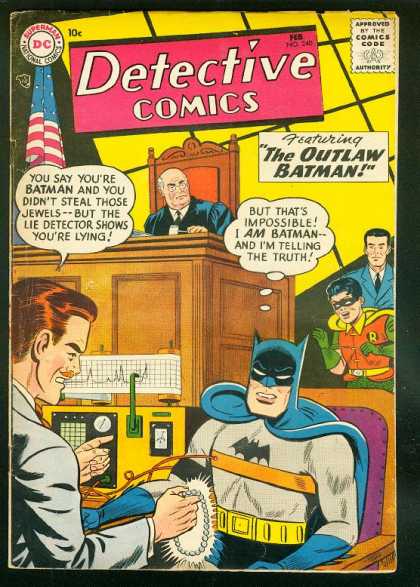
We couldn’t resist revisiting one of our favorite Friday topics: the courtroom, as depicted on old superhero comic book covers. Above, in Detective Comics #240 (which was published way back in 1957), Batman, the defendant, is apparently on the witness stand being questioned during a robbery or burglary trial, all the while hooked up to a polygraph machine. (Gotham must not be a Frye jurisdiction.). Also of concern is the fact that Robin appears to be up to something, and we’re not certain that the bailiff can handle a melee with a superhero, even a sidekick. (But then again, perhaps the Boy Wonder is simply leaning in to taunt Batman and suggest that even Hawkman could have beaten the lie detector.). The simplest solution may have been for Batman to take George Costanza’s sage advice:


When it comes to jury service in federal court, you’d best not mess around.

Earlier this week, our intrepid blogger Kevin Couch took on the law of Mardi Gras, going so far as to analyze the old tossed-coconut fact pattern. Walter Olson at Overlawyered links Kevin’s post and also directs our attention to some other Mardi Gras coconut posts.

If you happen to find yourself in Columbia, South Carolina this evening, and you dig live music, be certain to stop by The Elbow Room to see the South Carolina Bar Young Lawyers Division’s Justice Jam. Seven bands, each with at least one attorney member, are on the bill, all for a good cause: raising money for Sexual Trauma Services of the Midlands. For more information, see here. (By the way, if you’re not following the South Carolina Bar on Twitter, why aren’t you?)

California Magistrate Scoffs at Plaintiff’s MySpace Page, But Awards Damages Anyway

Yet another case illustrates why defense counsel, including products liability litigators, should be mindful of the ever changing landscape of social media and its potential for impeachment of Plaintiffs in litigation. That case is the recently issued Sedie v. United States, No. C-08-04417, 2010 WL 1644252 (N.D. Cal. April 21, 2010). In that case, the Plaintiff sued the federal government under the Federal Tort Claims Act after a 2006 automobile accident during which he, riding a bicycle, was struck by a postal vehicle. Both parties consented to a bench trial before U.S. Magistrate Judge Elizabeth D. LaPorte, which took place this past February. In her “Findings of Fact and Conclusions of Law Following Court Trial,” Judge LaPorte ultimately found that the Plaintiff had established the government’s liability and awarded damages in the amount of $297,624.66.

Even though the magistrate ultimately found for the Plaintiff, in reviewing some of the submitted damages evidence, the magistrate noted the contradictions between Plaintiff’s purported damages and Internet evidence uncovered by defense counsel:

Other evidence also undermines the extent of Plaintiff’s general damages. Plaintiff testified that he spends much of his time lying down, and there are times that he does not leave his room because he is depressed about his overall situation. However, the Court finds this testimony is only partially accurate, and is exaggerated given the other evidence of his actual activities and his pattern of exaggeration. For example, Plaintiff’s online writings show that his life was not constantly “hell on earth” as he claimed. Plaintiff maintained his pages on MySpace and Facebook since the accident, and as of January 12, 2010, his MySpace page listed various activities and hobbies, and friends of Plaintiff. Plaintiff wrote entries on his MySpace page, including one on June 3, 2007, in which he described painting as a frustrating activity when his arm hairs would get caught in paint. Yet painting was on the list of activities that Plaintiff claims were adversely affected by the accident. Plaintiff also testified that he had not done any painting since the accident, but the MySpace entry was written in the present tense at a time just prior to his microdiscectomy. Plaintiff testified that the MySpace entry was a joke, but the Court did not find the testimony credible.

Id. at *23 (emphasis added; citations omitted).

Plaintiff’s attorneys continue to warn their current and potential clients of the potential adverse impact of Facebook and MySpace profiles. For the most part, these clients do not appear to be heeding that advice. That is why the diligent practitioner will always survey the Internet to determine whether a given Plaintiff has established profiles on such sites.

Abnormal Interviews: Law Professor Mary J. Davis

Today, Abnormal Use continues its series, “Abnormal Interviews,” in which this site will conduct brief interviews with law professors, practitioners and other commentators in the field. For the third installment, we turn to law professor Mary J. Davis of the University of Kentucky College of Law. A products liability professor, she co-authored the products liability treatise, Owen, Madden and Davis on Products Liability. The interview is as follows:

1. What do you think is the most significant new development in products liability of the last year?

I think that the whole question of preemption continues to be the most significant new development in products liability in the last two decades and every time the Court decides a question, it is a significant new development. For example, when the Court found no implied preemption in the pharmaceutical labeling case, Wyeth v. Levine, in late 2009, that was a huge development given that the Court had been forecast to be friendly to preemption in that case and it was not. And now the Court is poised to answer another preemption case, Bruesewitz v. Wyeth, involving express preemption under the National Childhood Vaccine Injury Compensation Act. Any time the Court decides a preemption case, it’s a significant new development. Other than that, I think the Consumer Products Safety Improvements Act implementation is significant if only because the changes made in 2008 by the statute reflect a substantial re-focus on regulating product safety from the federal regulatory side.

2. What rule or concept in modern products liability jurisprudence is the most outdated? How would you change it and why?

No or limited liability for successor corporations. Come on. You shouldn’t be able to sell your company to get out from under liability that can be established under applicable law at the time of the product’s sale no matter how much it might make business sense to try to avoid that liability. I would expand the product line exception so that if the company continues to sell the product, or any variant, liability will continue to apply to products sold by the predecessor.

3. Generally, how would you characterize the media coverage of products liability?

Extremely weak. I think top journalists do a good job; I have read good material in The New York Times, Wall Street Journal and Washington Post on the Toyota recall and litigation frenzy, for example. Generally, though, I think the media does not try to understand even the basic features of products liability, much less the nuances. I would like to see more time/pages devoted to explaining products liability law and the litigation system. The public needs it. I am personally often reluctant to talk to the press, however, and, when I do, the most ridiculous, out-of-context information comes through. It is difficult to use the media to give a civics lesson, but the media should be more interested in clarifying the public’s understanding of the legal system than it appears to be.

4. What advice would you give to lawyers practicing products liability in 2010. What should they be looking out for?

I have not practiced since 1991, so I should be asking your readers what advice they would give me in training lawyers who might practice products liability in 2010. I hope some of them will take me up on that. I would say, however, that lawyers who practice in federal court must understand Iqbal, the Supreme Court case that changes the face of pleading under the Federal Rules. Of course, state pleading requirements are not affected.

5. What federal or state court opinion has been the biggest surprise for you of late and why?

That’s a tough one because I just told you that I was surprised by Wyeth v. Levine, the pharmaceutical preemption case. I was also extremely surprised when the Supreme Court decided Altria Group, Inc. v. Good, which found that consumer fraud litigation against the tobacco companies was not preempted. Since the first tobacco litigation preemption case in 1992, Cipollone v. Liggett Group, the Court had gravitated toward a strict/text-based express preemption analysis advocated by Justice Scalia in dissent in Cipollone and subsequent cases, most recently Riegel v. Medtronic, Inc., a medical device preemption case. Many observers anticipated that perhaps Justice Scalia’s approach would prevail in Altria Group. It did not. The decision indicates a trend in favor of a more flexible approach to the search for congressional intent to preempt which the Court had employed before Cipollone. I suppose you can tell that I am a follower of the preemption cases. They are the single most important development in products liability since I have been involved in the field, as a litigator for 6 years and now as a professor for 19.

BONUS QUESTION: What do you believe is the most interesting depiction of a products liability lawsuit in popular culture?

I liked the movie about the whistleblower in the tobacco litigation, Jeffrey Wigand, even though I think it’s unfortunate that the only products liability movies are [those] about the allegedly unsavory actions of corporate defendants. I always thought that most products liability defendants didn’t deserve that reputation.

BIOGRAPHY: Mary J. Davis is the Stites and Harbison Professor of Law at the University of Kentucky College of Law. Her research focuses on products liability law. She joined UK Law in 1991 after six years of a litigation defense practice, predominantly in products liability, for the law firms of Womble, Carlyle, Sandridge & Rice in Winston-Salem, North Carolina and McGuire, Woods, Battle, & Boothe in Richmond, Virginia. She is co-author of the textbook Products Liability and Safety: Cases and Materials (6th ed. 2010) (including the annual case supplement and Teacher’s Manual) with Professors David Owen and John Montgomery of the University of South Carolina School of Law. She is also a co-author of a multi-volume products liability treatise, Owen, Madden and Davis on Products Liability. Professor Davis is a 1985 magna cum laude graduate of the Wake Forest University School of Law and a 1979 cum laude graduate of the University of Virginia. She is also a member of the American Law Institute since 2001 where she serves on the Members Consultative Groups for the Restatement (Third) of Torts, Products Liability, and Aggregate Litigation Projects.

Friday Links

  • Over at the Sui Generis blog, Nicole Black has a very interesting piece about a recent opinion by the New Jersey Advisory Committee on Professional Ethics and the Committee on Attorney Advertising, which found that a “virtual office” is not a “bona fide office.” Black scoffs at the ruling and suspects that “New Jersey continues to dig its heels firmly in the 19th century, presumably requiring its attorneys to ride horses and buggies into work, while also requiring them to comply with [the bona fide office requirement.]” Yikes.
  • Robin Wheeler at the South Carolina Access to Justice Blog notes that the results of the February 2010 South Carolina bar examination will be released this afternoon. In so doing, she recounts her own experience with the bar and the harrowing experience of waiting for the results to be released. (That experience, apparently, was the proximate cause of her decision not to renew her subscription to Martha Stewart’s Living magazine. See her post for more details.).
  • There’s just a week left to enter the State Bar of Texas 140 Character Novel contest. Details are here, and the contest is open to all U.S. lawyers from any state.
  • “People make mistakes.” Conkright v. Frommert, — U.S. —-, 2010 WL 1558979 (April 21, 2010). That’s the first sentence of a U.S. Supreme Court opinion authored by Chief Justice John Roberts and released for publication on Wednesday. That opinion dealt with ERISA plan administrators. (In fact, for the record, the second sentence of the opinion, actually a sentence fragment, reads: “Even administrators of ERISA plans.”). However, we think this statement may have a more universal application and we may revisit it in the future.
  • According to Lawyerist, social media gets you on the golf course quicker.