







No Jurisdiction for Seller of Milk Trailer, Texas Court Finds

Last week saw the release of a somewhat interesting personal jurisdiction case out of Texas. In that case, the seller of a milk truck was found not to have minimum contacts with the State of Texas, and thus, the district court did not have personal jurisdiction over it in the Plaintiff’s products liability action. See Mateer v. Cabool Lease, Inc., No. 2-09-297-CV, 2010 WL 1509691 (
Tex. App. – Fort Worth, April 15, 2010, no pet. h.) (not designated for publication).

The Plaintiff, a milk truck driver, suffered a severe hand injury after a 2006 valve accident while he was pumping milk into his trailer. Following his injury, he sued several entities, including Cabool Lease, Inc. (“Cabool“), the company that had sold the trailer at issue to Plaintiff’s employer, on the grounds that the trailer was defective. In response to the suit, Cabool filed a special appearance under Rule 120a of the Texas Rules of Civil Procedure in order to assert a personal jurisdiction challenge. The trial court sustained Cabool’s special appearance and the Fort Worth Court of Appeals, in an unpublished opinion authored by Justice Sue Walker, affirmed the trial court’s ruling and denied the Plaintiff’s interlocutory appeal.

The basic facts were not in dispute. In 1998, Plaintiff’s employer purchased the trailer at issue from Cabool, based in, of all places, Cabool, Missouri. The court noted that Cabool was a Missouri corporation with its principal place of business in Missouri. It did no business in Texas:

[Cabool] is not a corporate entity formed under the laws of Texas, and it does not maintain a registered agent for service in Texas. [Cabool] has no employees in Texas and does not regularly recruit Texas residents to work for [Cabool]; it does not maintain a place of business in Texas and does not have any offices or other facilities in Texas; it does not own any real or personal property in Texas; it does not maintain any bank accounts or post office boxes in Texas; it does not pay any taxes to any local or state taxing authorities in Texas; it does not market or ship any products to individuals or corporations in Texas; it does not operate a website in order to promote its business; it does not have a telephone number in Texas; it does not send sales or marketing brochures to people or corporations in Texas; it does not have company meetings in Texas; it does not purposefully advertise in or direct marketing efforts to Texas with an intent to solicit business from Texas; it does not advertise in any Texas newspapers; it has never before been involved in a lawsuit in Texas; and it has never had an occasion outside of this lawsuit to call anyone in Texas or receive phone calls from Texas.

Good jurisdictional facts for a defendant, those. Nevertheless, the Plaintiff argued that “ninety percent of [Cabool’s] business ha[d] consisted of leasing and financing equipment such as milk trucks and milk trailers to entities affiliated with [Cabool], such as [Plaintiff’s employer],” which, although also a foreign corporation, had significant Texas contacts. Further, Plaintiff pointed to evidence of a significant link between Cabool and his employer. For a number of years, Cabool leased to Plaintiff’s employer trucks and trailers for use in its facilities, including those in Texas, and Cabool continued to lease trailers to Plaintiff’s employer (who made up approximately 90 percent of Cabool’s customer base). Plaintiff also noted that Cabool’s president was also the president of Plaintiff’s employer, suggesting the closeness of the companies.

However, the appellate court found that “the trial court’s implied finding that [Cabool] had no contacts with Texas is supported by the special appearance evidence.” Although Plaintiff’s employer may have had contacts with Texas, it remained a third party, and the acts of a third party could not be attributed to Cabool, despite the fact that the two companies were closely associated. (The court specifically noted that there was no issue of piercing the corporate veil, and thus, Plaintiff’s employer’s contacts with Texas were not relevant to those of Cabool.). Accordingly, Plaintiff was left with no evidence of any contacts that Cabool had with Texas, ending the inquiry.
Friday Links

  • Whew. We survived Tax Day yesterday. To celebrate, we direct your attention to the above video of George Harrison and Eric Clapton playing “Taxman” (from the 1966 Beatles album, Revolver) in Japan sometime, we suspect, in the early 1990s.
  • Over at Osler’s Razor, law professor Mark Osler asks the age old question, “What should be required in law school?” A good question. (Incidentally, this coming Monday is Osler’s “Last Lecture” at Baylor Law School before he heads off to a new post at the University of St. Thomas Law School in Minnesota).
  • We here at Abnormal Use love ABC’s “Lost.” We really do. We realize this makes us both law nerds and sci-fi nerds. SPOILER ALERT: This past Tuesday, on that show, Desmond Hume (Henry Ian Cusick) accelerated his vehicle in a school parking lot and crashed directly into wheelchair-bound John Locke (Terry O’Quinn). In Desmond’s defense, he may have done that just to awaken Locke to the notion that they are all living in a possibly sinister alternate reality, but that’s neither here nor there. In real life, though, Dr. Justin Sattin, Assistant Professor of Neurology at the University of Wisconsin School of Medicine and Public Health, has criticized the portrayal of the accident, claiming that the manner in which Locke reacted to the accident was not exactly accurate. Far be it for us to criticize the realism of a show about a magic island with time travelers. But when we watched that scene, the most unrealistic thing to us was the fact that 10 different Plaintiff’s lawyers didn’t show up with business cards immediately after the accident. (Hat tip: TV Tattle.).
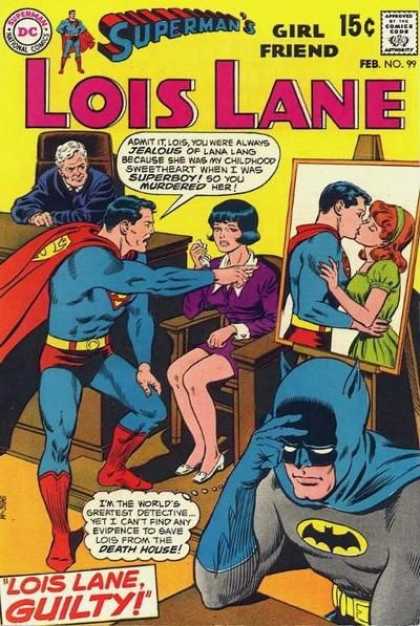
  • And finally, why do we never get trials like the one depicted below, in which Superman, apparently, is prosecuting Lois Lane for the murder of his former sweetheart, Lana Lang. (Note: Superman probably has one of those Lawyer as Witness ethical conflicts.). It seems Batman is defending Lane from the criminal charges. Click the image to enlarge.
  • Incidentally, in case you were wondering, that comic book is Superman’s Girl Friend Lois Lane #99, originally published in February 1970. No word on who actually won the trial.

Friday Links

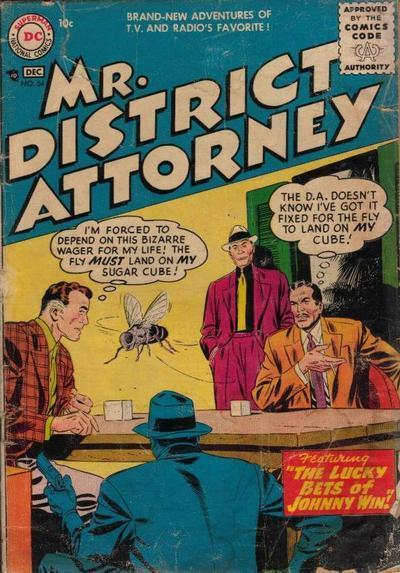
Several weeks ago, we here at Abnormal Use had some fun with Mr. District Attorney #53, in which the title prosecutor performed a direct examination of a canine eyewitness during a criminal trial. Well, today, we turn to the following issue of that epic comic book series, Mr. District Attorney #54. Take a look at the cover pictured above (and click to enlarge) and you’ll see the bizarre contest that the District Attorney is engaged in with some nefarious criminal. At first glance, the fly on the sugar cube gambit seems puzzling, but upon reflection, it may be more effective than mediation in some cases.

We’re not certain whether to chuckle or wince at last week’s post at Change.org calledFriday Unwind: 5 Ridiculous Lawyer Ads.” Maybe we’ll just cry. (Hat tip: Overlawyered).

Finally, someone steps up to respond to allegations that the iPhone is not secure enough to serve as the communications device for lawyers. Ben Stevens, a practitioner in our neighboring city of Spartanburg, South Carolina, and author of The Mac Lawyer blog, offers his treatise on this topic in a post entitled “The Truth about iPhone Security.”

The South Carolina Women Lawyers Association’s Blog: The Briefcase has posted a transcript of South Carolina Supreme Court Justice Kay Hearn’s recent speech to the SCWLA’s Midlands Region chapter. It is entitled “Judicial Independence.”

Above the Law notes in a post this week that the 2010 graduating class of the University of South Carolina School of Law has it right with respect to its chosen class gift.

Eric Goldman over at the Technology and Marketing Law Blog summarizes and comments upon an interesting Fourth Circuit case, Robinson v. Wix Filtration Corp. L.L.C., — F.3d —, No. 09-1167 (4th Cir. March 26, 2010). At issue was the Plaintiff’s failure to respond to a motion for summary judgment; Plaintiff’s counsel indicated that their firm’s computer system suffered a viral infection which, among other things, caused them to temporarily lose their Internet domain name and access to their email addresses (which, in turn, meant that any electronic filing notices from the federal district court would not have been received by them, including notice of the filing of the summary judgment by the Defendant in that wrongful termination case). The Fourth Circuit found that the Plaintiff had no remedy in this situation, although the opinion did draw a strong dissent. The lesson: If you have computer problems, you’d better login to PACER and monitor your federal cases. Any other option is fraught with peril. (See additional news coverage of this opinion here.).

The Third Circuit has ruled that defective sperm is not the proper basis for a products liability suit. We are grossed out by this jurisprudence. (See news coverage here.).

Friday Links

We greatly enjoyed the opportunity to engage in a bit of a hoax with yesterday’s April Fool’s Day post about a fake verdict from a non-existent Texas court arising from the consumption of an unsatisfactory Snickers bar. Surely you were tipped off by the “reasonable degree of confectionary certainty” standard and the “nougat defense.” Thanks to all those who linked the post, and for those of you who wrote in asking for a copy of the opinion, we won’t tell. In sum, we haven’t had this much fun since our chicken sandwich post (which, actually, was about a real court opinion).

Andrew Giuliani, son of former New York City mayor Rudy Giuliani, apparently sued Duke University over his being removed from the school’s golf team. This, he argued was some type of breach of agreement which deprived him both of team membership but also life time use of the school’s golfing facilities. This week, however, a federal district judge dismissed his lawsuit. Really, with this one, you just need to come up with your own golf pun. We’re fresh out. (See additional coverage of this opinion here at the Findlaw Courtside blog, here from the WSJ Law Blog, and here at Overlawyered.).

Over at the South Carolina Women Lawyers Association’s Blog: The Briefcase blog, you can find a post entitled “Eight Simple Ways to Lose Your Law License by Email.” The article, written by Barbara M. Seymour of the South Carolina Office of Disciplinary Counsel, concludes with a series of email usage tips for attorneys.

Richard Goldfarb at the Food Liability Law Blog offers his preliminary thoughts on the food labeling provisions of the new health care bill.

Sara Turner at DRI’s For the Defense blog comments upon speculation that Apple’s new iPad may be “the hot new technology for trial.” The associates writing this blog will need to forward that link to the shareholders in the procurement department. After all, how can one not have the latest in trial technology?

Unsatisfying Snickers Bar Unreasonably Dangerous and Defective, Texas Court Holds

We here at Abnormal Use are puzzled and alarmed at a very recent opinion by the Fifteenth Court of Appeals in Texas, which was released this very morning and quickly forwarded to our inbox by a reader in Anarene, Texas. In that case, the Court of Appeals affirmed a ruling by the trial court, which had permitted an expert to opine that a candy bar consumed by the Plaintiff was not, in fact, satisfactory, and was therefore, unreasonably dangerous and defective. This opinion’s rationale, if adopted elsewhere, has the potential to convert untasty sweets into causes of action to be wielded against unsuspecting candy manufacturers.

The case at issue is Arthur Slugworth v. Mars, Inc., — S.W.3d —, No. 10-48-15162342 (Tex. App. – Corsicana, April 1, 2010, no pet. h.). Slugworth, the Plaintiff, purchased a Snickers bar at a retail store in Texas after a harrowing road trip. He bit into the candy and later testified that he was “rather alarmed that the Snickers bar did not, as promised by advertisements, satisfy me.” As a result of the ingestion of the allegedly unsatisfactory candy bar, Plaintiff suffered extended bouts of melancholy, coupled with an occasional conflagration of ennui. He brought suit in state court under various theories of recovery, including strict products liability, intentional infliction of emotional distress, alienation of affection, and the offensive use of laches. The Plaintiff offered the expert testimony of one Violet Beauregarde, a candy expert, while the defense invoked “the nougat defense,” based on the old English common law rule that products containing a certain combination of sugar, honey, and hazelnuts cannot be subject to strict liability claims.

The jury found the candy bar to be unreasonably dangerous and defective and awarded the Plaintiff $2.13 million dollars in actual damages and twice that amount in punitives. The verdict was largely based on the testimony of Beauregarde, who opined that to a reasonable degree of confectionery certainty, the candy bar at issue was “yucky.” Mars, for its part, appealed the verdict, arguing the trial court erred by qualifying Beauregarde as an expert under E.I. du Pont de Nemours & Co. v. Robinson, 923 S.W.2d 549 (Tex. 1995), in which Texas adopted its own version of Daubert.

The appellate court rejected Mars’ first point of error that Beauregarde was not sufficiently credentialed to testify as an expert. Although Mars sought to exclude her based on her only having attended Greendale Community College and not some august scientific institution, the court noted that experience in the field was as important as a degree. In so doing, the court pointed to Beauregarde’s testimony that she had “consumed, and enjoyed, candy for many years, as far back as her childhood, and had never had an unpleasant experience with sweets.”

The court also dismissed Mars’ second point of error, in which it argued that Beauregarde’s testimony was unreliable. Beauregarde, Mars argued, had not tasted the particular candy bar at issue but had instead sampled an exemplar bar. Further, Mars pointed to the fact that Beauregarde cited to no peer-reviewed articles or epidemiological studies which established that a Snickers bar was incapable of satisfying a consumer. However, despite these arguments, the court found Beauregarde had indeed satisfied the reliability criteria.

The trial court had also thwarted Mars’ attempt at impeachment of Beauregarde over a past indiscretion involving carob, but the appellate court found Mars had waived that issue.

Watchdog groups in Texas are closely watching this case as it makes its way to the Texas Supreme Court, which in the past has offered some conflicting jurisprudence in this area, including Wonka v. Wonka, 472 S.W.3d 1012 (Tex. 2008) and In re: Bertie Bott’s Every Flavour Beans, 388 S.W.3d 999 (Tex. 2006). What happens next, no one can predict.

Joseph Throckmorton, outside counsel for the candy manufacturer, sighed when reached on his cell phone early this morning for a comment. He indicated that he has no further plans to engage in confectionary cases and now plans to dedicate his practice to the Soylent Green litigation, in which it is alleged that the foodstuff at issue contains certain undisclosed ingredients.

Friday Links

  • Last week, we commented upon our fair city of Greenville’s attempt to woo Google to bring its fiber optic initiative to town. The search engine giant plans to choose a medium sized city in which it will offer Internet service up to 100 times faster than that currently available from traditional Internet service providers. Thus, cities across the nation are actively attempting to convince Google to select their locale to be the site of the Google’s new initiative. Above, you’ll see Greenville’s entry into the fray: an aerial photograph depicting thousands of glow stick wielding Greenvillians spelling out Google’s name in lights. For more photographs (aerial and otherwise), please see Greenville’s We Are Feeling Lucky website. We here at Abnormal Use greatly applaud this effort. If you’re on Twitter (like we are), you can follow news of Greenville’s quest with the hashtags #GoogleOnMain and #LuckyGVL. We offer our congratulations to the event’s organizers, who apparently organized the enterprise in less than two weeks time. Below, you can see a bird’s eye video of the scene:

  • Foreign manufacturers should take note of some new law in New Jersey. In a recent piece entitled “Buy Globally, Sue Locally for Products Liability,” J. Russell Jackson of The National Law Journal notes that a recent New Jersey case significantly expands the concept of personal jurisdiction in products cases. That case is February’s Nicastro v. McIntyre Machinery America, Ltd., 987 A.2d 575 (N.J. 2010), and it may ensnare a number of foreign manufacturers, even those who do not purposefully avail themselves of the benefits of the forum. Jackson, of course, is also the author of the Consumer Class Actions and Mass Torts blog, long a staple of this site’s blogroll.
  • On Wednesday, former circuit court judge John C. Few of Greenville was sworn in as the new chief judge of the South Carolina Court of Appeals. See here for the Greenville News report of the investiture.
  • Here’s another interesting post. In a piece entitled “Toyota’s Embedded Software Image Problem,” Michael Barr of Embedded Gurus opines: “It remains unclear whether Toyota’s higher-than-industry-average number of complaints regarding sudden unintended acceleration (SUA) is caused (in whole or in part) by an embedded software problem. But whether it is or it isn’t actually firmware, the company has clearly denied it and yet still developed an embedded software ‘image problem.’ They’ve brought some of this on themselves.” Check out the full story for the rest of his thoughts on that topic.

Friday Links

  • That’s right; it’s all about the cosmic rays. Debra Cassens Weiss of the ABA Journal reported this week upon speculation that cosmic rays may be the cause of the sudden acceleration issues in Toyota vehicles. Of course, cosmic rays have prompted all sorts of problems in the past. In 1961, they caused four would-be astronauts to evolve and become the superhero group, the Fantastic Four (as indicated above). We’re wondering, would Reed Richards testify for the Plaintiffs or the defense in the Toyota cases on this issue?
  • Tim Smith of the Greenville News reports on a recent presentation by South Carolina Supreme Court Chief Justice Jean Toal in which she indicated the following troubling news: “Your court system is $11.5 million down at this time and about to run out of money. We can’t continue to operate like this.” Toal plans to work with South Carolina legislators to resolve the issue by increasing filing fees for complaints and motions.
  • Defending an auto wreck case? Check out the For The Defense blog’s post “Investigating an Auto Accident Case.” Written by Francisco Ramos Jr., the piece offers some tips for the investigation of such claims in light of recent advances in technology.

  • If you happen to find yourself here in downtown Greenville, South Carolina tomorrow, be sure to stop by the Google on Main event. Greenville is one of many mid-sized cities attempting to woo Google to its location as a part of the search engine giant’s fiber optic broadband experiment. Apparently, Google plans to pick one city, establish itself as an Internet service provider, and then offer service at speeds 100 times faster than that to which users are now accustomed. But which city will Google choose? We here at Abnormal Use officially endorse Greenville, whose citizens clearly support the technological endeavor. In the video above, you’ll see one local man was so supportive of the City of Greenville’s bid for the project that he had the Google logo shaved into his head.
  • As a reminder, you can receive Abnormal Use posts directly in your email box by entering your email address in the “Subscribe Via E-Mail” box in our blog’s right sidebar.

Ninth Circuit Reverses Exclusion of Plaintiff’s Expert in Medical Device Case

You know you’re in trouble as defense counsel when the appellate court’s opinion starts with the sentence: “[The Plaintiff] has suffered a miserable ordeal since she had elbow surgery. ” That can only suggest that reading the court’s ruling will be a miserable ordeal for the defendant. So begins the opinion in last week’s Primiano v. Cook, — F.3d —-, 2010 WL 788906 (9th Cir. March 10, 2010) [PDF]. Analyzing the admissibility of expert medical testimony at the summary judgment stage, the Ninth Circuit reversed the ruling of the trial court, which had excluded the Plaintiff’s medical expert and granted the defendants’ motion for summary judgment.

The Plaintiff, a 36 year old woman, suffered a fall in her kitchen, broke her right elbow, and ultimately required elbow replacement surgery. Her surgeon used an artificial elbow manufactured by the Howmedica Osteonics Corporation. Apparently, during the surgery, the surgeon realized that one of the component parts of the artificial elbow was intended to be used for a left elbow, not a right elbow. He then contacted a representative of Howmedica, who indicated that the component part was symmetrical, equally functional, and thus, able to be used for the surgery on the Plaintiff’s right elbow with only minor modifications. Following the surgery, all seemed to be well initially, but the Plaintiff ultimately experienced difficulties with the elbow replacement and required four additional surgeries, including the removal and replacement of the original artificial joint. Subsequent analysis revealed that the original artificial elbow had excessive wear. She then sued Howmedica, as the manufacturer of the device, its parent company, a Howmedica sales representative, and her surgeon under various theories of recovery, including products liability (the only cause of action at issue on the appeal). The suit was heard by the Honorable James C. Mahan of the U.S. District Court for the District of Nevada.

Noting that the prosthesis had been “malaligned,” the defense experts also argued that the life of the device would be limited due to the Plaintiff’s relative youth, level of activity, and her pre-existing rheumatoid arthritis. (Young people wear out artificial joints more quickly than older people, they said.). The district court excluded the testimony of the Plaintiff’s expert, Dr. Arnold-Peter Weiss, who had opined that “the polyethylene bushing had worn through in less than eight months, ‘not a usual or expected circumstance.'” The district court appeared concerned by the fact that Dr. Weiss had neither seen nor spoken with the Plaintiff as well as the fact that he could testify that the device failed but not why it did so. With no expert testimony supporting the Plaintiff’s case, the court granted the defendants’ motion for summary judgment. On appeal, the Ninth Circuit addressed the application of Federal Rule of Evidence 702 and Daubert to the testimony of expert physician witnesses. Analyzing the background, qualifications, and testimony of Dr. Weiss, the Ninth Circuit noted that they “[left] room for only one conclusion regarding its admissibility. It had to be admitted.” In so doing, the court noted:

Nevada law establishes that “those products are defective which are dangerous because they fail to perform in the manner reasonably to be expected in light of their nature and intended function.” In Nevada, a plaintiff need not “produce direct evidence of a specific product defect [or] negate any alternative causes of the accident.” An “unexpected, dangerous malfunction” suffices. Since Dr. Weiss, with a sufficient basis in education and experience, testified that the artificial joint “fail[ed] to perform in the manner reasonably to be expected in light of [its] nature and intended function,” that was enough to assist the trier of fact. He did not have to know why it failed.

The district court’s other concerns, that Dr. Weiss never saw or talked to Ms. Primiano, and there was no publication supporting his opinion that the device failed extraordinarily early, might be useful to the jury as impeachment, but neither furnished an adequate basis for excluding his opinion. What he most needed to see was what was inside her arm, not outside it, and he did. He saw the x-rays. He also saw the polyethylene from the implant installed in Primiano’s first surgery. As for lack of a publication backing his opinion up, Daubert offers several reasons why an opinion unsupported by peer-reviewed publication may be admissible, and Dr. Weiss furnished another one: that the phenomenon is so extraordinary that the specialists who publish articles do not see it in their practices.

(Emphasis added).

The Ninth Circuit then reversed the trial court’s granting of the defendants’ motion for summary judgment. An interesting result, as the opinion suggests that an expert who has never examined – or presumably even met – an injured Plaintiff can create a fact issue on summary judgment in a products liability action by claiming that a medical device failed too early without articulating why it did so. The district court had noted that evidence of rapid wear did not necessarily make the device defective. The defense experts did offer an explanation for the wear of the device, namely that devices tend to wear far more quickly when placed in the joints of younger – and presumably, more active – patients. Further, the defense pointed to the fact that this Plaintiff suffered from rheumatoid arthritis which further contributed to the wear. Thus, while the defense posited a specific reason for the rapid wear of the device, the Plaintiff’s expert simply offered the conclusion that the device should have lasted longer than it did. That is now enough to defeat summary judgment. (Interestingly, the Plaintiff did not sue the surgeon for malpractice but only as an agent of the manufacturer of the artificial elbow).

Breaking News: South Carolina Supreme Court Reverses $18 Million Dollar Verdict Against Ford

This morning, the South Carolina Supreme Court reversed an $18 million verdict against the Ford Motor Company arising from an automobile accident which killed one passenger and paralyzed the driver. At issue in this products liability case was the cruise control system of a Ford Explorer. The case is Watson v. Ford Motor Co., No. 26786 (S.C. March 15, 2010). In sum, the Supreme Court reversed and accepted Ford’s arguments that the trial court erred in qualifying two of the Plaintiff’s experts (one a cruise control expert, the other an alternative design expert) and by admitting evidence of prior sudden acceleration accidents. We’ll have more on this opinion in the coming days, but for now, you can see the opinion here and some early media coverage here. Authored by Chief Justice Jean Toal, the majority opinion drew one concurring opinion from Justice Costa M. Pleicones (who concurred in the result only).

Friday Links

Certainly, in our time, we have seen some trial witnesses fare worse than Shep the Wonder Dog, the canine eyewitness depicted above on the cover of the comic book, Mr. District Attorney #53, published way back in 1956. (Click to enlarge the cover and see it in all its glory!). Shep’s tale must be damaging to the defendant, as the bailiff seems posed to pounce upon the accused, who appears to be rising in response to Shep’s expected testimony. You’d think they would at least wait to see how Shep fared on cross before beginning to worry. Is there an optional completeness objection based upon the fact that Shep’s board does not include all 26 letters, thereby limiting his testimony? Rumor has it that Shep was prepared to give an impermissible lay opinion: Evolution provided the defendant with opposable thumbs but not sufficient wits to outsmart a dog. (For a full summary of this issue, see here.).

The Virginian Pilot in Norfolk, Virginia offers this interesting account of how that state’s courts have dealt with one vexatious litigant (who happens to share the name of the main character on a popular NBC sitcom). Says one jurist: “Within the memory of the incumbent judges of this court, the court has so designated only four people over the past fifteen years [as vexatious litigants]. The petitioner is the most persistent and vexatious of the four.”

Just think. This is what they were saying about law school 72 years ago: “American legal education is blind, inept, factory-ridden, wasteful, defective, and empty . . . [I]t blinds, it stumbles, it conveyor belts, it wastes, it mutilates, and it empties.” Karl Llewellyn, On What Is Wrong With So-Called Legal Education, 35 Colum. L. Rev. 651, 653 (1938). Wow.

The South Carolina Bar has joined Facebook.

Only in a nineteenth century marital property case involving the enhancement value of mules would you find a gem like this: “[T]he erratic mule standeth apart, like patience on a monument, smiling at grief.” Stringfellow v. Sorrells, 18 S.W. 689, 689 (Tex. 1891) (quotations omitted). Back then, we suppose everyone knew without being told that the author of the opinion was referencing Shakespeare’s Twelfth Night.

Speaking of Texas, its state bar is sponsoring a contest of interest. Several writers here at Abnormal Use plan to someday write the great American novel, but we fear that such an enterprise might detract from our billable hours. Perhaps the State Bar of Texas has a solution, though, as it has announced what is surely the first 140 Character Novel Writing contest. Inspired by the popularity of Twitter, the competition is open to all lawyers licensed in any state in the United States. (That’s a lot of lawyers.). Check it out:

Ernest Hemingway reportedly considered his best work to be his most succinct — a six-word novel he came up with to settle a bar bet: “For sale: baby shoes, never worn.”

Our contest challenges lawyers to write a short form novel, Twitter-style, in 140 characters or less. All U.S.-licensed attorneys are encouraged to enter.

One grand prize winner will receive an Apple iPad. The grand prize winner and runners-up will receive special recognition at the State Bar of Texas Annual Meeting on June 10, 2010, at a breakfast presentation featuring LexBlog, Inc. CEO and Twitter expert Kevin O’Keefe (@kevinokeefe).

For details, see here. The contest is open until May 1.