







Seventh Circuit Rejects Claim Based On Overheating Laptop Power Adapter

Okay, surely we all know not to fall asleep next to computer equipment that is plugged in and powering up, right?  No? Well, let’s talk about Ferraro v. Hewlett-Packard Co., 721 F.3d 842 (7th Cir. 2013). In that case, the Plaintiff fell asleep next to her laptop, and as she slept, she allegedly suffered injuries because the laptop’s power adapter allegedly overheated (as she slept). Of course, she sued.

In the interests of fairness, here are the specific facts as recited by the Seventh Circuit itself:

[W]hile sitting on her sofa and using her laptop, she noticed that the battery was running low. Ferraro shut down the laptop, placed it on a nearby coffee table, and plugged the laptop’s power cord into the wall. Midway along the cord is the power adapter, a brick-shaped plastic device housing a transformer, which converts AC electricity from the outlet into DC electricity used by the laptop. Ferraro propped the power adapter on the arm of her sofa, began reading a book, and fell asleep around 10:00 p.m.

At some point during the night, the power adapter slipped from the sofa’s arm, falling between the cushions. As Ferraro slept, the exposed skin of her right forearm came to rest against one of the adapter’s surfaces. It is unclear how long Ferraro’s skin was in direct contact with the adapter, but she eventually awoke with painful blisters at the point of contact.

“Slipped from the sofa’s arm,” eh? As you might expect, her claims were of the typical design defect, failure to warn, and breach of implied warranty of merchantability variety. As the court described it, the Plaintiff “alleged that the laptop was defectively designed because it ‘overheat[ed] during normal and foreseeable use’ and that it lacked ‘adequate or sufficient warnings.'” The district court granted summary judgment for the manufacturer, but the Seventh Circuit affirmed only begrudgingly (and not without great sympathy for the Plaintiff). On the design defect claim, the Seventh Circuit noted:

[L]aptops are designed precisely to be used in comfortable places, including sofas, beds, La–Z–Boys, or other places where people may nod off. By taking such a restricted view of the precise manner in which Ferraro’s harm materialized, the court sidestepped the undisputed fact that, at the time of her injury, Ferraro was using the power adapter to do just what it was designed to do: charge her laptop. Ferraro is not arguing that the power adapter overheated when she tried to use it to heat her blanket, or that it made for a poor drink coaster or paperweight; rather, she asserts that it was unreasonably dangerous when used for its intended purpose.

Well, we’re not sure that laptop chargers are designed to be placed precariously on the arm of a sofa upon which its user may ultimately fall asleep while undertaking another tasks altogether on said sofa (i.e., reading a book). The charger, of course, charges, but the user of the charger must surely consider where the charger is placed prior to using it, no? The Seventh Circuit had an answer for that, as well:

HP may be correct that Ferraro was not using the product in the precise manner intended by the manufacturer, insofar as the power adapter was designed to rest on a flat surface with ample ventilation, but this is beside the point. The appropriate inquiry for the consumer-expectations test is whether the product performed as safely as an ordinary consumer would expect when used in =an intended or reasonably foreseeable manner. The great virtue of a laptop is that it can be used on one’s lap, while sitting on a sofa, or perhaps while in bed. Indeed, we note that the Facebook page for “Using the laptop in bed” (Mission: “Public awareness of the usage of laptops in bed”) has nearly one million “Likes.” Our analysis would be no different if the power adapter had started a fire in the sofa while Ferraro was in the next room; in either case, the consumer’s use of the product would be the same. A jury could conclude that Ferraro was using the power adapter in a “reasonably foreseeable” manner when the relevant harm occurred.

(Quotations and citations omitted).

A Facebook group cited as persuasive authority? Really? How did that end up in the opinion? Take a look at that Facebook page and you’ll see the danger of citing to unofficial Facebook groups as authority. (Now, perhaps we would feel differently if the Facebook group were entitled “Precariously placing a laptop charger on the arm of a sofa while sleeping,” but we’ll cross that bridge when we come to it.).

Okay, so here’s the question: With such sympathy for the Plaintiff coming from the court, how did the defendant prevail? I mean, how does the defendant come back from that type of commentary?

A fatal appellate error, that’s how. Behold the following remarks made by the Seventh Circuit at the very beginning of its opinion in this matter:

The court concluded that Ferraro would be unable to show that the power adapter was “unreasonably dangerous,” a required element of her design defect claim. Under Illinois law, there are two alternative methods of establishing that element: the “consumer-expectations test” or the “risk-utility test.” The district court found Ferraro’s evidence insufficient to meet her burden under either one of them. On appeal, Ferraro argues that the district court erred only in concluding that she would be unable to prove unreasonable dangerousness under the consumer-expectations test. She has not challenged the district court’s determination that HP was entitled to summary judgment under the risk-utility test, nor has she appealed the district court’s dismissal of her defective warning and implied warranty claims. This puts her in an impossible bind. Under Illinois law, the risk-utility test “trumps” in design defect cases if the two methods of establishing unreasonable dangerousness yield conflicting results. Because the district court’s finding that she could not succeed under the risk-utility test furnished an independent and unchallenged ground for the decision, we affirm.

Oh, well.

Florida Court Rebuffs Request For Social Media Discovery

We knew it was coming, and we’ve seen evidence of it already. Courts are beginning to limit the nature of social media discovery, chiefly in light of the fact that we live so much of our lives online that not every post or status update can be discoverable in a lawsuit. Yesterday, in Root v. Balfour Beatty Const. LLC— So.3d —-, (Fla. Ct. App. Feb. 05, 2014), the Florida Court of Appeals overturned a magistrate’s order in a negligence case that had required the Plaintiff to produce a host of materials from her Facebook account. The Plaintiff was suing on behalf of her young son who was injured in an automobile accident near a construction site (the safety of which was at issue in the proceeding). It does not appear that the Plaintiff was present at the scene of the accident, and at that time, Plaintiff’s son was being supervised by his 17 year old aunt (which led to a negligent entrustment affirmative defense).

Here’s what the defendant’s asked for:

(o.) Any and all postings, statuses, photos, “likes” or videos related to [Plaintiff’s]’s
i. Relationships with [the injured child] or her other children, both prior to, and following, the accident;
ii. Relationships with other family members, boyfriends, husbands, and/or significant others, both prior to, and following the accident;
iii. Mental health, stress complaints, alcohol use or other substance use, both prior to and after, the accident;

….

v. Facebook account postings relating to any lawsuit filed after the accident by [Plaintiff] or others[.]

Not surprisingly, the Plaintiff object to the discovery requests on the grounds that they were overbroad. The Court of Appeals bought this argument, noting:

[Plaintiff’s] complaint contains claims on behalf of [the injured child] for negligence as to each defendant and Root’s derivative claims for loss of parental consortium. Defendants responded with several affirmative defenses including negligent entrustment of [the injured child] by [Plaintiff], the aunt’s failure to supervise, and the driver’s negligence. As to [the injured child’s] claims for negligence, none of the objected-to discovery pertains to the accident itself. Similarly, none of the objected-to discovery pertains to Defendants’ affirmative defenses. Instead, the discovery relates to [Plaintiff’s] past and present personal relationships with all her children, other family members, and significant others; [Plaintiff’s] past and present mental health, stress complaints, and use of alcohol or other substances; and lawsuits of any nature filed by [Plaintiff] or others after the accident.

At the hearing before the magistrate, the party seeking discovery didn’t help itself by noting that “These are all things that we would like to look under the hood, so to speak, and figure out whether that’s even a theory worth exploring.” Well, we as defense lawyers probably need to articulate the basis for our social media discovery requests a bit more artfully (although the magistrate judge, who apparently remarked at the hearing that “95 percent, or 99 percent of this may not be relevant,” did require production of the materials requested). The lesson: tailor social media discovery requests to require production of materials related as closely as can be to the claims and defenses in the case.

9/11 Scandal Surfaces, Mocks Legitimate Claims

In the age of social media, personal injury plaintiffs must be careful what they publish on the Internet. Settlement demands will take a hit once photos of a backyard tackle football game surface on an allegedly disabled plaintiff’s Facebook or Instagram account. We live in an age of transparency and the truth has a tendency to show its head. As such, we here at Abnormal Use weren’t surprised when we heard about the alleged 9/11 injury scam.

According to the New York Post, 80 NYPD and FDNY retirees have been arrested for an alleged Social Security scam whereby they lied about being at Ground Zero and suffering emotional trauma. The report notes:

Many of them claimed they couldn’t sleep, do simple arithmetic or even leave their own home — but investigators found that they’d been piloting helicopters, riding Jet Skis, teaching karate, deep-sea fishing and even running half-marathons.

Many of the individuals claimed to be so emotionally traumatized that they couldn’t use a computer, drive a car, or fly in a plane. Facebook, Twitter, and YouTube – along with car rental and airline receipts – said otherwise.

Obviously, at this stage the contents of the Post report are mere allegations. If true, however, the actions are disturbing, but not surprising. We were not at Ground Zero on that fateful day, but we can only imagine the emotional turmoil faced by those who were. We have no doubt that many of those brave individuals who responded to the scene face legitimate emotional trauma. If the allegations of this report are accurate, then these 80 persons should feel ashamed.

The fact that these individuals may have blatantly published the fabrication on social media significantly worsens the situation. We would like to think that if we lied about a significant injury for financial gain, we would be too scared to show our faces in public for fear of blowing our cover. But, we suppose once you initially get away with a scam of this magnitude, a feeling of invincibility must seek in. As is the case with personal injury actions, when someone is legitimately harmed due to the acts of others, then they deserve to be made whole. Unfortunately, a small percentage of people attempt to abuse the system, casting a shadow on legitimate claims.

Our Favorite Posts of 2013

Now is the time that we, as consumers of media, are inundated with year end best-of lists. So, just as we have done in years past, we here at Abnormal Use have collected our favorite posts of this past year – our fourth full year of existence (if you can believe it). If you’ve followed us from the very beginning, you know that we’ve posted at least every business day these past four calendar years. That’s a lot! Looking back over our posts this year, it was difficult to choose our favorites. But, dear readers, the ones we enjoyed the most are linked for you below, along with their author and publication date. Fill yourself with nostalgia, just as we have, and revisit these entries from 2013.

On The Perils of Replying To Blog Comments (Nick Farr, February 13, 2013)

Our Office Appeared in the 2001 film SHALLOW HAL (Jim Dedman, February 28, 2013)

Laches – The Saddest of All Affirmative Defenses (Jim Dedman, March 12, 2013)

The McDonald’s Hot Coffee Case: Distinguishing Between Facts and Theory (Nick Farr, March 19, 2013)

North Carolina Court Declares Harlem Shake “Over,” Enjoins YouTube From Accepting Further Videos Depicting Same (Jim Dedman, April 1, 2013)

The Perils of Expert Depositions and The Duration Thereof (Jim Dedman, May 2, 2013)

Killing Trees At Depositions – A Modest Proposal? (Jim Dedman, May 8, 2013)

Outrageous, Egregious, Preposterous: The Hoosier State Chilled Beer Law (Rob Green, May 21, 2013)

Mediation: Uncool Wiles and Stratagems (Jim Dedman, May 23, 2013)

SC Man Burns Down House Due to Witch Infestation, Found Not Guilty of Arson (Nick Farr, June 3, 2013)

No Matter What You Think of Scalia’s Opinions, This Guy Thinks They’re Musical (Frances Zacher, July 11, 2013)

Facebook Friendships In Litigation – Exploring Them In Detail (Jim Dedman, August 7, 2013)

NFL Litigation May Forever Change Football (Nick Farr, August 19, 2013)

Federal Court Denies State’s Motion To Seal Following Habeas Counsel’s “Ill-Advised” Facebook Post Citing Kris Kristofferson (Jim Dedman, September 5, 2013)

The Blue Book and Commercial Recording Citations (Jim Dedman, September 18, 2013)

FDA Considering Rule Change Affecting Suits Against Generic Drug Makers (Frances Zacher, November 13, 2013)

Titles of Nobility Act: A New Challenge To The Legal Profession? (Nick Farr, December 2, 2013)

Golfer Takes a Mulligan. Mayhem and Litigation Ensue. (Kyle White, December 16, 2013)

Friday Links

You know, we usually feature law inspired comic book covers in our weekly edition of Friday Links, but today, we thought we’d showcase a legal themed beer label. What better name for a beer than voter fraud? Apparently, Asheville, North Carolina’s own Burial Beer Company teamed up with Oskar Blues Brewery – the Colorado brewery with a heavy presence in Western North Carolina – to create this new concoction. Unfortunately, we’ve yet to try it! For more on the Voter Fraud beer, see here and here.

Headline of the Week: “The Hells Angels Are Surprisingly Litigious.” Now those will be some eventful depositions, we suspect.

You can check out the December 2013 issue of the South Carolina Bar News here! On pages 18 and 19, you can see our own Stuart Mauney’s article on “Revisiting The Lawyers’ Epidemic: Why Lawyers Are Vulnerable To Depression, Suicide, And Substance Abuse.” (That article originally appeared right here at Abnormal Use back in October of this year.)

Samantha Gilman of The Charlotte Observer reports: “Workplace injuries and illnesses drop in North Carolina.”

Get this: A blog called iClass cited our prior post on a federal court using the word “selfie” in a judicial opinion. How about that?

Friday Links

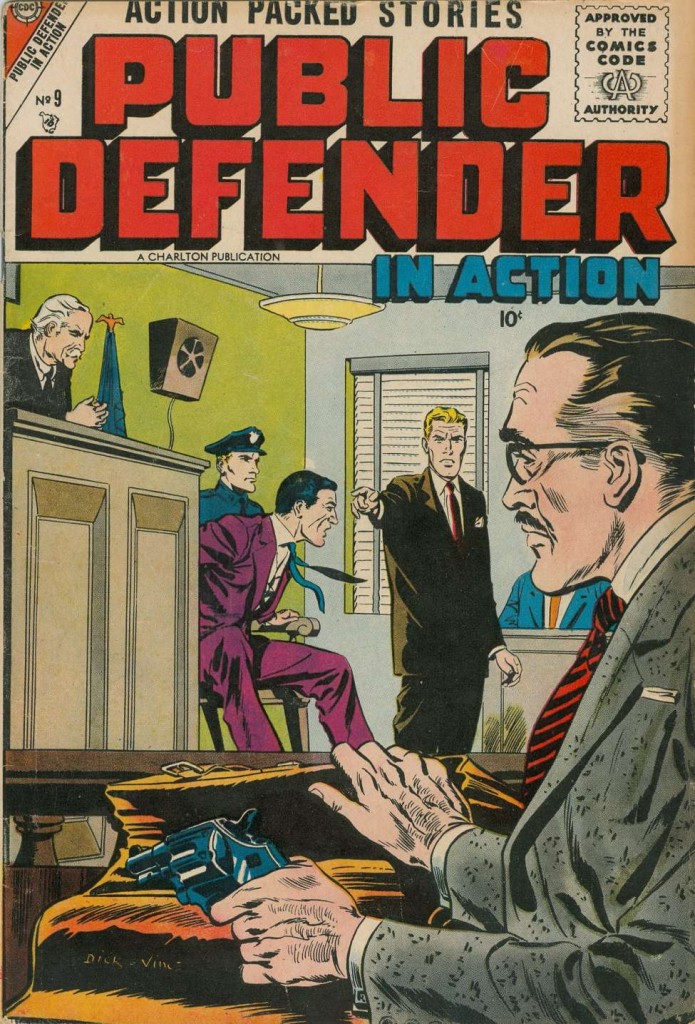
Two weeks ago, we brought to your attention Public Defender In Action, a legal themed comic book series from the 1950’s with which we were previously unfamiliar.  Above, you’ll find the troubling and uncomfortable cover of issue #9, published way, way back in 1957. Let’s consider this cover. We see the judge, the bailiff, a witness, and the public defender presumably cross examining said witness. (We doubt the public defender would be gesticulating so – or the witness reacting in such a way – during a direct examination.). So who is it in the foreground producing a gun from his attache case? Is it the public defender’s client – the defendant? We doubt it, as we can’t imagine why the defendant would want to interrupt his own lawyer’s examination with a fusillade. Is it the prosecutor? Surely not.  To be sure, it’s an odd and disturbing image. We’ll see if we can track down this issue and determine what is actually occurring.

Here’s our favorite excerpt from a federal court opinion this week:  “The Beastie Boys are a famous hip-hop group ‘from the family tree of old school hip-hop.'”  See Beastie Boys v. Monster Energy Co., — F. Supp. 2d —-, No. 12 Civ. 6065(S.D.N.Y. Nov. 4, 2013) (citing Beastie Boys, InterGalactic (Capitol Records 1998)).

Jeff Richardson at the iPhone J.D. blog reviews the new iPad Air.

“With all the focus on using Facebook, Twitter, and the newest communication technologies, the basics of practicing law are often pushed to the wayside,” writes Bill Miller of Greer & Miller, L.L.P in “Witness Preparation Program,” which appears in this month’s Texas Bar Journal. To see the full article, please see here.

The ABA Journal brings us “The Top Trials That Changed The World.”

Finally, we here at Abnormal Use and Gallivan, White & Boyd, P.A. are very pleased to announce that eight of our firm’s attorneys have been recognized as being among the 2013 Legal Elite of the Midlands by Columbia Business Monthly. Those who were honored include:

  • James Brogdon – Personal Injury
  • Johnston Cox – Insurance
  • Will Harbison – Workers Compensation
  • John Hudson – Healthcare
  • John T. Lay – Civil Litigation
  • Shelley Montague – Construction
  • Grayson Smith – Insurance
  • Childs Thrasher – Environmental

Our Columbia office opened in June 2011 with six attorneys.  In just two years, we reached sixteen lawyers. How about that?

Friday Links

We don’t know too much about the Criminals on the Run comic book series, but when we saw the cover of the seventh issue (published way, way back in 1949, we knew we had to run it here. As you can see, it features the most awesome crime fighting technique we’ve ever seen. There is really nothing more to say on this matter, no?

Here’s a fun case excerpt that we found from the early days of Internet cases: “In the colorful argot of computers, a ‘worm’ is a program that travels from one computer to another but does not attach itself to the operating system of the computer it ‘infects.’ It differs from a ‘virus,’ which is also a migrating program, but one that attaches itself to the operating system of any computer it enters and can infect any other computer that uses files from the infected computer.” United States v. Morris, 928 F.2d 504 (2d Cir. 1991).

Don’t forget! You can follow Abnormal Use on Twitter here and on Facebook here! Drop us a line!

Friday Links

Above, you’ll find the cover of The Best of DC #16, published way, way back in 1981.  “Happy Anniversary” the cake on the cover proclaims, and we share it because of yesterday’s milestone.  In case you missed it, yesterday, we published our 1,000th post (which means this here edition of Friday Links is our 1,001st post.).  We still can’t believe it.  So we will celebrate. Try and stop us. If you’ve been with us for some or all of the duration, remember that you can follow us on Twitter here and on Facebook here.

Okay. Someone is litigating The Chipmunks movies. For real. See here. We would like to see the Word Index on one of the depositions to see how many times the word “Squeakquel” is used.

Whoa! “More than 60 percent of people pretend to have read books they haven’t, according to a recent survey.” We swear we read Finnegan’s Wake. Three times!

This is our new favorite photograph from 1978.  It’s of Muhammad Ali reading the Superman vs. Muhammad Ali comic book. Enjoy.

Check this out: “Top 10 Reasons Not to Bother With a Law Firm App,” written by the North Carolina Bar Association’s own Erik Mazzone.

This may be the most important public service announcement we’ve ever made: “Breaking Bad” will run long this weekend, so you may want to adjust your DVR settings.  For more, see here.

The Blue Book and Commercial Recording Citations

Not too long ago, we directed your attention to a federal case in which a Kris Kristofferson song was at issue. We lamented the fact that the court in question did not see fit to cite the song at issue as per the dictates of Blue Book rule 18.6.1, entitled “Commercial Recordings.” Here’s that rule:

Cite Commercial Recordings by artist and title, providing the name of the recording company and the date of release (if available):

* Cowboy Mouth, Are You With Me? (MCA Records 1996).

* The Beatles, Sgt. Pepper’s Lonely Hearts Club Band (Capitol Records 1990) (1967).

If a particular song or musical work is referred to, cited by analogy to shorter words in a collection according to rule 15.5.1:

* Don Henley, The Boys of Summer, On Building the Perfect Beast (Geffen Records 1984).

Well, that is from the 18th edition of the Blue Book, which is the one we had handy. The fact that the most recent cited example of an audio recording is from 1996 struck us funny, although we are certainly fans of Cowboy Mouth, a New Orleans rock band made famous for its rock anthem “Jenny Says.” But Sgt. Pepper’s Lonely Hearts Club Band? Building the Perfect Beast? We’re huge Beatles fans, but come on, surely the authors of the Blue Book – comprised of the editors of the Columbia Law Review, the Harvard Law Review, the University of Pennsylvania Law Review, and the Yale Law Review, can cite some more recent records and songs than those? First, the quibble with the Beatles citation. Why cite to a later pressing from 1990 when one can and should simply cite to the original 1967 recording? Further, wouldn’t it have been better to cite Rubber Soul or Revolver?

Next, Don Henley? Sure, we love “The Boys of Summer,” with its classic reference to aging hippies with their “Deadhead stickers on Cadillacs,” but how many law students using the Blue Book will recognize Henley and this classic from 1984? At this point, most law students were born after 1984, anyway. Surely we could throw some Radiohead in there?

So, come on, editors, let’s throw in some updated references! (Full disclosure: We’re still using the 18th edition, so let us know if they’ve already updated these issues in the 19th.).

There Is Now Federal “Selfie” Authority

Who says the federal courts lag behind technical advances?

Well, thanks to last week’s United States v. Doe, No. 1:12–cr–00128–MR–DLH (W.D. N.C. Aug. 14 2013), we now have a federal definition of “selfie.” Well, kind of.

The opinion arises from a motion to suppress, and since we don’t opine on criminal law, we won’t recite the facts and specific issues.  But check out this footnote:

The term “selfie” is the name given to a self-portrait photograph, “often snapped at odd angles with smartphones[,]” and “typically made to post on a social networking website (or sen[t] in a text message)[.]”

See id. at *8 n.6 (citing Katy Steinmetz, “The Top 10 Buzzwords of 2012,” Time, Dec. 4, 2012, http://newsfeed.time.com/2012/12/04/top–10–news–lists/slide/selfie).

According to our very, very brief Westlaw search, this is the only state or federal court to use the word “selfie.”

Curiously, the link cited in the footnote is no longer active; the correct portion of the cited article can be found here.

The court also noted:

With the popularity of social media sites like Twitter, Facebook, and Instagram, together with cell phones’ capability to send text messages and pictures, common sense would lead a practical person to conclude that human behavior includes the making of flattering or unflattering “selfies.” That the Defendant’s phone probably would contain evidence of the three crimes listed in the warrant application was within the issuing magistrate’s realm of lawful consideration. The issuing magistrate, therefore, had a substantial basis for concluding that probable cause existed.

Id. at *8.

It’s good to see courts catching up to the technological trends, and we hope any selfie-related litigation cites to this opinion.