








Abnormal Interviews: Larry D. Thompson, Author of "The Trial"
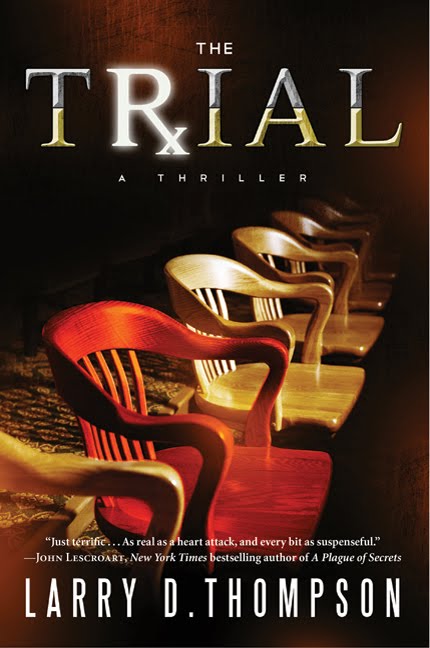
Tomorrow marks the release of Texas attorney Larry D. Thompson’s new novel, The Trial, a legal thriller which chronicles the plight of a small town attorney litigating against a fictional international pharmaceutical company. The book’s protagonist, Lucas Vaughn, is a former Houston-based trial lawyer who migrates to a small Texas town to escape the stress associated with his trial work. His plan appears to be working as his health improves and he is finally able to mend his troubled relationship with his teenage daughter, Samantha. Unfortunately, his new found peace is short-lived. After participating in a clinical trial for a drug manufactured by the fictional drug company Ceventa, Samantha contracts severe drug-induced hepatitis. With her life dwindling away, Vaughn takes the fight to the courtroom. During the litigation, he quickly learns that there are no limits to what Ceventa will do to protect its “revolutionary” new drug. You can see the novel’s “book trailer” (complete with dramatic music) here.

We here at Abnormal Use were fortunate enough to have the opportunity to interview Mr. Thompson about his new book and his inspiration for the tale.

Excerpts of that interview follow below:

[ON PORTRAYING HIMSELF IN THE NOVEL]

FARR: The Trial’s protagonist, Lucas Vaughn is a seasoned UT [University of Texas] law grad, Houston-based trial lawyer. Did you see a little bit of yourself in Lucas?

THOMPSON: Not really. There’s more of me in my first novel, So Help Me God. The protagonist in [So Help Me God] is Todd Duncan. He’s primarily a defense lawyer, so there’s more of me in him. [With Lucas Vaughn] I just wanted a character who had been around the courthouse some. I wanted to put him in a small town, so there’s really none of me. And of course, he was a plaintiff’s lawyer and I had been primarily defense. Although, like any defense lawyer, if a good plaintiff’s case comes along and it’s not against the client, then I’m happy to take the case.

[DEPICTING A LAWYER’S QUALITY OF LIFE]

FARR: Quality of life and the challenge of balancing a successful career with a good home life are serious issues in the legal community. What does the novel say about these issues – particularly in the context of Lucas and his relationship with his daughter, Samantha?

THOMPSON: Well, I think Lucas Vaughn thought he was being a good father. He was faced with having to raise a daughter by himself and I think he thought that “I provided a roof over her head and three meals a day and see her a few hours now and then,” then that’s what a father is supposed to do. He had the rude awakening when he moved her to San Marcos and discovered that his method of fathering really wasn’t all that good. He moved, and he changed his lifestyle. He didn’t change his method in fathering until Samantha flunked out of [Texas] A&M. It was his romantic interest, Sue Ellen, who finally said you need to change it [his parenting style], and he did. That gave him about a year’s worth of a good father/daughter relationship before she took the drug. My old deceased law partner said once that the “law is a jealous mistress.” And that is, in fact, true. No matter what you’re doing, you cannot let it consume you and you’ve got to find time for family. Actually, you’ve got to make time for family. If you don’t, then you end up with problems with your kids and problems with your spouse.

[DIFFICULTY OF REPRESENTING FAMILY]

FARR: In the novel, Lucas represents his daughter as she’s dying of liver failure against the clinical trial physician and Ceventa, the pharmaceutical company that manufactured the clinical drug. How difficult do you think it would be for a lawyer to actually represent a loved one under these circumstances?

THOMPSON: Hugely difficult. I mean, nearly impossible. I wouldn’t recommend it to anybody that they represent a family member. I have some personal experience in that. My brother was a successful lawyer in the eighties. He died way too young. He wrote crime non-fiction. He got sued for libel for a book called Blood and Money in Texas. The first lawsuit was a nothing lawsuit when he lived in Los Angeles. I said, “I’ll handle that for you, and we’ll dispose of it pretty quickly.” Then came two other more serious lawsuits. Suddenly, I’m representing my own brother with three lawsuits, two of which were with very strong plaintiff attorneys. So I had a few sleepless nights as we went through those. We won all three of them primarily because my brother had gotten all his facts right. But to have to represent your daughter when she’s dying is something really that no lawyer in his right mind ought to do.

[ON REALISTIC DEPICTIONS OF THE LEGAL PROCESS]

THOMPSON: I want to make sure that any lawyer that reads this book will think, “Okay, the guy that wrote it really knows something about trials and evidence and what goes on in a lawsuit. It’s not ‘made up.'” From that standpoint, I generally succeed. My first novel had a trial at the end. This one has a trial at the end. The one I’m starting now will end up with a trial. I want lawyers to read it and think, “Okay, this guy really does know something about trying lawsuits.”

[ON MAKING LITIGATION INTERESTING]

FARR: The Trial is about far more than just those proceedings in front of the jury, the trial itself. In the book, you go through the rigors of written discovery, depositions, and pretrial motions. What were the challenges of, not only including a large part of the litigation process in a 300 page novel, but also of making it interesting to the reader?

THOMPSON: That is a challenge. I think the only way it can be done is that you have to – you can’t have talking heads for too long a period of time in any book. The reader is going to get bored when that happens. I think you have to mix in (along with the discovery and the depositions) . . . some scenes that involve a little more conflict, a little more drama, something totally apart from the discovery process itself. I think that’s the only way you can really keep a reader’s attention if you’re talking about discovery and hearings at the courthouse and that kind of thing.

[ISSUES WITH THE LENGTH OF COMPLEX LITIGATION]

FARR: One of the ways you were able to kind of condense the process, I guess, was to have the trial expedited due to the circumstances surrounding Samantha’s health. I believe that Ceventa had 90 days to prepare for trial. In practice, a case of this magnitude can be in litigation for a couple of years before it ever goes to trial, if at all. Do you think that courts should do more to expedite the process – especially in situations like Samantha’s?

THOMPSON: Absolutely. I think that – having been a trial lawyer for a long time, I think we [trial lawyers] waste far too much time in discovery. I really think that we could cut out about three quarters of it and it would not affect the outcome. I’ve actually got a plaintiff bad faith case against a disability carrier that I’m going to go to trial in September, and I’ve elected not to depose anybody from the insurance company. . . . I’ve just decided I’ve got their claim file. I know where I want to go with it. I’ve just decided that I’ve tried enough lawsuits that I’ll cross-examine them at the courthouse for the first time. . . . Of course, the big problem is that you go up against a big insurance company or a big pharmaceutical company or even a big products manufacturer, and they want to wear down the plaintiff’s lawyer and the plaintiff if they can drag it out long enough. I’ve seen it and know it happens. I’ve done it myself. It may not be the best way to achieve justice, but sometimes the money they’re willing to throw at it can just cause one delay after another.

[ON THE DEPICTION OF PHARMACEUTICAL COMPANIES]

FARR: In the novel, Ceventa, the pharmaceutical company, takes some pretty drastic measures – bribery, kidnapping, and murder – to not only have their drug approved by the FDA, but also to protect their interests during the course of the trial itself. Obviously, The Trial is a fiction novel, but were you concerned in any way as a defense attorney about the message that this may convey to readers about large corporations and corporate interests?

THOMPSON: Not really. The reason is because I did do a lot of research. Now, short of murder and kidnapping, well, maybe not even that because where I got interested in this subject was I had a doctor who was on the periphery of the VIOXX litigation and that got me interested in it. There’s a whistle blower named David Graham, who still works for the FDA. He’s a medical doctor and he was interviewed when he blew the whistle on VIOXX and all the problems that it was causing with the heart. He was interviewed by CNN and a question was specifically asked to him, “Because you have come forward and taken this position against Merck [manufacturer of VIOXX], are you in fear for your life?” He [Graham] just said, “Well, I try not to think about that. I am going to do what I think is right.” So far nothing has happened. . . . I’m stretching it a little bit when I tie in kidnapping and murder. As far as bribery , there’s evidence that the FDA has – some people on the FDA have taken bribes. It’s not too big a leap to say that a drug company might commit something like that. But, obviously, that’s fiction.

[ON REPRESENTING THE PHARMACEUTICAL COMPANY]

FARR: If you were standing in Audrey Metcalf’s shoes representing Ceventa, would you have handled the case any differently? Are there any things that you may have done that Audrey did not do during the course of the litigation?

THOMPSON: Good question. I don’t think anybody has posed that question to me. . . . What could she have done differently that might have impacted on the trial itself? I think things got out of her hands. I think she was doing a good job as a defense lawyer. She was throwing up obstacles. She had actually kept the clinical trial results out of evidence with a very innovative theory that the results didn’t make any difference because Samantha was participating in the trial itself. I think that she was on the right track until the results of the clinical trial, including the falsified data, came to light through Ryan Sinclair. I think that once that was done the die was probably cast. But I think if that had not come to light, then I think she was on track to win the case. I don’t think she ever – she, herself, did not know that there was fraud involved in the trial itself. So I really think she did a good job. It was her client who was the one that really torpedoed the case.

[ON WRITING A NOVEL WHILE WORKING AS AN ATTORNEY]

THOMPSON: . . . [J]ust a matter of desire and self discipline. If once you decide you want to write, if you’re still a full time lawyer, then you have to get up a little earlier in the morning and write a couple of hours in the morning and then go to the office. That’s assuming you’re not in trial. If you’re in trial or getting ready for trial, then you’ve got to set the book aside and you’ve got to focus on your trial. . . . I couldn’t do it when I was in your stage in life [young associate] and I was too busy with . . . trial and family and . . . all the other stuff that was part of the world then. That took up all my time and I couldn’t have possibly written a book then. But, when my youngest [child] graduated from college and I said okay, I think I’ll give it a try.

[ON WRITING FROM THE PLAINTIFF’S PERSPECTIVE]

THOMPSON: I think David versus Goliath always has an appeal. So if you’re going to write a David versus big old Goliath story, you want to make David the protagonist. So – actually, I’ll give credit to John Grisham who’s the master of this genre in that he usually has, at least in some of his early novels, . . . some little guy against a big establishment company industry figure or something of that sort. And they succeeded. So I decided, well, if it’s good enough for Grisham, then I think I will. Nobody’s done one on the pharmaceutical companies really, so if I’m going to do one on the pharmaceutical companies, I don’t want to make the drug companies the good guys. I want them to be the bad guys.

[DEFENSE AS THE GOOD GUYS?]

FARR: Do you think it’s possible to tell a story, at least a story that people would actually want to read, where the corporate defendant is the good guy?

THOMPSON: Yes. Actually, I’ll direct you back to my first novel, So Help Me God. It’s not really about a corporate defendant, but I decided that for my first novel I took on a noncontroversial subject. I took on the abortion controversy. I decided I wanted to write a novel that would tell both sides of that without taking sides. I wrote it and I submitted it to a bunch of publishers and agents and, not surprisingly, got rejected by everybody – every single one of them. . . In that I actually presented both sides as evenly as I could. I had two really good, different personalities – lawyers on each side. I wanted to show that the – that lawyers can be professional adversaries, but still not take it personally as we so often see in what we do. . . and that there could be a trial where both sides could have really good lawyers. Both sides could have really good cases to present. Then I thought of a way so that I could end the story without taking a side as far as pro-life or pro-choice, which I did. But that doesn’t quite answer your question about the corporation. Can a corporation be a good guy and a protagonist? I would think probably the best way a corporation could do that is if you made the antagonist the federal government. Most people do not personally align themselves with big corporations. I’ve represented too many in my time, and you have, too. I know you haven’t been practicing very long. Juries usually don’t like big corporations. That’s one of our problems when we defend them.

BIOGRAPHY: Larry D. Thompson is a graduate of the University of Texas School of Law and is a member of Houston’s Lorance & Thompson, PC. While he has tried numerous cases involving products liability, medical malpractice, insurance coverage, and health care throughout his career, in recent years, over seventy percent of his practice has been in the defense of physicians and health care providers.
Friday Links

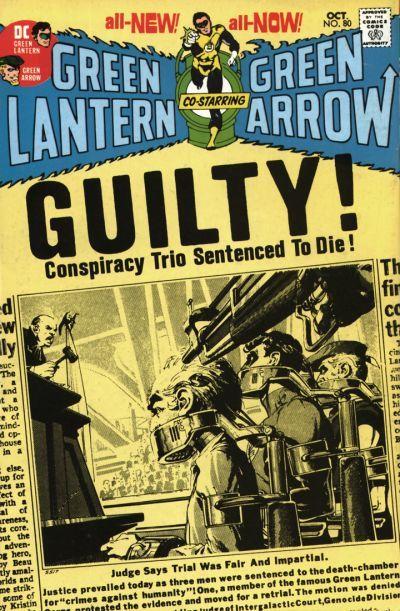
  • The comic book cover above, that of Green Lantern # 80, published way back in 1970, depicts a newspaper cover alerting the world to the death sentence of Green Lantern, Green Arrow, and an unidentified third conspirator. According to one of the sub-headlines, the judge says the trial was “fair and impartial.” Well, at least there’s that. If you read the excerpt of the article at the bottom of the cover, you’ll see that the charge at issue was “crimes against humanity” and that Green Lantern “protested the evidence and moved for a retrial,” which was denied. It appears the court in question was the Intergalactic Court, Genocide Division. Think they appealed? Let’s hope so.
  • One of our readers writes in to remind us of the late Elizabeth Taylor’s connection to legal history on film. In 1951, following a successful career as a child actress, she appeared in A Place in the Sun, based on the novel “An American Tragedy” by Theodore Dreiser, itself inspired by the criminal case of People v. Gillette, 191 NY 107 (1908). In the film, Taylor played the chief love interest of the defendant, based on Chester Gillette (played by Montgomery Clift), who killed his other love interest (played by Shelley Winters). The prosecutor was played by Raymond Burr, who went on to become far more famous as television lawyer Perry Mason. One notable footnote: In the movie, the death was accidental; in real life, Gillette was executed for the murder.
  • David Post of The Volokh Conspiracy has a pretty interesting blog piece about a federal judge’s rejection this week of the Google Books settlement agreement.
  • If you haven’t heard, legendary bluesman Pinetop Perkins died this week at 97 years old. He was still recording and touring well into his 1990s. Back in the day, he was a member of Muddy Waters’ band. We here at Abnormal Use were fortunate enough to see him in concert just a few years ago in nearby Asheville, North Carolina. It was a good show.
  • The Cleveland Plain Dealer publishes excerpts from a ten page deposition in an open records dispute over the definition of the term “photocopying machine.” It’s got to be read to believe, so we’d advise that you head over there for a chuckle or two.

    Our favorite parts:

    Marburger: Let me be clear. The term “photocopying machine” is so ambiguous that you can’t picture in your mind what a photocopying machine is in an office setting?

    Patterson: I just want to make sure I answer your question correctly.

    Cavanagh: Dave, the word “photocopying” is at issue in this case, and you’re asking him whether something is or isn’t a photocopy machine, which is a legal conclusion —

    Marburger: This isn’t a patent case. There’s no statute that defines — where I’m asking him to define technology for me. I’m asking — I want to find out from a layperson’s perspective, not an engineer’s perspective, not a technician’s perspective, but from — I have an idea.

    Patterson: If you’re referring to a type of machine where you place a piece of paper on the top and press a button and out comes copies of it, they usually refer to it as a Xerox.

    Marburger: Have you ever heard it referred to as photocopying?

    Patterson: Not with my generation, no.

    (Hat tip: Overlawyered).

Hall v. Sunjoy Industries and Kmart: How NOT to litigate a products liability case

Growing up, we here at Abnormal Use were told more than once that one can learn more from failures than successes. If that’s the case, the perpetrators of one recent Florida lawsuit may have learned a great deal recently. See Hall v. Sunjoy Indus. Group Inc., No. 8:09-cv-2032-T-30MAP, 2011 WL 589830 (M.D. Fla. Feb. 18, 2011).

The facts are simple. Plaintiff Dorothy Hall sat on a patio chair displayed in the garden center at her local Kmart. The chair collapsed, causing her to allegedly suffer “various injuries, including a painful back condition.” Hall and her husband sued Kmart as the retailer, and Sunjoy as the alleged manufacturer on theories of strict liability for a manufacturing defect, negligence for failing to inspect and test the chair, and negligent failure to warn. They also sued Kmart on a fourth count, res ipsa loquitur for displaying the chair. Both defendants filed summary judgment motions on all counts, as well as a motion to dismiss based on the plaintiffs’ dishonesty during their depositions. The plaintiffs also filed a motion to establish a rebuttable presumption of negligence based on the fact that the chair was not preserved.

Here are the lessons that we can take from this case:

Lesson #1: Make Sure You Sue the Correct Manufacturer. This may be obvious advice, but these plaintiffs could have used it before facing the court on this issue. Apparently, Sunjoy was not the chair manufacturer. In fact, the record was undisputed as to that fact. In order to avoid Sunjoy’s motion for summary judgment, the plaintiffs filed a motion to voluntarily dismiss Sunjoy without prejudice. The court wasn’t buying their trick and remarked:

When the parties have expended considerable resources to fully develop a case, a court may infer that a plaintiff seeks a voluntary dismissal solely to avoid a pending motion for summary judgment.

In those cases, it is appropriate to do as this court did: deny the motion for voluntary dismissal without prejudice and grant the summary judgment motion.

Lesson #2: Hire the Necessary Experts. The plaintiffs’ first count against both defendants was a strict liability claim for a manufacturing defect. Step one in building such a case is to establish that there is, in fact, a defect. Expert testimony is necessary on this issue if the defect is latent, i.e., not obvious, as in this case. In fact, the plaintiffs needed to establish, through expert testimony, that the chair malfunctioned when it collapsed. While this may appear to be an easy question because the chair in fact collapsed, the court explained that “While the chair may have broken after Plaintiff sat on it, this does not automatically mean the chair ‘malfunctioned.'” The plaintiffs also sacrificed their design defect claim by failing to hire an expert who could provide expert testimony about whether or not testing or an inspection could have revealed a design defect. Finally, the plaintiffs’ negligent failure to warn claim failed because of a lack of expert testimony. “A claim that a warning is necessary and that the failure to warn rendered a product unreasonably dangerous and defective requires a warnings expert,” the court noted.

Lesson #3: Vet Your Clients Properly. The plaintiffs also filed a claim of res ipsa against Kmart. The court granted summary judgment on this claim for two reasons: First, the plaintiffs could not prove that the chair was in the store’s exclusive control because it was in the garden department where people, like Ms. Hall, could sit in it. Second, the court held that the plaintiffs had not presented “any evidence that the reason for the chair’s collapse was some act of the Defendants as opposed to Ms. Hall’s excessive weight” of over 350 lbs.

Even more on this point. The court’s opinion in this case included several footnotes alluding to the fact that both Mr. and Mrs. Hall appear to have perjured themselves, in either their depositions or in affidavits, or both. Not only is that a problem for them, but it could be a problem for their lawyers. It appears that the court did not find the legal theories any more admirable than the Plaintiffs, as evidenced by the reference to the Rule 11 motion which was filed by Sunjoy, based on the fact that Sunjoy was not the manufacturer of the chair.

Lesson #4: Keep the Evidence. The plaintiffs also filed a motion asking the court to grant them a rebuttable presumption of negligence based on the fact that Kmart didn’t preserve the chair at issue in the case even after a preservation letter was sent. Apparently, Kmart kept it initially, but discarded it after seven months, thinking the case was “old.” Because the court found no evidence of bad faith by Kmart, it denied the plaintiffs’ motion. Still, this is one of the cardinal rules of defending a products case: keep track of the evidence, or it may lead to a presumption of negligence later.

The McDonald’s Broken Toilet Case

Plaintiffs certainly have high expectations for what McDonald’s should “know” in civil litigation these days. Back in the early 1990s, in the infamous Stella Liebeck McDonald’s hot coffee case, the plaintiff asserted that the fast food chain should have known that the beverage could cause serious harm to a person who did not appreciate the dangers that steaming hot drinks perched in laps could inflict. Now, just last week, an Illinois woman sued McDonald’s based on her claim that the restaurant should have known that a toilet located in its restroom was dangerous.

The Chicago Sun-Times reports that Plaintiff Cherry Hardie has filed a lawsuit against a Chicago-area McDonald’s after allegedly suffering injuries to her left arm and shoulder after the toilet upon which she sat broke underneath her. She has asked for damages exceeding $30,000.00 and claims to have suffered a “shock to her nervous system” and become disabled.

Now, if we were the lawyers taking this Plaintiff’s deposition, we would have a few interesting questions for her. First, we might ask why she thought it was okay to sit down in the first place, given the cleanliness of most fast food chain restaurant restrooms we’ve seen of late. Assumption of the risk, indeed. Next, we might ask what kind of notice she believed the restaurant may have had that a solid piece of commercial-grade porcelain might collapse. Finally, since Ms. Hardie claims she suffered severe, disabling personal injuries as a result of the mishap, we would ask about any prior personal injury suits. In fact, during our cursory online search for a copy of her complaint in this matter, we stumbled across this prior suit. Is it possible that the pro se Cherry Hardie in that prior Illinois lawsuit is the same woman now claiming to be victimized by the McDonald’s toilet? And what injuries was she claiming in this prior suit?

Cynical? Perhaps. But an important issue to explore nonetheless.

The Regulation of Electronic Cigarettes

If you are a fan of Bravo’sReal Housewives of Beverly Hills” series, you will undoubtedly recall the episode featuring the appearance of psychic Allison DuBois at a dinner party hosted by Camille Grammer. DuBois was quite irksome, but surprisingly, not due to the cigarette she puffed at the dinner table. While DuBois’s cigarette caused little conflict at the party, the product has been at the forefront of some intense litigation and proposed legislation in recent months.

DuBois’s “cigarette” was an electronic cigarette or “e-cigarette.” As such, it was a battery-powered device that allows users to inhale vaporized nicotine, minus the tobacco, tar, and carbon monoxide. E-cigarette advertisements claim that the product is “the smarter and safer alternative to smoking” which looks, tastes, and feels like a real cigarette. If true, the e-cigarette could dramatically impact the nation’s health. Apparently, though, the Food and Drug Administration (“FDA”) has its doubts.

The emergence of the e-cigarette presented the FDA with a new opportunity to extend its regulatory reach. However, over a decade ago, the FDA lost its initial bid to regulate cigarettes and smokeless tobacco under the Federal Food, Drug, and Cosmetic Act (“the Act”) via the U.S. Supreme Court’s decision in FDA v. Brown & Williamson Tobacco Corp., 539 U.S. 120 (2000) (holding that Congress had not vested the FDA with the power to regulate cigarettes and smokeless tobacco products). Despite that loss, the FDA has made other attempts to regulate e-cigarettes, and we’ve created the handy list below to summarize those attempts:

  • In 2009, the FDA warned that e-cigarettes contain carcinogens and toxic chemicals such as diethyline glycol (an ingredient used in antifreeze). According to its statement, the FDA was concerned that e-cigarettes would increase nicotine addiction and tobacco use in young people. The FDA began detaining shipments of e-cigarettes at the border. Following the examination of the seized goods, it determined that the product meets the Act’s definition of a combination drug-device product and, accordingly, was subject to FDA regulation. E-cigarette distributors challenged the FDA’s jurisdiction.
  • In January 2010, the U.S. District Court for the District of Columbia granted a preliminary injunction to allow e-cigarette distributors to continue to import their products into the country. Judge Richard Leon agreed with the distributors that Brown prevented the FDA from regulating e-cigarettes. The FDA appealed the ruling, and the D.C. Circuit Court of Appeals issued a stay on Judge Leon’s injunction. (For a more thorough examination of the Court’s decision, see our earlier discussion of that matter here.)
  • In September 2010, the FDA notified five e-cigarette distributors that it was taking enforcement actions against the companies for violations of the Act. The list of violations included “violations of good manufacturing practices, making unsubstantiated drug claims, and using the devices as delivery mechanisms for active pharmaceutical ingredients like rimonabant and tadalafil.” In addition, the FDA announced its decision to regulate e-cigarettes as combination drug-device products. As a consequence of regulation, e-cigarette manufacturers would be required to comply with the FDA’s drug-approval process.
  • On December 7, 2010, the D.C. Court of Appeals affirmed the district court decision and held that the FDA lacked the authority to regulate e-cigarettes under the Act as drugs or devices. In addition, the D.C. Court of Appeals held that the FDA may only regulate the marketing of e-cigarettes pursuant to the Tobacco Act.

While the FDA may have been unsuccessful in its legal battles thus far (the FDA is considering an appeal), several states are considering regulating, or in some instances banning, e-cigarettes. Recently, New York took the first steps to becoming the first state to ban e-cigarettes, passing a proposed bill through the Health Committee of the New York Assembly. The bill’s sponsor, Assemblywoman Linda Rosenthal, indicated she wanted to proscribe e-cigarettes until they undergo more investigation and regulation. Assembly Health Committee Chairman Richard Gottfried has urged e-cigarette manufacturers to prove to the FDA the legitimacy of their “smoking cessation” claims.

Rosenthal and Gottfried may have a point: e-cigarettes may pose some yet-to-be-determined health hazards. It is interesting that the FDA and state legislatures have become so adamant at this stage about banning a cigarette alternative. While we may not know the ill-effects, if any, of vaporized nicotine, we do know the risks associated with tar, tobacco, and carbon monoxide. There is always a risk that e-cigarettes can lead to hazards more significant than cancer and emphysema. However, it seems counter-intuitive to protect consumers by banning a product which may have risks in favor of one we know poses the threat of serious illness.

We can all relate to the fear of the unknown. On the one hand, we may discover in the future that the conservative approach of the FDA and the various state legislatures was proper. On the other hand, we may discover Allison DuBois knew what was safe all along. After all, she is a psychic.

Juror’s Failure to Disclose Family Member’s Similar Injury Involving Similar Product Did Not Warrant New Trial

Last month, a New York federal court ruled that a prospective juror’s alleged failure to disclose in a products liability suit that a family member of his had been injured under circumstances similar to the plaintiff’s, while using the same product, did not warrant a new trial. Leibstein v. LaFarge North America, Inc., — F. Supp. 2d—, No. CV-06-6460, 2011 WL 499952 (E.D.N.Y. Feb. 14, 2011). The case involved a plaintiff who allegedly suffered third-degree burns to his knees while laying a portland cement product in his basement. He filed suit on theories of strict liability and negligence, and his wife joined the suit with a claim for loss of consortium.

The jury returned a verdict in favor of the plaintiffs in the amount of $125,400. Interestingly, it was the plaintiffs who alleged that a new trial was warranted based on the juror’s alleged failure to disclose during voir dire a similar injury to a family member. The Court noted that the request “presumably was triggered by plaintiffs’ disappointment as to the size of the award.”

The plaintiffs’ motion for a new trial was based largely on information supplied in an affidavit authored by the injured plaintiff’s wife. According to her submission, she spoke with several jurors following the trial during which time she became aware of facts previously undisclosed. Specifically, she learned from these jurors that another juror, “juror number four,” had disclosed during deliberations that a member of his family similarly had been burned while using a portland cement product. The juror failed to disclose this information, in spite of the fact that this information was responsive to questions asked of the jury panel on voir dire.

One might initially wonder on what theory the plaintiffs would hang their hat. It certainly seems as though the defendant would be most prejudiced by the fact that a juror’s family member was injured in the same way as the plaintiff allegedly was. The plaintiffs’ theory was this: “Most probably, this person did not bring a lawsuit or receive any compensation” and, accordingly, the juror was unsympathetic to plaintiffs’ claims. Although it is unclear what damages were submitted by the plaintiffs to the jury, it certainly doesn’t seem that $125,400 was entirely “unsympathetic.” In any event, the court disagreed with the plaintiffs’ allegation that had this information been disclosed by the juror, there would have been valid basis for a challenge for cause.

Thus, the court held that a new trial was not warranted, and the verdict should stand. The court based its ruling on the fact that there was no dispute at trial that an improper use of portland cement could cause burns. This was therefore not an issue at trial. Rather, the “crux of the liability dispute” was whether the packages of cement purchased by the plaintiff contained adequate warnings of that hazard. Accordingly, the information was not sufficient to warrant a new trial. Furthermore, the court held the “sketchy, second- and third-hand information” provided by the plaintiffs did not warrant a post-verdict inquiry into the juror. The court concluded instead that the $125,400 “verdict fits comfortably within the realm of reasonableness.”

Friday Links

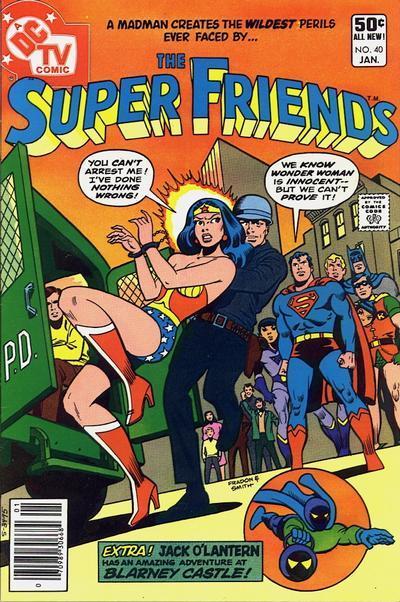
Wonder Woman is arrested by a police officer in the comic book cover above, that of Super Friends # 40, published back in early 1981. We think we know how this story will end, as we previously wrote about a Wonder Woman encounter with the judicial process when she was forcibly removed from a courtroom for disruptive outbursts. In this altercation, Wonder Woman exclaims that she has “done nothing wrong,” although Superman’s response is puzzling. He remarks “We know Wonder Woman is innocent – but we can’t prove it!” Does the Man of Steel not know of the presumption of innocence?

Speaking of which, friend of the blog and law professor Mark Osler (who we once interviewed here for our Abnormal Interviews series) recently claimed on his own blog that Batman went to Yale Law School. We’re not so sure about that, but okay.

How can you not read this post by John A. Day, of the Day on Torts blog, which begins with the following sentence: “A plaintiff in a slip and fall case in New York was permitted to testify as an expert on pigeon droppings.” There’s a Daubert joke in that tale, but we can’t quite get there.

We’re crestfallen that we neglected to include Husker Du’s “Sorry Somehow” in the list of rock songs about lawyers and the law we posted this past Monday. That 1980s college rock classic includes the immortal line, “Send me a subpoena, baby, tell me what to do.”

In light of our love of the character, we direct you to a post at the Legal Profession Blog entitled “Calling Jackie Chiles.” The post is not about “Seinfeld,” but rather the dismissal of a personal injury suit arising from an accident at a Starbuck’s.

Expert Witness Testimony: The Difference Between Testing Scientific Principles and Determining Cause

We can’t resist writing about recent judicial opinions in which a Plaintiffs’ expert is excluded, and last month, the Eighth Circuit affirmed a lower court’s decision to do just that. In Dunn v. Nexgrill Industries, Inc., —F.3d —, 2011 WL 668062 (8th Cir. Feb. 25, 2011) [PDF], the Eighth Circuit considered whether the trial court abused its discretion when excluding the testimony of an expert witness as well as the trial court’s granting of the defendant’s summary judgment motion. In so doing, the Eighth Circuit held that 1) the district court did not abuse its discretion in excluding the Plaintiffs’ expert’s testimony, and 2) that without the expert testimony, the plaintiffs could not establish that the grill was unreasonably dangerous or defective. As a result, the Court affirmed the trial court’s rulings.

Thomas and Thelma Dunn filed a complaint against Nexgrill Industries, Inc., the designer, manufacturer, and seller of a propane grill they claim caused a fire at their home. They claimed that the grill was defectively designed, such that the grease tray came into contact with the rubber regulator hose, which melted and allowed propane gas vapors to escape and ignite.

To prove their case, the Dunns presented the testimony of purported expert Randy Bicknese. He attended the initial investigation into the cause and origin of the fire, which determined that the fire originated in the bottom cabinet of the grill and was caused by the escape of propane gas from the fuel delivery system. Bicknese also conducted additional tests by using a used grill of the same make and model, since the specific grill at issue was no longer manufactured. In his affidavit, Bicknese stated that the purpose of the testing was as follows:

. . . to establish certain scientific principles: (1) to determine whether or not the propane hose can deteriorate sufficiently to leak when in contact with the grease tray during grill operation; (2) to determine if propane leaking from the deteriorated hose can be ignited by the operating burner; (3) to determine if a propane hose fire in the cabinet can be sustained after the burner controls are turned off; (4) to determine if a propane hose fire in the cabinet is readily detectable from outside the grill with the grill lid open and the cabinet door closed; (5) to document the operating characteristics of the grill’s propane distributing system; (6) to determine the consumption rate of the propane hose as a result of the ignited leak.

Bicknese also performed a subsequent round of testing, after which he reported that “the second test continued to support his theory that the fire was the result of the deterioration of the rubber propane hose caused by contact with the heated grease tray.”

Nexgrill filed a motion to exclude Bicknese’s testimony and testing, which was granted because in the opinion of the district court the testing “was done to recreate the fire at the Dunns‘ residence to determine the cause of the fire, not to test scientific principles.” The court further concluded that the test was not substantially similar to what happened during the fire at the Dunns‘ house. After the court excluded Bicknese’s evidence, Nexgrill filed a motion for summary judgment, which was also granted.

The Eighth Circuit affirmed the ruling, finding that the district court had not abused its discretion. As that court noted, “The Dunns‘ main argument is that the tests were conducted to test scientific principles and Bicknese’s hypothesis, not to show exactly how the accident occurred.” Although the line between these two testing principles is “very difficult to draw,” the Eighth Circuit determined that it was unable to say that the lower court abused its discretion.

Without expert testimony, the Dunns were in a real pickle in terms of proving that the grill was actually defective. They tried the only route they had left: they argued that they should be allowed to present circumstantial evidence of the products defect, despite the fact that they failed to plead res ipsa in their complaint. The Eighth Circuit prohibited this type of proof not only because of the improper pleading, but also because “grills are designed specifically to ignite,” and therefore, the fact that the grill actually ignited did not prove a defect. As a result, the Eighth Circuit affirmed summary judgment for Nexgrill.

Asbestos Exposure, Summary Judgment and Replacement Parts

Just this past Monday, in Massachusetts, that state’s appellate court released an asbestos causation opinion. In most states, to prove causation in an asbestos case, the plaintiff must establish (1) that the defendant’s product contained asbestos (product identification), (2) that the victim was exposed to the asbestos in the defendant’s product (exposure), and (3) that such exposure was a substantial contributing factor in causing harm to the victim (substantial factor). Whether or not the plaintiff had established these three elements was the issue in Morin v. AutoZone Northeast, Inc., — N.E.2d —, 2011 WL 834160 (Mass. Ct. App. March 14, 2011).

From 1952 to 1991, Geraldina Medeiros and her husband Anthony Medeiros ran Bedford Fruit Company. Fifteen years later, Ms. Madeiros died of malignant mesothelioma. Her daughter, as the administratrix of her estate, sued approximately forty (yes, that’s 40) defendants, mostly brake manufacturers which the plaintiff asserted had exposed the decedent to asbestos fibers in the course and scope of her work around the delivery truck and trailer. Although some defendants settled with the estate, many defendants moved for summary judgment on the issue of causation. After the motions were granted, the plaintiff appealed the ruling as to three defendants: AutoZone Northeast, Inc., Great Dane Trailers, Inc., and Orleans Auto Supply, Inc.

As the Court of Appeals pointed out, the main issue before it was that of causation:

Several characteristics of the generation of disease and death by asbestos inhalation have moved courts to adapt the standard of proof of causation. Those characteristics are the prolonged latency of the induced disease, the multiple points of exposure of the victim, and the indistinguishability of contributory exposures. Because the resulting injury may not emerge for years or decades after exposure, the law does not require the plaintiff or his or her witnesses to establish the precise brand names of the asbestos-bearing products, the particular occasions of exposure, or the specific allocation of causation among multiple defendants’ products. Evidence will be sufficient to reach the fact finder if it permits the reasonable inference of the presence at a work site of both the plaintiff and the defendant’s asbestos-containing product for an appreciable period of exposure.

So, the crux of any asbestos suit is this: the level of exposure to asbestos in a particular product, and the duration of the exposure. The Court of Appeals affirmed summary judgment for Great Dane Trailers, but reversed as to Orleans and AutoZone.

The case itself is pretty straightforward in terms of its analysis, but it highlights one of the hot topics in asbestos litigation right now. (Yes, apparently there are still “hot” topics in asbestos law, after more than thirty years!) The decedent’s exposure to asbestos brake pads and linings from these three defendants occurred during brake jobs where the asbestos-containing parts were replaced. What liability does an original manufacturer have for replacement parts? If we assume that the manufacturer knew that the brake parts on the truck and the trailer used to transport fruit would have to be changed, and would likely be replaced with parts containing asbestos, what liability does that manufacturer have? Watch this issue to be raised again and again in your state.

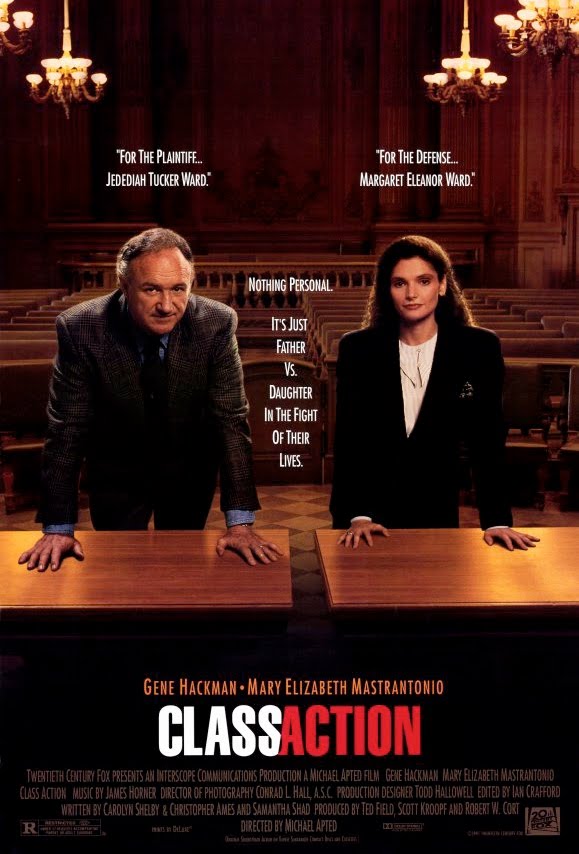
Abnormal Interviews: Robert W. Cort, Carolyn Shelby and Christopher Ames, Makers of the 1991 Film, "Class Action"

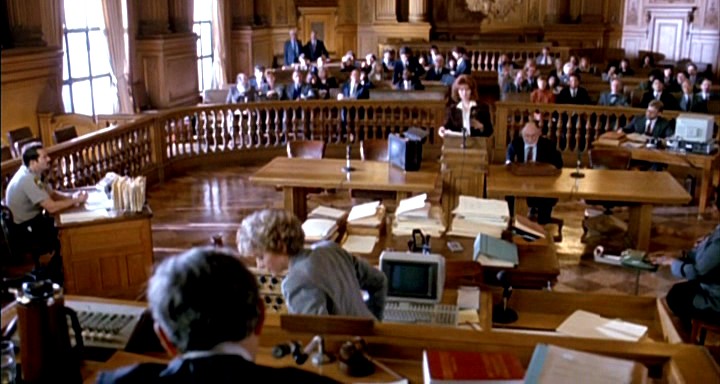
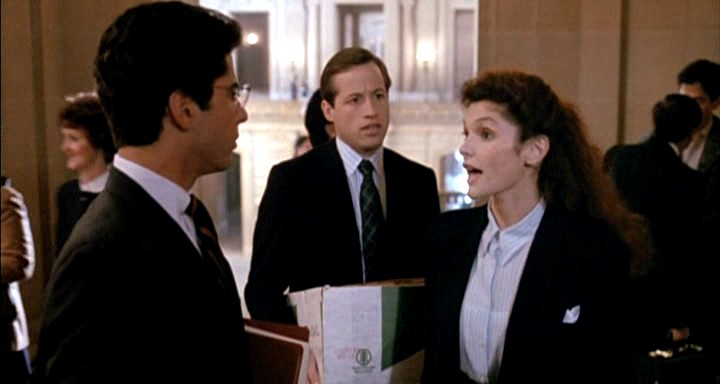
Twenty years ago today, on March 15, 1991, the film Class Action was released to theatres. Directed by Michael Apted, written by Carolyn Shelby, Christopher Ames, and Samantha Shad, and produced by Robert W. Cort, Ted Field, Scott Kroopf (as well as Shelby and Ames), the film chronicles a products liability suit involving an allegedly defective station wagon, which when struck from the rear when the left turn signal is operating, bursts into flames. Essentially, the lawsuit is a fictional version of the famous Ford Pinto litigation. However, the real conflict in the film was familial in nature: Big Law corporate defense attorney Maggie Ward (Mary Elizabeth Mastrantonio), who represents the automotive company in the suit, is the estranged daughter of Jedediah Tucker Ward (Gene Hackman), the flamboyant plaintiffs’ attorney who brought the suit. Watching the film twenty years later, it’s notable that it made a real attempt to accurately depict the legal process. There are scenes featuring a motion to compel hearing, a discovery document dump, a contentious Plaintiff’s deposition, and ethical dilemmas aplenty for both sides of the bar. Interestingly, the film uses each legal sequence to further and elaborate upon the strained relationship between the father and daughter.

We here at Abnormal Use were fortunate enough to obtain an interview with producer Robert W. Cort and writer-producers Carolyn Shelby and Christopher Ames.

Excerpts of that interview follow below:

[ON REALISTIC DEPICTIONS OF THE LEGAL PROCESS]

SHELBY: It was really a tribute to, well first of all, Michael Apted, the director, [who] came from the documentary world. And he was very committed to doing as honest a depiction of the legal process as you can in a movie. There just has to be some, artistic license to be taken, but he got technical advice, and I was very happy when the movie came out. For years thereafter, various and sundry legal journals would do ratings of movies, and Class Action would always be rated very highly, and the overwhelming reaction was that it did as good a job as was possible to depict the legal process. I was very proud of that because we did work very hard, and we had the luck of a documentarian as our director and the luck of time and the luxury of time to do as good a job as humanly possible when you have to make a story have a true line and you’ve got to focus on characters.

[LOOKING BACK 20 YEARS AT THE FILM]

DEDMAN: Looking back twenty years, what are your thoughts on the film and how it was received as a courtroom or legal drama?

CORT: . . . [O]ne could never get this movie made today . . . Movies in which the ambiguities, the ambivalences, the grays of the world, in which character rules over plot, are almost impossible to get made. The business has changed so much, and I often say that one of the really fortunate things in my career is that I had my career at a time when I could do movies like Class Action, and I have such fond memories and [am] so proud of it. . . . Its really core idea is a relationship between a father and a daughter. It takes the kind of classic, Father of the Bride relationship between a father and a daughter and puts it into, a much darker, much more interesting context and plays out family dynamics as it affects the story.

. . . [W]e began to realize that the father/daughter dynamic was just really a fascinating thing, and then the surrogate son in the part played by Laurence Fishburne became a really interesting character [in conjunction with] the divided loyalties of the daughter. I look back and I’m struck by the ambition of the movie . . . .

SHELBY: . . . When we wrote Class Action with Robert, we went through five years of working [and] did 25 drafts. And that allowed us to go quite a while going in different directions and exploring different ways to do it. You can’t do that now. People make their decisions after one draft or so as to whether or not it’s going to get made.

. . .

CORT: [W]e were incredibly fortunate to be able to develop this in a way outside of the studio. We did develop it completely outside of the studio framework, and we sold it to Fox ,but we were not forced to go through a process. . . . Even in the eighties, even in the nineties, they kind of took the flesh off of anything. So, and I think if you want to look at that, most, many, many, many really wonderful movies were sort of developed outside the studio system.

[CASTING THE FILM; THE NEAR CASTING OF JULIA ROBERTS]

DEDMAN: How did Gene Hackman and Mary Elizabeth Mastrantonio become involved with the project?

CORT: . . . Gene was always kind of in our mind. We wanted a very powerful character who played against the Henry Fonda of that character . . . We wanted someone who had been toughened and was tough because that’s who those people are; they’re not saints. They’re rough people even if their passions will have been shaded over into obsessiveness. And if you look at a lot of Hackman’s roles, going back to Popeye [Doyle] and The Conversation, you see a character in pursuit of what he believes is right [who] will go to any length and ignore everything else, including, in this particular case, his daughter.

. . . I had seen Mystic Pizza, and there was an enormous amount of heat about this young actress and it was, of course, Julia Roberts. We had given it to a few other major actresses and we’d been passed on . . . The character had a lot of gravitas and huge intelligence and a fair piece of alienation even though she was working very much within the system. . . . Michael Apted and I and Scott and Chris and Carolyn met with Julia, kind of saw what she was like, and she desperately wanted to do the movie. And we really believed in her. I was friendly with the people at Disney and knew that they had not released Pretty Woman yet, but that they were through the roof on the movie. They thought that she was going to be the biggest movie star around and she desperately wanted to do it, we wanted her, Joe Roth, who was the head of Fox, just didn’t believe in her, and he just kept fighting us and fighting us and he said “Well, all right maybe.” And we thought, “Oh my God, we’re going to get her.And then he called me one day, and he said, “Forget Julia Roberts.” He said, “I have just seen the biggest movie star of her generation.” And he had just come from a screening of James Cameron’s The Abyss, in which Mary Elizabeth starred. Mary Elizabeth had been in, at that time, The Color of Money, in which she was great. She’s a terrific actress, absolutely a terrific actress. We couldn’t see the movie because Cameron wouldn’t show us. We never got to see it. Joe was sure it was going to be titanic. Obviously, it turned out not to be titanic. He said, “You’ve got to go to her, and if she doesn’t do it, all right you can use Julia Roberts.So, we made the offer, she was represented by a man named Sam Cohn, who is a legendary agent in New York, and he gave it to her, and she delayed, and she hadn’t read it. I kept calling, and I said, “Sam, we need an answer ,”and he said, “Yeah, I’ll get you an answer.” I called Roth, and I said, “Look, we’re just getting jerked around, let us go with Julia.” He said, “All right, I’m calling Sam. If she doesn’t commit to it by noon on Friday, noon L.A. time, 3:00 in the afternoon in New York, go with Julia Roberts.” I absolutely kid you not, at 11:55, the phone rang in my office in L.A. and it was Sam Cohn saying “All right, Mary Elizabeth will do the movie.” So, by five minutes, we missed the part being played by Julia Roberts. And I think that it wasn’t just, in my opinion, the fact that Julia Roberts became this enormous star, and we would have been following Pretty Woman, [adding] incalculable value to that. But I think that Mary Elizabeth is a very dramatic actress, and she always went for the very dramatic and the very hard. And Julia, by nature of who she was and what she brought to it, always had that vulnerable, softer quality. And I think it would have been, opposite Hackman . . . it would have taken the movie, perhaps from a commercial standpoint, to another dimension. And the great story was that she got so mad that she went to see Joe Roth and said, “You didn’t believe in me,” and she and Joe Roth became unbelievably good friends. Basically, I didn’t talk to her again until she did Runaway Bride for us.

[DEPICTING THE CHALLENGES OF WOMEN LAWYERS]

DEDMAN: The Maggie character is an interesting one because she is both a young lawyer who wants to make partner, but also a woman in a profession that is dominated by men ,particularly at that time. How do you think the film addresses those issues, and do you think that’s changed in the last twenty years?

AMES: We talked a lot about this in the development of the script. . . . [W]e hung a lantern on that very issue with one particular piece of dialogue between her and her lover, who was also her boss, where she said “I want to make partner on my own, it’s different for a woman in a firm.” I’m not so sure that’s the case anymore. I hope it’s not the case. But certainly in those days, particularly because she was sexually involved with her boss, there was a tremendous stain that she was trying very, very hard to stay away from.

[DEPICTING THE LAW AND FAMILY STRIFE]

DEDMAN: You mentioned the film does portray not just the actions of lawyers in the courtroom but also how some of what happens in the courtroom bleeds into the family life. How many of Jed’s issues with respect to how he relates to Maggie are the result of him being a lawyer as opposed to him just being who he is as a person?

AMES: Well, I don’t think you can necessarily divorce one from the other. It strikes me with Jed that his was a gigantic ego and that informed everything he did, both in his own family and in court. Jed was the kind of character who believed that he could get away with anything just because of the sheer strength of his character. One of the things that we talked to Robert about from the very first day we started developing this script was that we were going to make him a “people’s lawyer” and her a “corporate lawyer.” We had to give each of them significantly large other dimensions to their lives which is why we made him morally compromised and why we made her somebody who second guessed her own decisions.

CORT: Look at Martin Luther King and his sexual peccadilloes. People of that ego, whatever they’re doing, they’re doing it for the right reasons or they tend to believe they are. There is so much testosterone in those people, so much drive, that they need sort of eat everything in their path. I think he was a hugely compelling character in that movie. I never knew anyone who ever said anything other than he felt real.

AMES: He was patterned on some real people. There was a little of Alan Dershowitz in him. There was a little of Tony Serra in him, too. As a matter of fact, the office that you see Jed in – his “office” was Tony Serra’s office – complete with the ashes of a former drug dealer/client [which] was sitting on the desk.

SHELBY: That was put to death by order of the court. And there was artwork all over from prisoners in prison who were using their served out time to paint art.

AMES: So we did have real models out there. Bill Kunstler was a model for him, also. He probably came closer to Kunstler than anybody else.

[REACTIONS OF LAWYERS TO THE FILM]

DEDMAN: What kind of reactions have you gotten from lawyers over the years about the legal elements of the film?

SHELBY: . . . [W]e used to go to theaters that were showing it, and we would come in, all the theaters got to know us, we would come in the last ten minutes of the movie . . . follow the people out and listen to the comments. And we always gravitated toward the lawyers who would be in great debate as they left about [whether the conduct depicted was] ethical. “Could they do this ?” and it went back and forth, and it was hysterical to listen to. But this was wonderful, because there was such huge debate, and these lawyers were having the time of their lives trying to analyze the movie and mainly coming out very positively.

AMES: Perhaps the highest compliments I ever got about the movie was my daughter called me breathless one day from George Washington University . . . to inform me that the plot of this movie was being taught in one of her classes that day and she about fell out of the chair.

[LEGAL ETHICS AND THE FILM]

DEDMAN: . . . [T]here is sort of a debate about some of the ethical decisions made by the lawyers in the film. What Maggie does at the end is probably something she feels is right but may be something that would get her in trouble with the disciplinary authorities.

AMES: I’ve heard arguments for twenty years on both sides of the issues. There are two issues that people always raise about it. Number one is that and number two is whether a father and daughter really could go up against each other in court, and we were scrupulous in our desire to make this an accurate movie.

SHELBY: We also found it was fun during the process of researching and writing it, particularly towards latter stages. At every stage, we wrote a draft that went to the studio, got a response from the legal department who would tell us do this, do that, this isn’t [accurate], and so we would adapt appropriately. So all the way through the process we were getting notes from attorneys, and ironically, we finally hired . . . a technical adviser two weeks before we were going into production. And he was not an entertainment attorney, he was a products liability attorney, and he said, “Well, [I] really loved the script, but it’s not a class action.How could this be! We came to realize that “Oh, wow, these lawyers are very specialized in their knowledge level, and all these attorneys that we’ve been talking to have not been in the field that was appropriate.” So we then talked to three different class action attorneys who read it and promptly gave us some notes to truly make it accurately a class action. . . . [B]ut the technical advisor, who was a products liability attorney, kept saying, “No, they’re wrong, it’s not a class action.”

AMES: And I must say in the years since the release, no one has ever suggested it wasn’t a class action.

[DEPICTING THE PLAINTIFF’S DEPOSITION]

DEDMAN: There is a scene where Maggie is deposing the plaintiff who is played by Robert David Hall, and in it, she seems troubled that she has to ask him about past accidents and some pre-existing psychological issues that he has related to automobiles. Why is she troubled about that approach?

SHELBY: That that scene was rewritten to death. Every single day for five years, we rewrote that scene.

AMES: A fair amount of that deposition came to us from David Hall who was a friend of mine prior to the filming and when I got David scenes to do the part and David talked about the two-day deposition that he had had where the attorneys for, I think it was Volkswagen in that case, had grilled him over and over asking him the same questions over and over just slightly rephrased and how agonizing it had been for him. I thought always with Maggie was that there was a bit of her wanting to have her cake and eat it, too. That she wanted to be a powerful corporate lawyer, but she wanted to be a partner, but that she had perhaps too many moral qualms about what you had to do to people. There’s a scene just subsequent to that in a bar where she identifies herself as a professional killer. That’s how she saw herself behaving in there [at the deposition], and frankly, the scene that she played just before that with [the character of] Quinn, the main partner in the firm, who said, “I want him eliminated as a viable witness in this case,” she was not so much deposing him as she was destroying him.

SHELBY: . . . [W]e needed to see her be hard and be the good soldier and do what she needed to do. But we also, as the audience, we needed to have her do it in such a way that we wouldn’t hate her. We just would not hate her for the rest of the movie. And that is a balancing act that’s very difficult to write.

[FILMS ABOUT PRODUCTS LIABILITY]

DEDMAN: [T]here have been a number of films since Class Action was released that address this sort of products liability complex litigation class action context. What is it about those types of lawsuits that make them a good backdrop for films?

CORT: It’s always a greedy, irresponsible, immoral force against people who can’t really defend themselves and somebody standing up to them. That’s been at the heart of movies since Mr. Smith Goes to Washington back in the thirties. There’s been this kind of war in America so to speak between the enormous kind of secret respect we give to people who travel and become famous and rich and powerful and this hatred we have for people who trample our rights and the rights of the defenseless. So, I think thematically this has been a part of our society and hence been a part of movies ever since. You don’t see that much of it in major Hollywood movies any more because I think the sense in Hollywood is that the courtroom drama has been completely taken over by television and they just don’t want to do it. . . . But it’s not a staple of Hollywood film any more because Hollywood film is so dominantly about the created world and fantasy worlds that are aimed at sort of all ages audiences and most importantly are aimed overseas. And one of the problems with doing courtroom drama or doing a class action lawsuit like this is that it doesn’t travel well because the laws of other countries are different, the things that are crimes here and not necessarily crimes abroad . . . . So, I think the foreign or the international demands of the business mitigate against anything other than the guy who kills somebody is wronged kind of thing. So I think class action kinds of stuff is, or products liability are becoming more difficult to make work.

[THE PRESIDENTIAL CONNECTION]

DEDMAN: Two of the actors in your film went on the play Presidents of the United States. Donald Moffat in Clear and Present Danger and Gene Hackman in Absolute Power and Welcome to Mooseport and then Fred Thompson [who played a corporate representative in Class Action] actually ran for President. Is that a coincidence?

CORT: If I’m not mistaken, Donald Moffat also played LBJ in a movie.

DEDMAN: That was before Class Action. Is there a presidential coincidence there?

AMES: I’ll answer that question with a line from a review that I read shortly after the movie came out, where a reviewer was pontificating about the movie and actually liked it, but said “Can it be a coincidence that Maggie’s father’s first name is the same as the first name of the second in command in Citizen Kane?” And I read it and out loud I said, “Yes, it can be.”

[LAWYERS AND QUALITY OF LIFE]

DEDMAN: One thing that is always on the forefront of discussions in lawyer magazines and publications is the quality of life issue and how lawyers who are traditionally workaholics can achieve some type of balance between the work they need to do and their obligations to their family. What do you think that the movie says about those issues in light of the strained the relationship between Jed and Maggie?

AMES: If given his choice, Jed would always be working. Jed is a classic workaholic ,and Maggie has inherited that. I also think that the lack attention that Jed and probably Maggie to paid to their familial relationship growing up was something that was bound to bear fruit later on down the line and also put the mother in the position of being the arbiter between these two.

SHELBY: There’s no question that workaholism has worked a great deal on Maggie and Jed and really, I think, many achievers in our country, I don’t know any great thing to say about it except it’s just reality. And I think it’s worse now for attorneys than ever with the decline in opportunities for employment. I would not want to be an attorney. Of, course being a screenwriter wasn’t that far off.

[DEFENSE FIRM AS GOOD GUY IN A FILM?]

DEDMAN: You mentioned that part of the appeal for some of the movies that have been released over the years depicting these types of lawsuits is the David versus Goliath angle – the powerless taking on powerful interests. Do you ever think there will be a film, or is there a way to tell a story, where the large corporate interest isn’t necessarily the bad guy in the lawsuit?

SHELBY: Well, definitely. Good drama is the gray part where you can be ambivalent about who is the good guy and who is the bad.

CORT: I’m not sure where the story is when Goliath beats David. So I don’t know, I’m not, I don’t quite see that.

AMES: What we have here, Jim, is the perfect differentiation between a producer and a writer.

AMES: I think the writer is saying, “Now, wait a minute, this could be interesting. Let’s make this dog dance.”

DEDMAN: Well, is it just that the stakes are not as high if the big company . . .

CORT: You’re suing them and you falsified your claim to make them look bad, I guess. But I don’t really see that. . . . I don’t know what I’m watching there or what I’m supposed to feel. You know, there’s again, I think “The Good Wife” does a lot of ambivalent stuff.

SHELBY: There’s always a bigger firm that is more corrupt, you know?

AMES: There’s the movie: A firm that thinks of itself as being completely corrupt and then comes up against somebody who’s more corrupt.

CORT: Yeah, but then it’s like a pox on everybody . . . Who cares?

[SHELBY, AMES, AND DEF LEPPARD]

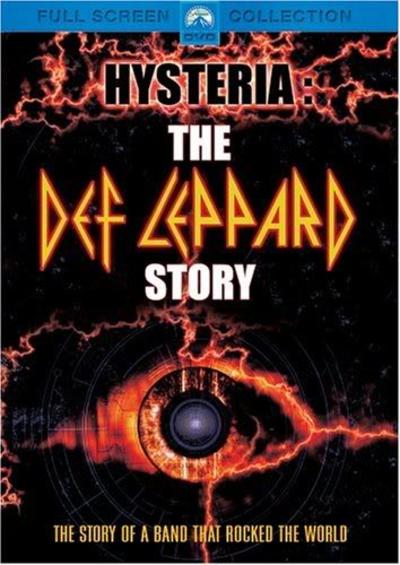
DEDMAN: I have to ask [Chris and Carolyn] about “Hysteria – The Def Leppard Story.” How did you get involved in that and how did you prepare to write that script?

. . .

AMES: [Our agent] said “I have this strange news for you.” She said “I’ve put you up for all kinds of projects which you would have been absolutely perfect for and you haven’t gotten them. As a group, I put you up for this and they jumped through hoops to get you.”

SHELBY: We had done a movie that was a TV movie that had not been made on, was it Marge Schott or was it – we had become kind of pigeon-holed in doing autobiographical stories or real stories about people and doing them in a way that, generally, most of the people were proved despicable but we did them giving them the benefit of doubt and depicting their background so that people could understand how the Marge Schotts of the world could happen and characters like that. And so they had read Marge Schott and they had read a project for Proctor & Gamble and they loved that we were able to take [on a] very complex context. We also did a thing on the Olympics bid in Utah and how it was achieved . . . . And they loved how we were able to take very big concepts and compress them into something with a story like that we could do in an economic amount of time. But we were so wrong on every other level . . . we were just too old and you wouldn’t think of us to write this and I had a classical music background. . . . I think one of the things that they did like about us was that we weren’t huge Def Leppard fans . . . . We were going to ask the hard questions and we were going to do our best to make it a compelling story without making it too syrupy.

[EDITOR’S NOTE: Mary Elizabeth Mastrantonio, through her agent, declined a request for an interview. Samantha Shad, one of the writers, also declined our request for an interview.]