









Friday Links

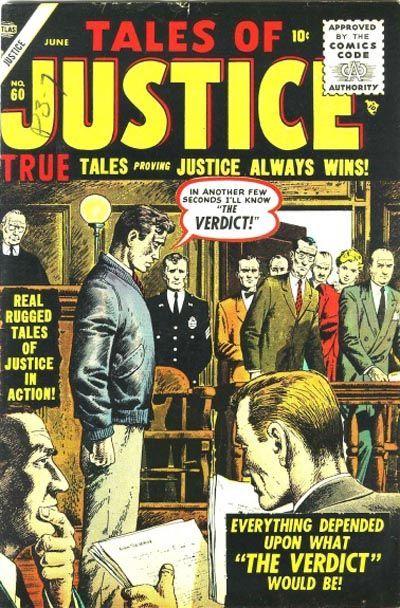
  • “In another few seconds, I’ll know ‘The Verdict,'” exclaims the apparent defendant featured on the hard boiled cover of Tales of Justice #60, published way back in June of 1956. The series, which billed itself as a compilation of “real rugged tales of justice in action,” does not appear to be the type of lighter superhero fare we typically feature on Friday Links. But there’s a tinge of optimism to the series, it seems, as the cover proclaims that it features “True tales proving that justice always wins!” That’s encouraging.
  • There’s a lawsuit over the Dr. Who villain Davros! (Hat tip: Media Law Prof Blog).
  • You might recall that in February we mentioned that our own Jim Dedman was doing some music blogging on the side for an Atlanta-based music website. He’s written a review of the new album by Jason Isbell and the 400 Unit, which hits stores soon. Check it out.
  • Last week, Eugene Volokh of The Volokh Conspiracy mentioned our recent April Fool’s Day post. As you may recall, we wrote about a fictitious court that held that the Star Wars prequels were unreasonably dangerous and defective as a matter of law. Wise jurisprudence, that. That said, we loved reading the comments to Eugene’s post.
  • Remember Cracked magazine? Not unlike Mad magazine, the juvenile humor themed Cracked, once a staple of newsstands in long ago days, has made a name for itself in the Internet age by creating lists of famous this or thats in popular culture. Well, this week, Christina H. at Cracked published a column entitled “6 Famous ‘Frivolous Lawsuit Stories That Are Total B.S.,” which includes the Stella Liebeck McDonald’s hot coffee case. All we can say is that Christina obviously didn’t read our FAQ on the case. However, we must confess a bit of jealousy that our friends at Overlawyered are cited in the piece.
  • Friend of the blog Ryan Steans of The Signal Watch blog recently visited London for the first time and marveled at the sense of history. Comparing England’s approach to history to America’s, he had this to say over at his blog:

    It strikes me that we in the vast, vast majority of the geography of the US do[es] not have memorials to those who died more than 200 years ago, and the further west one travels in the US, the briefer our sense of history as much more than an abstraction of something left behind somewhere else. A lack of living history, of being surrounded by those who’ve gone before (some winning, many not winning) may be what gives us an inflated sense of destiny, like a teenager who sees only a future as a rock star ahead of them when they pick up their first guitar and who can’t be bothered to learn more than the chords of their current favorite songs.

    And as hard fought as democracy has been here in the US, it was also the first step we took as a nation. Everything prior to the French-Indian Wars is buried in a sort of primordial soup of witch-hunts and Indian killing that we’d rather not discuss. In England, this period is just short of current events. You can see the change from one-thousand years of feudal clashes to the rise of democracy in the stones and monuments, and there’s something to that, I think. We’re a blip on the continuum, it seems to say, and what we do while we’re here is important, but it will also pass, and those who are remembered are remembered as either good or terrible souls, and history will look back on you with an audio tour that will speak frankly about your deeds as people walk on your grave.

    Very interesting.

FDA Convenes Expert Panel to Consider Food Dye-ADHD Link

Last week, a Food and Drug Administration advisory panel composed of doctors, scientists, and consumer representatives spent two days reviewing evidence that purportedly shows a link between synthetic food colorings and ADHD, or hyperactivity, in kids. Artificial dyes are added to many familiar snack and junk foods – staples of the modern diet. This alleged link has been the subject of ongoing debate for decades, pitting the food industry against parents, public watchdog groups and academics who have demanded a closer look at food additives.

Businessweek reports that the FDA believes there is not enough evidence at this point to definitively conclude whether food dyes contribute to ADHD. The panel’s task thus was not to consider imposition of a ban on the additives, but rather to consider whether foods should require warning labels or whether more research should be done. Well, the panel has spoken. CBS News reports that although the panel recommended that the FDA further study the possible link, it voted 8-6 that warning labels are not necessary. There is not enough evidence at this point, according to the panel, to show any link. As it stands, packages must list the food colorings on its labeling, but no warnings about a potential link to hyperactivity are required.

Interestingly, across the ocean, where this issue is already “old news,” the European Food Safety Authority has already mandated that foods with color additives contain warning labels for consumers. Here at least, additional regulation may be on the horizon, but not soon. One last thought: Perhaps it’s not the color additives that instigate the alleged behavioral problems, but the overall quality of the snack and junk foods, their sugar content, or even the lifestyle choices of the families that purchase said food in order to appease the sweet teeth of their children.

CPSC: Beware the Dangers of Walking on Water

We here at Abnormal Use work hard to maintain our “street-cred.” We tweet. We use Foursquare. We go to concerts, preferably before you have heard of the band that we are going to see. We watch foreign films that are later (and regrettably) adapted by Hollywood, and we snarl in disdain when anyone mentions the subsequent remakes. However, despite our great efforts to remain hip and relevant, one fad has eluded us, and it was the federal government, of all things, that alerted us to its existence. Yes, the Consumer Product Safety Commission (CPSC) recently informed us of something called water walking. Who knew? Certainly not us!

According to this Fox News report, this new trend can be witnessed at amusement parks and carnivals. Water walking is a new recreational activity where individuals roll across the water while encapsulated in large, airtight, plastic balls. While this activity may be entertaining, it doesn’t quite rise to the level of “miraculous,” like that of a certain Biblical figure. Recently, the CPSC warned of the dangers associated with water walking, namely the potential for suffocation. Because the water balls are airtight, the CPSC advises that there is an inadequate air supply within the enclosed spheres required for the activity. In addition, the CPSC expressed concern over the lack of an emergency exit in the event an encapsulated individual becomes distressed. Two incidents of physical injury, both involving children, have already been reported.

It stands to reason that an airtight, plastic ball does not have a limitless supply of oxygen. The CPSC claims that suffocation can occur inside the balls in just a few minutes. In an interview with the Chicago Tribune, Charles Jones, who claims to have invented the water sphere, disagrees. According to Jones, each 6 1/2 foot water ball contains 90-minutes worth of oxygen. Without empirical evidence as to the oxygen supply, we cannot validate either claim. However, with only two reported incidents despite the numerous participants, it is difficult to envision a scenario where a water walker’s oxygen supply is actually depleted in a matter of minutes. But, hey, don’t ask us; we just heard about water walking the other day, so what do we know?

While the CPSC’s investigation into the safety of water walking continues, they have not resorted to a draconian ban of the water spheres. The CPSC report is a warning. It is merely a lesson that, despite how much fun walking on water may be, the oxygen supply inside your vehicle will eventually be exhausted. If you really want to walk on water without the fear of suffocation, we here at Abnormal Use recommend you start studying the anatomy of the basilisk (aka “Jesus Lizard”). In the meantime, enjoy your rides – albeit short ones – inside the water balls.

Abbott Labs Wins Motion to Dismiss

Where have we gone so wrong, America? Our pioneer forefathers are rolling in their graves. Whereas they endured disease, famine, and early death, we spit in their faces, enjoying our iPhones, antibiotics, and frivolous lawsuits. Some measure of order was restored in O’Neil v. Abbott Laboratories, Inc., No. 11-11, 2011 WL 902427 (E.D. La. March 11, 2011), when the court dismissed a complaint alleging infant injury from beetle parts allegedly present in Similac, which you may remember from here. Put simply, there may have been some ground up warehouse beetle in 0.2% in a particular lot of infant formula. No big deal. Even the FDA says that there is no immediate health risk just a chance of GI irritation.

Plaintiffs presented a putative class action based on the fact that their child suffered diarrhea and diaper rash due to consumption of Similac. Do you know what a pioneer would call a day in which he had to face only diarrhea and diaper rash? An outstanding day. If I told my mother that I found a bug in my food, do you know what she would call it? Protein. Oh, America, we have become a nation of wimps.

The court saw this putative class action for what it was, and used Iqbal to dismiss the action. Noting that infants often suffer diarrhea and diaper rash for “non-entomological reasons,” the court subtly chastised the plaintiffs for bringing a negligence-styled products liability action, when negligence is not available in the Louisiana Products Liability Act against manufacturers. Nevertheless, the court afforded the plaintiffs a chance to amend, and even spelled out the four elements that a plaintiff’s complaint must satisfy on its face.

Sure, it may be discomforting to imagine a baby consuming a little warehouse beetle. But babies lick the floor and eat other disgusting things. I’m sure that these concerned parents who think that their kid may have eaten a little bug would not self-report if they found their child chewing on a shoelace that may have touched a public restroom floor or other germ-infested surface. Unfortunately, this case will be refiled in a style that survives the motion to dismiss, and you and I will get the class action settlement notice by mail or email a year from now. Millions of dollars wasted to litigate some GI problems. Oh, America, what have we become?

Abnormal Interviews: Brian Dale Allen Strouse of The Lawsuits, A Philadelphia Band

Today, Abnormal Use once again continues its series, “Abnormal Interviews,” in which this site will conduct brief interviews with law professors, practitioners, and makers of legal themed popular culture. For the latest installment, we turn to Brian Dale Allen Strouse, a vocalist and guitarist of the Philadelphia based band, The Lawsuits. We’re fascinated with that band’s decision to name itself after the chief component of litigation. Strouse was kind enough to submit to a brief interview with Abnormal Use about his band’s music and name.

1) How did you decide to call yourselves The Lawsuits?

We decided on the name The Lawsuits because originally we were called The Mondays. . . . [T]here was a band called The Mondays from New York (or New Jersey), and they had [an] interest in playing our favorite bar where we got our start (John and Peter’s, New Hope, PA). We called to confirm a date for a show we had booked, and the girl called me Rick or James or Robert or Zimmy, and I said, “Excuse me?” Turns out, the bar booked The Mondays by accident, when they were intending to book THE MONDAYS. We thought it’d be clever to change our name to The Lawsuits, as we were in a situation where legal matters possibly could have been taken. Plus, two of my brothers are lawyers, and it wasn’t already a band name.

2) What has been the reaction to that choice of name?

The reaction has been mixed. The name personally has grown on me and the other members, but believe me, we’ve had our fair share of people claiming we can do better, or the name “turns them off.” I like that, though. If I can bring out an emotion of dislike, then at least I’m getting something in return from the audience. They don’t like the band name, but they like the band? Even better. Anything to position yourself strategically, placing yourself (in this case, the band) in a situation where, from the moment we walk into the venue, we’re at a disadvantage. It’s the Rudy factor, the underdog story. It’s true art. We’re trying to infect the audience, not so much live, but more so with the recorded music. And once someone is infected, (Leo Tolstoy would agree) they can’t not get “it.” It’s real, it’s honest, it’s wholly human. Some songs take two years to finish, some take two minutes, but the bottom line is this: Regardless of the name itself, once someone really gives the music a shot, and if they’re capable of liking the music (can’t deny preferences and tastes), they will see that there is something bright and strangely refreshing going on in Philadelphia.

3) How would you describe your music?

We tend to describe our music as folk-rock-blues.

4) What do you think is the biggest challenge facing musicians in 2011?

The biggest challenge that musicians face in the year 2011 is the fact the market flooded, and there are only a handful of boats floating around. There are so many musicians, and so many outlets musicians can use to promote their music. Glenn Morrow, the owner of Bar/None Records in Weehawken New Jersey did an interview . . . [in which] he said something like this, “The modern day label’s job is to weed through all the bands out there and find that gem.” Seems to be that labels now-a-days are much more cautious with their time, energy, and money. I suppose they must be. It is a business. Labels aren’t everything, though, when we dissect the idea of “what it takes to make it” or “What’s standing in my way between me and my goal?” or “What’s my biggest challenge?”, the answer is “What is it?” or “What’s your goal, really?” or “Biggest challenge, in what sense?” Ideally, I’d have tons of money, time, energy, contacts, oh, and talent, and then I’d simply combine all of that together in a large saucepan over medium heat and just sit back. However, the reality of it is this: The average musician has a finite amount of money, time, energy, contacts, and talent. They must rely on the “unexplainable” [and] “unteachable” things like luck and a workhorse attitude. In short, the biggest challenge facing musicians in 2011 is the face they see in the mirror. Even though the market is flooded and labels aren’t biting, almost anything is possible with belief.

5) As musicians, what do you think of the process of working with lawyers in the music industry?

As a self-proclaimed musician, I don’t think much about the process of working with an entertainment lawyer because I have yet to do so. I believe they are an important piece of the puzzle. They are, like the a-typical musician, “thinkers”- modern day philosophers in a sense. Also, everything now-a-days comes with a contract, and lawyers are expected to excel at deciphering the fine print. They are expected to protect the best interests of their client and advise their clients on which path to take.

BONUS QUESTION: What is your favorite song about the law or legal themes?

The Bobby Fuller Four’s “I Fought The Law” is a good one. The Clash did a great version of it, as well. The Dead Kennedy’s also did a version. I believe their’s goes, “I fought the law, and I won.”

Here’s a few videos of the band we found on YouTube (including one tune called “Appeal #46” and a cover of The Beatles’ “Oh, Darling”:

BIOGRAPHY: The Pennsylvania band The Lawsuits formed in 2008 as a four piece rock band, morphed into a ten piece band in 2009, and fine tuned the sound back to a four piece the same year. At present, the Lawsuits are:

Brian Dale Allen Strouse – Vocals, Guitar
Josh Friedman – Drums
Brendan Cunningham – Bass, Vocals
Vanessa Winters – Vocals

Friday Links

  • Above, you’ll find the cover of Four Color #13, published way, way back in 1942. We here at Abnormal Use are not criminal lawyers, so we can’t say how often prosecutors disarm thugs on city rooftops. We do remember something from law school about prosecutorial discretion, though, so perhaps cavalier rooftop melees fall into that category. We’d have to look at our notes. Nevertheless, we are big fans of the exploits of Mr. District Attorney.
  • Yes, yes, our Star Wars post this morning was, in fact, an April Fool’s Day joke. It was a bit more transparent than our April 1 offering from last year, which you can revisit here.
  • Yet again, we’ve recalled some legal rock songs we neglected to include on the list we published two weeks ago. How could we forget Wilco’s “Passenger Side,” in which the singer notes, “I’ve got a court date coming this June / I’ll be driving soon”? Or Grace Potter and the Nocturnals’ “Paris (Ooh La La),” in which the singer exclaims, “If I was a judge, I’d break the law”? Or even Son Volt’s “Down to the Wire,” which features the line, “No jury will have a final say / Everyone knows the jury is guilty.” Oh, well, we’re sure others will come to us in the future, as well. Let us know if you recall any we haven’t mentioned.

Star Wars Prequels Unreasonably Dangerous and Defective, South Carolina Federal Court Finds

Although though we were perplexed to see a federal court address the issue, we can’t say we disagree with today’s opinion from the U.S. District Court for the Western District of South Carolina, which found that the three Star Wars prequels were “unreasonably dangerous and defective” as a matter of law. See Kurtz v. George Lucas, Lucasfilm Ltd., and Indus. Light & Magic, No. 2011-1138-THX (W.D.S.C. April 1, 2011). After hearing cross motions for summary judgment, the court denied the Lucas Defendants’ motion for summary judgment and granted the Plaintiff’s motion finding no genuine issue of material fact as to the films’ defects.

The facts were these: In 2007, Plaintiff Danny Kurtz found himself at his local video store in Seneca, South Carolina browsing through the racks of new DVDs. His young seven year old son, Milo, pleaded with his father to buy him some action movies. Dutifully acquiescing to the request, Plaintiff bought him the prequels: 1999’s The Phantom Menace, 2002’s Attack of the Clones, and 2005’s Revenge of Sith. At the time of the purchase, neither the Plaintiff nor his son had seen the films. (“Somehow, I made it through the last decade without seeing those movies,” the Plaintiff testified at his deposition, although he later acknowledged his familiarity with the films’ generally poor reviews.). Although the purchase was “against his better judgment,” he relented only because of the joy he felt his child might experience in being introduced to the Star Wars universe, a delight the Plaintiff recalled from his own youth in the early 1980s. After a marathon weekend viewing of all three prequels, the Plaintiff and his son experienced nausea, confusion, light-headnesses, shortness of breath, tinnitus, and a “foreboding sense of ennui.”

Plaintiff brought suit individually and on behalf of his minor son against George Lucas and several corporations, asserting various tort theories, including negligence and strict products liability. Plaintiff also asserted a novel “tortious interference with childhood memory” cause of action on his own behalf, arguing that the release of the prequels had destroyed his ability to reminisce his own younger days and his youthful enjoyment of popular culture. (The alienation of affection claims of Plaintiff’s spouse, Carrie, were settled for an undisclosed sum.).

In their joint answer, the Lucas Defendants asserted the affirmative defenses of contributory negligence, assumption of risk, unclean hands, and equitable estoppel, essentially arguing that Plaintiff knew or should have known of the films’ lack of artistic merit and was thus barred from asserting any tort claims based upon his viewing of same. See In re: The Last Airbender, 523 F. Supp. 2d. 147 (N.D. Ga. 2010); In re: Ishtar Litig., 111 F.2d 102 (9th Cir. 1988).

In denying the defense motion for summary judgment, the court rejected the Defendants’ reliance on In re: Bob Dylan Live Performance Litig., 867 F.3d 539 (S.D.N.Y 2006), in which that court held that a once talented artist can devolve and become so well known in the community as a disappointment that damages are not recoverable as a matter of law. See also Shyamalan v. United States, 543 F.3d 129 (6th Cir. 2008). In distinguishing Dylan, the South Carolina court observed that while Bob Dylan’s decline had been gradual over a period of years, the decay of the Star Wars franchise was sudden and immediate (and preceded by nearly two decades of engendered good will prior to the prequels’ release in 1999).

The court then granted the Plaintiff’s motion for summary judgment, noting in a single paragraph order that the films were “unreasonably dangerous and defective as a matter of law.”

The case is also notable for a few other procedural rulings made by the court:

  • The court quashed the Defendants’ deposition subpoena to actress Natalie Portman, who the court decided had “already suffered enough.”
  • Finding the issue nonjusticiable and incapable of resolution by the judiciary, the court denied Plaintiff’s request to issue a declaration that Han Solo had, in fact, shot first.
  • Earlier in the case, the court had dismissed Plaintiff’s state law Unfair Trade Practices Act claim which was premised upon the casting of Hayden Christensen as Anakin Skywalker in the second and third prequels. In so doing, the court noted that the Unfair Trade Practices Act claim was merely an attempt to assert an improper negligent casting cause of action, a claim which the South Carolina Supreme Court had only last year abrogated in the Watchmen litigation. See Moore v. Snyder, 572 S.E.2d 492, 652 S.C. 19 (2009).
  • The court denied the Defendants’ request to consolidate the case with a similar North Carolina matter arising from a Charlotte family’s viewing of 2008’s Indiana Jones and the Kingdom of the Crystal Skull.

Ear Candler Presents Issue of Fact

“Your Honor, don’t let stupidity create an issue of fact.”

Surely, someone, somewhere has uttered this sentence. Perhaps counsel for one of the defendants in Danaher v. Wild Oats Markets, Inc., No. 08-22930-DJW, 2011 WL 903878 (D. Kan. March 14, 2011). In a case with multiple defendants, Wild Oats Markets could not reach summary judgment on the plaintiff’s products liability claims related to ear candling. I have to admit that I was gainfully employed in the early 2000s and had not heard of the ear candling fad. Prior to reading the remainder of the post, I would recommend that you visit the Wikipedia page on ear candling, which contains such unintentionally humorous sentences as “According to medical researchers, [ear candling] is both dangerous and ineffective.”

The immediate takeaway from the case is that retailers should honestly consider whether carrying certain products is worth the risk of litigation. The basic facts of the case are as follows: Plaintiff buys an ear candle at Wild Oats in 2003. For some reason, by 2006, she still possesses the ear candle and decides that she would like to use it. She calls Wild Oats for a recommendation of an ear candler, they refer her to another store, and she eventually finds a person to perform the ear candling procedure, during which, Plaintiff inexplicably suffers a burn to her ear drum, when wax from the candle rolls into her ear. Although the manufacturer promulgated warnings about ear candles in the packaging, Plaintiff did not remember any warnings. Without reciting the entirety of the case, Plaintiff was able to survive a motion for summary judgment on warning defect and breach of implied warranty.

We may be somewhat defendant-friendly here at the blog, so let me offer potential defendants some advice. Do not sell devices designed to combust in the middle ear. It is not worth the $2 you will generate in revenue. Sell something else. In all seriousness, this product is at the very least some homeopathic harmlessness, but there should be some thought (foreseeable use) about the economics of the business. Is it reasonable to anticipate someone being injured from using the product in a reasonable way? If so, how much money can you make, taking into account the likely cost of insurance/litigation? It’s hard for me to believe that the manufacturer/distributor/retailer of the candle sat down with a lawyer at the inception of the business and the selling of this absurdity was determined to be an economically rational choice. But lawyers are good at telling entrepreneurs why things won’t work, and, if all entrepreneurs listened, we would not have such grand creations as the ear candle, Ford Pinto, or the Hindenburg. Today’s lesson is to examine the inventory that you sell for $10 or less. It might not be worth it.

Defense Verdict: Jury Finds Vehicle Defective But Driver At Fault

In a case the judge reportedly called the biggest civil trial in the history of the county, an Ohio jury on March 21 rendered a verdict in favor of the defendant, Yamaha Motor Corp., in a $20 million case involving the death of a 10 year-old girl, in spite of its conclusion that the ATV at issue was defective in its design or warnings. The machine at issue was Yamaha’s Rhino. AboutLawsuits.com reports that this was the sixth case won at trial by Yamaha over claims that its ATV is prone to rollovers; however, it reports that Yamaha settled more than 100 others.

The facts of the case were quite sad. It was reported by the local news that the 10 year-old plaintiff riding in the Rhino at a 2007 church picnic. The 21 year old driver, according to the defense, was inexperienced with the machine. He attempted to perform a high-speed “fishtail” stunt maneuver in a dark, muddy cornfield with multiple unhelmeted child passengers. The driver was not sued in the civil action but pleaded no contest to criminal charges.

It is refreshing to see that jury members, in spite of the tragic underlying facts of the case involving death of a child, seriously and thoughtfully deliberated as to what they believed was the true cause of the injury. This case is reminiscent of another case in Texas, which we covered here, involving very similar facts with a very different outcome. There, an 18 year-old Texas man was boating and swimming with friends when the driver of the boat, another 18 year-old, put the boat in reverse, striking his leg with the propeller. It eventually resulted in the loss of his leg.

The Texas plaintiff sued the makers of the boat, alleging the propeller was defectively in its design. The Texas jury did not believe that the actions of the driver, who was not named as a defendant, was a superseding cause of the injury. It attributed only 17 percent of the negligence to the driver, and ultimately awarded the plaintiff $3.8 million in damages for the loss of his leg. These cases are further proof that with a jury, it’s always a gamble.

"Greenwashing" Litigation in California

In November 2011, a California federal court is scheduled to preside over a significant “greenwashing” class action lawsuit which was filed against S.C. Johnson & Son, Inc. by a California resident on behalf of purchasers of various household products manufactured by the company. Koh v. S.C. Johnson & Son, Inc., No. C-09-00927 RMW (N.D. Cal.). “Greenwashing” is a term used to describe the deceptive use of “green” marketing to promote a misleading perception among buyers that a company’s products are environmentally friendly.

In January 2008, S.C. Johnson, the maker of household cleaning products including Windex and Shout stain remover, began marketing and selling Windex with its prominently displayed, trademarked “Greenlist” labeling. It later incorporated the Greenlist label on other products, including Shout. The company devloped this system internally to rate its products in terms of their impacts on the environment. The plaintiffs alleged that the Greenlist label was deceptively designed to look like a third party’s seal of approval, which it is not. They further alleged that “among today’s environmentally-conscious consumers, products seen as ‘green,’ or environmentally friendly, often command a premium price and take market share away from similar, non-‘green’ products.” The plaintiffs claimed that had they known the Greenlist label was the result of the company’s own review process, they would not have purchased them.

Before the class-certification stage, S.C. Johnson moved to dismiss the complaint on two grounds: (1) that the plaintiff had not sufficiently alleged an injury; and (2) no reasonable consumer could have found the Greenlist label misleading. That motion to dismiss was denied by the California federal court in a five-page, unpublished order in January of 2010. Koh v. S.C. Johnson & Son, Inc., 2010 WL 94265 (N.D. Cal. Jan. 6, 2010).

This will be an important case to watch, as it could have significant implications on acceptable “green” marketing practices. In fact, the class-action suit should serve as a warning to product makers to be cautious in advertising their products as “green” or environmentally friendly, especially where that representation is not supported by a credible third party.