








Thanksgiving in 1810, 1910, and 2010

Every Thanksgiving, American readers of newspapers and magazines are treated to similar nostalgic pieces about the origins of Thanksgiving and the uniqueness of the holiday.

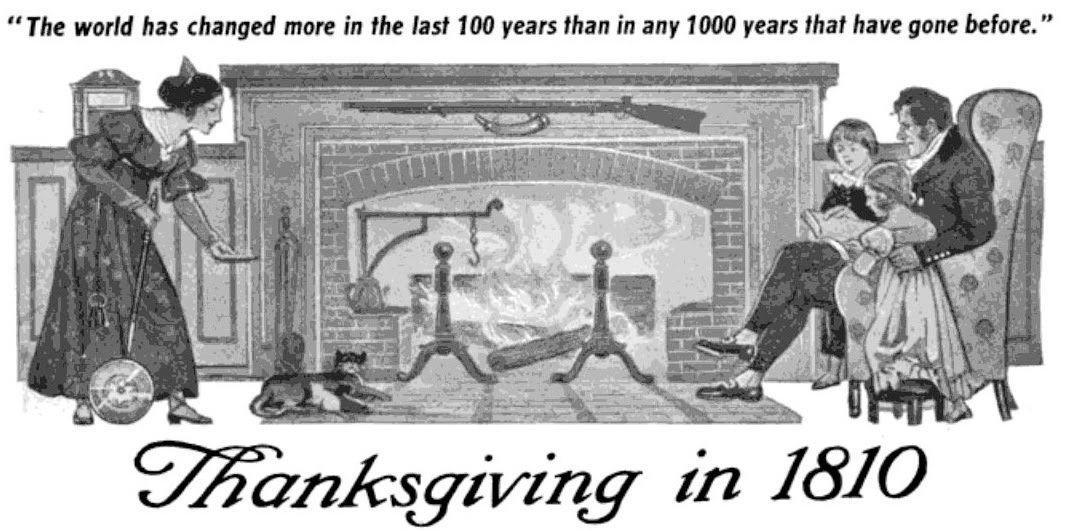
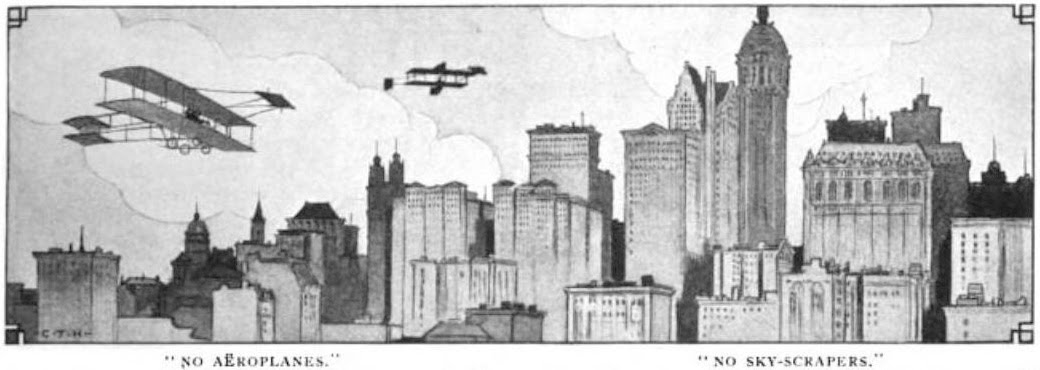
It was no exception in 1910, one hundred years ago, in the pages of St. Nicholas: An Illustrated Magazine for Young Folks, a then popular family magazine. In that publication’s November 1910 issue, writer Clifford Howard authored a piece called “Thanksgiving in 1810,” in which he looked back a century to see how far the nation had progressed since that time. What a fun and intriguing article to stumble across exactly one hundred years later (particularly with the stellar illustrations by C.T. Hill, some of which we’ve embedded here in click to enlarge format).

“The world has changed more in the last 100 years than in any 1000 years that have gone before,” Howard wrote, not knowing how much that change would accelerate in the coming years. But surely, in writing such a piece, Howard wondered whether anyone a century from his time would look back to 1910 and comment upon similar changes in the culture. Of course he did. In fact, he ended his piece with the question, “[W]hat will it be in 2010? Who can tell?”

So, we here at Abnormal Use, denizens of 2010, will take it upon ourselves this Thanksgiving week to revisit Howard’s long forgotten article from that long forgotten magazine. (Considering the nature of his task, we think he would appreciate our responding via the Internet, a medium that he could not have imagined in his wildest dreams way back in 1910).
Most of Howard’s commentary concerned the huge advances in technology that occurred in the century preceding the publication of his piece. Thus, he began with the following premise:

A hundred years back may seem a long while ago, but when you remember that there are men living to-day whose fathers saw General Washington, a century does not seem so long a time after all. And up to the time of Washington a hundred years did not mean very much to the human race. The world moved very slowly. When Washington died, in 1799, people were using the same sort of appliances and doing the same things in the same way that they did in 1699 and even 1599. In former times, if a man could have returned to earth at the end of a hundred years, he would not have been very much surprised at any of the changes that had taken place during this absence. But if Washington or Franklin, or even Thomas Jefferson, who died less than a century ago, were to come back to earth now, he would not know where he was.

Howard notes the obvious, that the citizens of 1810 had no “air ships or automobiles or motor-cycles,” and so of course, travel was not nearly as speedy as it was for those of 1910. But then he ponders how those of 1810 would interpret the technological marvels of the early 20th century:

In fact, not only the humble farmer of that day, but the scientist and philosopher as well, would have found it impossible to believe all the wonderful things that were to take place within the century. If you could have lived then and looked ahead a hundred years and told your friends and neighbors that men would travel by steam and electricity, that they would fly in the air from London to Manchester, or from New York to Philadelphia, that they would talk to one another from Boston to Chicago, they would flash news across the ocean in the twinkling of an eye, that the great wilderness beyond the Mississippi would be populated with millions of people and contain some of the big cities of the world, that men and woman would go across the Atlantic and across the vast continent of America in perfect ease and comfort and in less time than it then took to journey from New York to Washington – if in 1810 you had foretold these marvelous things, your friends and neighbors would have shaken their heads and whispered sadly to one another that you were crazy. If the wonders you related to them were to come to pass during the next thousand years, they perhaps would have admitted that there might be truth in some of your stories; but to say that they would all come true inside of a hundred years and that some of the very people to whom you were talking would live to see many of these magical inventions, would have been really to much for any sane person to believe.

Fifty years later, Arthur C. Clarke would summarize the same sentiment when he wrote that “[a]ny sufficiently advanced technology is indistinguishable from magic.”

Of particular interest is Howard’s comparison of the communications infrastructure of both time periods. When we, as modern readers, study history, we have an omniscient view based upon the many events pieced together by the historian. We know what was occurring at all relevant times in all relevant places. But the participants of those historical events had no such luxury. News traveled very, very slowly in 1810, at a molasses like pace even by 1910 standards:

As there were no railroads, news traveled only as fast as a horse could run or a ship could sail. There were no wires to carry messages, for there was no telegraph and there was no telephone.

If the farmer of 1810 got a newspaper at all, it was a week or a month or perhaps three months old before it reached him.

Imagine what Howard would think of live television or the Internet. Would he be able to comprehend Facebook or Twitter? Or the technology which allows each of us, with everyday devices, to capture a moment on film or video and share it with the world instantly? What would he think of the notion that in this age we are all pamphleteers and publishers?

On a side note, we, as proprietors of a legal blog, can’t help but wonder just how different the practice of law was in 1910 based, in part, on the aforementioned differences in communications technology. It was certainly slower, in that litigators could not easily save and alter legal forms and blast them out instantly via fax or email. Never mind the fact that the information gathering process must have been slow, as well, simply because not everyone had telephones. Documents were locked away in dusty file rooms of courthouses, not available with a quick digital search. But the advantage of that may have been that lawyers weren’t scurrying about all the time in such great haste to perform this task or file that motion. Might the practice have been described as slow but rewarding? We can only surmise based on what we know in hindsight.

Some other fun bits:

  • Howard observes that in 1810, the states of Florida, Texas, and California were not yet a part of the nation and were, thus, merely “waste places or foreign lands.” Ouch.
  • Howard notes that Thanksgiving, as his generation knew it, was not celebrated officially outside of New England in 1810.
  • Most newspapers in 1810 were issued only weekly, and the would be news contained therein was a few days to half a year old.

What will it be in 2110? Who can tell?

So, what became of Howard the writer and the publication to which he submitted this piece?

The St. Nicholas magazine, which began publishing in the 1870’s, folded in the 1940’s. Howard, for his part, didn’t make it to the halfway point of the 20th century, either. He died in 1942, at the age of 73, apparently after spending some time in Hollywood writing movies. According to his brief New York Times obituary (behind that site’s paywall archive), Howard “worked with Cecile B. De Mille and his research was largely used for the film King of Kings.” He was the author of many magazine articles and a number of books (and his work wasn’t always family friendly, either).

Here’s the best nugget we discovered about Howard’s life and education: According to this 1895 mini-biography of Howard published in a poetry journal, he once studied the law! It notes: “Like many others in their gradus ad Parnassum, he devoted some time to the study of law, graduating with the title of L.L.B. from the Columbian University in 1890, only to find that Blackstone and Kent were uncongenial masters and that his literary aspirations would never be content within the narrow bounds of prosaic law.”

Well, at least that’s something that hasn’t changed since 1910.

When Technology Outpaces the Law: The Driverless Car Problem

Fact: Technology is moving faster than many of us can fathom. This is, of course, news to no one. The laptop I bought just one year ago is now a “dinosaur,” and I could probably buy a brand new one with the same specs for roughly half of what I paid last year.

Fact: The law has not kept up with the quick pace of technology. This is also news to no one. Privacy concepts have been turned on their heads by the Facebook/MySpace/Twitter social media explosion. Entirely new concepts of law have also developed over the past few years; “e-discovery” has raised the stakes – and the cost – of litigation dramatically.

The ABA Journal provided another example of technology outpacing law in its newsletter last week: the driverless car, citing a recent New York Times article on the same subject. Apparently, Google has developed technology that can drive a car with minimal human input. In fact, the only accident that occurred during testing of the vehicle was caused by human, not car, error. This is a huge jump even from the Lexus LS460 that can park itself.

As both the ABA Journal and the New York Times point out, the obvious question is this: Who is liable for an accident caused by a car that is driving itself – the person sitting in the driver’s seat of the car who isn’t actually driving, or the manufacturer of the driverless car itself?

We don’t have an answer yet, because it’s all hypothetical at this point, and “the law” hates hypotheticals. But my point is this: Do we really want “the law” to keep pace with technology?

Technology always asks “Can we?”, but in my experience, sometimes fails to consider the better question of “Should we?” For my part, I’m not sure a driverless car is a good idea. Thus, I disagree with Kenneth Anderson of The Volokh Conspiracy, who recently opined that “[t]he idea of robotic cars that drive themselves is a good one, I think, and one whose time is rapidly coming.” But the law is different. It must always ask, what “should” the law be? And if that means that it moves slowly, even glacially, while it considers the answer to that question in a new situation, then that’s okay. Or maybe I’m just old [fashioned].

For my part, I’m still waiting for someone to sell me my own personal Rosie.

Someday.

Friday Links

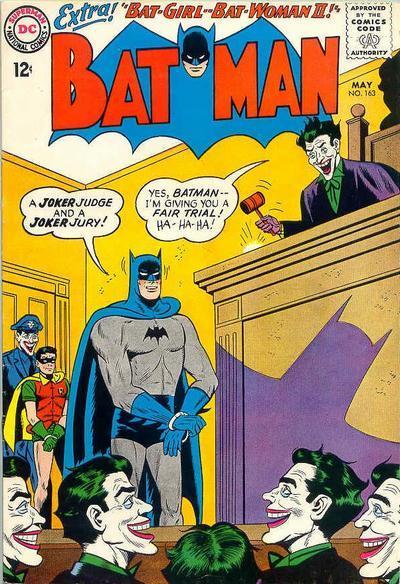
Above, you’ll find the cover of Batman #163, an issue published way back in 1964. We think that defendant Batman may have grounds for a motion for recusal of the the judge, but we doubt it will be granted. And if that’s the jury, we’d hate to see the venire panel.

Don’t forget: You can still nominate our fair site, Abnormal Use, for consideration in the ABA Journal‘s Top 100 Legal Blogs contest. But today is the very last day you can do so. The last day! See our earlier tongue in cheek plea for support here (which also provides instructions how to submit your nomination, which you know you want to do).

Blogger and Law Professor Alberto Bernade at The John Marshall Law School asks, “What’s with all the lawyer shows on tv?!” That, dear readers, is a question that we feel must be asked, especially in light of our recent reviews of the new legal dramas “Outlaw” and “The Defenders.” Just once, we’d like to see a television show in which the first year associates are enduring a harrowing week of document review. Or, perhaps, a program in which one junior associate’s problem of the week is a senior partner’s fondness for serial commas in a particular memorandum of law? Or an episode in which a first year associate’s biggest dilemma is how long it took he or she to draft an answer to a complaint?

Today sees the release of The Social Network, a film about the Facebook, a website. As the operators of a website, we here at Abnormal Use look forward to the day when Aaron Sorkin and David Fincher will craft a film about us. However, our contributor Kevin Couch insists that Leonardo DiCaprio play him in any such film, but we just don’t see it.

Apparently, there is a new law blog dedicated to legal productivity called, of all things, Legal Productivity. We’ll be checking it out. (Hat Tip: The Mac Lawyer).

Eric Goldman of the Technology and Marketing Law Blog has an interesting post on a new New York state case on the discoverability of deleted social networking profile data for impeachment purposes. Remember: Just because your Plaintiff has deleted those incriminating photographs and statements from their Facbeook profile, that doesn’t mean they’re gone forever, at least not yet.

Friday Links

Steven F. Coronado at the DRI Blog has this piece about the perils of jurors updating their Facebook statuses to reflect their thoughts on ongoing trials. If you’re on a juror, it’s probably best not to tweet that you can’t wait to render a guilty verdict.

Okay, now this is, well, awesome. Terry Tottenham, the President of the State Bar of Texas, quotes Bruce Springsteen lyrics not once, but twice, in his column this month in the Texas Bar Journal. Can you guess which two songs he quoted? See here for the column.

We welcome the newly launched South Carolina Tax Credit Blog to our state’s legal blogosphere. (Hat tip: South Carolina Business Law Blog).

We sometimes find ourselves nostalgic for law school, and then we realize what we must be thinking. A former teacher and now a brand new law school student, the author of the blog Tanny’s News recounts what happened last week to a student who was late to class: “One of my esteemed colleagues was late the second day of class, didn’t know the answers when called on the third day of class, and was late again the fourth day of class. In real life, our clients suffer the consequences of our mistakes. So, our whole class, except this student, has to spend the weekend writing a 5-6 page memo on the consequences of lawyers being late to court. As a teacher, I marvel at the brilliance of this plan. I used to do similar things to my students when 2/3 of them were involved in something and I couldn’t pick out which ones were innocent. I always felt badly for the innocent ones, but now I can truly understand how they must have felt.”

After a 21 month absence from the blogosphere, the South Carolina Bid Protests Blog triumphantly returns with a new post. Welcome back!

The Mac Lawyer has this post entitled “5 Essential iPad Apps for Students.” This makes us feel very old, as our only study aids were dusty old copies of Emmanuel outlines.

Here’s the first paragraph of the abstract from Lucille A. Jewel’s article, “I Can Has Lawyer? The Conflict Between the Participatory Culture of the Internet and the Legal Profession,” which is thought provoking: “The Internet allows citizens to comment on public affairs with an amplified and unfiltered voice, creating an open, community-based culture where robust debate flourishes. However, many of the ideals and practices of participatory culture clash with the traditional legal culture as it exists in the United States. This cultural conflict can be seen in emerging narratives, in the form of web blogs and lawyer emails that go “viral,” in which lawyers comment on the lack of humanism within big law firm hiring and firing practices; expose the alienating work environments experienced by low-level contract attorneys; or criticize judges who show hostility toward criminal defense attorneys. ” (Hat tip: Media Law Prof Blog).

We couldn’t resist sharing this gem at the My Legal Fiction blog, entitled “Woody Allen Jokes As Applied To Law School.” (Hat Tip: Legal Underground).

Friday Links

Finally, the occasionally salacious, always funny eavesdropping website Overheard in New York provides link fodder for a legal blog. See here for a recent courtroom exchange which a contributor to that site overheard and reported.

Meredith R. Miller of the ContractsProf Blog asks in this post if a website’s privacy policy constitutes a binding contract.

We’re a bit surprised that Lawyerist has to ask, “Do Lawyers Need Smartphones?” It’s 2010. Everyone needs a smartphone. Lawyers (arguably) are a subset of people, and thus, they need smartphones. Why would they not?

A Kansas driver has a vanity plate that says “So Sue Me.” (Hat Tip: Overlawyered). One of our contributors – we won’t say who – has a vanity plate that says “LACHES.”

Speaking of Overlawyered, that site’s Ted Frank is going on a speaking tour to various states, but not South Carolina. We hope he’ll make it our way soon.

We always knew that Facebook would be the end of all things good and just. In this post, the Technology and Marketing Law Blog reports the following: “The Eastern District of Pennsylvania recently concluded that a Facebook ‘friendship’ between a Temple University disciplinary board member and a witness may have procedurally undermined a disciplinary hearing.”

Friday Links

A judicial candidate in Florida may not personally promote his or her campaign on Facebook, says the Florida Judicial Ethics Advisory Committee in a recent opinion. However, the opinion does note that a committee working on behalf of the judicial campaign may establish such a Facebook presence; it’s just that the judge may not do so in his or her own personal capacity. (Hat tip: The Legal Profession Blog).

Hold onto your hats: The Workplace Prof Blog informs us that a new edition of The Bluebook has been published. Ah, The Bluebook. It will forever remind of those halcyon law school days when we performed citation checks on articles assigned to us by our law review editors.

The Detroit Free Press has a great article about crazy statutes still on the books. (Hat tip: The Business Law Prof Blog). Our favorite? It is illegal in Clawson to throw a snowball. Someday, perhaps, we’ll do a similar analysis of South Carolina laws.

We hope this one doesn’t go to litigation. The DRI Blog has a post entitled “Frozen Reptile Food Poses Salmonella Risk to Snake Owners.” Yikes. We’re at a loss.

Overlawyered reports on the interplay between the ADA and South Carolina courthouses.

Friday Links

  • Eric Goldman of the Technology and Marketing Blog has this post, entitled “Private Facebook Group’s Conversations Aren’t Defamatory.” In so doing, he profiles the recent case of Finkel v. Dauber, 2010 WL 2872874 (N.Y. Sup. Ct. July 22, 2010), in which the court was called upon to review a private group started by a group of puerile high school students and dedicated to making fun of a classmate, who brought suit for defamation. Goldman notes that “the group’s discussion is embarrassingly puerile and hearkens back to John Hughes’ bleak depictions of high school life.” Ah, high school.
  • The Tex Parte Blog has this post about the perils of attorneys attempting to follow up with an appellate court about the release of an overdue opinion. Apparently, counsel for the Plaintiff contacted with the Texas Supreme Court to inquire about a matter which had been pending before the court for four years. Eight days after the request was made, the Texas Supreme Court issued its opinion and ruled against the Plaintiff.
  • The title of this post at the Legal Profession Blog, “After Failed Witchcraft, Client in Love With Attorney Sought Hit Man to Murder His Wife,” says it all. A must read. Who knew workers compensation litigation could be so dangerous?
  • The North Carolina Business Litigation Report has this post entitled “A Tale of Reluctant Reconsideration in the Business Court.” In that post , author John Buford tells of a recent case in which the North Carolina Business Court “reconsidered and reversed the prior dismissal of a breach of fiduciary duty claim, but the principles it outlined should not give litigants high hopes for reconsideration motions in general.”
  • And, no, we here at Abnormal Use have still not yet seen Inception. Well, contributor Kevin Couch has, but he is under strict orders not to reveal any spoilers.

Friday Links

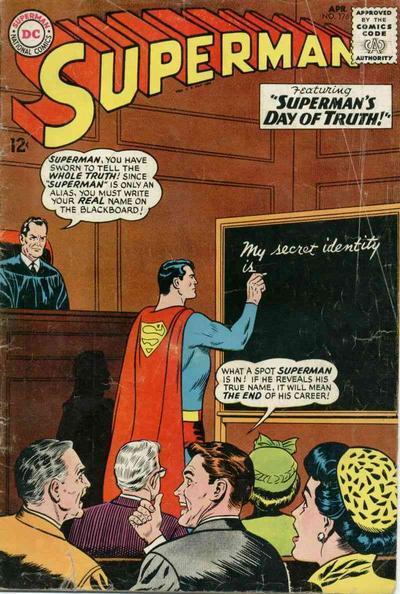
  • Check out the comic book cover above for Superman #176 (published way back in 1965). Superman has apparently just been sworn in as a witness, presumably at a criminal trial, and has been asked to state his name for the record. Why he decided to answer via chalk on a chalkboard seems peculiar, despite the dilemma he faces in revealing his identity in open court. Surely, the prosecution previously addressed this matter via motion in limine to thwart any attempt to place the Man of Steel in this tough spot. In fact, considering Superman’s role as a crimefighter, it is very likely that it would be the prosecution calling him as a witness to testify against the defendant, which begs the question: Why would the prosecution place Superman in this terrible, terrible position? Of course, the best bet may be for Superman to reply that his name is Kal-El, the moniker given to him by his Kryptonian parents. How could the defense attorney object to that?
  • “[W]e face a media landscape that would have been almost unrecognizable in 1978. Cable television was still in its infancy. The Internet was a project run out of the Department of Defense with several hundred users. Not only did Youtube, Facebook, and Twitter not exist, but their founders were either still in diapers or not yet conceived.” Fox Television Stations, Inc. v. Federal Commc’ns Comm’n, — F.3d —-, 2010 WL 2736937, at *7 (2d Cir. July 13, 2010) [PDF]. It was in that opinion that the Second Circuit struck down the FCC’s so-called “fleeting expletives” policy. We here at Abnormal Use are not certain why the court felt it necessary to reference the conception of social media company founders (and we wonder if some federal law clerk had to do that math). For more on that opinion, see this post by Christine A. Corcos at the Media Law Prof Blog.
  • A lesson from the Third Circuit: If you a a corporate officer that is a party to litigation, and your Chief Financial Officer is on the stand at trial testifying, don’t send him text messages about his testimony while the judge is conducting a sidebar with counsel. It’s generally bad form, and the judge will declare a mistrial. For more, see this post by Jeffrey Kuntz at The Florida Legal Blog.
  • J. Benjamin Stevens at the South Carolina Family Law Blog offers this post about the perils of litigants posting about themselves on Facebook.
  • Speaking of which, the South Carolina Court of Appeals this very week released Jennings v. Jennings, an opinion in which the issue was a husband’s claim that his wife had improperly logged into his Yahoo account, printed emails about his purported girlfriend, and provided said emails to her attorney and an investigator.

Friday Links

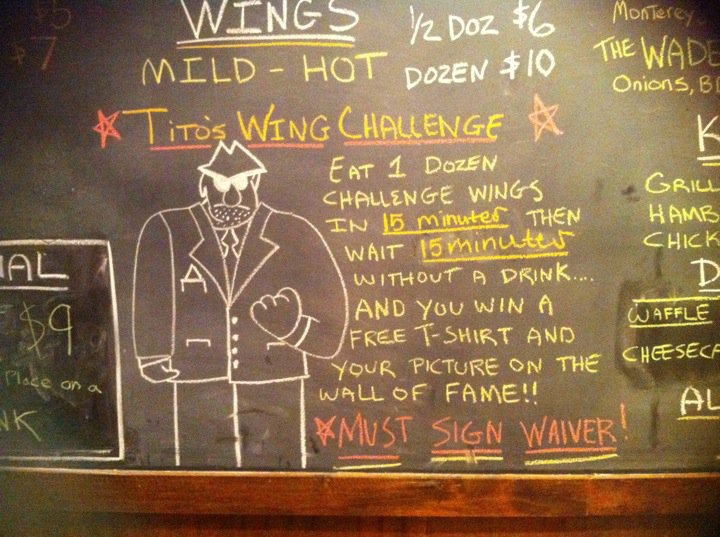
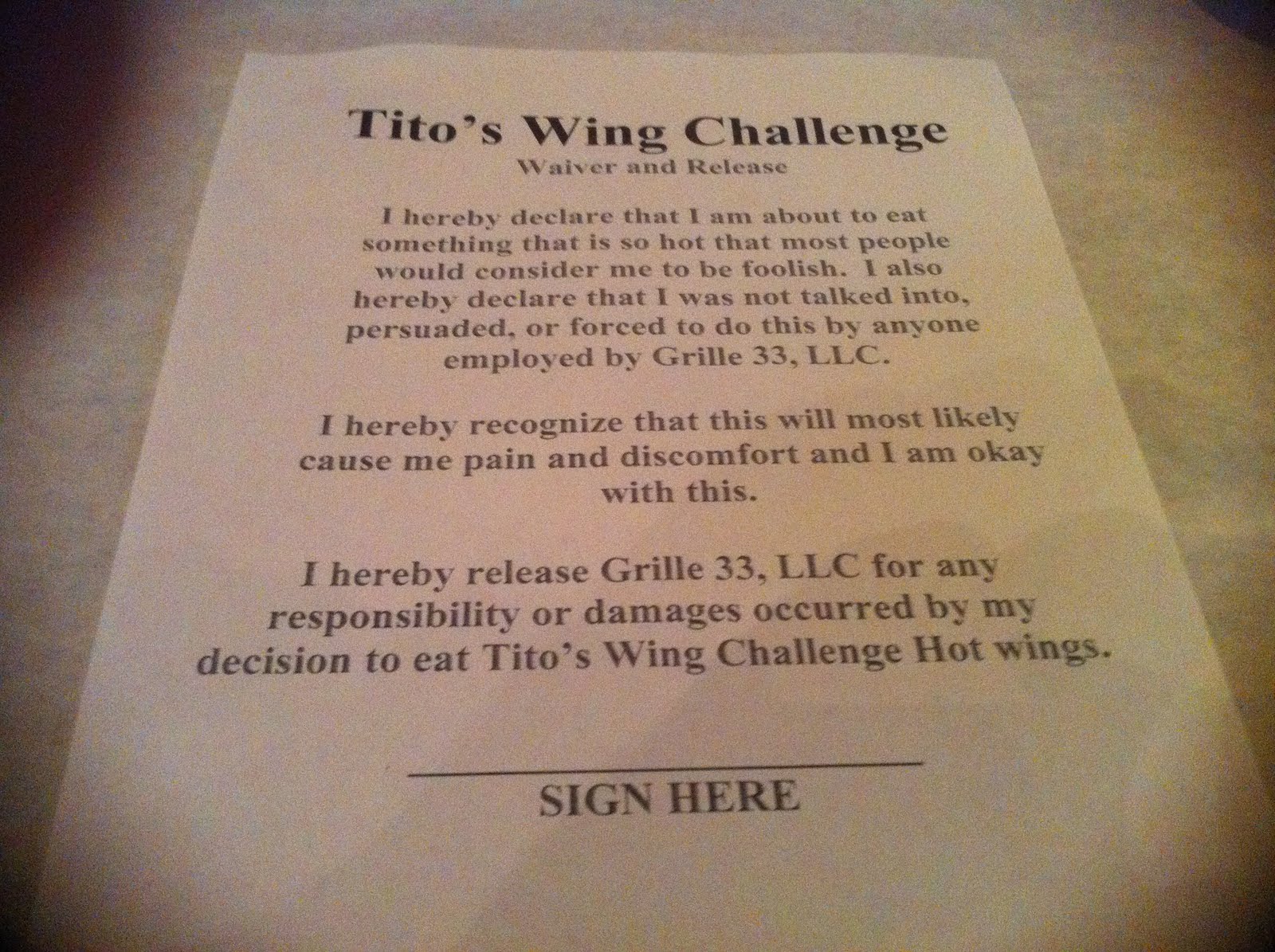
  • If there is one thing we here at Abnormal Use love more than wings, it’s liability releases arising from the consumption of wings. We recently learned that Grille 33 at the Channel, a burger joint that just opened up a block from our offices here in Greenville, has officially issued its “Tito’s Wing Challenge” (pictured above, click to enlarge). Note the stern pronouncement written in red chalk: “Must Sign Waiver.” Now, we here were too chicken to accept the challenge (as we have a very delicate palate), but we did manage to review the waiver in question (pictured below, click to enlarge). Someday, though, we will muster up the courage to take the challenge, but it shall not be today. No, not today.

  • The Texas Lawyer‘s Tex Parte Blog reports on a new iPhone 4 products liability suit recently filed in the U.S. District Court of the Southern District of Texas. Meanwhile, Randall Ryder at Lawyerist claims that “lawyers are wasting their money if they think [the iPhone 4] will add a new dimension to their practice.” Well, to that, we can only say, that but for our handy iPhone 4, we would not have been able to take those crisp pictures depicting the Tito’s Wing Challenge and the required liability waiver.
  • The Litigation and Trial Blog speculates that Facebook founder Mark Zuckerberg will not bring a defamation suit as a result of the upcoming film, The Social Network, which details the founding of Facebook. He might do some defriending, though, we suspect.
  • Jeffrey V. Mehalic of the West Virginia Business Litigation Blog spends some time talking about Barbour v. International Union, in which the Fourth Circuit adopted the last-served defendant rule for removal purposes. A good post, that. (We previously mentioned the Barbour opinion briefly here).

Friday Links

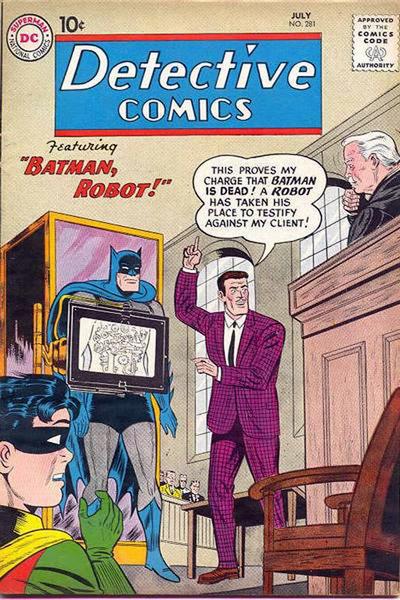
We think that there may be some junk science in the courtroom in the comic book cover depicted above, but unfortunately, Detective Comics #281 was published 33 years before Daubert. We’re not sure why Batman’s death is being litigated or why Robin is in the courtroom, but we would have advised some simple discovery requests on the Batman-as-robot issue, perhaps a request for admission along the lines of “Please admit whether you are a robot.” At least then a denial would have entitled the opponent to fees and costs.

South Carolina attorney J. Benjamin Stevens at The Mac Lawyer has this post, entitled “Top 10 Resources for Mac Junkies.” On a related note, the partners at our firm have still not supplied we few, we happy few, we band of bloggers with our own iPads.

Begins this New York Times article: “The singer and former Talking Heads frontman David Byrne has sued Gov. Charlie Crist of Florida, saying he used the Talking Heads’ song “Road to Nowhere” in a Senate campaign ad without permission.” We have nothing else to add to the news of this litigation, although it does provide us yet another opportunity to link to the fabled and extraordinary Fifth Circuit Talking Heads opinion.

James Parton has a post entitled “Obtaining Records from Facebook, LinkedIn, Google and Other Social Networking Websites and Internet Service Providers” at the DRI For the Defense blog. It’s worth a read, especially considering how challenging it is to actually obtain information from those types of entities in civil litigation.

Although it’s a bit out of our subject matter, we here at Abnormal Use are closely following the case of Justin Kurtz v. T&J Towing. Read more about it here. Based on the accounts of that dispute, how can you not be on Team Kurtz?

Jeffrey V. Mehalic at the West Virginia Business Litigation blog has this in-depth post on the recent Fourth Circuit opinion, In re: Abrams & Abrams, P.A., about which we blogged very briefly in last week’s edition of Friday Links.

As seen in the ABA Journal, a “new study finds that less attractive defendants fare worse in criminal cases when the jurors have an ‘experiential’ style of judging.” The author of the article, Debra Cassens Weiss, finds a nice way to say that “experiential” means not listening to the evidence and judging on legally irrelevant information. We would like to go on record that not all persons sporting a unibrow and English-style overbite are criminals. We would also like to see a study on how attractive lawyers fare versus less physically appealing advocates. Would you find for the ugly defendant represented by an objectively attractive counsel?

We are disappointed to learn that W. Lawrence Wescott of the Electronic Discovery Blog decided this week to end his blog. We enjoyed reading it.

The new South Carolina Business Law Blog celebrates its first two months of existence next week. Congratulations to them on that milestone, which is no small feat in the legal blogging world.