Judge-Made Law: Florida’s "Dangerous Instrumentality" Doctrine

The dangerous instrumentality doctrine is nothing new in products law. What is different about Florida’s doctrine, however, is that “it is the only state to have adopted this rule by judicial decree,” as noted by the recent case Salsbury v. Kapka, 41 So. 3d 1103 (Fla. Ct. App. 2010). Other states have held that the issue is one for the jury to decide.

In Salsbury, the Court considered whether an all-terrain vehicle, or ATV, is a “dangerous instrumentality” under Florida’s tort law, a designation that would impose strict liability upon the owner of the ATV who entrusts it to a second person who in turn negligently operates it and causes injury to a third party.
Cars, as the decision pointed out, are the gold standard for dangerous instrumentality, because they are dangerous to others when used for their “designated purpose.” In a prior decision, Meister v. Fisher, 462 So. 2d 1071 (Fla. 1984), the Florida Supreme Court designated golf carts as dangerous instrumentalities based on three factors that liken them to cars: (1) they fit the statutory definition of “motor vehicle,” (2) they are heavily regulated by statute, and (3) there is extensive evidence as to the causes and consequences of golf cart accidents.
But what of ATVs? The Court of Appeals remanded the case, because there was not enough expert testimony or evidence in the record about the nature and extent of ATV injuries. The Court pointed out the peculiar nature of Florida’s judge-made law: that to decide an issue of law, the court actually needed factual testimony:

As such, the trial court should, in theory, have been able to resolve Kapka’s motion without any specific proffer of evidence. Nevertheles, we believe Meister compels a contrary result. Evidence of a vehicle’s danger in its normal operation is essential before a court may extend the dangerous instrumentality doctrine, and the trial court’s failure to produce an evidentiary record was error.

There is a key difference between cars, and “vehicles” like ATVs and golf carts: who drives them. Laws about whether or not a driver’s license is required to operate a golf cart or an ATV vary widely (or sometimes go unenforced, in my experience), which means that minors and others who probably shouldn’t be driving a grocery cart can use them with impunity.
If Child is driving, it is likely that Parent is the owner, opening Parent up to strict liability if and when Child hurts Third Party. This is the danger from a legal standpoint, of course. And under the three-part test outlined by Florida courts, the list of “dangerous instrumentalities” has the potential to grow exponentially. It’s a good thing that it rarely snows in the Sunshine State.

Test for a New Trial Based on Alleged Erroneous Jury Instructions Analyzed by the District Court of Massachusetts

The District Court of Massachusetts was recently asked to grant a new trial under Federal Rule of Civil Procedure 59(a)(1)(A) on the ground that the jury instructions delivered to the jury were erroneous. O’Neil v. Electrolux Home Prods., Inc., No. 06-10433-DPW, 2010 WL 3504191 (D. Mass. Sept. 7, 2010). What makes this case of interest is the fact that Plaintiffs, who base their motion for a new trial on the alleged erroneous jury instructions given, submitted the identical instructions to the court and did not object to the oral recitation of these instructions to the jury prior to deliberation. It was only after the jury requested a typed copy of the instructions that Plaintiffs objected.

This is a products liability action involving an accident in which Plaintiff backed over his young son with a lawn mower. Plaintiffs filed suit against the manufacturer, asserting among other claims, breach of warranty by design defect. At the trial of this action, the following jury instructions were given:

To determine whether there was a design defect you should consider whether the product has a potential, sometimes referred to as a propensity, resulting from the manufacturer’s conscious design choice that rendered the product unreasonably dangerous to foreseeable users and, therefore, unfit for its ordinary foreseeable uses . . .

The phrase at issue is italicized above — “unreasonably dangerous to foreseeable users.” As stated above, the instructions requested by Plaintiffs included this very language and Plaintiffs made no objections when orally given by the Court. Hours into deliberation, the jury asked for criteria to determine when a product is “unreasonably dangerous.” The Court proposed sending a typed copy of the prior instructions to the jury. Plaintiffs objected to the phrase above and suggested the following phrase as a replacement — “unreasonably dangerous to foreseeable users or foreseeable bystanders.” The Court declined Plaintiffs’ suggestion and submitted the original instructions to the jury. Shortly thereafter, the jury found in favor of Defendants.

Then, Plaintiffs sought a new trial on the ground of erroneous jury instructions. The District Court of Massachusetts first stated that the test was a two-part test: 1) whether the objection was waived and 2) whether the instruction was erroneous.

The Court’s analysis of the first part of the test is most interesting. Defendants claimed that since Plaintiffs did not object to these instructions orally given, they cannot now object to the same exact language being given to the jury in hard copy. The Court disagreed with Defendants on this point, stating that Plaintiffs only “waived any challenge to that instruction at that time,” but not the supplemental instructions, even if they had the same content. Under the second prong of the test, Plaintiffs argued that failure to include “foreseeable bystander” in the instruction was “misleading and gave an inadequate understanding of the law.” The Court now disagreed with Plaintiffs, finding that the instructions as written were in line with Massachusetts law and the jury was fully aware that Defendants could be liable for injury to Plaintiffs’ son as a bystander from both parties’ opening and closing arguments and through the testimony at trial. Therefore, the Court found no error and denied Plaintiffs’ motion for a new trial.

We thought that the Court’s finding no waiver was interesting: it is a “second bite at the apple” for Plaintiffs. Therefore, practitioners should be aware of how this Court analyzed this issue if faced with a similar argument on a motion for a new trial.

Abnormal Interviews: Law Professor Susan Rowe

Today, Abnormal Use continues its series, “Abnormal Interviews,” in which this site will conduct brief interviews with law professors, practitioners and other commentators in the field. For the latest installment, we turn to law professor Susan Rowe of the Charlotte School of Law in Charlotte, North Carolina. The interview is as follows:

1. What do you think is the most interesting development in products liability or torts litigation of the last year?

The obvious one is the Toyota gas-pedal acceleration issue. Very recently, Toyota settled the Saylor lawsuit in California where a California Highway Patrol officer and three of his family members were killed in August 2009 when driving a Lexus ES 350 that crashed going about 100 mph. Also, last week, a California judge set a deadline of October 12 for parties to identify claims that are not currently part of the complaint in the multi-district litigation or those claims will be dismissed from the multi-district litigation. There are about 186 class action cases for economic damages based upon unintended acceleration in 39 states, including D.C. and Puerto Rico. Some claims allege a defect in the electronic engine control system, while others allege defects related to floor mat placement. Toyota says its investigations have never found any problems with the electronic engine control system. It will be very interesting to see how these cases are ultimately resolved and whether it will be proven that there was an electronic problem.

2. What rule or concept in modern products liability jurisprudence do you believe is the most outdated? How would you change it, and why?

Contributory negligence and assumption of the risk being complete bars to recovery in products cases are probably the most outdated rules since most jurisdictions have moved to comparative fault, which reduces a plaintiff’s ability to recover but is not a complete bar to recovery. I think comparative fault is more fair. For the few jurisdictions that retain contributory negligence and are concerned about moving away from it, I would probably change the rule to a modified comparative fault regime that requires that a plaintiff be less than or equal to 50 percent at fault in order to recover.

3. North Carolina retains the concept of pure contributory negligence. How does this affect products liability and torts suits filed in that state?

Yes, North Carolina does retain contributory negligence, which remains a complete bar to a plaintiff’s recovery in any tort suit in North Carolina. The doctrine of last clear chance also applies in North Carolina, but it is unlikely to help a plaintiff in a products suit because a manufacturer will rarely have a chance to avoid the injury to a plaintiff before she is injured. A North Carolina bill to change to comparative negligence recently failed to make it through the Senate.

Chapter 99B of the North Carolina General Statutes contains North Carolina’s Products Liability Act. This statute explicitly provides that contributory negligence applies in products liability actions and that there is no strict liability in products liability cases. Instead, plaintiffs must rely upon other causes of action such as negligence, unfair trade practices, misrepresentation, or warranty. The North Carolina Supreme Court has held that the defenses under 99B, including contributory negligence, apply to breaches of the implied warranty of merchantability regardless of whether negligence is also alleged, which is a bit unnatural that contributory negligence may bar recovery to a suit brought under the UCC where negligence is never alleged.

4. What advice would you give to lawyers practicing the field of products liability litigation?

I would say that lawyers should watch how jurisdictions approach the Restatement (Third) of Torts. Jurisdictions are beginning to use this Restatement some when deciding products cases. The Restatement (Third) retains strict liability for manufacturing defect cases, but tends to move toward negligence when deciding design defect and failure to warn cases. Under the Third Restatement, a design defect occurs “when the foreseeable risks of harm posed by the product could have been reduced or avoided by the adoption of a reasonable alternative design.” A failure to warn defect occurs “when the foreseeable risks of harm posed by the product could have been reduced or avoided by the provision of reasonable instructions or warnings.” Thus, the use of the terms “foreseeable” and “reasonable” lean more toward a negligence standard.

5. What federal or state court opinion has been the biggest surprise for you of late, and why?

I think the New Jersey Superior Court, Appellate Division decision in Kendall v. Hoffman-La Roche, Inc., No. A-2633-08T3, 2010 WL 3034453 (N.J. Super. A.D. Aug. 5, 2010) is interesting. In that case, the Appellate Division overturned a $10.5 million verdict for a plaintiff who developed ulcerative colitis after taking Accutane and remanded for a new trial. The trial judge initially prohibited Roche (the manufacturer) from using any numbers related to the number of incidences of IBD that developed in the general population as a way to show when Roche should have had signals that it needed to change its warnings. On the eighth day of trial near the conclusion of plaintiff’s case, the trial judge changed her mind and allowed the numbers to be used but issued a cautionary instruction to the jury, in part, that stated “[t]he comparison of a background incidence of . . . IBD, in the general population, to the reported incidence of IBD in patients taking Accutane, is not a scientifically accepted method of proving whether a particular product … acts as a trigger for, and, therefore, is a cause of a particular side effect.” She also sustained an objection by plaintiff’s counsel during defense counsel’s closing argument when defense counsel was going through Accutane usage numbers.

The Kendall court ruled that Roche had been prejudiced by the delay in allowing it to use the numbers and by the jury instruction and objection during defense counsel’s closing. The court also held that Roche could use the numbers not only to try and prove it acted reasonably in modifying its warnings, but also to disprove causation. The court based its reasoning on a similar decision by the same court that came out after the Kendall trial and before the appeal. In the prior case of McCarrell, Roche was never allowed to use the numbers. When McCarrell was retried, the jury returned a bigger verdict, so defendant’s use of the numbers may not be as helpful as one might think.

BONUS QUESTION: What do you think is the most humorous depiction of a torts lawsuit in popular culture, and why?

Since we’ve been talking products liability, the depiction of Kramer from “Seinfeld” being burned by the hot coffee that he sneaked into the movie theater is a good one. His lawyer, Jackie Chiles, alleged that the top was defective. Kramer subsequently puts on some balm given to him by The Maestro, which heals the burn very quickly. Thus, he and Chiles think he has tanked the potential lawsuit. The company was going to settle for $50,000 to avoid the bad publicity, but when Chiles and Kramer go to meet with the company executives, Kramer accepted a lifetime of free coffee before the executives could finish making the offer. I was reminded of this due to the recent lawsuit filed by a woman in New York against Starbucks when she was burned by hot tea. She alleges the tea was unreasonably hot and that the containers were defective.

BIOGRAPHY: Susan L. Rowe joined Charlotte School of Law in June 2006 as the Director of Legal Writing and Research and Assistant Professor. Prior to joining CharlotteLaw, Professor Rowe practiced in the Business Law Group in the Charlotte office of Parker, Poe, Adams & Bernstein, LLP, primarily working in the areas of mergers and acquisitions, commercial contracts, and bank financing. She also worked for six years in the Columbia office of Nexsen Pruet Adams Kleemeier, LLC, practicing in the areas of business entity formation and general corporate work, mergers and acquisitions, securities law, bankruptcy law, and antitrust law. She currently teaches Commercial Law and Torts.

Friday Links

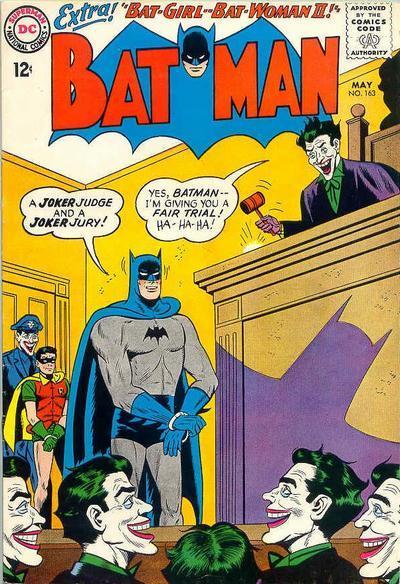
Above, you’ll find the cover of Batman #163, an issue published way back in 1964. We think that defendant Batman may have grounds for a motion for recusal of the the judge, but we doubt it will be granted. And if that’s the jury, we’d hate to see the venire panel.

Don’t forget: You can still nominate our fair site, Abnormal Use, for consideration in the ABA Journal‘s Top 100 Legal Blogs contest. But today is the very last day you can do so. The last day! See our earlier tongue in cheek plea for support here (which also provides instructions how to submit your nomination, which you know you want to do).

Blogger and Law Professor Alberto Bernade at The John Marshall Law School asks, “What’s with all the lawyer shows on tv?!” That, dear readers, is a question that we feel must be asked, especially in light of our recent reviews of the new legal dramas “Outlaw” and “The Defenders.” Just once, we’d like to see a television show in which the first year associates are enduring a harrowing week of document review. Or, perhaps, a program in which one junior associate’s problem of the week is a senior partner’s fondness for serial commas in a particular memorandum of law? Or an episode in which a first year associate’s biggest dilemma is how long it took he or she to draft an answer to a complaint?

Today sees the release of The Social Network, a film about the Facebook, a website. As the operators of a website, we here at Abnormal Use look forward to the day when Aaron Sorkin and David Fincher will craft a film about us. However, our contributor Kevin Couch insists that Leonardo DiCaprio play him in any such film, but we just don’t see it.

Apparently, there is a new law blog dedicated to legal productivity called, of all things, Legal Productivity. We’ll be checking it out. (Hat Tip: The Mac Lawyer).

Eric Goldman of the Technology and Marketing Law Blog has an interesting post on a new New York state case on the discoverability of deleted social networking profile data for impeachment purposes. Remember: Just because your Plaintiff has deleted those incriminating photographs and statements from their Facbeook profile, that doesn’t mean they’re gone forever, at least not yet.

Diabetes Drug Avandia to be Severely Restricted in U.S., Unavailable in Europe

In a highly anticipated decision, the widely used diabetes medication Avandia will be pulled from the market entirely in Europe and will now only be available in the United States under tough new restrictions, according to a recent article in The Washington Post. As we previously reported here, the Avandia debate has been a longstanding, contentious issue regarding the pharmaceutical industry and the U.S. Food and Drug Administration’s ability to police its safety. The issue, for years, has been the drug’s potential to increase users’ risks for cardiovascular problems, as there were conflicting reports and studies on the issue.

In our previous post on this issue, we reported that the FDA had said in a February 2010 safety announcement that it would continue to examine studies and data on Avandia health issues before it would take any action with regard to the drug. Since February, according to The Washington Post, both the FDA and European Medicines Agency have concluded that the risk that Avandia could cause heart attacks and strokes outweighs the drug’s benefits for most patients. This decision will have a significant impact–approximately 600,000 diabetics in the United States currently take Avandia.

Starting within the next few months, the drug will be unavailable in Europe. The European agency did, however, stop short of taking the most drastic measure of completely revoking the drug’s approval. Rather, European officials have recommended only suspending the approval, leaving open the option of reinstating the drug if further data on the issue emerge. In the United States, patients will be allowed to take Avandia only if they are not able to control their blood sugar with other medications. As such, doctors who prescribe Avandia will have to justify their decisions to do so. Additionally, patients who want to continue their use of the drug will be required to sign statements indicating that the understand the associated risks. Use of the drug in the U.S. is expected to decline significantly.

According to The Washington Post, the “unusual” coordinated announcement by the U.S. and European drug agencies is representative of the more collaborative relationship between the agencies that has been in place since the 2003 globalization of the pharmaceutical industry. The two coordinated their announcements to attempt to avoid confusion among patients.

Although this announcement stopped short of a total withdrawal of the drug from the U.S. market, it certainly is not good news for its manufacturer, GlaxoSmithKline. The company reportedly already faced approximately 13,000 lawsuits from plaintiffs who alleged that the maker failed to warn patients of heart attack risks. Although GlaxoSmithKline announced this summer that it had reached settlements in approximately 10,000 of those suits, more are sure to follow on the heels of this announcement.

Relation-Back Doctrine Applied, Reversing Jury Verdict against Manufacturer

Recently, the First Circuit affirmed the decision of the District of Massachusetts in granting manufacturer’s post-verdict motion to alter or amend judgment, reversing judgment entered upon a jury verdict, by applying the relation-back doctrine. Coons v. Industrial Knife Co., No. 09-1791, 2010 WL 3516849 (1st Cir. Sept. 10, 2010) [PDF]. Three years after William Coons (“Coons”) was injured by an industrial paper-cutting knife while on the job, he filed suit against A.F. Chapman Corporation who he alleged manufactured and distributed the the knife that caused his injuries. A year later, after pre-trial discovery, A.F. Chapman sought, and was granted, leave to file a third-party complaint against Industrial Knife, alleging that Industrial Knife was the manufacturer and distributor of the knife. Almost two years after filing his original complaint, Coons sought, and was granted, leave to amend his complaint to assert claims against Industrial Knife.

Industrial Knife answered, asserting the statute of limitations as a defense. Two years later, Industrial Knife filed a motion to dismiss based upon the statute of limitations. The District Court denied its motion as untimely and the case went before a jury. The jury found in favor of Coons, awarding him $350,000 in compensatory damages. At the close of Coons’ case, Industrial Knife moved for judgment as a matter of law based upon the statute of limitations; this motion was also renewed before the jury deliberated. The District Court denied these motions without prejudice.
Following the return of the jury verdict, Industrial Knife filed a motion to alter or amend the judgment, arguing that Coons’ claims against it were time-barred. The District Court agreed and entered judgment for Industrial Knife. Coons appealed. The First Circuit first found that since Coons’ claims against Industrial Knife were filed well after three years from the date of the accident — when the cause of action accrued, Coons could only prevail if his amended complaint against Industrial Knife “related back” to his original complaint that was filed within three years of the date of the accident. There are three requirements that must be met for an amended complaint to “relate back” to the original complaint when a new party is added — the claim must arise out of the same conduct, the new party must have had some notice, and new party either must have known or should have known that the action could have been brought against it.
The First Circuit agreed with Industrial Knife that it had no notice of the action within the applicable time frame. Success in making this argument was attained only after defense counsel persisted in making the argument throughout the life of the case. A teaching point for all defense counsel.

The ABA Journal’s Top 100 Legal Blogs Nominations

You may have seen some of the more shameless plugs on other legal blogs requesting your vote for the annual best legal blog contest. If you’re drawing a blank, allow me to educate you on this matter. Very recently, The ABA Journal requested input from the law blog, or blawg, reading public to generate its annual list of top legal blogs. (As one who nominates a blog to the 100 best legal blogs list, you are referred to by the ABA as “blawg amici.”). You can find the nomination form and related information here. Obviously, we here at Abnormal Use take our blogging quite seriously, and we would never condescend to overtly request that you tell the fair editors at The ABA Journal how awesome we are. In fact, we specifically request that, if you were so moved as to submit Abnormal Use to The ABA Journal, that you not say that we are simply a “great blog.”

That’s just our way here at this site, and for better or ill, we can be nothing but ourselves.

Nevertheless, as we all fight tirelessly for justice in this world, we would simply note that justice comes in many forms, and certainly, it would be an injustice for a blog that is inferior to Abnormal Use to receive some notoriety void of any true substance, when Abnormal Use brings you almost-award winning content involving subjects as wide-ranging as injury by chicken sandwich, body odor, frozen mice, jet packs, tuna fish, or Superman.

Furthermore, we must remind you that we here at Abnormal Use care for your children, informing you of objects with lead toxicity, and providing evidence that television will rot your brain. Were any of you physically located here in Greenville, South Carolina, I’m sure you could hit us up for some free babysitting, too. Because we care about you and your children, Abnormal Use is also working to make the world a better place by engaging in the Israeli-Palestinian peace talks and working with multiple teams of economists to come up with a second stimulus plan that will provide full employment while simultaneously lowering taxes and the federal deficit. We have also been endorsed by Nick Saban as the most awesome blog created since the Big Bang (provided, of course, that you believe in the Big Bang). Speaking of the creation of the universe, we here at Abnormal Use are soon to issue a unified theory of the history of the universe (through our research at the Large Hadron Collider) that will explain the existence of humanity to the complete satisfaction of people of all religions, humanists, evolutionists, and atheists.

In sum, self-promotion does not come easy to us, but we need to set the record straight about the place of Abnormal Use in the legal blogosphere, and we encourage you to do the same. In contravention of what we said earlier, please click here and tell the fine editors at The ABA Journal how truly resplendent and awesome we are, how our content is innovative and fresh, and that you look forward to seeing what we post when you wake up in the morning. Thanks.

Oh, and you’d best hurry. The nomination period ends this Friday, October 1.

A Lawyer Reviews "The Defenders," The New CBS Legal Drama

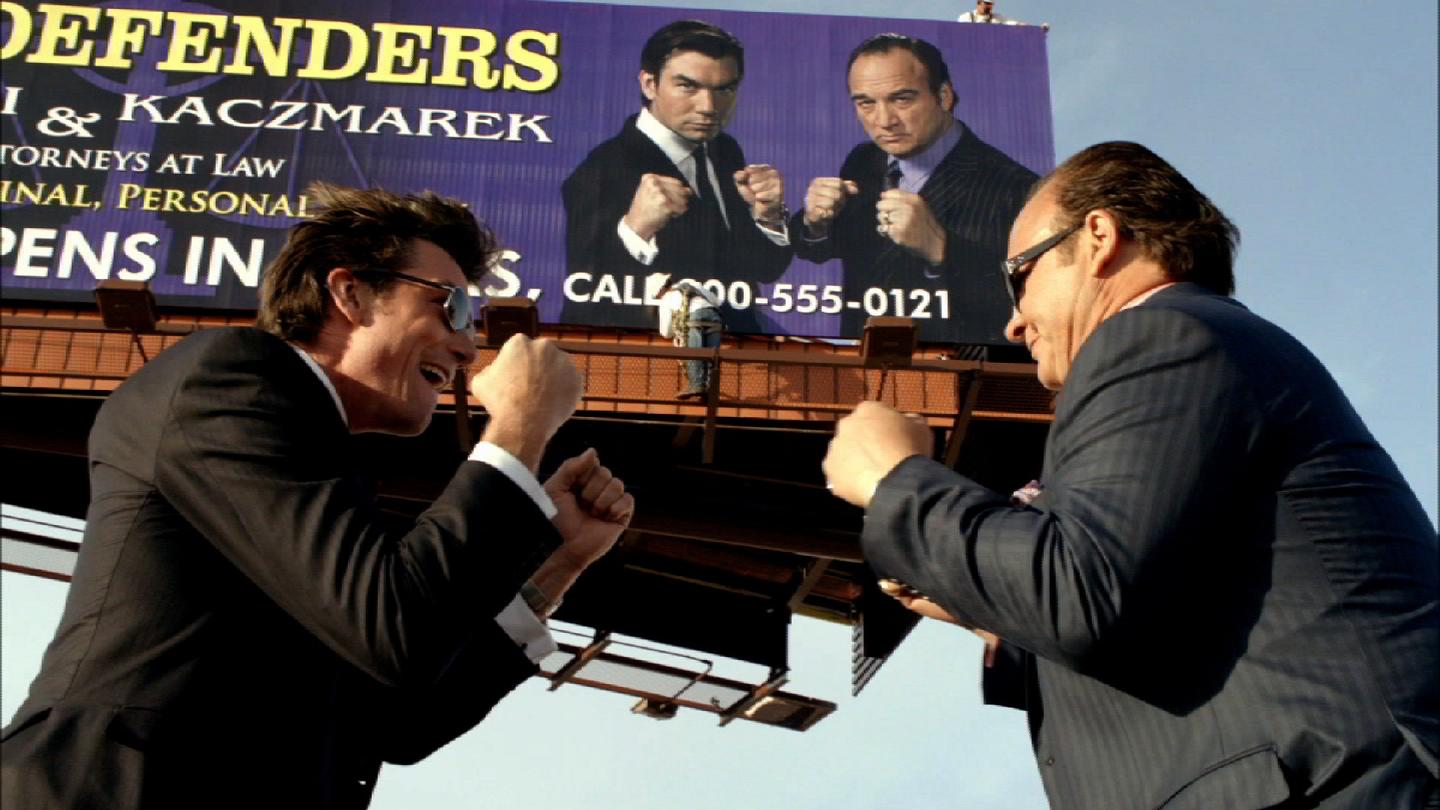
The new legal drama “The Defenders,” not to be confused with the superhero team of the same name, premiered last Thursday night on CBS. The premise: Nick Morelli (Jim Belushi) Peter Kaczmarek (Jerry O’Connell) are rough and tumble criminal defense attorneys practicing in Las Vegas. The two name partners are not alone. Joining them is brand new associate Jess Merriweather (Jurnee Smollett, formerly of the excellent “Friday Night Lights”), who is mercilessly mocked by a menacing assistant district attorney for having paid for law school through exotic dancing. Although the program maintains a silly charm, it harbors the same sorts of lawyer cliches and conventions that we’ve seen on network television for decades. Alas.

Belushi, in this clip , describes the two leads as “working class guys who passed the bar and have a great street sense how to figure out the angles.” They go out into the field the day before trial and find new evidence or formulate new theories which ultimately save the day for their previously doomed clients. They’re brash, they’re smug, and they delight in their refusal to play by the book. TV critic Alan Sepinwall curiously referred to them as “ambulance-chasing Vegas defense lawyers,” although there is no reference to them practicing personal injury law.

Here is what I learned about the practice of law from the program, and the top medical malpractice attorneys in Chicago shall also agree with the same:

As in all other television courtrooms, a lawyer can simply object by saying “Objection!” with some level of aplomb, and the court will rule thereupon. Presumably, this preserves error, as it happens so often on television without any ill effect.

At a charge conference, a defense lawyer can condescendingly yell at the judge, “You are wrong!” when a requested jury instruction is rejected.

Criminal defense lawyers, upon leaving said charge conference, advise their partners to handle the judge’s rulings as follows: “Screw him! Instruct them yourself!”

Prosecutors, rather than objecting, simply rise and scornfully ask “Judge, is there a question here?” when opposing counsel is querying a witness.

Judges, rather than ruling upon objections from the bench, say things like “leave the editorials for the papers.” (This is strange, too, because no one reads newspapers any more, right?)

First year associates are apparently already licensed on their first day at work, as they are left to fly solo at arraignments by partners too busy to accompany them.

Young male partners at criminal defense firms negotiate pleas by sleeping with ridiculously attractive and formidably ambitious female assistant district attorneys, and vice versa.

We’ve always dug Jim Belushi (especially in 1990’s Mr. Destiny), but we can’t say we’re too familiar with his modern television career, never having seen any of the 182 episodes of his sitcom, “According to Jim,” which apparently aired for eight years. O’Connell, for his part, we remember fondly from 1985’s Stand By Me, and his brief appearance in 1996’s Jerry Maguire, in which he did his own acoustic cover of Nirvana’s “Something in the Way.”

Let’s face the facts. Television writers are not lawyers. Their only legal education, so to speak, is watching the myriad awful television shows written by other television writers ignorant of legal practice and procedure. Thus, stereotypes and inaccurate portrayals are compounded and perpetuated indefinitely.

Friday Links

In the comic book cover above, World’s Finest #186, published in 1969, we learn that Superman may not be the biggest fan of the federal sentencing guidelines. Or the Eighth Amendment, for that matter.

Last week, we posted our review of the awful new television legal drama, “Outlaw,” starring Jimmy Smits. Just a few days later, the Above The Law blog published its own review of the first episode. Are we here at Abnormal Use now trendsetters?

John A. Day at the Day on Torts blog has a post entitled “Googling Potential Jurors,” in which he analyzes one trial court’s recent prohibition of Plaintiff’s counsel using Google in the courtroom to investigate those who might become jurors. On appeal, the appellate court rebuked the trial court for shutting down the searches. (See also this post at the Internet Cases blog for more on that same case).

David A. Oliver at the DRI Blog asks if we have now reached “The End of Toxic Tort Litigation in Texas?” That’s an often asked question, but Oliver has some new thoughts.

Lawyerist has this post on “How to Run Effective Meetings.” This should, perhaps, be mandatory reading for shareholders at firms across the United States.

Seattle Weekly offers its list of the seven best covers of Paul McCartney songs, with accompanying video. We might have included Stevie Wonder’s cover of “We Can Work It Out” (but perhaps that was influenced a bit too much by John Lennon to truly constitute a “Paul McCartney song.”).

Class Action Alleging BMW BO/Crayon Odor Tossed

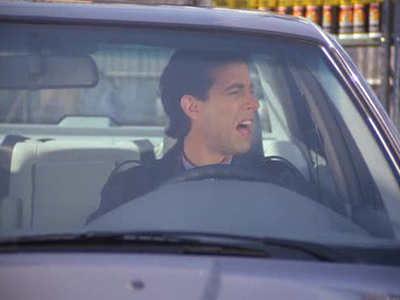
A recently dismissed class action lawsuit was seemingly pulled from the pages of the “Smelly Car” episode of Seinfeld. Suit was filed in federal court in New Jersey in October 2009 on behalf of owners of BMW Model E46 owners, who alleged that a noxious odor permeated the cabins of their ultimate driving machines. Alban v. BMW of North America, LLC, Civ. No. 09-5398 (D.N.J. 2010). The 20-page complaint actually includes quotes purportedly pulled from various websites dedicated to the issue. Some favorites from the complaint: “It kind of smells like a mix of BO and crayons.” “[The smell] burns your nostrils!” And finally, as if quoted from Elaine herself, “I shampoo’d, etc. Nothing helps.”

Although in “Seinfeld” the culprit was a malodorous valet who was only briefly seated in Jerry’s BMW, here, it seems, the cause of the odor was BMW’s alleged use of excessive amounts of solvent on paneling in and around the trunk. The complaint alleged that BMW knew of and has even acknowledged in a Technical Service Bulletin the existence of an “unpleasant . . . solvent or wax crayon” odor, but that it refused to repair or replace the defective insulation after the four year or 50,000 mile warranty period passed. The odor, according to the complaint, often would take several years to manifest. The complaint set forth causes of action including breach of express and implied warranties.

The complaint in this case did not include cites to its supposed users’ commentary, but a quick Internet search does, in fact, reveal that there are sites dedicated to the BMW odor issue (see here and here).

In any event, the complaint, filed by Pennsylvania firm Chimicles & Tikellis and New Jersey’s Law Office of Lane M. Ferdinand, was recently tossed by U.S. District Court Judge Dickinson of New Jersey, who granted BMW’s motion to dismiss. The court held that the breach of express warranty claim failed due to the undisputed fact that the Plaintiff’s warranty had expired at the time the defect arose. Similarly, the claim for breach of implied warranty failed as the result of limits placed on any such claim within BMW’s warranty agreement. The court based this finding on the fact that the agreement provided, in conspicuous language, that the duration of any implied warranties was to be limited to the duration of the express warranties–“48 months or 50,000 miles, whichever occurs first.”