The Tylenol Recall

Just in time for the height of the spring allergy season, a voluntary recall was announced on April 30, 2010 for numerous over the counter allergy treatment medications and pain relievers produced by McNeil Consumer Healthcare. This is the second major recall for Tylenol products this year. As you may recall, in January, there was a recall of the adult pain reliever due to concerns about mold. The products recalled were for children and infants which has created somewhat of a panic. McNeil’s most recent press release detailed the reason for the new recall:

McNeil Consumer Healthcare is initiating this voluntary recall because some of these products may not meet required quality standards. This recall is not being undertaken on the basis of adverse medical events. However, as a precautionary measure, parents and caregivers should not administer these products to their children. Some of the products included in the recall may contain a higher concentration of active ingredient than is specified; others may contain inactive ingredients that may not meet internal testing requirements; and others may contain tiny particles. While the potential for serious medical events is remote, the company advises consumers who have purchased these recalled products to discontinue use.

As can be seen, McNeil has cited quality control standards as being the reason for the recall. The buzz in the blogosphere and in the online news outlets references the presence of bacteria in at least one facility. At this point, it appears that the concerns are not as dire as the buzz would like to portray them. In this report from the Associated Press, Deborah Autor, director of the Food and Drug Administration’s drug compliance office, was quoted as stating that the risk, at this point, to consumers was “remote.” What may eventually come of the recall is too hard to predict at this point. However, with the FDA considering additional steps in the investigation, this is definitely an issue that we will need to continue to monitor. A complete list of the products that were involved in the most recent recall can be found here.

When Is a Product Sold?

I am honored to have the Cinco de Mayo post, and, in honor of this holiday, please ponder with me the age-old question, when does a bucket truck become a bucket truck? In Campbell v. Altec Industries, Inc., No. 09-13472, 2010 WL 1740691 (11th Cir. May 3, 2010) [PDF], the Eleventh Circuit certified a question to the Georgia Supreme Court to decide an statute of repose issue. Campbell worked for Georgia Power Company and was injured when a cylinder on a bucket truck, owned by Georgia Power, failed. Campbell sued the manufacturer of the truck (“Altec”) and the manufacturer of the defective lift cylinder (“THI”). The statute of repose limits the timing of a products liability action to “ten years from the date of the first sale for use or consumption of the personal property causing or otherwise bringing about the injury.” The certified question asks whether the statute of repose begins to run when

(1) a component part causing an injury is assembled or tested, (2) a finished product, which includes an injuring component part, is assembled, or, (3) a finished product, which includes an injuring component part, is delivered to its initial purchaser?

Id. The district court ruled that the statute of repose began to run on January 14, 1998, when Altec placed the completed lift assembly on a test chassis and operated it. “The final assembly of the lift cylinder and placement onto the bucket truck, however, did not occur until sometime in March 1998. The initial delivery to the ultimate purchaser, Georgia Power Company, then occurred in April 1998.” Id. The district court’s order granting the defendants’ motion for partial summary judgment shed’s more light on the facts, noting that Georgia Power initially ordered the bucket truck in March 1997 from Altec, and Altec purchased the lower lift boom cylinder in October 1997. The district court essentially reasoned that Altec purchased the cylinder for production of the truck ordered by Georgia Power, and the completion of the lift assembly on January 14, 1998, which could operate independently of the truck itself, was the moment triggering the statute of repose.

Thus, the relevant inquiry is not when the bucket truck ultimately entered the stream of commerce or whether it was operating as it was intended but rather the movement and function of the lift.

Order, Campbell v. Altec Indus., Inc., No. 08-CV-0810 (N.D. Ga. Feb. 19, 2009) [DE #56]. As shown above, the dates matter, because if the statute of repose was triggered by the assembly of the final bucket truck or its delivery, then Campbell’s suit is timely.

It will be interesting to see what Georgia does with this case. The case will impact vehicles that do something in addition to being vehicles (fire trucks with ladders) in addition to finished products made from components that can function independently of the finished product. I like the defendant-friendly ruling, but I don’t know if it will hold up in a different factual scenario, e.g., firefighter deaths from a defective ladder assembly.

Defective Vacuum Sucks Hair Out of Scalp, Suit Says

An Illinois woman has recently filed suit against Ohio-based vacuum manufacturer The Kirby Company for $200,000, reports the Chicago Sun-Times, alleging her defective vacuum cleaner broke during use and sucked the hair out of her scalp.

The complaint, filed in U.S. District Court in Illinois on April 23, reportedly sets forth that the vacuum was “defective and unreasonably dangerous” and that Kirby sold the vacuum without adequate testing and without proper warnings of the hazards of personal injuries. The plaintiff’s Chicago-area lawyer, Thomas A. Reed, to whom the plaintiff referred all questions, has told the media that his client was using the vacuum hose to clean underneath her bed when the attachment broke, “causing a tremendous sucking that took her hair right into the machine.” He declined to discuss the extent of his client’s injuries, but did indicate that she was rushed to the emergency room after the incident.

The suit has generated considerable discussion. See local Chicago NBC coverage here, where a poll shows that 79 percent of Chicago locals think the story is laughable, or commentary here, where one writer notes the marketing potential (“Hairs on the floor don’t stand a chance!”).

In spite of the skepticism surrounding the suit, there appears to be evidence to suggest her claim may have legs. Video coverage at Fox News includes pictures of the woman’s scalp allegedly showing the injury to her head. The pictures were thought to be so disturbing that the affected area of the woman’s scalp were blurred for the television clip.

It’s certainly an interesting set of facts. We’ll have to see where this one goes.

Foreseeable Misuse in Pennsylvania

Does foreseeable misuse have a place in determining liability in a products liability action? In Pennsylvania, it doesn’t. Recently, the Third Circuit, applying Pennsylvania law, rejected a consumer’s argument that the meaning of “intended use” included all uses “reasonably foreseeable” by the manufacturer. Jacobson v. BMW of North America, LLC, No. 08-4322, 2010 WL 1499809 (3d Cir. Mar. 23, 2010).

In 1999, Robert Jacobson (“Jacobson”) went to do errands with his two sons, Ryan and Christopher, in his BMW 325i. Jacobson stopped at a convenience store, parked, placed the gear shift in park, turned off the engine, engaged the emergency brake, removed the keys from the ignition, and exited the vehicle, leaving his sons inside. Ryan, playing with the gear shift, placed the vehicle in reverse or neutral and the vehicle began to roll. Christopher exited the vehicle without injury. However, Ryan sustained severe injuries as a result of his exit from the vehicle. Thereafter, Jacobson filed a action against BMW alleging that it should have had a device in place that would have prevented the car from shifting out of park.

At trial, the jury returned a verdict in favor of BMW. Jacobson filed a motion for a new trial, which was denied, and filed the present appeal. Jacobson raised four errors on appeal, including an argument that the court gave an erroneous jury instruction on the definition of “design defect.”

Under Pennsylvania law, “a manufacturer can be deemed liable only for harm that occurs in connection with a product’s intended use by an intended user.” On appeal Jacobson cited to two Third Circuit opinions, Pacheco v. The Coats Co., 26 F.3d 418, 422 (3d Cir. 1994) and Sheldon v. West Bend Equipment Corp., 718 F.2d 603, 608 (3d Cir. 1983) for the proposition that “intended use” under Pennsylvania law includes all uses “reasonably foreseeable by the manufacturer.” The Court disagreed and held that this proposition had been expressly rejected by the Pennsylvania Supreme Court in Pa. Dep’t of Gen. Servs. v. U.S. Mineral Prods. Co., 898 A.2d 590 (Pa. 2006). The Court found no error in the underlying court’s decision to omit “foreseeability” from its jury instruction on “intended use.”

This case seems to represent the current state of Pennsylvania law; however, practitioners and courts alike recognize the potential for change. As recognized by the Eastern District of Pennsylvania in July 2009, McGonigal v. Sears Roebuck and Co., No. 07-CV-4115, 2009 WL 2137210 (E.D. Pa. Jul. 16, 2009), Pennsylvania courts note that “negligence concepts should not be imported into strict liability law.” However, the McGonigal court also stated that “[t]he role of negligence concepts in strict liability doctrine in Pennsylvania features numerous unsettled issue of law.” The Supreme Court of Pennsylvania was recently afforded the opportunity to clarify strict liability law in Bugosh v. I.U. N. Am., Inc., 971 A.2d 1228 (Pa. 2009) — as recognized by Drug and Device Law blog back in April 2009 — however, the appeal was dismissed as been “improvidently granted.” As a result, Pennsylvania law still contains inconsistencies with the hope for clarification someday.

Friday Links

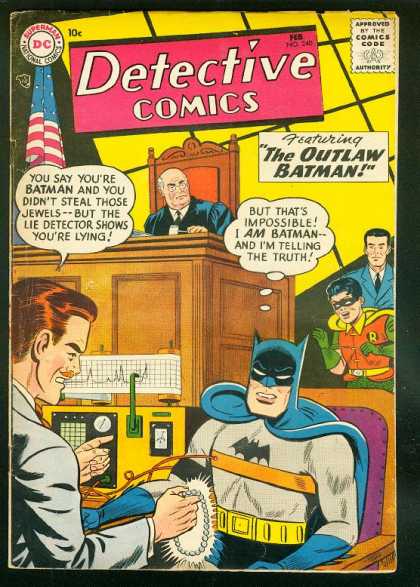
We couldn’t resist revisiting one of our favorite Friday topics: the courtroom, as depicted on old superhero comic book covers. Above, in Detective Comics #240 (which was published way back in 1957), Batman, the defendant, is apparently on the witness stand being questioned during a robbery or burglary trial, all the while hooked up to a polygraph machine. (Gotham must not be a Frye jurisdiction.). Also of concern is the fact that Robin appears to be up to something, and we’re not certain that the bailiff can handle a melee with a superhero, even a sidekick. (But then again, perhaps the Boy Wonder is simply leaning in to taunt Batman and suggest that even Hawkman could have beaten the lie detector.). The simplest solution may have been for Batman to take George Costanza’s sage advice:


When it comes to jury service in federal court, you’d best not mess around.

Earlier this week, our intrepid blogger Kevin Couch took on the law of Mardi Gras, going so far as to analyze the old tossed-coconut fact pattern. Walter Olson at Overlawyered links Kevin’s post and also directs our attention to some other Mardi Gras coconut posts.

If you happen to find yourself in Columbia, South Carolina this evening, and you dig live music, be certain to stop by The Elbow Room to see the South Carolina Bar Young Lawyers Division’s Justice Jam. Seven bands, each with at least one attorney member, are on the bill, all for a good cause: raising money for Sexual Trauma Services of the Midlands. For more information, see here. (By the way, if you’re not following the South Carolina Bar on Twitter, why aren’t you?)

California Magistrate Scoffs at Plaintiff’s MySpace Page, But Awards Damages Anyway

Yet another case illustrates why defense counsel, including products liability litigators, should be mindful of the ever changing landscape of social media and its potential for impeachment of Plaintiffs in litigation. That case is the recently issued Sedie v. United States, No. C-08-04417, 2010 WL 1644252 (N.D. Cal. April 21, 2010). In that case, the Plaintiff sued the federal government under the Federal Tort Claims Act after a 2006 automobile accident during which he, riding a bicycle, was struck by a postal vehicle. Both parties consented to a bench trial before U.S. Magistrate Judge Elizabeth D. LaPorte, which took place this past February. In her “Findings of Fact and Conclusions of Law Following Court Trial,” Judge LaPorte ultimately found that the Plaintiff had established the government’s liability and awarded damages in the amount of $297,624.66.

Even though the magistrate ultimately found for the Plaintiff, in reviewing some of the submitted damages evidence, the magistrate noted the contradictions between Plaintiff’s purported damages and Internet evidence uncovered by defense counsel:

Other evidence also undermines the extent of Plaintiff’s general damages. Plaintiff testified that he spends much of his time lying down, and there are times that he does not leave his room because he is depressed about his overall situation. However, the Court finds this testimony is only partially accurate, and is exaggerated given the other evidence of his actual activities and his pattern of exaggeration. For example, Plaintiff’s online writings show that his life was not constantly “hell on earth” as he claimed. Plaintiff maintained his pages on MySpace and Facebook since the accident, and as of January 12, 2010, his MySpace page listed various activities and hobbies, and friends of Plaintiff. Plaintiff wrote entries on his MySpace page, including one on June 3, 2007, in which he described painting as a frustrating activity when his arm hairs would get caught in paint. Yet painting was on the list of activities that Plaintiff claims were adversely affected by the accident. Plaintiff also testified that he had not done any painting since the accident, but the MySpace entry was written in the present tense at a time just prior to his microdiscectomy. Plaintiff testified that the MySpace entry was a joke, but the Court did not find the testimony credible.

Id. at *23 (emphasis added; citations omitted).

Plaintiff’s attorneys continue to warn their current and potential clients of the potential adverse impact of Facebook and MySpace profiles. For the most part, these clients do not appear to be heeding that advice. That is why the diligent practitioner will always survey the Internet to determine whether a given Plaintiff has established profiles on such sites.

Partying at Mardi Gras

Obviously, we vet all posts here to an abnormal extent, seeking to bring you, our readers, content that is timely, thoughtful, and based on rigorous and bulletproof analysis. Because of this tireless dedication to the truth, we need to set the record straight on a subject of great importance to us all: Mardi Gras.

Fellow blogger Brett Burlison runs a plaintiff-oriented blog in San Francisco, and he recently authored a post entitled “Product Liability Gets More Difficult.” The post is reproduced below:

Let’s say you decide to head south and enjoy Mardi Gras. But let’s also say that you have the unfortunate distinction of being harmed by a float. Maybe the float collapses and falls on you or maybe you suffer personal injuries due to one of the vehicles in the parade.

In any event you’re injured. You would think that there would be laws that protect you and other injury victims like you in such a situation and that make sure you are adequately compensated for your injuries – made whole.

Well, not so fast – the legislature in Louisiana is considering a bill that would actually make it harder for injury victims to be compensated if they are harmed at Mardi Gras. According to media reports, a bill has been introduced by a state representative from New Orleans that would require proof of gross negligence or a deliberate act in order to hold a company that makes floats for Mardi Gras liable for damages due to injuries of death.Two years ago an individual was crushed by a float that was defective. Advocates for injury victims believe that the bill has been introduced to simply shield float manufactures from liability for future similar events.

That’s not really the case. As reported here, and as evident from the language of the bill, the limitation of liability does not extend “to any claim or cause of action against a manufacturer or lessor for damages arising from the failure in the design, manufacture, or maintenance of the trailer or float.” H.B. 902, 2010 Reg. Sess. (La. 2010). Rest assured that, were you to be injured by a float, your products liability action would be available, although I’m not sure how to define the “user” of a float.

Apparently there was some confusion as to the scope of the bill, with the bill’s sponsor merely wanting to limit the filing of frivolous lawsuits, i.e., potential plaintiffs severely injured by beads thrown from the float. But there is some question about a constituent of the bill’s sponsor benefiting from the bill. As an example of the type of lawsuits filed, see the New Orleans Metro Crime and Courts News, discussing the appeal of a case of a woman injured by a flying coconut. She claimed injuries including a cut to the forehead, a loss of interest in Mardi Gras, and “nightmares of airborne coconuts.” Apparently, in the olden days of Mardi Gras, persons riding on the float could hurl the coconuts at onlookers and be protected from ordinary negligence. Although the coconut crowd has adopted a tamer, “handing out” policy, other groups still toss “missiles” such as beads, cups, and doubloons from their floats.

On the legal side, surely this move is motivated to protect Mardi Gras from Lousiana’s system of pure comparative negligence, where any drunken reveler in any other setting may run up defense costs and potentially obtain a recovery even if he is 99 percent negligent in causing his own injury. (The coconut article notes the tens of thousands in legal fees spent solely by one group in defense of claims). Nevertheless, if you choose to attend Mardi Gras, beware of flying objects, and plan out your legal theory about how you were using a float at the time of your injury.

Abnormal Interviews: Law Professor Mary J. Davis

Today, Abnormal Use continues its series, “Abnormal Interviews,” in which this site will conduct brief interviews with law professors, practitioners and other commentators in the field. For the third installment, we turn to law professor Mary J. Davis of the University of Kentucky College of Law. A products liability professor, she co-authored the products liability treatise, Owen, Madden and Davis on Products Liability. The interview is as follows:

1. What do you think is the most significant new development in products liability of the last year?

I think that the whole question of preemption continues to be the most significant new development in products liability in the last two decades and every time the Court decides a question, it is a significant new development. For example, when the Court found no implied preemption in the pharmaceutical labeling case, Wyeth v. Levine, in late 2009, that was a huge development given that the Court had been forecast to be friendly to preemption in that case and it was not. And now the Court is poised to answer another preemption case, Bruesewitz v. Wyeth, involving express preemption under the National Childhood Vaccine Injury Compensation Act. Any time the Court decides a preemption case, it’s a significant new development. Other than that, I think the Consumer Products Safety Improvements Act implementation is significant if only because the changes made in 2008 by the statute reflect a substantial re-focus on regulating product safety from the federal regulatory side.

2. What rule or concept in modern products liability jurisprudence is the most outdated? How would you change it and why?

No or limited liability for successor corporations. Come on. You shouldn’t be able to sell your company to get out from under liability that can be established under applicable law at the time of the product’s sale no matter how much it might make business sense to try to avoid that liability. I would expand the product line exception so that if the company continues to sell the product, or any variant, liability will continue to apply to products sold by the predecessor.

3. Generally, how would you characterize the media coverage of products liability?

Extremely weak. I think top journalists do a good job; I have read good material in The New York Times, Wall Street Journal and Washington Post on the Toyota recall and litigation frenzy, for example. Generally, though, I think the media does not try to understand even the basic features of products liability, much less the nuances. I would like to see more time/pages devoted to explaining products liability law and the litigation system. The public needs it. I am personally often reluctant to talk to the press, however, and, when I do, the most ridiculous, out-of-context information comes through. It is difficult to use the media to give a civics lesson, but the media should be more interested in clarifying the public’s understanding of the legal system than it appears to be.

4. What advice would you give to lawyers practicing products liability in 2010. What should they be looking out for?

I have not practiced since 1991, so I should be asking your readers what advice they would give me in training lawyers who might practice products liability in 2010. I hope some of them will take me up on that. I would say, however, that lawyers who practice in federal court must understand Iqbal, the Supreme Court case that changes the face of pleading under the Federal Rules. Of course, state pleading requirements are not affected.

5. What federal or state court opinion has been the biggest surprise for you of late and why?

That’s a tough one because I just told you that I was surprised by Wyeth v. Levine, the pharmaceutical preemption case. I was also extremely surprised when the Supreme Court decided Altria Group, Inc. v. Good, which found that consumer fraud litigation against the tobacco companies was not preempted. Since the first tobacco litigation preemption case in 1992, Cipollone v. Liggett Group, the Court had gravitated toward a strict/text-based express preemption analysis advocated by Justice Scalia in dissent in Cipollone and subsequent cases, most recently Riegel v. Medtronic, Inc., a medical device preemption case. Many observers anticipated that perhaps Justice Scalia’s approach would prevail in Altria Group. It did not. The decision indicates a trend in favor of a more flexible approach to the search for congressional intent to preempt which the Court had employed before Cipollone. I suppose you can tell that I am a follower of the preemption cases. They are the single most important development in products liability since I have been involved in the field, as a litigator for 6 years and now as a professor for 19.

BONUS QUESTION: What do you believe is the most interesting depiction of a products liability lawsuit in popular culture?

I liked the movie about the whistleblower in the tobacco litigation, Jeffrey Wigand, even though I think it’s unfortunate that the only products liability movies are [those] about the allegedly unsavory actions of corporate defendants. I always thought that most products liability defendants didn’t deserve that reputation.

BIOGRAPHY: Mary J. Davis is the Stites and Harbison Professor of Law at the University of Kentucky College of Law. Her research focuses on products liability law. She joined UK Law in 1991 after six years of a litigation defense practice, predominantly in products liability, for the law firms of Womble, Carlyle, Sandridge & Rice in Winston-Salem, North Carolina and McGuire, Woods, Battle, & Boothe in Richmond, Virginia. She is co-author of the textbook Products Liability and Safety: Cases and Materials (6th ed. 2010) (including the annual case supplement and Teacher’s Manual) with Professors David Owen and John Montgomery of the University of South Carolina School of Law. She is also a co-author of a multi-volume products liability treatise, Owen, Madden and Davis on Products Liability. Professor Davis is a 1985 magna cum laude graduate of the Wake Forest University School of Law and a 1979 cum laude graduate of the University of Virginia. She is also a member of the American Law Institute since 2001 where she serves on the Members Consultative Groups for the Restatement (Third) of Torts, Products Liability, and Aggregate Litigation Projects.

More than 10 Years Later, Drug Settlement Litigation is Still Going

On November 19, 1999, American Home Products Corporation, now known as Wyeth, entered into a settlement agreement with class members of a diet drug nationwide class action, creating a settlement trust to pay claims of class members that were injured by ingesting certain diet drugs. On August 28, 2000, the Eastern District of Pennsylvania entered an order certifying and approving the nationwide settlement class. Now, more than 10 years later, there is still litigation surrounding claimants seeking benefits under this settlement agreement.

In fact, in the past two weeks, on April 6, 2010 and April 13, 2010, the Eastern District of Pennsylvania and Third Circuit, respectively, upheld the decisions by the settlement trust to deny benefits. In re Diet Drugs Products Liability Litigation, No. 99-20593, 2010 WL 1404624 (E.D. Pa. Apr. 6, 2010); In re Diet Drugs Products Liability Litigation, No. 09-2424, 2010 WL 1473752 (3d Cir. Apr. 14, 2010).

The decision by the Eastern District of Pennsylvania on April 6, 2010 involved claimant Betty Brown-Riddle. In order to seek benefits from the trust, Brown-Riddle had to submit evidence that she she suffered from “moderate aortic regurgitation,” as set forth in the Settlement Agreement. Brown-Riddle submitted a statement by her treating physician that she suffered from “mild to moderate aortic insufficiency.” Thereafter, the trust forwarded Brown-Riddle’s claim for review. The reviewing physician found that there was no reasonable medical basis for her treating physician’s finding that she suffered from moderate aortic regurgitation. As a result, the trust denied her claim and she sought review. After a series of administrative reviews pursuant to the Settlement Agreement, Brown-Riddle’s found its way into the district court for review.

The Court found that Brown-Riddle merely disagreed with the reviewing physician’s determination that she lacked a medical basis for her claim. She failed to identify or substantiate any specific errors and rested on her physician’s “check-the-box diagnoses.” The Court affirmed the decision of the trust denying benefits.

Similar to the above case, on April 13, 2010, the Third Circuit reviewed a claim of a class member that had been denied benefits. In this case, the Court affirmed the decision of the district court that the claimant did not provide adequate proof of diet drug ingestion required to support her claim because her supporting affidavits provided a dispense date when the drugs were off the market and stated dosages that were inconsistent with the dosages at which the drugs were issued. Further, addressing an argument by claimant, the Court found that the form she had to fill out in connection with her claim for benefits did not constitute a contract for benefits.

These decisions by the the Eastern District of Pennsylvania and the Third Circuit show that even when a mass class action is settled, litigation continues and our courts are continually asked to evaluate expert evidence as it would in a case of traditional posture. Plaintiffs in these types of cases are not off the hook of providing expert testimony. It will be interesting to note when litigation surrounding this class settlement ends — 10 more years, maybe 20.

Friday Links

  • Over at the Sui Generis blog, Nicole Black has a very interesting piece about a recent opinion by the New Jersey Advisory Committee on Professional Ethics and the Committee on Attorney Advertising, which found that a “virtual office” is not a “bona fide office.” Black scoffs at the ruling and suspects that “New Jersey continues to dig its heels firmly in the 19th century, presumably requiring its attorneys to ride horses and buggies into work, while also requiring them to comply with [the bona fide office requirement.]” Yikes.
  • Robin Wheeler at the South Carolina Access to Justice Blog notes that the results of the February 2010 South Carolina bar examination will be released this afternoon. In so doing, she recounts her own experience with the bar and the harrowing experience of waiting for the results to be released. (That experience, apparently, was the proximate cause of her decision not to renew her subscription to Martha Stewart’s Living magazine. See her post for more details.).
  • There’s just a week left to enter the State Bar of Texas 140 Character Novel contest. Details are here, and the contest is open to all U.S. lawyers from any state.
  • “People make mistakes.” Conkright v. Frommert, — U.S. —-, 2010 WL 1558979 (April 21, 2010). That’s the first sentence of a U.S. Supreme Court opinion authored by Chief Justice John Roberts and released for publication on Wednesday. That opinion dealt with ERISA plan administrators. (In fact, for the record, the second sentence of the opinion, actually a sentence fragment, reads: “Even administrators of ERISA plans.”). However, we think this statement may have a more universal application and we may revisit it in the future.
  • According to Lawyerist, social media gets you on the golf course quicker.