What In The Name Of Subrogation, Equitable Indemnification and Contribution Is Going On Here?

Often, when talking to clients, a practitioner will interchangeably use words like “subrogation,” “contribution,” or “indemnification” to console a client about a loss that they are facing with a pending lawsuit or claim. However, these words are not as synonymous as some think they are. Although each term stands for the proposition of “don’t worry, we’ll get somebody else to help pay for this,” courts will carefully scrutinize whether each claim is viable in a particular situation.

Consider the recent decision in White Elec. Servs., Inc. v. Franke Food Servs., No. 09-CV-0504-CVEPJC, 2010 WL 1542575 (N.D. Okla. Apr. 15, 2010). The case arose from an underlying lawsuit brought by Sarah Austin against an electrical contractor, White Electrical Services, Inc. Austin alleged that she received an electrical shock when she attempted to plug in a food preparation table while working at McDonald’s. Id. at *1. White settled with Ms. Austin and then brought suit against Franke, the alleged manufacturer of the food preparation table. Id.

Franke was not a party to the underlying lawsuit filed by Ms. Austin. Id. White alleged that the table was defective and that the table caused Ms. Austin’s injuries. As such, White sought to recover all funds paid to Ms. Austin from Franke. White asserted multiple claims against Franke including products liability, contractual indemnity, subrogation, equitable indemnity and contribution. Id. at *2. White apparently waived its claims of product and contractual claims. The court found that since White had not used the term “subrogation” in its complaint, it did not assert a subrogation claim. Id. When dealing with the claim of equitable indemnity, the court’s analysis was quite sound. That is, the court found that the right to indemnity is based upon a legal relationship between the parties. White asserted that since Franke was strictly liable to Austin, it was entitled to indemnity. The court disagreed and stated that in a products situation, a distributor may bring a claim for indemnification against the manufacturer of a defective product based upon the manufacturer’s duty to the distributor. Id. In this case, White was not a seller of the allegedly defective table. White was not in the chain of distribution whatsoever. The court held that a products liability theory does not supply the required legal relationship between White and Franke. Id. As such, White’s claim for equitable indemnification failed as a matter of law.

Finally, the court analyzed White’s claim for contribution and found that contribution “represents a sharing of joint and several liability by providing for proportional reimbursement from other parties who are liable to the plaintiff.” Id. at *3. Since there was at least a possibility that both White and Franke could have been jointly and severally liable to Ms. Austin, the court allowed for White’s contribution claim to go forward. The moral of this case is that practitioners must exercise caution when using seemingly synonymous terms in any document filed with the court.

Minimum Contacts for Maximum Recovery

Rather than describing the due process limitation on a state’s exercise of personal jurisdiction, “minimum contacts” may more accurately describe the interpersonal relationships of some of us at Abnormal Use. While relationships and the due process limits on personal jurisdiction may both be equally obtuse, only one can support a blog post. Alas, perhaps we can make some headway with personal jurisdiction.

The Colorado Court of Appeals recently found minimum contacts supporting personal jurisdiction in Etchieson v. Central Purchasing, LLC, No. 09-CA-0218, 2010 WL 1491642 (Colo. Ct. App. Apr. 15, 2010) [PDF]. Etchieson was injured when an electric meter exploded. As happens now in our globalized society, the defective product was manufactured outside of the United States by a Chinese company (“Precision”) with “no offices, employees, or facilities in the United States.” Id. The electric meter was purchased and sold among several companies before reaching the hands of the Plaintiff. Without going through a painful recitation of the facts, perhaps it is sufficient to say that Precision purposefully sold its product in the United States, but Precision did not “aim any advertising exclusively at Colorado and no Precision personnel ever visited Colorado.” Id. The trial court found these contacts insufficient to support exercise of the long-arm statute, but the Court of Appeals reversed.

The Colorado Court of Appeals discussed specific jurisdiction and Supreme Court precedent involving foreign corporations. At the risk of oversimplifying, the court of appeals reasoned that Precision purposefully manufactured its product for the United States market, and, because of that general availing of the broader market, Precision availed itself of the Colorado market. Moreover, specific jurisdiction was reasonable because “in the context of product liability, the limits on personal jurisdiction have been relaxed as trade has . . . globalized . . . and as modern transportation and communication have eased the burden of defending oneself in a distant state . . . .” Id. Therefore, personal jurisdiction is proper.

So what? How is this Plaintiff going to effectuate any judgment that he gets against a foreign company with no domestic assets? It seems a lot of this is driven by Colorado’s apportionment of liability statute, which does not permit recovery against any one tortfeasor in excess of the jury’s finding of liability. Moreover, a jury could consider the liability of any nonparty in the proceeding in its assessment of liability.

Big Verdict in Texas Boat Propeller Strike Case

In what was reportedly the first successful case against the boating industry brought by a person injured by a motor, and in a case that could have huge implications in the industry, a Texas federal jury this month awarded a teen Plaintiff $3.8 million in damages after the his leg was severed by a boat propeller. The case, heard by federal district court Judge Sam Sparks, was actually tried thrice, as the first two trials resulted in hung juries. Brochtrup v. Mercury Marine, C/A No. 1:07-CV-00643-SS, Western District of Texas, Austin Division (April 5, 2010). We here at Abnormal Use have previously reported on a watercraft warning case here.

The Plaintiff, then 18 years old, was boating with friends on Lake Austin in the summer of 2005. He had just returned to the boat from wakeboarding when the tow rope fell in the water. When the Plaintiff jumped back in the water at the rear of the boat to retrieve the line, his friend and 18-year-old driver put the boat in reverse. The boat’s propeller caught the top of the Plaintiff’s leg and twisted it around, causing extensive blood loss and eventual loss of his leg. See local news coverage of the accident here .

The Plaintiff filed suit against the parent company of Sea Ray Boats, alleging that the boat should have been equipped with safety devices, such as guards or covers, to prevent the plaintiff from becoming entangled or stuck. However, the U.S. marine industry reportedly has fought the idea installing prop guards on motors because no design has ever been proven safe or effective for maneuvering boats. The U.S. Coast Guard has agreed, and has consistently refused to order boat and engine builders to install prop guards.

Apparently, though, this Texas jury didn’t buy it. It found both the Plaintiff and the driver (who was not named a defendant) of the boat each to be 17% negligent, and the defendant 66% negligent and responsible for the injury. Its award of damages included $200,000 for past physical pain and anguish, $200,000 for future physical pain and mental anguish, and $100,000 for disfigurement.

The decision has naturally drawn harsh criticism from the industry, which points out the common-sense factor at work here and the fact that all motors are “emblazoned” with pronounced warnings. It likens the facts on this case to the infamous McDonald’s hot coffee suit. This case, which Brunswick Corp has said it intends to appeal, may be one to watch, as it surely will have a profound effect on the boating industry.

No Jurisdiction for Seller of Milk Trailer, Texas Court Finds

Last week saw the release of a somewhat interesting personal jurisdiction case out of Texas. In that case, the seller of a milk truck was found not to have minimum contacts with the State of Texas, and thus, the district court did not have personal jurisdiction over it in the Plaintiff’s products liability action. See Mateer v. Cabool Lease, Inc., No. 2-09-297-CV, 2010 WL 1509691 (
Tex. App. – Fort Worth, April 15, 2010, no pet. h.) (not designated for publication).

The Plaintiff, a milk truck driver, suffered a severe hand injury after a 2006 valve accident while he was pumping milk into his trailer. Following his injury, he sued several entities, including Cabool Lease, Inc. (“Cabool“), the company that had sold the trailer at issue to Plaintiff’s employer, on the grounds that the trailer was defective. In response to the suit, Cabool filed a special appearance under Rule 120a of the Texas Rules of Civil Procedure in order to assert a personal jurisdiction challenge. The trial court sustained Cabool’s special appearance and the Fort Worth Court of Appeals, in an unpublished opinion authored by Justice Sue Walker, affirmed the trial court’s ruling and denied the Plaintiff’s interlocutory appeal.

The basic facts were not in dispute. In 1998, Plaintiff’s employer purchased the trailer at issue from Cabool, based in, of all places, Cabool, Missouri. The court noted that Cabool was a Missouri corporation with its principal place of business in Missouri. It did no business in Texas:

[Cabool] is not a corporate entity formed under the laws of Texas, and it does not maintain a registered agent for service in Texas. [Cabool] has no employees in Texas and does not regularly recruit Texas residents to work for [Cabool]; it does not maintain a place of business in Texas and does not have any offices or other facilities in Texas; it does not own any real or personal property in Texas; it does not maintain any bank accounts or post office boxes in Texas; it does not pay any taxes to any local or state taxing authorities in Texas; it does not market or ship any products to individuals or corporations in Texas; it does not operate a website in order to promote its business; it does not have a telephone number in Texas; it does not send sales or marketing brochures to people or corporations in Texas; it does not have company meetings in Texas; it does not purposefully advertise in or direct marketing efforts to Texas with an intent to solicit business from Texas; it does not advertise in any Texas newspapers; it has never before been involved in a lawsuit in Texas; and it has never had an occasion outside of this lawsuit to call anyone in Texas or receive phone calls from Texas.

Good jurisdictional facts for a defendant, those. Nevertheless, the Plaintiff argued that “ninety percent of [Cabool’s] business ha[d] consisted of leasing and financing equipment such as milk trucks and milk trailers to entities affiliated with [Cabool], such as [Plaintiff’s employer],” which, although also a foreign corporation, had significant Texas contacts. Further, Plaintiff pointed to evidence of a significant link between Cabool and his employer. For a number of years, Cabool leased to Plaintiff’s employer trucks and trailers for use in its facilities, including those in Texas, and Cabool continued to lease trailers to Plaintiff’s employer (who made up approximately 90 percent of Cabool’s customer base). Plaintiff also noted that Cabool’s president was also the president of Plaintiff’s employer, suggesting the closeness of the companies.

However, the appellate court found that “the trial court’s implied finding that [Cabool] had no contacts with Texas is supported by the special appearance evidence.” Although Plaintiff’s employer may have had contacts with Texas, it remained a third party, and the acts of a third party could not be attributed to Cabool, despite the fact that the two companies were closely associated. (The court specifically noted that there was no issue of piercing the corporate veil, and thus, Plaintiff’s employer’s contacts with Texas were not relevant to those of Cabool.). Accordingly, Plaintiff was left with no evidence of any contacts that Cabool had with Texas, ending the inquiry.

Friday Links

  • Whew. We survived Tax Day yesterday. To celebrate, we direct your attention to the above video of George Harrison and Eric Clapton playing “Taxman” (from the 1966 Beatles album, Revolver) in Japan sometime, we suspect, in the early 1990s.
  • Over at Osler’s Razor, law professor Mark Osler asks the age old question, “What should be required in law school?” A good question. (Incidentally, this coming Monday is Osler’s “Last Lecture” at Baylor Law School before he heads off to a new post at the University of St. Thomas Law School in Minnesota).
  • We here at Abnormal Use love ABC’s “Lost.” We really do. We realize this makes us both law nerds and sci-fi nerds. SPOILER ALERT: This past Tuesday, on that show, Desmond Hume (Henry Ian Cusick) accelerated his vehicle in a school parking lot and crashed directly into wheelchair-bound John Locke (Terry O’Quinn). In Desmond’s defense, he may have done that just to awaken Locke to the notion that they are all living in a possibly sinister alternate reality, but that’s neither here nor there. In real life, though, Dr. Justin Sattin, Assistant Professor of Neurology at the University of Wisconsin School of Medicine and Public Health, has criticized the portrayal of the accident, claiming that the manner in which Locke reacted to the accident was not exactly accurate. Far be it for us to criticize the realism of a show about a magic island with time travelers. But when we watched that scene, the most unrealistic thing to us was the fact that 10 different Plaintiff’s lawyers didn’t show up with business cards immediately after the accident. (Hat tip: TV Tattle.).
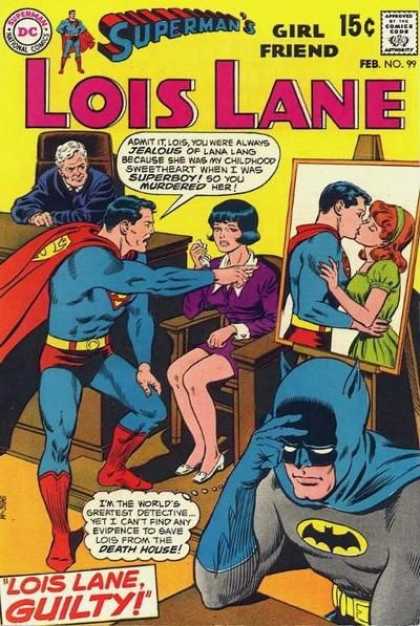
  • And finally, why do we never get trials like the one depicted below, in which Superman, apparently, is prosecuting Lois Lane for the murder of his former sweetheart, Lana Lang. (Note: Superman probably has one of those Lawyer as Witness ethical conflicts.). It seems Batman is defending Lane from the criminal charges. Click the image to enlarge.
  • Incidentally, in case you were wondering, that comic book is Superman’s Girl Friend Lois Lane #99, originally published in February 1970. No word on who actually won the trial.

Smoke and Mirrors?

Oftentimes, litigants find themselves in discovery battles in which one party simply refuses to produce documents to the other. In cases involving products, most defendants are unwilling to produce documents to a plaintiff that is on a fishing expedition. Some documents contain vital company secrets, engineering specifications or e-mails that the writer wishes were never sent. In these circumstances, the question of whether to produce or not produce turns upon whether an actual privilege attaches to the document in question. Many times, a party will assert each and every privilege or protection imaginable with the hope of creating enough smoke and mirrors to make the other party give up on obtaining the requested documents. In a very recent case handed down just this past Monday, the South Carolina Supreme Court opined that the South Carolina Attorney General’s assertion of the attorney-client privilege may apply to certain documents that were requested by a tobacco company.

In Tobaccoville USA, Inc., v. McMaster, No. 26799, 2010 WL 1439108 (S.C. April 12, 2010) the South Carolina Supreme Court heard a certified appeal in which the attorney general was in a discovery dispute with a tobacco company. The dispute stemmed from the attorney general’s assertion that various privileges applied to Tobaccoville’s request for documents. The actual documents themselves were not identified in the opinion. However, based upon the references to the Master Settlement Agreement (MSA), one can reasonably conclude that Tobaccoville was seeking disclosure of documents relating to either the MSA itself or documents relating to the underlying litigation that was resolved by the MSA. In 1998, South Carolina, like many other states, entered into the MSA with the tobacco companies to settle litigation brought by the states to recover health care expenses that were allegedly related to tobacco use.

The court reviewed the various privileges and doctrines asserted by the attorney general including the attorney-client privilege, the attorney work product doctrine, the deliberative process privilege, and the common interest doctrine. The court disagreed with the administrative law judge’s determination that the attorney-client privilege did not apply to this particular situation. The administrative law court found that the privilege did not apply since neither the National Association of Attorneys General (NAAG) nor the other states’ attorney generals were retained as counsel. Based on this determination the administrative law court reasoned that there could not be an attorney-client relationship upon which to base the privilege. However, the supreme court reasoned that since the attorney general is a paid member of NAAG and that NAAG staff attorneys are available to provide legal advice concerning the MSA and tobacco regulation and enforcement, the privilege may apply to the documents in question.

The supreme court remanded the case to the administrative law court for a determination of whether the alleged privileged documents are indeed confidential communications pertaining to the underlying litigation. The court also relied upon a Southern District of New York case for the proposition that the similar documents between an attorney general and the NAAG were protected by the attorney-client privilege. See Grand River Enterprise Six Nations, Ltd. v. Pryor, No. 02 Civ. 5069(JFK)(DFE), 2008 WL 1826490 (Apr. 18, 2008 S.D.N.Y.). Coincidentally, or maybe not so coincidentally, Grand River is the same manufacturer of cigarettes at issue in Tobaccoville USA, Inc. v. McMaster. It appears that the administrative law judge will now have to perform an in camera inspection of the documents to determine whether the attorney-client privilege actually applies to the disputed documents.

He or she will be further assisted by the supreme court’s direction that the attorney work product doctrine does not apply to this situation and that South Carolina has declined to adopt the deliberative process privilege. As such, whether the attorney general’s assertions of privilege to the documents actually apply will now by thoroughly examined by the administrative law court.

A Motorcycle Built for Two

To capitalize on our increasing popularity, the contributors at Abnormal Use have floated the idea of pursuing product sponsorship deals, e.g., Old Spice becoming the official deodorant of the blog. Today, I adopt the Honda Gold Wing as the blog’s unofficial motorcycle. No motorcycle better speaks to the classic risk-aversion of the defense attorney. I, personally, have never seen a Gold Wing rider 1) without a helmet or 2) cruise at a speed in excess of 35 miles per hour. In addition, the design of the Gold Wing promotes the use of Daubert against all oncoming Plaintiffs’ attorneys.

In American Honda Motor Co. v. Allen, No. 09-8051, 2010 WL 1332781 (7th Cir. Apr. 7, 2010) the Seventh Circuit considered the application of Daubert prior to an order certifying a class. Honda sought leave to appeal the district court’s grant of class certification. Plaintiffs, unhappy purchasers of Gold Wings, asserted that the bike had a design defect: Namely, the motorcycle does not properly compensate for “wobble.” Imagine the front wheel of your bike shaking from right to left to the point where you would lose control. (Note: A Google search will reveal multiple videos on motorcycle wobble not appropriate to link here.). Plaintiffs’ claims were based entirely on the expert report of Mark Ezra, who has testified against Honda since the mid-1980s. Ezra developed a wobble decay standard, which set forth that a motorcycle, by its design, should dissipate a certain amount of wobble so that the rider does not react to the wobble.

The District Court, for multiple reasons, was critical of Mr. Ezra’s science, but declined to exclude him at such an early stage of the proceedings. The Seventh Circuit ruled that this failure to exclude was an abuse of discretion and “exclusion is the inescapable result” in this matter. Going forward, the Seventh Circuit noted that some substantive decisions may have to be made prior to deciding the motion for class certification.

We hold that when an expert’s report or testimony is critical to class certification, . . . a district court must conclusively rule on any challenge to the expert’s qualifications or submissions prior to ruling on a class certification motion.

Id. No longer can a Plaintiff bootstrap his way to class certification by hiring an expert. As we noted earlier here, the Seventh Circuit seems earnestly concerned in making sure Defendants are treated fairly in federal class actions, or, in this case purported class actions. While Plaintiffs’ complaint may pass muster under Iqbal/Twombley, the Seventh Circuit sends yet another message to Plaintiffs: Consider Daubert before filing your class action. Moreover, the Seventh Circuit has set forth another method for a court to consider the substance of a lawsuit early in the litigation. Defendants, begin working on your Daubert motions right away.

Defective Sperm Not Actionable in the Third Circuit

In a case we briefly addressed Friday, and in what has been called the first decision of its kind, the U.S. Court of Appeals for the Third Circuit this month upheld a lower court’s 2009 ruling that genetic defects in sperm from a sperm bank cannot form the basis of a products liability suit. To allow such a claim to go forward, the court held, would be tantamount to recognizing a claim for “wrongful life.” D.D. v. Idant Laboratories, Slip Copy, No. 09-3460 (3d Cir. April 1, 2010).

The Plaintiff brought suit both in her individual capacity and as parent and guardian of her minor daughter against the New York-based sperm bank, setting forth causes of action for strict products liability and breach of express and implied warranties of merchantability. The Plaintiff began her research to find a sperm bank in 1994, when she was promised by Defendant Idant Laboratories that its donors went though a rigorous screening process to ensure they had good genetic backgrounds and that the company employed a screening program that far exceeded mandated standards. She thereafter purchased sperm from the Defendant and gave birth to her daughter in 1996. The Plaintiff then began to notice abnormalities in her daughter’s development. Subsequent genetic testing revealed that the child had Fragile X syndrome, a genetic mutation that causes mental retardation and behavioral disorders, as a result of the genetic defect of the sperm donor.

Initially, the district court judge ruled that, pursuant to New York law, the sperm bank could be sued under products liability laws because “the sale of sperm is considered a product and is subject to strict liability.” However, two months later, the judge reversed himself and dismissed the case in its entirety, predicting that New York’s appellate court would reject Plaintiff’s claims.

The Third Circuit affirmed the judge’s second decision. In a thought-provoking opinion penned by Circuit Judge Maryanne Trump Barry, (interestingly, she’s Donald Trump’s older sister), she held that the child’s impaired genetic makeup was not a cognizable injury. She explained:

Wrongful life cases pose particularly thorny problems in the damages context. Simply put, a cause of action brought on behalf of an infant seeking recovery for wrongful life demands a calculation of damages dependant upon a comparison between the Hobson’s choice of life in an impaired state and nonexistence. This comparison the law is not equipped to make. . . . The difficulties that [the child] now faces and will face are surely tragic, but . . . she like any other child, does not have a protected right to be born free of genetic defects. To find to the contrary would invite litigation for any number of claimed injuries and, even more problematic, require courts to identify certain traits below some arbitrarily established marker of perfection as “injuries.”

D.D. at *10, 11 (internal citations omitted).

“Whether it is better never to have been born at all than to have been born with even gross deficiencies,” Judge Barry quoted from a separate court’s opinion, “is a mystery more properly to be left to the philosophers and the theologians.” This is certainly an interesting lawsuit that has generated an intriguing opinion and sparked considerable discussion. To see some other bloggers’ and commentators’ views on the issue, see here, where the author notes the fallacy of considering one’s personal imperfection an injury for which another is to be held responsible, and here, where a reader disagreed with the lower court’s initial ruling allowing the case to go forward, arguing that creating a life is a “gamble” irrespective of how the parent goes about it.

Contact Lens Solution MDL Matter Partially Resolved for Lack of Expert Testimony

In a recent Multidistrict Litigation products liability matter pending in South Carolina, Chief Judge David C. Norton of the U.S. District Court for the District of South Carolina found in favor of manufacturer, Bausch & Lomb Inc., on a motion for summary judgment as a result of Plaintiffs’ failure to provide sufficient expert testimony. In re Bausch & Lomb Inc. Contacts Lens Solution Prods. Liab. Litig., C/A No. 2:06-MN-77777, MDL No. 1785, 2010 WL 597184 (D.S.C. Feb. 17, 2010).

On April 13, 2006, ReNu with MoistureLoc contact lens solution, manufactured by Bausch & Lomb in its Greenville, South Carolina facility, was voluntarily withdrawn from the market in the United States when an increased number of consumers who used MoistureLoc began to develop Fusarium keratitis. On May 11, 2006, Bausch & Lomb met with the Federal Drug Administration and announced that they decided to remove the product from the market worldwide.

Subsequent to this recall, a number of individual personal injury cases emerged around the country asserting they were injured as a result of the use of MoistureLoc. These actions were consolidated into this Mulitdistrict Litigation proceeding and each Plaintiff had to submit a fact sheet and medical documentation demonstrating use of MoistureLoc and the type of eye infection that resulted. As of the date of Bausch & Lomb’s motion for summary judgment, “348 Plaintiffs had not submitted any documentation showing that they experienced a Fusarium keratisis infection.” Judge Norton’s order concerns these “non-Fusarium Plaintiffs.”

In May 2009, Baush & Lomb moved to exclude the testimony of Plaintiffs’ expert, Dr. Elisabeth Cohen, with respect to non-Fusarium infections. As reported by the Drug and Device Law blog on August 27, 2009, Judge Norton, along with Judge Shirley Werner Kornreich of the Supreme Court of the State of New York, granted Baush & Lomb’s motion to exclude “Dr. Cohen’s general causation opinions relating to non-Fasarium infections.”

Following this ruling, Baush & Lomb moved for summary judgment on all claims and causes of action asserted by non-Fusarium Plaintiffs. Notwithstanding five individual cases that remain under advisement for various reasons, the U.S. District Court for the District of South Carolina granted Baush & Lomb’s motion for failure to prove causation. The Court explained that “[t]o establish medical causation in a product liability case, a plaintiff must show both general causation and specific causation[,]” meaning that Plaintiffs must show that the “substance [at issue] is capable of causing a particular injury” and that the “substance caused a particular individual’s injury.” Proof of general causation was a precursor to proving specific causation. The Court determined that this was the applicable rule is all jurisdictions, including Puerto Rico where some Plaintiffs resided.

The Court concluded that since Plaintiffs’ general causation expert, Dr. Cohen, was excluded, Plaintiffs could not prove general causation, and thus, could not prove the essential causation element of any products liability action. Further, the Court disagreed with Plaintiffs’ assertion that they could prove causation through Physicians’ differential diagnoses. This is a “technique of identifying the cause of a medical problem by eliminating the likely causes until the most probable one is isolated.” Judge Norton stated that Plaintiffs could not rely on this technique to “end-run” the general causation requirement.

All defense practitioners should be aware, for future use, of Judge Norton’s holdings requiring both general and specific causation and not allowing the use of the differential diagnoses technique to prove general causation.

Since Judge Norton’s ruling on February 17, 2010, two individual non-Fusarium Plaintiffs have filed motions to alter or amend the judgment pursuant to Rule 59(e) of the Federal Rules of Civil Procedure, Baush & Lomb has filed a response to one Plaintiff’s motion, and Baush & Lomb has filed a motion for summary judgement as to all other non-Fusarium Plaintiffs that were inadvertently not included in the February 2010 order. Therefore, be on the lookout for further rulings on the non-Fusarium Plaintiffs in addition to resolution of those claims by Fusarium

Plaintiffs, which Drug and Device Law blog reported in August may be resolving out of court.

Friday Links

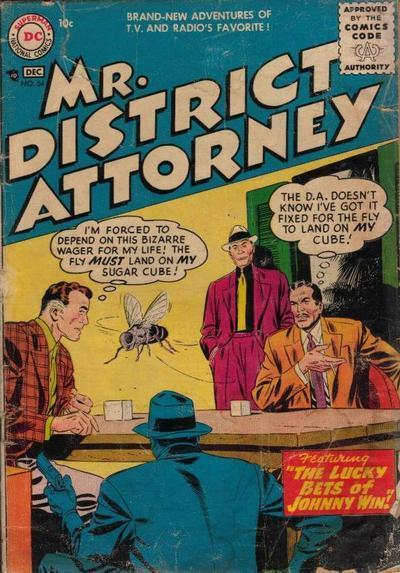
Several weeks ago, we here at Abnormal Use had some fun with Mr. District Attorney #53, in which the title prosecutor performed a direct examination of a canine eyewitness during a criminal trial. Well, today, we turn to the following issue of that epic comic book series, Mr. District Attorney #54. Take a look at the cover pictured above (and click to enlarge) and you’ll see the bizarre contest that the District Attorney is engaged in with some nefarious criminal. At first glance, the fly on the sugar cube gambit seems puzzling, but upon reflection, it may be more effective than mediation in some cases.

We’re not certain whether to chuckle or wince at last week’s post at Change.org calledFriday Unwind: 5 Ridiculous Lawyer Ads.” Maybe we’ll just cry. (Hat tip: Overlawyered).

Finally, someone steps up to respond to allegations that the iPhone is not secure enough to serve as the communications device for lawyers. Ben Stevens, a practitioner in our neighboring city of Spartanburg, South Carolina, and author of The Mac Lawyer blog, offers his treatise on this topic in a post entitled “The Truth about iPhone Security.”

The South Carolina Women Lawyers Association’s Blog: The Briefcase has posted a transcript of South Carolina Supreme Court Justice Kay Hearn’s recent speech to the SCWLA’s Midlands Region chapter. It is entitled “Judicial Independence.”

Above the Law notes in a post this week that the 2010 graduating class of the University of South Carolina School of Law has it right with respect to its chosen class gift.

Eric Goldman over at the Technology and Marketing Law Blog summarizes and comments upon an interesting Fourth Circuit case, Robinson v. Wix Filtration Corp. L.L.C., — F.3d —, No. 09-1167 (4th Cir. March 26, 2010). At issue was the Plaintiff’s failure to respond to a motion for summary judgment; Plaintiff’s counsel indicated that their firm’s computer system suffered a viral infection which, among other things, caused them to temporarily lose their Internet domain name and access to their email addresses (which, in turn, meant that any electronic filing notices from the federal district court would not have been received by them, including notice of the filing of the summary judgment by the Defendant in that wrongful termination case). The Fourth Circuit found that the Plaintiff had no remedy in this situation, although the opinion did draw a strong dissent. The lesson: If you have computer problems, you’d better login to PACER and monitor your federal cases. Any other option is fraught with peril. (See additional news coverage of this opinion here.).

The Third Circuit has ruled that defective sperm is not the proper basis for a products liability suit. We are grossed out by this jurisprudence. (See news coverage here.).