Merry Christmas

We here at Abnormal Use wish you and your family a very Merry Christmas. We may be cynical, but even we are not immune to those wistful moments of Christmas magic. Were you to send us a request to admit that Christmas is a splendid time of year full of fine sentiment and warm feelings, we could not in good faith deny it. But we’d probably throw in a token objection for vagueness just to preserve our street cred. Above, you’ll find the cover of Comic Cavalcade # 9, published way back in 1945 and featuring, once again, almost ancient versions of The Flash, Wonder Woman, and the Green Lantern. We’re a little distressed that those heroes appear to be breaking and entering a local home and usurping the duties traditionally reserved for Santa.

Christmas Links

It’s Christmas Eve, and if you’re reading a products liability blog today, odds are you were the one associate or junior partner who couldn’t extricate him or herself from coming into the office today. We here at Abnormal Use would feel for you, but unfortunately for you, we wrote this post days ago and set it to automatically publish today before we headed off for the holidays.

By the way, depicted above is the cover of Christmas with the Super-Heroes #2, published in the late ’80s. Please note that Batman is staring intently at a teddy bear held by Green Lantern.

The question you have to ask yourself, though, is: Are you really going to do any billable work today, or are you going to play around on the Internet and read Christmas links?

We suggest the latter, and in that spirit, we present to you the following links:

  • We still dig 1947’s Miracle on 34th Street, which is both a Christmas and a courtroom movie. Law nerds that we are, we are happy to see that the Wikipedia entry for the film includes a section dedicated to the film’s legal inaccuracies, which we quote here: “In the book Reel Justice, the authors claim that Judge Harper could have dismissed the case early without the political repercussions he feared. In their theory, once the prosecutor rested his case immediately after Kris Kringle admitted in court simply that he believed he was Santa Claus, Judge Harper could have ruled that prosecution had forfeited its opportunity to prove that Kringle was dangerous (the basic point of such hearings; Kringle’s actual mental state itself being irrelevant), and ordered him immediately released. However, this high standard for involuntary commitment was not instituted until 1975 with the U.S. Supreme Court’s decision O’Connor v. Donaldson.” Indeed.
  • We hate those gooey holiday candies – peeps. So we direct you to the “100 Ways To Kill A Peep” blog which, sadly, is no longer being updated.
  • The news here in merry Greenville is that it may actually snow on Christmas day. However, we fully expect to publish each day next week, barring some unforeseen snowpocalypse.

Abnormal Interviews of 2010

As readers of this site are aware, we here at Abnormal Use occasionally publish interviews with law professors and practitioners on products liability and litigation. In 2010, we published a total of eleven such interviews. Today, we list them all and provide links back to them:

As 2010 draws to a close, we’d like to take this opportunity to thank the individuals listed above for being kind enough to grant the interviews. We think our site is all the better for it.

Our Favorite Posts of 2010

Now is the time that we, as consumers of media, are inundated with year end best-of lists. So, we here at Abnormal Use thought we would add to that cacophony and list for you our favorite twelve posts of this past year – which was also our first year. If you’ve followed us from the very beginning, you know that we’ve posted at least every business day this calendar year. Looking back over several hundred posts, it was difficult to choose only twelve. But, dear readers, the ones we enjoyed the most are linked for you below, along with their author and publication date.

The Not-So Deep End (Kevin Couch, January 22, 2010). Our very first foray into the realm of television reviews. The program we reviewed, “The Deep End,” did not last. In fact, both this blog and that show debuted in January of 2010. We outlived the show!

What Does Society Demand from a Chicken Sandwich? (Kevin Couch, February 3, 2010). Our first truly irreverent look at products liability litigation. We have since learned that any posts having to do with hot chicken (or hot coffee) garner great attention. (We were particularly pleased the chicken sandwich post earned this link from How Appealing and this one from Overlawyered, two of our favorite law blogs).

A Modest Proposal: Abolish Strict Liability (Phil Reeves, April 7, 2010). Our first editorial, in which site author Phil Reeves argued for the abolition of an old products doctrine. That’s right; we’re not afraid to have an opinion. Don’t tread on us.

Unsatisfying Snickers Bar Unreasonably Dangerous and Defective, Texas Court Holds (Jim Dedman, April 1, 2010). Our first hoax, perpetrated, of course, on April Fool’s Day. We were pleased to report that we actually did fool a few people, despite the many clues indicating that it was all in fun. “Reasonable degree of confectionery certainty,” indeed.

A Can of Tuna A Day, Keeps The Doctor Away? (Mary Giorgi, May 10, 2010). Someone who ate a can of tuna a day sued claiming damages for eating a can of tuna day. We had to comment. Really, we did.

Our First Milestone: 100 Posts (Stephanie Flynn, May 18, 2010). Our first arbitrary celebration of an arbitrary milestone. Pensive as we are, though, we couldn’t resist. Blogging is, after all, an introspective medium designed for self indulgent self reflection. That’s what we here do best!

Live from Litchfield Beach (Dan Eller, June 7, 2010). If you had any doubts, this post is clear and convincing evidence that we blog even when on vacation.

Google Failed to Warn Woman Not to Walk into Oncoming Traffic (Laura Simons, June 22, 2010). Someone alleged that she walked into the highway traffic because she was blindly following directions taken from Google Maps. Um, okay.

Bluejays and Mockingbirds (Mills Gallivan, July 6, 2010). Our boss – senior partner Mills Gallivan – paused to observe the anniversary of the publication of Harper Lee’s To Kill A Mockibird and reflect on what that means to the legal profession as a whole.

Wii Class Action Strikes Out: Hang on to Your Controller (Frances Zacher, October 12, 2010). People who inadvertently toss their Wii controllers at there televisions, thereby damaging them, attempt to certify themselves as a class. We comment thereupon.

Thanksgiving in 1810, 1910, and 2010 (Jim Dedman, November 22, 2010). We dug up a forgotten magazine article from a long forgotten magazine. Writing in 1910, the author – a lawyer, no less – looked back a hundred years and commented upon the many changes that had taken placed and briefly wondered at the world of 2010. We responded, and in the process, received so many links and hits that we broke all of our site traffic records.

Views of 2011 From 1931 (Jim Dedman, December 14, 2010). We comment upon the predictions contained in a series of editorials published in The New York Times in 1931. The paper of record asked that day’s visionaries what they thought they year 2011 would look like. Some were surprisingly accurate; others, not so much. It became our most linked post of the year, and we saw huge, huge traffic as a result.

    Artificial Hip Case Prompts Preemption Analysis

    As a defense lawyer, I dream about preemption; it can bar a staggeringly wide range of claims. The plaintiffs in Gelber v. Stryker, — F.Supp.2d —-, No. 09-CIV-1322, 2010 WL 4740432 (S.D.N.Y. Sept. 14, 2010), however, do not view preemption so fondly. After Jeannette Gelber’s hip was replaced with a Stryker Trident hip, she began to have pain and noticed a squeaking sound when she walked. She was told the artificial hip was defective, and thereafter, filed suit. The defendants filed a motion to dismiss, and the plaintiff conceded the dismissal of claims based on failure to warn, improper labeling, improper or misleading marketing and/or defective design. Therefore, the only claims remaining in the defendants’ motion to dismiss were those of negligence, strict liability and breach of warranty claims based on alleged violations of the FDA’s manufacturing requirements.

    And then, the defendants dropped the atom bomb: federal preemption based on the rigorous review the FDA had used in approving the Trident hip for use and distribution; in fact, as a so-called “Class III” device, the Trident hip had been subject to the “rigorous regime” of premarket approval (“PMA“) within the FDA, a process under which only 1% of devices were scrutinized in 2005:

    The PMA process is lengthy-it takes over 1,200 hours to review each application-and involves the submission of volumes of comprehensive information on the device. The FDA only grants premarket approval if it finds there is a reasonable assurance of the device’s safety and effectiveness. After approval, the FDA still retains regulatory control over the device. The manufacturer is prohibited from changing “design specification, manufacturing processes, labeling, or any other attribute, that would affect safety or effectiveness” without first obtaining FDA’s approval.

    There is a way around federal preemption, and the plaintiffs tried it in this case: the plaintiffs claimed that the defendants violated FDA manufacturing requirements, a so-called “parallel” claim. Here’s how a parallel claim would work, in the Court’s opinion

    Riegel [v. Medtronic, Inc., 552 U.S. 312, 316, 128 S.Ct. 999, 169 L.Ed.2d 892 (2008)] specifically found that claims of strict liability, negligence and breach of implied warranty were expressly preempted. However, there is an absence of Supreme Court guidance on whether the [Medical Device Amendments of 1976] preempts state requirements of general applicability that only incidentally regulate medical devices, e.g., Uniform Commercial Code or unfair trade practice laws, since Riegel refrained from analyzing the exception provided by 21 U.S .C. § 808.1(d)(1). Riegel, 552 U.S. at 328-29 (” § 808.1(d)(1) can add nothing to our analysis but confusion…. Neither accepting nor rejecting the FDA’s distinction between general requirements that directly regulate and those that regulate only incidentally[,] the regulation fails to alter … the outcome of this case”). Post-Riegel, courts have struggled to determine whether state-law claims that only incidentally regulate medical devices are still available insofar as they are “parallel” to federal requirements. . . . This Court finds it persuasive that since the Supreme Court did not carve out a safe harbor for state laws that only incidentally regulate medical devices, the same preemption analysis applies and only those claims that are parallel to federal requirements are permissible.

    (internal citations omitted). This might have been a great argument for the plaintiffs, except that the court held that they did not sufficiently plead claims “grounded in violations of federal law and/or requirements.” The pleadings didn’t provide the requisite amount of factual detail and specificity to survive the defendants’ motion to dismiss and, therefore, the remaining claims of the plaintiffs were dismissed. Pesky pleadings. However, the Court stated that “because courts have only recently articulated how a plaintiff can successfully plead a parallel claim,” the plaintiffs would be allowed to replead.

    Massachusetts: Summary Judgment For Manufacturer due to Plaintiff’s Lack of Causation

    Recently, the United States District Court for the District of Massachusetts granted summary judgment in favor of a manufacturer of an injection molding machine on plaintiff’s claim that it was defectively manufactured, for lack of causation evidence. Brown v. Husky Injection Molding Sys., Inc., — F.Supp.2d —, No. 08-11840-RGS, 2010 WL 4638761 (D. Mass. Nov. 17, 2010). This case is interesting for the Court’s analysis of a manufacturing defect claim regarding a product that was manufactured and installed in the 1970s.

    Defendant, Husky Injection Molding Systems, Inc. (“Husky”) manufactured a 1525 series injection molding machine with serial number 3350 (“3350 machine”) which was sold to WNA Comet East, Inc. (“Comet”) in 1974. Plaintiff, Jimmy Brown (“Brown”), began working for Comet as an injection molding machine operator in 2003. In 2006, while trying to clean the 3350 machine, his left hand got caught in the belt and pulley, suffering “crush injuries.” It was undisputed that the 1525 series was designed with a front pulley guard, and if it had been in place, the accident would not have happened. It was also undisputed that in 2000, Comet had “rebuilt the 3350 machine, stripping it to its base, and replacing or refurbishing constituent parts as needed.”

    Brown asserted a claim against Husky alleging that the 3350 machine was defectively manufactured because Husky failed to install the front pulley guard. In response, Husky asserted that Brown had no evidence that the 3350 did not have the pulley guard when it was delivered to Comet. Husky filed a motion for summary judgment. In support of Husky’s position, the technician that installed the 3350 machine in 1974 testified that it had the front pulley guard when installed. In rebuttal, Brown offered testimony of a Comet employee that testified that he had never seen a guard on the 3350 machine. However, this employee did not begin working with these machines until 1976, two years after installation.

    The Court first distinguished a claim for a design defect and a manufacturing defect. To prove the first, a plaintiff must only prove that a defect in the design existed at the time the product left the manufacturer’s control. To prove the latter, a plaintiff must show that the defect was caused by a manufacturing error affecting only one particular product and that it was not caused by intermediaries. The Court concluded that while Brown had testimony that no guard was on the machine in 1976, he could not rebut Husky’s installer’s testimony that at installation, a guard was on the machine. Further, Brown did not have testimony regarding the presence or absence of guards before and after the 2000 refurbishment. Therefore, the Court found that Brown could not prove causation and granted Husky’s motion for summary judgment.

    This case exemplifies the difficulties in proving a manufacturing defect case, especially when a product is in the hands of an intermediary for a long period of time. Essentially, in this type of case, a plaintiff must be armed with testimony accounting for a product’s condition and non-alteration the entire period of time from the date it left the manufacturer’s control until the injury. Sometimes this can be extremely hard. But without that testimony, a defendant will be able to raise, like here, the potentially fatal absence of evidence of causation.

    Friday Links

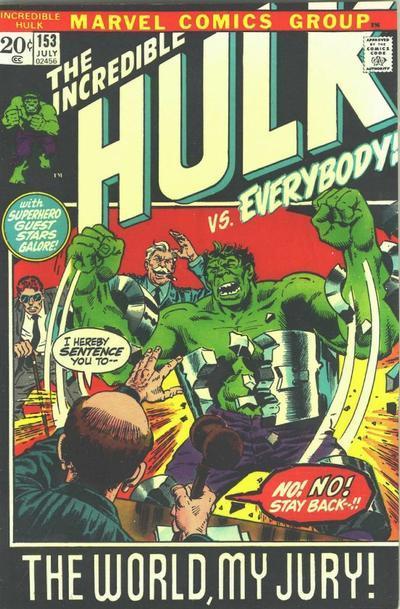
    • Depicted above is the cover of The Incredible Hulk #153, published way back in 1972. As civil litigators, we can’t say we know in detail all the various rules of criminal procedure which govern the sentencing of defendants. However, surely there must be one that could be invoked to allow the judge to sentence The Incredible Hulk in absentia to prevent the result shown above. The shackles they elected to use didn’t seem to do the trick.
    • Jeffrey Kuntz of The Florida Legal Blog asks an interesting question: “Is It Proper To Cite To A Shortened URL in An Appellate Brief?” As Kuntz notes, there is a risk inherent in such citations, as the abbreviated link may itself expire, and if it does, there is no way to ascertain the nature or domain of the original link. Best to use the full URL, we think.
    • Oh, boy, do we have a bone to pick with Stephen J. McConnell over at the Drug and Device Law blog. Writing about a series of four related court orders, McConnell strayed into popular culture and opined that “any rock band with four letters in its name will produce wretched music. Okay, we agree about Bush, Devo, Fuel, KISS, and TOTO, but AC/DC?! (There is massive disagreement here in Dechert-ville over ABBA, Rush, and Styx.).” We are aghast and agog. Where to begin? First off, Rush is a fine band as a matter of law. There can be no reasonable disagreement as to that fact (although the closest that one may come to creating a fact issue may well be the band’s 1991 album, Roll The Bones, which includes a pseudo-rap in the title track.). But as to McConnell’s more general statement about bands with four letter names, what about Beck, INXS, Muse, Nico (whose “These Days” is sublime), Pulp, Ween, Love (led by the late, great Arthur Lee), Luna, Lush and MGMT? Blur, Cake, Ride (who would inspire a band called Radiohead), RJD2, and Fear (the immortal Los Angeles punk band)? What about glam legend T. Rex and rap star Jay-Z? Sure, we’re torn about Ratt, Asia, Toto, and Seal, but Devo is sacrosanct. Earlier this year, we here at Abnormal Use were very excited to learn that Devo was to play a gig within 60 miles of our fair city, and we were crestfallen when that show was canceled due to an injury suffered by the guitarist. Alas.
    • Funny Or Die has posted a new Jackie Chiles video titled “Jackie Chiles Knows The Internet.” You’ll recall that we here interviewed actor Phil Morris – who plays Chiles in the video and on “Seinfeld” back in the old days – here.
    • Elsewhere in online video circles, Jon Stewart of “The Daily Show” has a little bit of fun with the reaction of the Consumer Product Safety Commission to news that Shrek souvenir glasses might contain cadmium. See here for that amusing clip.
    • Don’t tell our managing partner, but we here at Abnormal Use may sneak out of the office a bit early today to see the Tron sequel. We were kids when the original came out in the early 1980s. The sequel gives us a chance to revisit that era in our minds and recall a time when we had never heard the terms “billable hours” or “document review.”

    New Governmental Regulations Seek to Improve Vehicle Safety

    Recently, the federal government proposed new rules aimed at improving rear visibility standards for vehicles. The requirements, which the Transportation Department intends to take effect by the 2014 model year, were created to address concerns about drivers unintentionally backing over children. The Associated Press reports that most car makers will comply by installing rear-mounted video cameras and in-vehicles displays, which the governments estimates will add approximately $200 to the cost of each new vehicle.

    According to data kept by the National Highway Traffic Safety Administration, every year, nearly 300 people are killed and 18,000 are injured because of backovers. Nearly half of the deaths involve children under the age of five and in approximately 70 percent of the cases, it is a family member who is responsible for the death.

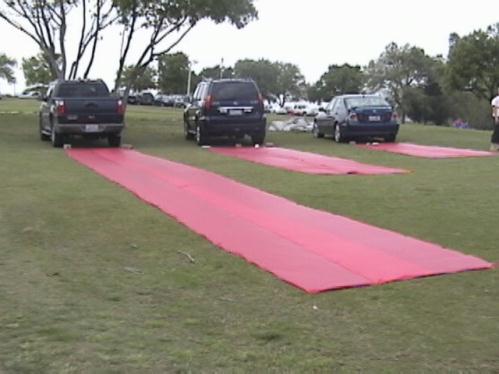
    KidsAndCars.org, whose website entry regarding the recent regulations calls this the biggest announcement since seatbelts and airbags, is a Kansas-based nonprofit organization that has pushed for these changes for years. Founder and president Janette Fennell reportedly said, “No one would buy a car if you couldn’t see 20-30 feet feet going forward, but we all have been buying vehicles where we can’t see 20-30 feet going backwards.” As the photo above illustrates, studies have shown that the bigger the vehicle, the bigger the blind spot. Sedans have an average blind spot of 12 feet, minivans have an average blind spot of 13 feet, SUVs have an average of blind spot of 14 feet, and pickup trucks have double that number, with a blind spot of approximately 30 feet. The shorter the driver, the bigger the blind spot.

    The current changes reportedly have been in the works for a number of years, with President Bush’s 2005 signing of the Safe, Accountable, Flexible, Efficient Transportation Equity Act, and Congress’s 2008 setting in motion of safety upgrades dealing specifically with backover accidents. Look for this safety upgrade during your next new car purchase.

    The Case of the Reconditioned Lawnmower and Implications on Strict Liability

    As we all know, a finding by a jury that a product is unreasonably dangerous will cause the manufacturer to be held strictly liable for any injuries the product causes. But what happens when the product itself has been used, “reconditioned,” and sold to someone else?
    This was the question considered by the Seventh Circuit in Malen v. MTD Products, et al., No. 08-3855, 2010 WL 4670176 (7th Cir. 2010). Malen bought a Yard-Man riding lawnmower from Home Depot which was manufactured by MTD Products. The lawnmower was marketed by Home Depot as having been “reconditioned,” and the product came with a warranty. Malen took the lawnmower home and used it between 30 and 50 times without incident. One day, while mulching leaves, the lawnmower became wedged up against a curb and Malen couldn’t dislodge it. So, he stood up and tried to get off the lawnmower. There was conflicting information about the exact sequence of events, but it is undisputed that the blade of the lawnmower cut Malen’s foot, and he suffered permanent injuries.
    According to industry standards, the lawnmower should have been equipped with two separate safety features–one that stopped the lawnmower blade if the operator stood up from the seat, and another that stopped the blade if the lawnmower was put into reverse. It was undisputed that at the time Malen test drove the lawnmower at Home Depot, the reverse safety function was not operational. Furthermore, it was uncontested that the blade did not stop when Malen stood up from the seat on the day of the accident.
    As the Seventh Circuit pointed out, “Manufacturers and sellers are strictly liable for injuries caused by unreasonably dangerous products unless an unforeseen alteration by a third party introduced the unsafe condition.” Second, the court acknowledged that when products are used and sold “as is,” any unforeseen defects introduced by prior owners cannot be attributed to manufacturers and sellers. Both Home Depot and MTD attempted to show that the product had been altered by the first owner of the mower, by Malen, or by some other “nefarious person.” The court was not convinced.
    It was, however, a case of first impression as to how Illinois courts would treat products that had been “reconditioned.” By reconditioning a product, the Seventh Circuit reasoned, is different than simply repairing a product, and in its opinion “extends the useful life beyond what was contemplated at the point of manufacture and effectively creates a new product.” The Seventh Circuit surmised that, as they have before, Illinois courts would follow the Restatement (Third) of Torts and apply strict liability in the case of re-manufactured products. On this basis, the Seventh Circuit found that the lawnmower, by failing to have the requisite safety measures in place, could be found unreasonably dangerous.
    The court also concluded that a jury could find that the lawnmower was defectively designed, and the proximate cause of Malen’s injury on negligence theories. It reversed the grant of summary judgment for MTD and Home Depot, and remanded the whole case.
    In this case, there was evidence that the safety measures were not properly connected or installed before the lawnmower was sold to its first owner. However, the decision has serious implications for manufacturers of products which are then “reconditioned” by someone else, and perhaps warranted by the retailer. If the reconditioned product later causes injury, the manufacturer may eventually be released from liability, but it obviously won’t prevent the manufacturer from being sued and forced to engage in expensive discovery as to the original condition and/or design of the product, and as to what modifications and/or repairs were performed on the product prior to resale, without the manufacturer’s knowledge and without compliance to the specifications of the manufacturer. All for the re-sale of a product for which the manufacturer saw no profits.

    Views of 2011 From 1931

    1931 was a long time ago, and few who live today can claim to remember it all too well. Just two years after the stock market crash of 1929, 1931 claimed Herbert Hoover as the President of the United States (which that year had 48 states). Movie monsters were the rage; Bela Lugosi starred in Tod Browning’s Dracula film and Boris Karloff did his star turn in Frankenstein. Cab Calloway recorded the classic “Minnie The Moocher” (and he was 49 years from performing it again in 1980’s The Blues Brothers). James Dean was born that year; so were William Shatner and Leonard Nimoy. That December, the first Christmas tree was placed at the construction site that would later become Rockefeller Center. The Lindbergh kidnapping was a year in the future, and the attack on Pearl Harbor – precipitating the country’s entry into World War II – was a full decade away.

    It was a far different time culturally, socially, politically. The issue: What did the great minds of 1931 predict the rapidly approaching 2011 would be like?

    There is actually an answer to that question.

    Way back on September 13, 1931, The New York Times, founded in 1851, decided to celebrate its 80th anniversary by asking a few of the day’s visionaries about their predictions of 2011 – 80 years in their future. Those assembled were big names for 1931: physician and Mayo Clinic co-founder W. J. Mayo, famed industrialist Henry Ford, anatomist and anthropologist Arthur Keith, physicist and Nobel laureate Arthur Compton, chemist Willis R. Whitney, physicist and Nobel laureate Robert Millikan, physicist and chemist Michael Pupin, and sociologist William F. Ogburn. Since these guys all have their own Wikipedia entries so many decades later, they had to have been important for their time, right? Perhaps not a diverse lot, but it was 1931.

    Ford, perhaps the most recognizable name to modern readers, set the tone of the project in his own editorial of prognostication:

    To make an eighty-year forecast may be an interesting exercise, first of the imagination and then of our sense of humility, but its principal interest will probably be for the people eighty years on, who will measure our estimates against the accomplished fact. No doubt the seeds of 1931 were planted and possibly germinating in 1851, but did anyone forecast the harvest? And likewise the seeds of 2011 are with us now, but who discerns them?

    We’re not certain why The Times chose to celebrate an arbitrary 80 years of existence. Whatever the case, the predictions are full of gems, so we encourage you to read the original articles (which, hopefully, The New York Times will unlock from its paywall as 2011 approaches). Today, we are just two weeks shy of 2011, so we must ask, how did some of these men fare in their predictions? Let us do as Ford suspected we would and measure their estimates against accomplished fact (at least as much as a humble products liability blog can do).

    Dr. Mayo had this to say:

    Contagious and infectious diseases have been largely overcome, and the average length of life of man has increased to fifty-eight years. The great causes of death in middle and later life are diseases of heart, blood vessels and kidneys, diseases of the nervous system, and cancer. The progress that is being made would suggest that within the measure of time for this forecast the average life time of civilized man would be raised to the biblical term of three-score and ten.

    Dr. Mayo predicted the average life span in 2011 would be 70. He wasn’t far off. According to this post at the Centers for Disease Control and Prevention, it’s currently 77.9 years.

    Interestingly, Keith warned of the coming perils of overspecialization in medicine:

    Eighty years ago medicine was divided among three orders of specialists – physicians, surgeons, and midwives. Now there are more than fifty distinct special branches for the treatment of human ailments. It is this aspect of life – its ever growing specialization – which frightens me. Applying this law to The New York Times, I tremble when I think what its readers will find on their doorsteps every Sunday morning.

    Any litigator who has ever attempted to secure a medical expert in an obscure field certainly understands the concerns espoused by Keith. All we can say is that Keith would probably not be pleased to see all the various branches of medicine that have arisen in the past eight decades. (But we here at Abnormal Use, as consumers of medicine, are pretty pleased about all the smart folks out there who know lots and lots about important fields and sub-fields of medicine.).

    Ford, writing in 1931, just two years after the stock market crash, predicted that we as a nation might focus more on the intangibles of life than the bottom line:

    We shall go over our economic machine and redesign it, not for the purpose of making something different than what we have, but to make the present machine do what we have said it could do. After all, the only profit of life is life itself, and I believe that the coming eighty years will see us more successful in passing around the real profit of life. The newest thing in the world is the human being. And the greatest changes are to be looked for in him.

    Uh, okay. In these troubling economic times of ours today, we’ll just say, “No comment.”

    Millikan observed:

    Among the natural sciences it is rather in the field of biology than in physics that I myself look for the big changes in the coming century. Also, the spread of the scientific method, which has been so profoundly significant for physics, to the solution of our social problems is almost certain to come. The enormous possibilities inherent in the extension of that method, especially to governmental problems, has already apparently been grasped by Mr. Hoover as by no man who has heretofore presided over our national destinies, and I anticipate great advances for moving in the directions in which he is now leading.

    Certainly, the scientific method has not solved all of our social problems (and Millikan would likely be displeased to learn how history now views President Herbert Hoover.).

    Pupin was optimistic that workers would come to share in the profits of that they produced:

    The great inventions which laid the foundation of our modern industries and of the resulting industrial civilization were all born during the last eighty years, the life time of The New York Times. This civilization is the greatest material achievement of applied science during this memorable period. Its power for creating wealth was never equaled in human history. But it lacks the wisdom of distributing equitably the wealth which it creates. One can safely prophesy that during the next eighty years this civilization will correct this deficiency by creating an industrial democracy which will guarantee to the worker an equitable share in the work produced by his work.

    Er, not quite.

    Compton predicted:

    With better communication national boundaries will gradually cease to have their present importance. Because of racial differences a world union cannot be expected within eighty years. The best adjustment that we can hope for to this certain change would seem to be the voluntary union of neighboring nations under a centralized government of continental size.

    Well, national boundaries are just as important as they were back in 1931. (And in fact, there have been a ton of wars in the past 80 years over just that issue). The United Nations would be formed fourteen years after Compton’s call for a “voluntary union of neighboring nations,” but its efforts and successes over the past 65 years have been, at best, a mixed bag. (Interestingly, Compton also predicted that China, “with its virile manhood and great nature resources,” would take “a more prominent part in world affairs.”).

    Our favorite set of predictions, though, comes from Ogburn, who actually went out on a limb and made some bold predictions (some of which were dead on, other of which were not so much):

    The population of the United States eighty years hence will be 160,000,000 and either stationary or declining, and will have a larger percentage of old people than there is today. Technological progress, with its exponential law of increase, holds the key to the future. Labor displacement will proceed even to automatic factories. The magic of remote control will be commonplace. Humanity’s most versatile servant will be the electron tube. The communication and transportation inventions will smooth out regional differences and level us in some respects to uniformity. But the heterogeneity of material culture will mean specialists and languages that only specialists can understand. The countryside will be transformed by technology and farmers will be more like city folk. There will be fewer farmers, more wooded land with wild life. Personal property in mechanical conveniences will be greatly extended. Some of these will be needed to prop up the weak who will survive.

    Inevitable technological progress and abundant natural resources yield a higher standard of living. Poverty will be eliminated and hunger as a driving force of revolution will not be a danger. Inequality of income and problems of social justice will remain. Crises of life will be met by insurance.

    The role of government is bound to grow. Technicians and special interest groups will leave only a shell of democracy. The family cannot be destroyed but will be less stable in the early years of married life, divorce being greater than now. The lives of woman will be more like those of men, spent more outside the home. The principle of expediency will be the dominating one in law and ethics.

    Not too bad for a man born in 1886 who didn’t live to see 1960. Sure, he was off by about 150 million on the United States population for 2011. Sure, he didn’t predict the microchip or the Internet. Oh, and yeah, poverty hasn’t been eliminated and hunger is still a problem worldwide. But he generally seemed to understand the coming material leisure culture, the rise of big government, and the differences in the family unit in the world eight decades from his prediction.

    Oh, and for the record, we here at Abnormal Use do not plan to use this occasion to make predictions about 2091, save for the lone augury that we here will still be toiling away at our desks in an effort to bring you fresh and insightful commentary each business day.

    Bibliography

    All of the articles listed below are linked and available online, but they’re also all behind The New York Times paywall archive. Unless you have access, all you’ll get is the abstract.

    Compton, A.H. “Whole of the earth will be but one great neighborhood; Dr. Compton envisions the great development of our communications,” The New York Times, September 13, 1931.

    Ford, Henry “The promise of the future makes the present seem drab; Mr. Ford foresees a better division of the profits to be found in life,” The New York Times, September 13, 1931.

    Keith, Sir Arthur. “World we hope for runs away with the pen of the prophet; Sir Arthur Keith doubts if his individualist longings can be realized,” The New York Times, September 13, 1931.

    Mayo, W.J. “The average life time of man may rise to the biblical 70; Dr. Mayo says also that a proper use of our leisure will be evolved,” The New York Times, September 13, 1931.

    Millikan, Robert A. “Biology rather than physics will bring the big changes; Also, says Dr. Millikan, the scientific method will aid in government,” The New York Times, September 13, 1931.

    Ogburn, William F. “The rapidity of social change will be greater than it is now; and hunger, says Dr. Ogburn, will not be a danger as a revolutionary force,” The New York Times, September 13, 1931.

    Pupin, Michael. “Our civilization will create a new industrial democracy; it will give the workers a fair share in wealth, says Michael Pupin,” The New York Times, September 13, 1931.

    Whitney, W.R. “Better world-wide education will serve our experiments, self-improvement is viewed by Dr. Whitney as the great task set for mankind,” The New York Times, September 13, 1931.