Marketing vs. The Market: A Debate About Bilingual Warnings

A few weeks ago, we commented upon the recent Florida case of Farias v. Mr. Heater, Inc., — F. Supp .2d —, No. 09-CIV-23789, 2010 WL 4814660 (S.D. Fla. Nov. 19, 2010) to start a discussion on bilingual warnings and what, if any, duty a manufacturer has to provide them. In so doing, we questioned what, if any, responsibility a manufacturer should have to provide bilingual warnings here in the United States, since the country has no official language and prides itself on its rich cultural and linguistic diversity.

Friend of the blog and John Marshall Law School professor Alberto Bernabe recently responded to our post on his own blog, and he made a number of interesting points. Just as the Farias court did, Professor Bernabe focused on the issue of marketing. The Farias court held that the heater manufacturers had no duty to provide a warning in Spanish in part because the heaters had not been marketed directly to a Spanish-speaking population, distinguishing the case factually from an earlier decision in a Florida federal court, Stanley Indus., Inc. v. W.M. Barr & Co., Inc., 784 F. Supp. 1570 (S.D. Fla. 1992), in which the product had been directly marketed to a Spanish-speaking population.

Professor Bernabe asked the following question in response to the Farias decision and our post:

If we are ready to say that we should recognize a duty if the product is marketed to a specific audience, is it that much of a leap to say we should recognize a duty if the product is marketed in a particular market. By this I mean, there are specific areas in this country that are known to be centers of foreign populations. And if there is a great example of this it is Miami! Let’s face it, Miami is a bilingual city. A large portion of the city is known as “Little Havana.” Everyone knows this. So is it really that burdensome to suggest that labeling should be different for that market?

His question, therefore, is whether the concept of duty in this situation should be based on marketing, or just market. As Professor Bernabe himself appears to acknowledge, this would absolutely extend the concept of duty beyond reasonable limits. Miami is the easy case – there are parts of the city in which road signs are written only in Spanish.

But what about places like New York City, where huge populations of non-English speakers are concentrated in particular areas, but also run right into each other? For years the areas of the city known as “Little Italy” and “Chinatown” have been separated by little more than about a half a city block. There is also a huge Puerto Rican population in the city, along with countless other pockets of peoples of different nationalities and language in that city.
If we were to focus on the “market” itself, rather than the “marketing,” then manufacturers that sell any product in New York City would have to hire the United Nations to translate warnings into virtually every language spoken on the earth. Any manufacturer who bought advertising time on a national basis on the networks would have similar problems.

We’re not suggesting there is an easy solution. While we think there needs to be a reasonable limit to the duty imposed on manufacturers, it would also be unreasonable for us to say that manufacturers should be able to stick their collective heads in the sand and ignore the fact that there are people in this country who can’t read or understand English. For now, the marketing issue seems to be the best we have.

(Back in November, we interviewed Professor Bernabe as a part of our Abnormal Interviews series. You can read that interview here.).

An Open Letter to "Joe Consumer" of The Pop Tort blog

Dear Mr. Joe Consumer,

As relatively new legal bloggers, we can attest that few things bring as much gratification as the acknowledgment that our work is being read by our distinguished colleagues. Imagine our excitement here at Abnormal Use upon learning that you, a contributor to The Pop Tort legal blog, not only read last week’s Hot Coffee post, but took time away from your fight against dirty corporate disinformation campaigns to write your own retort. As you may know, we were pleased to present some basic background facts regarding the new Hot Coffee documentary and the ties of its producer Susan Saladoff to the Plaintiffs’ bar. We’re elated to engage in further dialogue about the film and the issues it presents with you, a writer at blog we’ve read for years. We think that additional discussion on the film, and the infamous Stella Liebeck McDonald’s hot coffee litigation, is truly a boon to public discourse. So, today, we write this thank you note.

Thank you, Mr. Consumer. We owe you much, for your reply provided us with an opportunity to engage in a bit of soul searching and introspection. In the circles in which you travel, you may have heard the vicious rumors that we defense attorneys are soulless, but this is simply not true.

So, thank you for pointing out our corporate bias. We suspect that The Pop Tort, a project of the Center for Justice and Democracy, would never attempt to inject its own ideological agenda into its film commentary – especially a film in which its founder and executive director appeared.

Thank you also for alerting the blogosphere that we have not yet seen the Hot Coffee documentary. We agree that the plainly evident disclaimer of that fact we placed in our original piece may not have been apparent to readers. Despite the fact that we made no representations that we saw the film, it is easy to see how our readers would think we were presenting an actual review of the documentary and not a commentary on the filmmaking team’s potential agenda.

Thank you also for citing to actual Hot Coffee reviews from more “responsible” film critics. Fortunately, you located non-lawyer reviewers untainted by a legal education and the perils of the legal profession. By mentioning only the fact that the filmmaker is an attorney (and omitting any reference to her long career suing large corporations), these reviewers offered truly objective reviews based on the facts as told by Saladoff without referencing other pesky info and context.

Thank you also for halting our “dirty corporate disinformation.” Shame on us for presenting the information in our accompanying FAQ file taken directly from such unreliable sources as pleadings, deposition transcripts, and contemporary news accounts of the case. Shame on us for giving anyone the impression that coffee is best served at McDonald’s temperatures. Shame on us for becoming so caught up in the facts that we neglected to see your truth. After all, as the old writer once said, “[f]acts and truth really don’t have much to do with each other.”

Thank you for putting a stop to our attempt to relitigate the original Stella Liebeck lawsuit. Apparently, we momentarily forgot the well-established principle that once a court or jury renders its decision, all criticism must end. We momentarily forgot that no one wants to hear the losers “whining” about how the case should have been decided. Certainly, our friends at The Pop Tort would never commit such a horrible offense. The winners win the day, and they must be protected from those looking to revise history. Please forgive us this transgression.

Most of all, in light of our errors in judgment, we appreciate that you did not mention our blog’s name or our writer Nick Farr’s name in your post. We would hate for our reputations to be further sullied by last week’s abomination. If only the etiquette of the blogosphere would allow us to remove our original post from the Internet permanently! We remain crestfallen.

Finally, Mr. “Joe Consumer,” we must commend you on your own staid personal transparency and straight-forward, no-nonsense approach to legal commentary. You are an example to us all.

Sincerely,

Abnormal Use

The Abnormal Use Review of the ABA Joint CLE Seminar in Colorado

This past weekend, the ABA Section of Litigation once again held a successful joint CLE seminar of the Environmental, Mass Torts and Products Liability Committees. The destination was certainly a great attraction. Who can beat Aspen, Colorado and its beautiful slopes (not to mention that the Winter X Games 15 were held this very same weekend!). The conference featured broad and familiar topics (Medicare Secondary Payer reporting and repayment obligations – now a staple at all conferences) but also specific products liability updates.

The Products Liability Committee held two break-out sessions, the first of which was devoted to medical monitoring damages. The panel presentation on this topic was moderated by Rudy Perrino of Fulbright & Jaworski, L.L.P., and included speakers Scott DeVries of Winston & Strawn, L.L.P. (to provide the defense perspective), and Andrew J. “Duke” Maloney, III, of Kreindler & Kreindler, L.L.P. (to provide the plaintiff’s perspective). Whereas medical monitoring damages have not really been addressed in South Carolina, they have come into play in many other states, with the current majority refusing to recognize them. In essence, medical monitoring damages are those that could be awarded to a plaintiff seeking to monitor the long-term effects of an injury or residual effects of exposure to chemicals, radiation or pharmaceuticals, resulting in an increased risk of developing disease or injury in the future. The issue presents some challenges for both parties to litigation and the courts, particularly in the context of alleged toxic exposure that initially does not result in evident injury.

From a defense perspective, the number of plaintiffs could become quite large, imposing a heavy expense over an extended period of time. Further, if a defendant agrees to pay for long-term medical monitoring damages, the defendant is essentially building an apparatus to allow a plaintiff to potentially come back for additional damages if or when the plaintiff develops some sort of disease. As the plaintiff will see it, the defendant has been paying to monitor him or her for disease and, if they indeed develop disease (regardless of whether it was actually caused by the prior exposure versus some alternative cause or whether that plaintiff would have developed the disease without the exposure), that plaintiff has a basis to come back to the defendant. Moreover, a defendant does not want to be required to pay for regular medical care and physical exams that an individual should be seeking anyway. Additionally, there are the side effects that could develop from the testing itself (such as the increased risk of developing cancer from having a yearly MRI for instance, if such a procedure were a part of the recommended monitoring).

From the plaintiff’s perspective, a tort has already occurred, and the plaintiff deserves to be monitored for future injury, should that plaintiff choose to do so. If there is an increased risk of disease as a result of the testing itself, that risk should be one decided by the plaintiff. Additionally, the plaintiffs’ bar suggests that their clients still must prove that the disease that has developed was, in fact, caused by the prior alleged toxic exposure. Of course, the concession that causation will still be on the table does not alleviate the concerns of the defense bar. The very fact that a plaintiff has previously been awarded medical monitoring damages to detect the development of the very type of condition caused by the prior exposure bestows upon the plaintiff some type of litigation advantage. Indeed, it would be nearly impossible for a defendant to take the position that the disease is idiopathic in light of the past monitoring for that very condition.

The issue is bound to present difficult issues for the courts. For instance, what if a state demands evidence of physical injury in order for a plaintiff to receive an award of medical monitoring damages, an expert establishes that there were subcellular changes that will make the plaintiff more susceptible of developing cancer (even though there is no evident injury at present), and the plaintiff later develops cancer? A defendant, understandably enough, is likely to argue that the plaintiff is barred by the statute of limitations. The plaintiff, through an expert, already made the case for the injury in order to obtain the medical monitoring damages in the first place. Then there is the issue of what care should comprise the medical monitoring and who should conduct it. Medical professionals often don’t agree on what tests should be performed to check for various disease and how often they should be done. Moreover, the plaintiff’s and defense attorneys are very likely not going to trust the other side to select the care providers.

Overall, the issues surrounding medical monitoring made for a very interesting debate. The presenters believe that the issue will be a developing one that litigators will eventually encounter, and the plaintiff’s bar, at least, believes that the trend will be to allow such damages. A prime example is the recent federal legislation to allow medical care for those who worked at Ground Zero following the September 11 terrorist attacks. Whereas federal courts have rejected medical monitoring claims absent physical injury, the legislation circumvented that common law in handling this high-profile issue. We will be interested to watch the development of this issue over the next few years and see if the prediction of an increase in such awards comes to fruition.

We could not close out this report without mentioning friend of the blog James Beck, one of the authors of the Drug and Device Law Blog. He spoke at this seminar on new developments in litigation, particularly on the American Law Institute’s new Principles of the Law of Aggregate Litigation. He has a commanding presence as a speaker and gave an enjoyable presentation.

Friday Links

  • Depicted above is the cover of Green Lantern #11, published way, way back in 1962. It features a story entitled “The Strange Trial of Green Lantern,” which is an odd affair indeed. It’s nice to know that the High Court of the Green Lanterns of the Universe doesn’t just find criminal defendants to be not guilty of the charges at issue; they go so far as to pronounce the defendant innocent of the charges. However, we think that Earth’s Green Lantern, the apparent defendant in this case, should have just pleaded guilty in the first place if his response to the acquittal is “I’m Guilty! You must strip me of my super-powers!” Extraterrestrial judicial economy is not served by forcing an alien tribunal to go through a trial if you’re just going to plead guilty at the end of the process, anyway.
  • We’ve arrived! We here at Abnormal Use must be doing something right if a Plaintiff’s friendly blog like The Pop Tort sees fit to bash our commentary of “Hot Coffee,” the documentary by Plaintiff’s lawyer Susan Saladoff which profiles the famous Stella Liebeck case and advocates civil justice reform to make it easier for Plaintiffs to recover. The Pop Tort‘s philippic, written under the pseudonym “Joe Consumer,” calls our writer Nick Farr’s story a “sorry attempt to slam” the film and part of “a dirty corporate disinformation campaign” all concocted by a “corporate lawyer” attempting to relitigate the famed case. Wow! Nick is planning his own retort to set the record straight which we will publish next week. In the meantime, we thank the mysterious “Joe Consumer” for also linking our “comprehensive” FAQ on the Liebeck case, published here the day after our film comment.
  • This is not a copyright and trademark blog, but we can’t resist sharing WordSpy‘s definition of the term “copyfighter,” which is defined as “[a] person who opposes copyright laws and practices that he or she perceives to be unfair.” If you’re not familiar with the site, WordSpy is dedicated to defining newly coined words and clever turns of phrase in the media.
  • In this video, we learn that Darth Vader is quite adept at contract modification. We pray he doesn’t alter the deal again. (Hat tip: ContractsProf Blog).
  • We congratulate the Honorable Henry F. Floyd of the U.S. District Court for the District of South Carolina for his appointment by President Obama to the 4th Circuit Court of Appeals. See the news coverage of the appointment here.

Abnormal Use at the ABA Joint CLE Seminar in Colorado

We here at Abnormal Use are sending one of our own – Stephanie Flynn – to this year’s Joint CLE Seminar for the Environmental, Mass Torts and Products Liability Committees held by the ABA’s Section of Litigation. This year, the Joint CLE Seminar is being held at the Silvertree Hotel Conference Center in Snowmass Village, Colorado, one of two favorite snowy destinations for this annual conference. The conference begins tonight with a welcome reception for all attendees and extends through Saturday with substantive presentations by all of the committees.

As we discovered last year, this conference presents great opportunities for networking and becoming more involved in these worthwhile committees. In particular, we are looking forward to the break-out sessions for the Products Liability Committee, which will include a program devoted to understanding medical monitoring damages. This year’s discussion will include the state of the law, scientific understanding of disease processes, availability of testing for early detection, and risk/benefit analyses that can be employed by a court tasked with determining whether to award such damages. Then, there is a most informative Products Liability Year in Review, a presentation that we very much enjoyed last year. This presents a great opportunity to review the good, the bad, and the ugly from 2010 when it comes to products liability law.

If any of you, our dear readers, are also attending, please say hello! We would love the opportunity to get to know you. As for those of you who will not be able to join us in Colorado this year, keep an eye out for updates from us on the products liability presentations.

One Not So Great Burger Meat Recalled

Recently, the U.S. Department of Agriculture issued a news release regarding the recall of 226,400 pounds of ground beef from a company called One Great Burger out of Elizabeth, New Jersey. Customers had complained that the meat was discolored and emitted a bad odor.

According to the release, the company had repackaged and redistributed meat that had been returned to them. This immediately reminded us here at Abnormal Use of the 1992 ABC “PrimeTime Live” television show, in which undercover reporters went inside Food Lion and discovered the grocery chain had been going to rather drastic lengths to extend the life of some bad meat. Apparently, Food Lion employees had been grinding out-of-date meat with fresh meat, redating meat that had passed its expiration date, and even using bleach to mask rank odors from expired meat. (Side note: Food Lion sued ABC over the story on theories of fraud, breach of the duty of loyalty, trespass, and unfair trade practices and a decision was reported in the case Food Lion, Inc. v. Capital Cities/ABC, Inc., 194 F.3d 505 (4th Cir. 1999)).
So, you’d think that One Great Burger may have had some clue that re-dating meat is not a good idea, or great for your company’s image.
This recall is a good reminder that when it comes to food recalls, the USDA has three recall classifications, which focus on the likelihood and seriousness of negative health effects from the item being recalled, and are defined as follows:
Class I: “This is a health hazard situation where there is a reasonable probability that the use of the product will cause serious, adverse health consequences or death;”
Class II: “This is a health hazard situation where there is a remote probability of adverse health consequences from the use of the product;” and
Class III: This is a situation where the use of the product will not cause adverse health consequences.”
The One Great Burger recall is classified by the USDA as a Class II recall.

The Stella Liebeck McDonald’s Hot Coffee Case FAQ

First entering the public consciousness in 1994, the Stella Liebeck trial, known as the McDonald’s hot coffee case, has become such a fixture of litigation lore that many are unaware of the basic facts of the case, or even where and when it was tried. Litigated and reported upon before the rise of the Internet, much of what appears online about the case is the worst sort of unsourced speculation and conjecture. Our friends at Overlawyered have done an excellent job over the years dispelling the various myths about the case, including those that have arisen suggesting that the industry standard was to serve coffee at temperatures lower than that of McDonald’s. In an effort to publish some of the basic facts of the case, we here at Abnormal Use have created the following FAQ file regarding the matter. In so doing, we have relied solely upon the original pleadings and motions in the case and some contemporary news coverage.

On February 27, 1992, seventy-nine year old department store clerk Stella Liebeck was in the passenger seat of her grandson’s Ford Probe when she ordered a 49 cent cup of coffee at the drive through of a McDonald’s franchise in Albuquerque, New Mexico. Shortly thereafter, she spilled the coffee into her lap and sustained a series of burns. Her original state court lawsuit was filed in March of 1993, tried in August of 1994, and ultimately settled for an undisclosed sum in late 1994. Media coverage of the jury’s original verdict was, shall we say, immense.

Where was the case filed and tried?

The Second Judicial District Court
in Bernalillo County, New Mexico.

What did the complaint allege?

Filed on October 5, 1993 the Plaintiff’s Amended Complaint recited the following allegations:

A. The coffee purchased by her on 2/27/92 was unreasonably dangerous because it was excessively hot and Defendants are liable to her for the physical and mental harm which it caused at the time of its sale and consumption on 2/27/92.

B. The product in question, coffee, was and is routinely sold and manufactured by the Defendants, and it reached Plaintiff in the same condition as it was at the time of the sale; further, Plaintiff in no way is guilty of any fault and the Defendants are strictly liable to Plaintiff under the Restatement of Torts Second, §402(a);

C. The coffee was defectively manufactured, served in a container that had design defects, and the coffee itself was manufactured defectively due to excessive heat; further, the container that it was sold in had no warnings, or had a lack of warnings, rendering the product defectively marketed;

D. The producing cause of Stella Liebeck’s injuries was the exclusive fault of the Defendants;

E. At all material times Defendants were aware of the dangerous condition of the coffee inherent in serving it at the temperature at which it was sold; they knew of the likely consequences of such acts; they knew of the risks involved and acted with a conscious indifference and willful and wanton disregard for the safety of Stella Liebeck and any other consumer of the product;

F. Defendants are expert manufacturers, distributors, and sellers of coffee and had a duty to test and inspect the product for unreasonably dangerous conditions, which they either failed to do, or alternatively, which they did negligently, or in the alternative, did with malice with complete disregard for the dangers inherent in selling coffee at the temperature at which it was sold causing a high probability of severe burns in connection with the sale of the product.

What damages were alleged in the amended complaint?

As set forth in the Amended Complaint, the damages purportedly sustained and sought were:

VI.

As a result of spillage of the defective coffee, Plaintiff sustained burns on her perineum, upper inner thighs, buttocks, genital areas, and lower abdominal wall including the left groin. The burns consisted of both second and third degree burns and were of such severity as to require debridement and skin grafting, causing enormous conscious pain and suffering, mental anguish, and loss of life’s enjoyment, for which she seeks damages. The foregoing treatment caused Plaintiff to incur medical expenses in the past, at the present, and into the reasonable future as follows: (a) past medical expenses: approximately $10,500.00; (b) future medical expenses: approximately $2,500.00. Total: $12,500.00.

VII.

Plaintiff Stella Liebeck was born on XX/XX/12 and was 79 years old at the time of the injury. At the time in question Plaintiff was a healthy, robust, and gainfully employed person, who worked as a sales clerk and earned in excess of $5,000.00 per year; Stella Liebeck has incurred lost earnings of approximately $5,000.00.

IX.

Further, as a direct result of the fault, or in the alternative, the negligence of the Defendants, Plaintiff has sustained severe disfigurement and permanent scarring to her body, which she claims has damaged her in an amount of not less than $100,000.

X.

As a result of the severe and painful burns described herein, Plaintiff sues the Defendants in the amount of $125,000 for physical pain, mental pain and anguish, and loss of life’s enjoyment during the pendency of treatment including skin grafting, debridement, and general recovery from painful scarring, as well as pain and discomfort associated with drawn and tight skin in the scarred areas, which pain and discomfort persists at the present and will persist into the future.

XI.

Plaintiff comes now and sues McDonald’s Corporation and McDonald’s Restaurants P.T.S., Inc. for gross negligence, for willful and wanton disregrad of the rights, safety, and welfare of Stella Liebeck and any other consumers that purchase coffee in the defective state in which it is sold by Defendants, and for the marketing defect of no warning, or in the alternative, insufficient warning, because McDonald’s Corporation and McDonald’s Restaurants P.T.S., Inc. fully know of and are aware of innumerable burn cases caused by the fault, or in the alternative, negligence of their operations in the manufacture, sale, and marketing of extremely hot coffee. For this, Plaintiff comes now and sues in the amount of three times compensatory damages for punitive damages.

What were McDonald’s defenses?

In its Answer to the Amended Complaint, filed on September 22, 1993, McDonald’s asserted the following affirmative defenses:

SECOND DEFENSE

If the Plaintiff was injured and damaged as alleged, then her injuries and damages were the result of her own negligence or of the negligence of a third person or party for whom this Defendant may not be held responsible.

THIRD DEFENSE

If the Plaintiff was injured and damaged as alleged, which is specifically denied, then her injuries or damages were the result of an accident or inadvertence which was not the fault or responsibility of this Defendant.

FOURTH DEFENSE

Plaintiff has failed to mitigate her damages.

FIFTH DEFENSE

Plaintiff should be required to make a prima facie showing of entitlement to punitive damages before any evidence hearing thereupon is adduced before a jury.

SIXTH DEFENSE

Plaintiff’s claims for excessively hot coffee fail to state a claim for which this Court might grant relief.

SEVENTH DEFENSE

At all material times, these Defendants adhered to the applicable standard of care and engaged in reasonable conduct.

Who was sued?

In the original complaint, which was filed on March 21, 1993, Plaintiff only sued P.T.S., Inc., a New Mexico corporation and the local franchise operator. In the amended complaint, however, the McDonald’s corporation was added as a defendant. Ultimately, P.T.S., Inc. was dismissed as a defendant prior to the matter being submitted to the jury.

Where was the McDonald’s franchise in question?

The franchise was located at 5001 Gibson Blvd., S.E., Albuquerque, New Mexico 87108. According to Google Maps, there’s still a McDonald’s franchise at that location: ‎


View Larger Map

Is there a reported opinion?

Yes. The trial court’s original order entering the jury verdict is available on Westlaw as Liebeck v. McDonald’s Restaurants, P.T.S., Inc., No. CV-93-02419, 1995 WL 360309, (In the Second Judicial District Court of New Mexico, Bernalillo County, August 14, 1994). However, there is no reported appellate opinion due to a confidential settlement several months after the verdict.

Who was the judge?

The Honorable Robert Hayes Scott was the state court district judge who presided over the case. He is now a United States Magistrate Judge for the U.S. District Court for the District of New Mexico in Albuquerque. He was initially appointed to the position in 2003.

Who were the Plaintiff’s attorneys?

The lead Plaintiff’s attorney was S. Reed Morgan of S. Reed Morgan & Associates (now of the Law Offices of S. Reed Morgan, P.C.) of Comfort, Texas. Serving as counsel with him were Jerry R. McKenney of Houston, Texas (who at the time of the filing of the original complaint, had been licensed just two years) and local counsel Kenneth R. Wagner of Kenneth R. Wagner & Associates, P.A. (now of Wagner Ford Law, P.A.) in Albuquerque, New Mexico.

Who were the defense attorneys?

Bruce Hall, Tracy McGee, Susan S. Throckmorton, and Charles K. Purcell, all of the Rodey, Dickason, Sloan, Akin, & Robb, P.A. firm in Albuquerque, New Mexico. Now the managing partner of the Albuquerque office of Jackson Lewis, Danny W. Jarrett was then a law clerk at the Rodey firm who executed a summary judgment affidavit setting forth coffee temperature measurements he took at six local restaurants as a part of the defense case.

What were some of the pretrial motions filed in the case?

On January 21, 1994, the defendants moved for summary judgment. The motion was denied. On July 29, 1994, a hearing was conducted on Plaintiff’s Motion for Partial Summary Judgment. The parties stipulated as to causation of the injuries – that the burns were caused by the coffee. On July 29, 1994, in a letter decision, Judge Scott denied Plaintiff’s motion as to liability.

What was the basis of the McDonald’s motion for summary judgment?

In support of its motion for summary judgment, McDonald’s alleged the following as “undisputed material facts” upon which it based its motion:

1. Plaintiff Stella Liebeck was a passenger in a vehicle which proceeded through the drive-through window of a McDonald’s Restaurant (franchisee P.T.S., Inc.) located at 5001 Gibson, S.E., in Albuquerque, New Mexico, on or about February 27, 1992. Complaint for Damages, Paragraph III.

2. At the time in question, Plaintiff was 79 years old. Complaint for Damages, Paragraph VI.

3. Subsequent to purchasing the coffee, Plaintiff spilled it on herself, sustaining second and third degree burns to her upper inner thighs, buttocks, and other areas of her body. Complaint for Damages, Paragraph VI.

4. Plaintiff has alleged that the coffee was “excessively hot” and “defective” because of its high temperature. Plaintiff’s Complaint, Paragraph IV.

5. The second and third degree burns which Ms. Liebeck sustained could have been sustained at temperatures as low as 130 Fahrenheit. Aff. of Turner M. Osler, M.D., Para. 17.

6. The fact that the coffee that Ms. Liebeck spilled on herself may have been slightly or even significantly hotter than 130° Fahrenheit does not mean that her injuries were worse or more extended than they would have been otherwise. Aff. of Turner M. Osler, M.D., Para. 18.

7. Ms. Liebeck’s age may have caused her injuries to have been worse than they might have been in a younger individual, as the skin of an older person is thinner and heals less easily than the skin of a younger individual; however, even a young adult could have sustained third degree burns after spilling liquid at a temperature of as low as 130° on herself. Aff. of Turner M. Osler, M.D., Para. 19.

8. Unless Ms. Liebeck removed all of her clothing immediately, the clothing may have served to hold in the heat of the spilled liquid, and this may have aggravated the nature and extent of her injury; however, to a reasonable degree of medical probability, she would nevertheless have sustained third degree burns as a result of the coffee spilled. Aff. of Turner M. Osler, M.D., Para. 20.

9. A survey of six (6) fast food or restaurant establishments and two (2) private residences was conducted in September 1993 by Danny Jarrett. Aff. of Danny Jarrett, passim.

10. As part of this survey, Mr. Jarrett used a standard food thermometer and measured the temperature of coffee brewed and maintained at these locations. Aff. of Danny Jarrett, Paras. 3 & 4.

11. Mr. Jarrett’s measurements of coffee were taken when it was first served to him, after approximately 15 minutes, and after approximately 30 minutes. Aff. of Danny Jarrett, passim.

12. The coffee was served to Mr. Jarrett in containers ranging from styrofoam cups to ceramic mugs. Aff. of Danny Jarrett, passim.

13. At no location did Mr. Jarrett record the temperature of freshly served coffee below 130°. Aff. of Danny Jarrett, passim.

After citing several cases in support of its position, McDonald’s argued:

Defendants contend that Ms. Liebeck’s burns were not the result of serving excessively hot coffee, as other restaurants in this community have been demonstrated to serve coffee at temperatures which, for the sake of argument, might be lower than those served at the McDonald’s in question, but which also were high enough temperatures to have still caused the type of injuries and burns that Ms. Liebeck sustained.

It is unclear from the materials currently available whether McDonald’s submitted a memorandum in support of its motion.

What was the Plaintiff’s argument in her summary judgment motion?

In her motion for summary judgment, Plaintiff, after relying upon McDonald’s responses to requests for admission and the deposition testimony of McDonald’s Quality Assurance Group Manager of Administration Christopher D. Appleton, argued:

Plaintiff contends that Defendants have admitted, either through testimony or requests for admission, all elements of products liability and breach of warranty sufficient to prove her case on liability and causation. Moreover, the lack of an adequate warning makes the product defective. The lack of an adequate warning has been admitted by the Defendants. Therefore the product was defective. The defective product caused the burns to Ms. Liebeck’s body. There are no material issues of fact remaining for decision on Plaintiff’s claims of product defect with injuries caused thereby.

Similarly, the Defendants have admitted that the product, when sold, was not fit for its intended purpose, consumption. Accordingly, there no longer exists any material question of fact on the question of whether Defendants breached the implied warranty of fitness for a particular purpose; Defendants themselves have admitted the breach.

(Record citations omitted).

When did the case go to trial?

August 8-12 and 15-17, 1994.

Who were the testifying experts?

The defense experts were as follows:

Christopher Appleton (McDonald’s Manager of Quality Assurance). Viewed as an ineffective witness, Mr. Appleton apparently admitted that he was aware of the risk of hot coffee and had no plans to reduce the temperature. (Gerlin, Andrea. “A Matter of Degree,” The Wall Street Journal, September 1, 1994). Further, Mr. Appleton stated that the number of reported burns from McDonald’s coffee in relation to the total number of cups sold was not high enough to justify the modification of the serving temperature.

Dr. P. Robert Knaff (human factors engineer). Dr. Knaff testified that the number of prior coffee burn victims was statistically trivial in comparison to the number of cups sold.

Dr. Turner M. Osler (medical expert). Dr. Osler submitted an affidavit, stating that in his opinion, Ms. Liebeck would have suffered the same extent of burns had she been served coffee at a temperature as low as 130 degrees.

The Plaintiff’s experts were as follows:

Dr. David Arredondo (Mrs. Liebeck’s treating physician). Dr. Arredondo testified as to the extent of Mrs. Liebeck’s injuries. Mrs. Liebeck suffered burns to approximately six percent of her body – 90 percent of which were third-degree burns. Further, he testified that elderly people are more susceptible to burns than younger people due to the thinning of the skin that occurs with age.

Dr. Charles Baxter (burn specialist). Dr. Baxter offered his opinion at trial that coffee served at 180 degrees was excessive and could not be consumed at that temperature. Dr. Baxter opined that the optimal temperature range to serve coffee was between 155 and 160 degrees. (Historical footnote: He operated on President Kennedy and Governor Connally on November 22, 1963).

Dr. Kenneth Diller (thermodynamicist). At his deposition, Dr. Diller testified that, in his opinion, McDonald’s was serving an unreasonably dangerous product when it sold its consumers hot coffee in styrofoam cups without warning of the possibility of sustaining burns.

Dr. Lila F. Laux (psychologist). Dr. Laux testified that the addition of a warning to the McDonald’s coffee would have influenced Mrs. Liebeck’s behavior.

Melissa Patterson (economist). In calculating hedonic damages of $660,900 from the date of Mrs. Liebeck’s injury, Ms. Patterson assumed that Ms. Liebeck lost all enjoyment of life the moment she was burned and would continue to have no enjoyment until her death.

What was the original verdict?

The jury found for the Plaintiff on her claims of product defect, breach of implied warranty, and breach of the implied warranty of fitness for a particular purpose. The jury also found that Plaintiff was twenty percent at fault.

What were the damages awarded?

After deliberating four hours, the six man, six woman jury initially awarded $200,000 in compensatory damages, which was reduced by the judge by $40,000 due to the finding of comparative fault. The jury also awarded $2.7 million in punitive damages.

What became of the verdict?

McDonald’s filed post-trial motions. In late August or early September 1994, Judge Scott appointed retired New Mexico Supreme Court Justice William F. Riordan to mediate the dispute and ordered the parties to “make a good faith effort to resolve and completely settle all pending issues.” (“Conference Ordered on Spilled Coffee,” Associated Press, Tulsa World, September 2, 1994, available at 1994 WLNR 5089128). On September 16, 1994, Judge Scott denied McDonald’s motion for new trial and motion for judgment notwithstanding the verdict, noting that “the compensatory award of $160,000 shall not be disturbed.” However, in that same order, the court noted as follows: “The award of punitive damages of 2.7 million dollars was excessive, as a matter of law. Accordingly, a new trial shall be granted on all issues unless Plaintiff accepts — by written notice to the Court within 25 days of the date of entry of this Order – a remittitur of the punitive damages award as hereby directed by the Court. The remittitur, if accepted, shall reduce the punitive damages award to $480,000, which represents the trebling of the $160,000 award of compensatory damages.” In so doing, Judge Scott commented that the new punitive amount was justified due to “‘willful, wanton, reckless and what the court finds was callous” conduct on the part of McDonald’s. (Associated Press, “Ruling Eases Heat on McDonald’s; Restaurant Will Still Appeal Coffee Verdict,” Wichita Eagle, September 15, 1994, available at 1994 WLNR 823624). At that time, McDonald’s spokesperson Ann Connolly told the Nations’ Restaurant News that “[s]afety is always our first concern, and that is why we have ‘hot contents’ printed as a reminder on our cups. We knew the initial damages awarded were excessive and unjustified, and yesterday the judge acknowledged that and agreed. But we feel they are still excessive, and we will appeal this decision.” “(Judge slashes McD settlement to $480,000: slams chain as ‘callous’ but reduces $2.9M jury decision,” Nation’s Restaurant News, September 26, 1994, available at 1994 WLNR 5313844). In early October of 1994, the New Mexico Supreme Court denied Liebeck’s appeal of the reduction of the punitive award. At that time, McKenney was quoted as saying that “[a] decision has to be made whether to seek a new trial or accept the reduced amount.” (“Court Refuses to Raise Award for Coffee Spill,” The Chicago Tribune, October 14, 1994, available at 1994 WLNR 4335536). On November 3, 1994, Judge Scott denied Plaintiff’s October 21, 1994 motion for reconsideration of the remittitur order. Finally, on November 28, 1994, the court vacated the judgment, presumably due to the confidential settlement which was announced in the media the following week.

What efforts were made to settle the matter?

Liebeck initially approached McDonald’s with a demand of $20,000 to cover her medical bills, future medical expenses, and lost income. McDonald’s countered with an offer of $800. (Gerlin, Andrea. “A Matter of Degree,” The Wall Street Journal, September 1, 1994). As trial approached, Liebeck’s settlement demand increased to approximately $300,000. (Id.). After denying McDonald’s motion for summary judgment, the trial judge ordered the parties to attend mediation. During the session, the mediator recommended that McDonald’s accept a $225,000 offer. (Id.). McDonald’s declined. Following the jury verdict and the trial court’s reduction of the punitive damages award, both parties appealed. Before the case was heard on appeal, the parties settled out-of-court for an undisclosed sum. When the settlement was announced, Wagner claimed that “McDonald’s now (is putting) warnings on its coffees as have some of the other fast food chains. That was her principal objective, to make things safe. Have you ever had McDonald’s coffee? It’s hot, hot hot. It’s as hot as the water in your radiator.” (“McDonald’s settles suit over burns from coffee,” The Houston Chronicle, December 2, 1994, available at 1994 WLNR 5009816).

What was the immediate reaction to the verdict?

The public immediately reacted to the size of the verdict; the consensus was that it was excessive in light of the perceived contributory negligence of the Plaintiff. The media reaction sent the Plaintiff’s bar into damage control mode. On October 24, 1994, The National Law Journal published a letter to the editor from Morgan, who noted as follows:

There has been a great uproar from people displeased at the size of the verdict, who see it as an example of the product of a runaway jury and a plaintiff who will not accept responsibility for her actions.

McDonald’s Corp. sold its coffee at 180-190 degrees Fahrenheit by corporate specification. McDonald’s coffee, if spilled, could cause full-thickness burns (third degree to the muscle/fatty tissue layer) in two to seven seconds.

McDonald’s knew about this unacceptable risk for more than 10 years; it was brought to the company’s attention by other lawsuits (more than 700 reported claims from 1982 to 1992). The company’s witnesses testified that it did not intend to turn down the heat. McDonald’s generates revenues in excess of $1.3 million daily from the sale of coffee alone.

Ms. Liebeck’s treating physician testified that this was one of the worst scald burns he had ever seen. Other expert witnesses termed the risk of harm from McDonald’s coffee to be unacceptable.

Most consumers don’t know that coffee this hot causes such injuries. Nor do they know McDonald’s made a practice of serving its coffee this hot.

The jury applied the law of punitive damages to deter McDonald’s and other similarly situated corporations from exposing consumers to this risk. It imposed a penalty of two days’ revenue from coffee sales, or $2.7 million, for willfully ignoring the safety of customers who feed the McDonald’s money tree. The system has numerous methods of overturning a verdict that is excessive.

Why should we tolerate corporate irresponsibility? What’s wrong with penalizing irresponsible behavior that injures consumers?

The news media, the day after the verdict, established that coffee at the McDonald’s in Albuquerque is now sold at 158 degrees. At that temperature, it would take about 60 seconds to cause third-degree burns. Mission accomplished.

(Morgan, Reed. “Verdict Against McDonald’s Is Fully Justified,” The National Law Journal, October 24, 1994, available at 10/24/94 Nat’l L.J. A20).

Morgan had similar letters published in both The Legal Times and the Texas Lawyer. (Reed Morgan, Reed. “McDonald’s Burned Itself,” The Legal Times, September 19, 1994, available at 1994 WLNR 5431838 and Morgan, Reed, “McDonald’s Burned Itself; What’s Wrong With Penalizing Corporate Irresponsibility That Burns And May Kill Our Consumers?,” Texas Lawyer, September 12, 1994, available at 1994 WLNR 5430539).

What was the substance of the McDonald’s post-trial arguments?

In its memorandum in support of its post trial motions, filed on August 29, 1994, McDonald’s argued as follows:

There can be no doubt that potable coffee is, by its very nature, hot. The evidence in this case establishes that there is nothing unique about McDonald’s coffee in this regard: although billions of cups of coffee are consumed without incident every year, all restaurateurs serve coffee at temperatures high enough to cause third-degree burns under certain conditions. Indeed, the courts of New Mexico have cited coffee spillage (not service) as a classic example of a negligent act, presumably because this sort of accident so often has consequences serious enough to merit the law’s attention. The scalding potential of coffee is so well understood that the courts almost take it for granted.

(citations omitted; emphasis in original).

The Wall Street Journal quoted one McDonald’s state court motion as saying: “First-person accounts by sundry women whose nether regions have been scorched by McDonald’s coffee might well be worthy of Oprah. But they have no place in a court of law.” (Gerlin, Andrea. “A Matter of Degree,” The Wall Street Journal, September 1, 1994).

What became of Stella Liebeck?

Born in December of 1912, she died on August 5, 2004 at age 91.

How has popular culture referenced the case?

One of the most famous pop culture parodies of the case is the episode of “Seinfeld” in which Kramer (Michael Richards), burned by a cup of hot coffee, hired flamboyant Plaintiff’s attorney Jackie Chiles (Phil Morris). Plaintiff’s attorney Susan Saladoff recently released Hot Coffee, a documentary on the case and an analysis of the civil justice system, about which we wrote here.

[This FAQ was researched and prepared by Jim Dedman and Nick Farr.]
Spill the Beans: The Truth Behind Susan Saladoff’s "Hot Coffee" Documentary

Everyone knows the tale of the New Mexico jury that awarded an octogenarian Plaintiff nearly $3 million after she spilled a cup of McDonald’s coffee into her lap at the drive through. In 1994, that verdict became the talk of the nation and the poster child for tort reform. Since that time, the case has become the legal community’s most infamous urban legend. However, most Americans probably wouldn’t recognize Plaintiff Stella Liebeck’s name; fewer realize that the large award of damages was ultimately reduced to approximately $800,000 by the trial court. The story of the hot coffee case – much like a childhood game of “telephone” – has been told and re-told so many times that the line between truth and myth has become indistinguishable.

Tonight, at the 2011 Sundance Film Festival, filmmaker Susan Saladoff premieres her new film, Hot Coffee, a documentary on the Liebeck case and the status of America’s civil justice system. But who is Susan Saladoff, and is her documentary an objective telling of legal history?

We think it’s important for filmgoers and, perhaps most importantly, film critics writing about the film, to be fully aware of the background of the filmmaker behind this effort. Saladoff is not the typical documentary filmmaker. She spent 25 years representing plaintiffs in personal injury, medical malpractice, and products liability actions. Long before anyone heard the name “Stella Liebeck,” Saladoff served as a member and officer of many trial lawyer groups. Since 1983, she has been an active member (and past President) of the Trial Lawyers for Public Justice (“TLPJ“) – an organization that has launched a campaign “designed to expose, challenge, and defeat the assault now taking place on the right to a day in court.” According to the TLPJ’s official website, the group fights against those who seek to close “courthouse doors so victims can’t hold the powerful accountable.” In addition, Saladoff was active in the Association of Trial Lawyers of America (which has since changed its name to the American Association for Justice), serving as the Co-Chair for the Constitutional Litigation Committee. Much like the Hot Coffee trailer, AAJ suggests that oil and pharmaceutical companies spent millions to manufacture a purported myth that lawsuits are “out of control” and that the Liebeck case is the proof of that fact.

We’re thinking that this might not be the most objective documentary on the subject.

Given her background, Saladoff has reason to fight against the public perception of the Liebeck case as an example of the civil justice system run amok. In fact, she recently told IndieWIRE that “unbiased” juries are now elusive because prospective jurors believe that “injured people [are] trying to cash-in on so-called ‘jackpot justice,'” a view prompted by the Liebeck case. With Hot Coffee, she also seeks to warn that citizens “are giving up their Constitutional rights every day without even knowing it.” These are not the views of an objective filmmaker.

The documentary’s cast list is composed of prominent plaintiff’s attorneys, law professors, and public officials. We doubt that Kenneth Wagner, counsel for Liebeck herself, will concede that any coffee served over 140 degrees could result in third-degree burns similar to those sustained by his client. It is unlikely that Alex Winslow, executive director of a consumer advocacy organization, will reference the National Coffee Association’s statement that McDonald’s coffee conformed to industry standards. (“Scalding Coffee Debate: When Does Java Become Lava?,” The Palm Beach Post, September 7, 1994, available at 1994 WLNR 1466981 (originally printed in The Wall Street Journal). We suspect that no interviewee will quote coffee connoisseur and Costa Rica coffee plantation owner William McAlpin’s opinion that coffee is best served at 175 degrees. (Id.). Finally, we do not expect Joanne Doroshow, founder and executive director of the Center for Justice and Democracy, to mention the numerous other courts placing legal responsibility on the spiller rather than the maker of the coffee.

To her credit, Saladoff did interview Victor Schwartz, co-author of the case book, Cases and Materials on Torts, and general counsel to the American Tort Reform Association. However, if the film features other tort reform advocates, she did not list them on her website. In a recent interview with Filmmaker, Saladoff claimed that her requests to interview Karl Rove and Newt Gingrich were declined. Interestingly, she made no mention of any attempts to interview McDonald’s representatives. Apparently, that type of balance wasn’t a huge priority since, according to Saladoff, we’ve “already heard the other side” of the story.

We are left with only one question – why? If Saladoff truly desired to debunk the purported myths of the Liebeck case, why limit that exploration to those who share her views and background? Even if opposing viewpoints damage her position, they at least give the audience the opportunity to decide for themselves what is myth and what is fact. As friend of the blog and Overlawyered contributor Ted Frank once noted, the Plaintiffs’ bar has been forced to spin certain facts to portray Liebeck’s case as meritorious. They consciously avoid the fact that the temperature of Liebeck’s coffee was within industry standards and, in fact, perfectly normal. It was actually at a lower temperature than many coffees enjoyed by consumers today. As Frank correctly observes, Plaintiffs’ lawyers are forced to rely on obscure and misleading data to conceal Liebeck’s own contributory negligence. In so doing, they invoke 700 complaints made about coffee temperature, but those 700 complaints come from a total of billions of cups sold.

But who wants to watch a film with such pesky little details?

Apparently, not Ms. Saladoff.

Full Disclosure: We’ve not yet seen the film, although we requested an advance screener from both Saladoff and her publicity agent. Further, we asked for an interview with Saladoff, and although that request was initially granted and the interview scheduled, Saladoff canceled the interview several days before it was to occur and has not responded to subsequent queries.

For additional reading, check out this online biography of Ms. Saladoff from her old law firm.

UPDATE: Read our Stella Liebeck McDonald’s Hot Coffee Case FAQ.

Friday Links

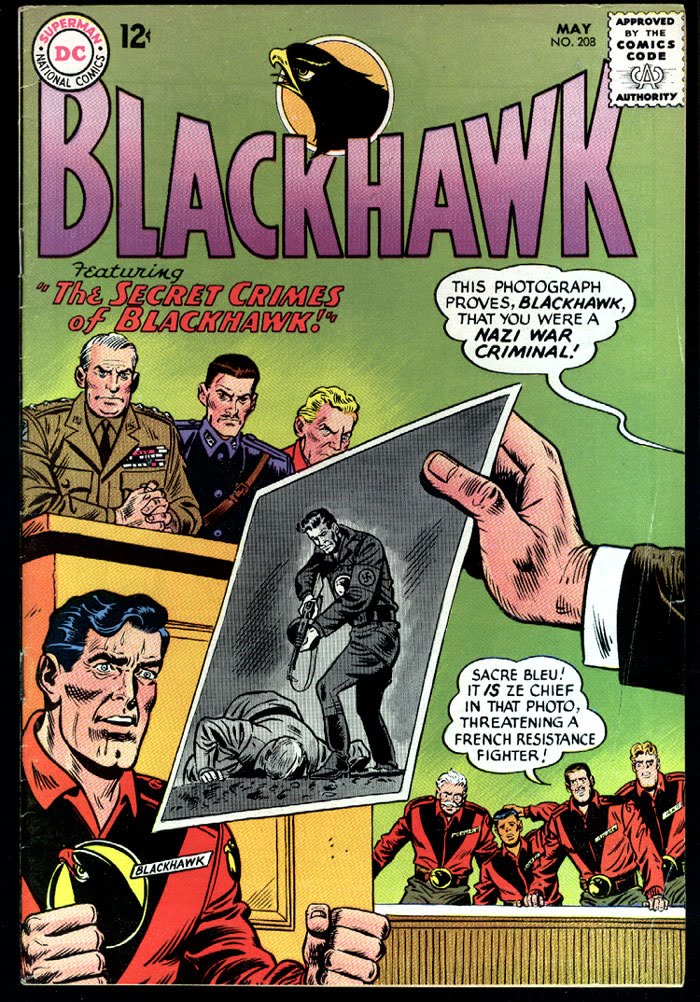
  • The comic book cover depicted above is that of Blackhawk #208, published way, way back in 1965. Blackhawk, if you remember, was an ace World War II era American pilot and leader of a team of airmen called, eponymously enough, The Blackhawks. In the issue above, he’s confronted at a military trial with a photograph purportedly showing him collaborating with the enemy. We don’t know how this one turned out, but he must have been acquitted, as the series continued for another few years. We think, though, that Blackhawk, who is apparently representing himself, should object to the authenticity of the photo.
  • With our reviews of “Harry’s Law” and “Fairly Legal,” this was surely Hollywood week at Abnormal Use. But we have to ponder why the chief protagonists of all these legal shows are introduced in the pilot as just having quit a more interesting and powerful job. In “Harry’s Law,” the character played by Kathy Bates quits a megafirm to start a tiny firm and shoe store. In “Fairly Legal,” the character played by Sarah Shahi resigns the bar to become a full time mediator. In “The Outlaw,” which we reviewed last fall, the character played by Jimmy Smits resigned from the U.S. Supreme Court, of all places, to start a new firm. Uh, wasn’t he already in a good spot to influence the law? What gives?
  • Friend of the blog and John Marshall Law School torts prof Alberto Bernabe responds to our earlier post on the issue of bilingual products warning. We’re prepping our reply to his response, which may prompt a sur-reply by him. We shall see.
  • Our firm, Gallivan, White, & Boyd, P.A. has at least one lawyer live tweeting the South Carolina Bar Conventon. That would be Stuart Mauney, and you can follow him here.

TV Review: USA’s "Fairly Legal" with Sarah Shahi

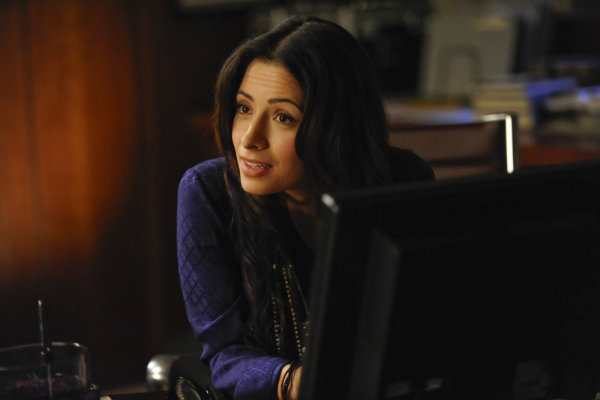
As noted Tuesday in our interview with creator and showrunner Michael Sardo, “Fairly Legal” centers around Kate Reed (Sarah Shahi, pictured above), a mediator and former attorney whose idealism stands in stark contrast to the demands of her employment at a big law firm. We here at Abnormal Use obtained advance screeners of both the pilot, which debuts tonight at 10/9 Central on the USA Network, and the fourth episode, which will air in February. Written by Sardo, and directed by Bronwen Hughes, the pilot sees the puzzled fiancé of a plaintiff ask Reed, “What kind of mediator are you?” Litigators may have the same question, as the mediation process depicted is quite different than that to which practitioners have become accustomed. Be forewarned, there may be minor, minor spoilers in the review we offer below.

Weary of the legal profession, Kate explains that she has “more than a small amount of self-hatred.” This may be why she has given up her litigation practice and gone so far as to resign her membership from the California State Bar. But the law is in her blood, and she comes from a family of lawyers. Her late father was once a masterful attorney who built the large San Francisco law firm of Reed & Reed. Her brother (Ethan Embry), who has retired from the profession, used to work at the family firm. Her “evil step mother” Lauren Reed (Virginia Williams) – much, much younger than Kate’s father – is now the managing partner at the law firm, which is struggling in light of Kate’s father’s death. To boot, Kate’s own ex-husband, Justin Patrick (Michael Trucco) is an assistant district attorney. So, despite no longer having a law license, Kate elects to maintain a mediation practice and remain in the employ of Reed & Reed.

Kate has the sort of quirky existence seen on contemporary television programs: she lives on a boat, maintains an unusually close relationship with her ex-husband, programs her iPhone to display images from The Wizard of Oz based on the personality of the caller, and never seems to find herself on the wrong side of the issue presented in the episode. Shahi plays Reed with a charm of sorts, although there is an element of the holier-than-thou in her character, who often has to explain why the traditional result of the law is not always the product of justice.

In the first episode, Kate mediates two principal disputes. In the first, she is called upon to resolve a disagreement between a stern father and his adult son – both of whom are corporate representatives of a large clothier client which had negotiated a buy out now in peril due to the family dispute. Apparently, the son was charged with a DUI under mysterious circumstances which threaten the transaction. In the second, Kate is appointed by a judge to mediate a dispute between a pro se plaintiff, a recently engaged man, who is suing three pro se defendants who he claims ruined his meticulously planned proposal. Her approach to both cases is unorthodox, to say the least, and at times, she seems to stray into offering legal advice to non-clients (which, of course, she should not really do as the mediator, especially a non-attorney mediator).

Like many television lawyers, Kate is an idealist. She shows up at one client’s house late one night and encourages him to “do the right thing” – something which is contrary to his own wishes and best interests. Her managing partner advises her that a non-client criminal defendant is not worth attention – and Kate responds sarcastically that she should “never let an innocent kid’s life stand in the way of our legal fees.” She lectures her district attorney ex-husband about justice and truth being higher than the laws that are held up as sacred and immutable. The difficulty she faces – and what is bound to become a central theme of the show – is her philosophy and its conflict with the daily back and forth of the legal profession (which she comes to understand are just as important, but not more, than her own idealism).

One of the most interesting characters is Williams’ Lauren (pictured above), the managing partner who is forced to do a bit of wining and dining to rekindle client relationships in the wake of her husband’s death (which leads to its own set of ethical difficulties). She faces a clear set of challenges, not just in the perils of client retention but also the day to day struggles of the business of law. (Real life firms Morrison Forrester of San Francisco and Wilson Sonsini Goodrich & Rosati of Palo Alto get shout outs as law firms moving in on Reed & Reed’s business following the death of Kate’s father.). To boot, Lauren also must cope with older male clients who think that she, as both a woman and a younger lawyer, might not be up to the task. As a foil to Kate, she could just be another symbol of a broken system, but there is potential in this character to showcase real and true dilemmas faced by attorneys across the country.

There are, of course, a number of inaccuracies and issues with the depiction of both the legal profession generally and the operation of a major law firm specifically:

One judge (Gerald McRaney) appoints her to mediate the dispute between the aforementioned unrepresented plaintiff and three unrepresented defendants. In so doing, he actually summons her to court (where all of the parties are waiting in the well of the court for the appointment to occur). The judge gives her two days to successfully mediate the dispute – a $10 million civil suit brought by a spouse suing an actor for blundering a proposal. Interestingly, she notes that two days would not be enough time to mediate a case involving multiple defendants and such a high initial demand.

Although we are told from the beginning that Kate is not a lawyer, she does not always inform those with whom she interacts and likely leaves the impression that she is not only a lawyer – but their lawyer as well. In the pilot, she visits an unrepresented criminal defendant and essentially offers legal advice in a fashion that borders on the unauthorized practice of law. Further, she makes no disclaimer to the defendant that she is not a lawyer generally and not his lawyer specifically, leaving him with the reasonable impression that he has created an attorney-client relationship with her.

Lauren, the managing partner, busily scurries about trying to save revenue. However, she never remarks on the fact that Kate, by resigning as an attorney but still holding herself out as a mediator, would almost certainly have to reduce her hourly rate. Surely a client would demand a lower rate for a former lawyer mediator than a licensed attorney mediator, especially from such a young former attorney as Kate.

As he indicated in his interview with our site, Sardo thinks of mediation as an opportunity for parties to a dispute to speak for themselves rather than through an attorney. If the pilot and fourth episode are an indication, this will lead to a reliance on stories involving unrepresented parties involved in a dispute with other unrepresented parties.

Although we dig the character, Lauren is a bit young to be a managing partner. According to her IMDB entry, Williams, the actress who portrays her, was born in 1978, making her the age of many associates. It may be difficult to buy into a managing partner of a major law firm being portrayed by an actress who was an aspiring teenage actress as recently as the mid-1990s (which was not too long ago). But, hey, it’s television, and what can you do?

What Sardo is trying to do with the show, though, is admirable. He’s not trotting out another formula legal drama that we’ve all seen before a million times. Rather, he’s attempting to depict the day to day business of alternative dispute resolution, which is something we here at Abnormal Use have not seen much of in popular culture. Sure, he’s got to take some liberties with the process, as no one wants to watch a program about a mediator shuffling from one conference room to another taking numbers back and forth and attempting to settle a case in that fashion.