Study Linking Childhood Vaccines with Autism a "Fraud"

By now, we’ve all heard The Associated Press report that the 1998 study conducted by British doctor Andrew Wakefield, from which he concluded from his study of 12 children that a link existed between the MMR (mumps, measles, rubella) vaccine and autism, has now been renounced and regarded as “a fraud” by Britain’s preeminent medical journal. The British Medical Journal (BMJ) condemned Wakefield’s work, claiming that he intentionally altered data to produce false results. The original publisher of Wakefield’s study, The Lancet, retracted the article last year, following which the British General Medical Council stripped Wakefield of his license to practice medicine.

As we previously reported here, the U.S. Supreme Court heard arguments recently in a case that likely will have significant implications for hundreds of pending lawsuits against vaccine makers, the vast majority of which allege a causal link between childhood vaccines and autism. The BMJ’s recent denunciation of Wakefield’s study certainly should play a significant role, too, in the disposition of these pending suits. According to a recent report in The Chronicle Herald, past investigations into Wakefield’s study revealed that his study received funding from lawyers who were suing vaccine manufacturers and that Wakefield, who had developed an alternative to the MMR shot, stood to gain financially if the leading vaccine was dropped from use.

Unfortunately, Wakefield’s bogus study has already caused some significant damage. In spite of the fact that numerous, more expansive studies found no causative link between childhood vaccines and autism, hundreds of thousands of parents–mostly in the U.K. and U.S.–have forgone vaccinations for their children. Not surprisingly, this has led to significant outbreaks of various preventable diseases, most notably those of measles and whooping cough. In 2010, California broke a 55-year-old record for the number of reported cases of whooping cough. We here in South Carolina also have seen a significant rise in the number of cases of whooping cough in recent months.

Although the recent exposure of Wakefield’s fraud brings good news to the scientific community, it seems as though the damage has been done. Though fraudulent, Wakefield’s study certainly was successful in raising long-lasting skepticism over vaccines.

Abnormal Interviews: Michael Sardo, Producer of USA’s "Fairly Legal," Talks Mediation

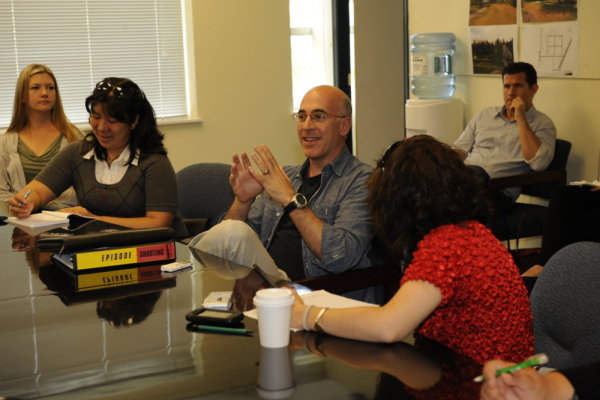
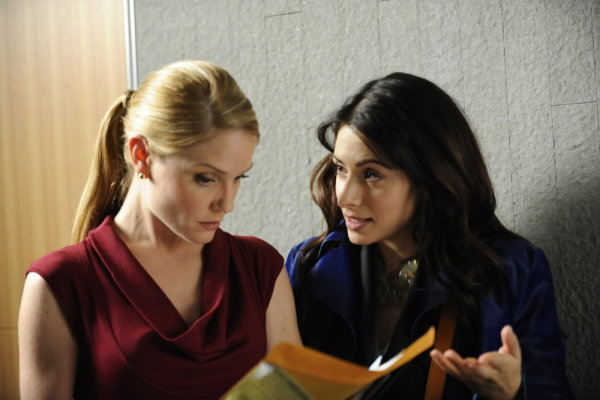
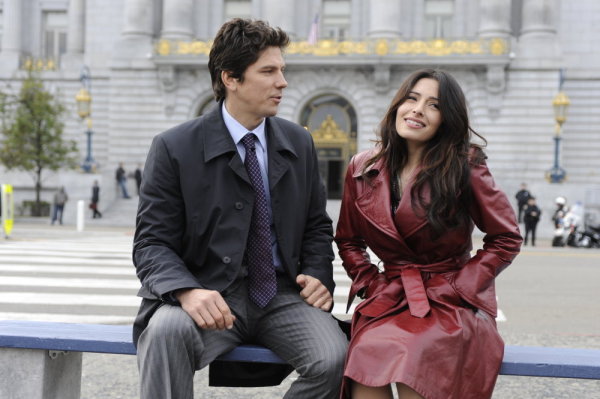
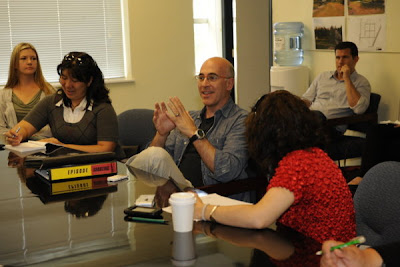
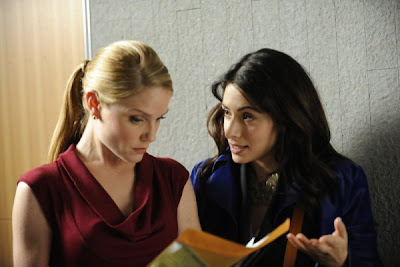
Believe it or not, we here at Abnormal Use scored an interview with Hollywood writer and producer Michael Sardo (pictured above), whose new show “Fairly Legal,” debuts Thursday night on the USA Network at 10/9 Central. The show stars Sarah Shahi (pictured below) as Kate Reed, a lawyer turned mediator, whose spirited idealism pits her against the staid conventions of life at her late father’s San Francisco law firm. So weary of the legal profession is she that she actually resigned from the bar. However, she has decided to remain a mediator at the firm and work alongside Lauren Reed (Virginia Williams) who, in addition to being the firm’s by-the-book managing partner, is also Kate’s father’s young widow. Further complicating Kate’s life is her relationship with her ex-husband, Justin Patrick (Michael Trucco), an assistant district attorney who somehow finds himself embroiled in many of Kate’s many mediation antics.

Sardo was kind enough to grant us an interview earlier this month about the show and his philosophy on alternative dispute resolution in general.

DEDMAN: You’ve referred to “Fairly Legal” as “our little anti-law law show,” and I wanted to ask you first, how is it different from other legal shows?

SARDO: Well, it’s different in several ways. It doesn’t take place in the courts. One of the most important scenes in the pilot is Kate being thrown out of a court. She’s the thing that doesn’t belong. Kate Reed, the lead character, is a former lawyer who was frustrated with the law and who resigned from the bar and becomes a mediator. She tries to find a more direct way to solve conflict. Kate’s point of view is that the artifice of the law is this sort of standardization that’s needed to create laws that fit all levels of society [that] actually leaves out some of the most important parts, and she wanted to get to those most important parts. At the same time, in the pilot, she realizes that you often need lawyers and the law because if everyone was a mediator, that way lies anarchy. But as the balance has shifted to us being such a litigious, law-filled society, she is someone who moves towards the opening up of another way for some conflicts to be resolved.

DEDMAN: Now, if I were a client of the Reed & Reed law firm, why would I want Kate Reed to mediate my dispute?

SARDO: Because she would understand the cost, both physical and mental, of going to court, what you could possibly win, but also what it would cost you, and what you could possibly lose, and so she would first propose a more direct streamlined solution which involves hearing what you think, and what the injured party or the complaining party thinks, would be the solution. . . . [N]owhere does the show say we don’t need laws or lawyers. . . . [S]ay you go into a courtroom, [and] I have a disagreement with Jim Dedman, who’s my neighbor – so instead of talking to him, I go to court. . . . . I don’t talk to anyone. My lawyer talks for me. His lawyer talks for him. And then, a judge, who’s sort of dad or grandpa, tells us what’s going to happen. He doesn’t tell you what’s right or wrong but what the law says is right or wrong. So we kind of give up our rights and our adulthood and sublimate it to these laws, some of which may work, and some of which may not. It’s a system that functions well in some cases and really poorly in others. Kate is someone who takes a more direct approach and . . . puts [people] in a mediation where they get to talk for themselves and propose their own solution.

DEDMAN: You mentioned at the beginning that she is a former lawyer, and at some point in the events prior to the pilot, she surrenders her law license as an attorney to become a mediator. Why does she take that approach?

SARDO: A lot of lawyers who are also mediators . . . [they’re] still a lawyer. [They] can still then also hold what’s happened in a mediation confidential, and then be engaged as the person’s lawyer, and Kate wanted to make a clean break from being a lawyer. But she was still interested in the pursuit of justice and truth. . . . Kate is someone who would cut things off if she didn’t like the way they were going. This is the beginning of her becoming an adult in the sense of saying, “I don’t like some of that, but I do like some of it, and I’m going to stay, I’m going to work at my father’s law firm, but I’m not going to do it the way he does it, and the people around me do it. I’m going to make it my own.” For me, as a writer, what appealed to me about that character was the idea of you taking two people in conflict, you put them in a room, you close the door and you send in someone like Kate – to me that’s inherently interesting drama without any of the other artifice surrounding it I think you’ve got to peel away to get through the drama.

DEDMAN: Some of the promotional materials describe Kate as a “recovering attorney,” and in the pilot, she says that she has “more than a small amount of self-hatred,” and I wanted to ask you if those are connected in any way.

SARDO: [Laughs.] Well, like any of us you know, our work life and personal life are connected. Kate is really well aware of her flaws, and she is someone who can act impulsively, and often will do something that makes whatever she’s dealing with, whether it’s personal or professional, worse, because she acts in the moment, and that’s where the “no small amount of self hatred” comes from. “Recovering attorney” is a line I actually heard from more than one mediator who I talked to who said that’s how they referred to themselves as “recovering attorneys,” and I just thought it was great and was always looking for a way to work it in.

DEDMAN: You once gave an interview a while back in which you said that “the writer’s job is to have a point of view,” and I wanted to ask you, what is the point of view you’re expressing in telling stories about mediation, which is something that is not often depicted on television?

SARDO: My point of view is that anything that’s important to you, you should be as personally involved as possible, and you should let your point of view be known, and you should have part of the solution. Whether you caused the problem, or you’re affected by the problem. And that the less you turn it over to someone else, the better. And in my own experience, just in life, the further things get removed from having some kind of personal contact, [the worse they become.] . . . [Y]ou used to go and get your mortgage from your local banker, and he sized you up, and said, “Can this guy pay this for 30 years?” So what happens when they would bundle this part of 10,000 mortgages? There’s no accountability on either end to what happens in court. They sort of give themselves over to a system, and you hire someone with a knowledge of that system to work it to your advantage. . . . [T]he more that people can get involved themselves and take charge of [and] make their own statement about what they want and need and let that be known and try to work it out, [the better.] It’s still not a perfect system, but [it’s] a better system.

DEDMAN: Now, Kate is an idealist and appears unappreciative of the day-to-day operations of her law firm. Why does she still work for that firm?
SARDO: She gives a speech at the end of the pilot where she acknowledges for the first time out loud what is the advantage of the law and the law firm that you do need both things. To go back to your earlier question, what bothered Kate about the law was that every lawyer that I know has had cases that bothered them. But they had to accept that that’s how the law works. [They] knew that somewhere down the line someone was going to change that or that [there] was a wrongful conviction but the person will eventually get out. It’s that kind of ancillary damage that you have to accept to be a good lawyer, I think. It’s a thing that Kate couldn’t accept. But she knows that you need laws in a society. It’s the situational part of it that she couldn’t look away from – the way laws apply differently to different economic classes and different people have different degrees of lawyers. She couldn’t participate in that system any more, but she wanted to be part of the figuring out of truth and justice part of the system.

DEDMAN: One character that was particularly interesting to me as a lawyer was Lauren, who’s played by Virginia Williams, who is the managing partner of the firm and the foil to Kate. How do you think viewers, or lawyer viewers in particular, will respond to that character?

SARDO: . . . [W]hat I hope, and what Virginia and I have both worked really hard on, is to create a character who is – in the hands of a less gifted actress – would be easily parodied. She seems on the surface to be a trophy wife and kind of a bitch, and I think Virginia has found a way to play Lauren the way it was intended: to be neither of those. She actually had a true love with Kate’s dad, and that’s what bothers Kate, even on the surface. Yes, she’s thirty years younger, and she’s beautiful, but she’s quite a good lawyer, and she’s quite smart, and Lauren and Kate both want similar things. But they’re looking at the world through different facets on the prism. Lauren believes the world works best when the trains run on time, and she’s the person to run them. And she looks at the firm and says, “You know what, Kate, I’m watching out for the clients who are paying us, that’s why you have a job and your assistant has a desk and health benefits, and the lights are on. There is good in what I do, not just that it keeps the building running, but that I’m enforcing the law.” She believes in it, and she believes in the rightness of it, and doesn’t believe that it’s her job to change that. Kate questions everything, and between those two poles, I think they represent the two poles of how you can feel about the law, and I don’t think that it’s a healthy system that functions with just one or the other. I think you need both.

DEDMAN: One interesting thing is that both Kate and Lauren have roles that have traditionally been held by men in the past, both in the legal profession and in television depictions of the legal profession. Will the series explore the challenges that are unique to female mediators and female managing partners in the law?

SARDO: Yes, very much so. You see it in one scene in the pilot in what Lauren faces. . . . [Y]ou see how she has to deal with a very important client of the firm and make a decision as to which way she’s going to take that. Kate will deal with some of those issues, also, because, it’s funny, when you have a lead as attractive as Sarah Shahi, and you want to portray her as very serious about her work, but at the same time, you can’t be oblivious to the fact that she’s gorgeous. So, we made a conscious decision to have characters react to that and react to her as a beautiful woman because she is one. If she was a handsome man, people would react in a certain way, so she will have people react to how she looks. . . . Lauren particularly will have to confront those things in her position because of her visibility as managing partner and the fact that she often has to play hardball within the firm and with other people who are interested in the firm.

DEDMAN: One thing that Kate does in the pilot is show up at the front door of a client’s home and encourage him to do “the right thing.” What happens when her definition of “the right thing” conflicts with her firm’s duty to represent that client who might not want to do “the right thing”?

SARDO: That is the conflict that exists between Lauren and Kate, and I was very interested in that because I think that’s the conflict all of us face in all of our jobs. I think if you’re working at an auto repair place [then] you know that you’re being pushed to find everything that can be fixed because you want a higher bill. Every time I go into Starbucks they say, “Would you like something to eat with that?” [Laughs.] Everyone is trying to increase their billings, and they’ll say it to you whether you’re on a diet or 100 pounds overweight or not interested in a snack. So Kate and Lauren, I think that’s something that in all our professional lives we have to grapple with. . . . Kate had to acknowledge the reality that you have to be conscious of the client, and Lauren is not someone who’s without morals. She will also have to deal with the moral complications of making decisions that are better for the business but worse for overall justice in the world.

DEDMAN: Have you gotten any feedback from practicing mediators about the show?

SARDO: Not yet, but it’s starting to come. I’m going to be talking with some soon. I talked to mediators as I was developing the show about their motivations to become a mediator. A lot of them had been lawyers. And about what are the boundaries of what a mediator can do, and what interested me was how much they all repeated the same thing, which was it’s completely about the personality of the mediator. . . . We’ve tried very hard to stay with some degree of realism of what a mediator could do. Of course, the most colorful, interesting, fun mediator. I think people are starting to see the pilot so I will be hearing from our mediator friends.

DEDMAN: You’ve gotten some good supporting cast members and some guests. I noticed you have Gerald McRaney and Esai Morales and John Ashton and Chris Ellis in the two episodes that I saw. Is there anyone else that we can expect to see in the first couple of episodes?

SARDO: Richard Dean Anderson comes back a couple of times. Gerald McRaney will be on a few. and he’s wonderful. Wonderful to have. Ken Howard is in the pilot. We have – I’m trying to think of anyone else that you would really know. Paul Shultze from “Nurse Jackie” does a great turn for us. He plays Eddie the pharmacist on “Nurse Jackie.” I think those are the ones you would know, I’m sure I’m leaving someone else out and hoping they don’t read Abnormal Use.
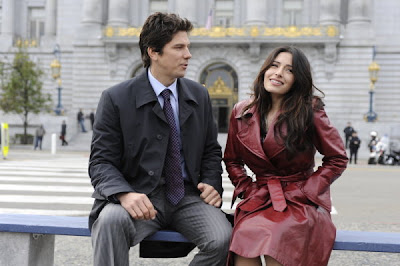
DEDMAN: I do have to ask you about the “Battlestar Galactica” connection. Michael Trucco plays the assistant district attorney, Justin Patrick, and Esai Morales plays his boss, the district attorney. Trucco was on “Battlestar Galactica” and Morales was recently on [the “Battlestar Galactica” prequel] “Caprica.” Is that a coincidence in the DA’s office on the show there?

SARDO: [Laughs.] I like that you’re looking deeper than we had time to think when we were casting. We were just looking for the best actors we could find, and the good actors work a lot, and they just happen to be in close proximity to each other, but it was not by design. Some of “Battlestar Caprica” people may want to believe it is.

DEDMAN: . . . [M]y last question to you would be is generally, what do you believe is the chief advantage of mediation as opposed to litigation?

SARDO: Quicker. Cheaper. More satisfying. And more in control of your own destiny.

Incidentally, the quotation we reference in our fifth question to Sardo comes from a 1991 interview he gave to Media Week as a 31-year old writer and recent Emmy nominee. The relevant portion of that interview is as follows:

“One of the biggest problems of TV is that show creators write what they can sell and not what they want to watch. I just write what interests me,” says Michael Sardo, 31, who earned an Emmy nomination for his writing for the “The Tracy Ullman Show” before landing a development deal at Lorimar Television to create half-hour comedies for the networks.

“Most of my ideas don’t sell, because they are not recognizable television,” he says. “In my work, the characters have problems that actual people may have. People keep trying to write things that are already on. Why? You’ve already got one. The writer’s job to me is to have a point of view.”

The same obligation should extend to the networks. “There’s a tendency to homogenize – – to appeal to every kind of audience. Always go for the most intelligent way. Executives seem to talk about this fictional audience that’s moronic. Networks should try to come up with what they see are good shows and not what they think people want to watch.”

Sardo came to Hollywood in 1982 via a blue-collar Bronx childhood and Ivy League education to pay his writing dues. At one point, he even lived out of his car. A spec comedy sketch finally landed on NBC followed by two specials for MTV and the Disney Channel before Sardo wound up on the Tracy Ullman staff.

While he credits shows like Northern Exposure, L.A. Law, and Murphy Brown as exceptions, more often, he says, writers and networks try to go for the quick buck by succumbing to safe story structures, then get to used to the money or typecast as formula writers.

“That’s why you also see such unlikely pairings in sitcoms,” says Sardo. “‘She’s a Jew, he’s a Nazi.’ Come on, would they really be together?”

Karlin, Sue. “The New Producers,” Media Week, October 14, 1991.

TV Review: NBC’s "Harry’s Law" with Kathy Bates

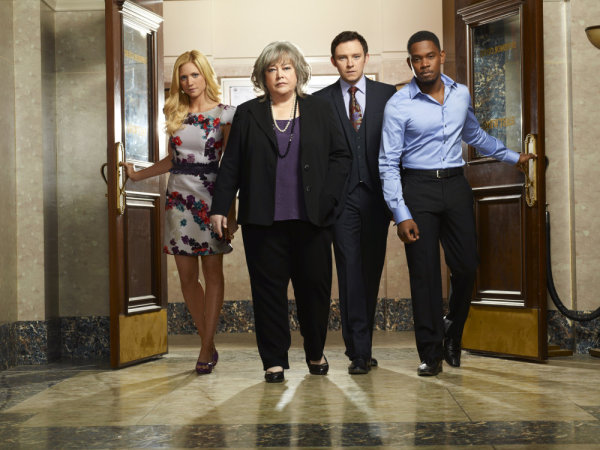
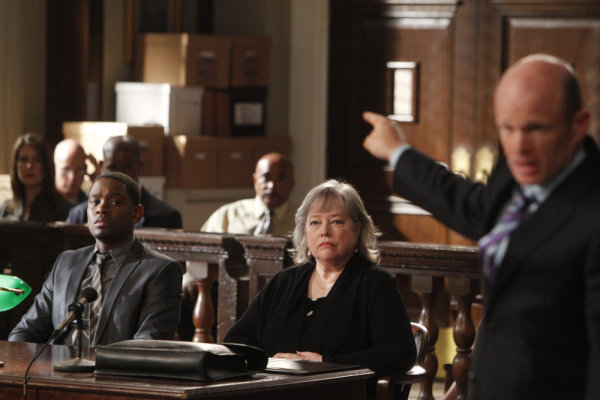
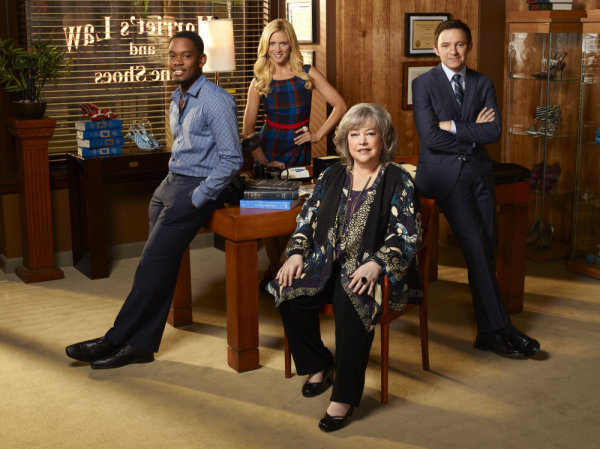
Television showrunner David E. Kelley (“Ally McBeal,” “The Practice,” “Boston Legal”) has a new legal drama, “Harry’s Law,” starring Kathy Bates, which premieres tonight on NBC at 10/9 Central. We here at Abnormal Use were able to pull some strings with our many Hollywood connections and score an advance screener of the series’ first two episodes, and we liked what we saw (especially since it takes many, many cues from Kelley’s recently departed “Boston Legal”).

Before reviewing the pilot episode, we must disclose that we have always been fans of Kelley’s oeuvre. Even when we were slumbering through psychology and biochemistry classes without even the slightest thought of attending law school, we rather enjoyed watching Ally McBeal dealing with the stress of working in a law firm with her childhood boyfriend. Once we made that fateful and immutable decision to attend law school, Denny Crane and Alan Shore in “Boston Legal” had us looking forward to those days when we too would be sharing cigars on the office balcony after a long day of legal shenanigans. Given our love for a good David E. Kelley legal drama, we were thrilled to obtain an advance screener of “Harry’s Law.

So much for objectivity.

Written by Kelley and directed by Bill D’Elia, the pilot was a fun bit of television. With only minor, minor spoilers, the basic premise is as follows: Harriet Korn, a highly successful attorney, is fired from her plush Cincinnati mega-firm after expressing her disgust and boredom with the everyday monotony of her patent work. (Possibly Kelley’s most realistic premise to date). Following a series of miraculous events, Korn establishes “Harriet’s Law and Fine Shoes” in an area of town not likely to be highlighted by the chamber of commerce. (Harriet’s firm also peddles, at the insistence of Korn’s legal assistant, Jenna Backstrom (Brittany Snow), a fine assortment of Prada and Jimmy Choo’s footwear left over from the previous tenant, who apparently abandoned a sizable inventory.). Along with Backstrom, Korn hires Adam Branch (Nathan Corddry), a young, over-the-top patent lawyer, who joins the firm after inadvertently striking Korn with his Mercedes, and Malcolm Davies (Aml Ameen), an aspiring college-student who literally falls upon Korn during a suicide leap following his third drug charge. “Harriet’s Law and Fine Shoes” begins its sojourn into criminal defense with Korn representing Davies on his drug charge and Branch representing Damien Winslow (Johnny Ray Gill) after Winslow’s “protective services” result in a bullet in the leg of an alleged armed robber.

As attorneys, it is rather easy to identify all the inaccuracies of “Harry’s Law.” For starters, the sale of expensive footwear out of a law practice must surely violate ethical principle (although we can’t recall any specific examples from the MPRE). However, if such a thing is ethically permissible, Kelley may have solved an issue for firms seeking to escape the economic conundrum. Aside from the ethical pickle of shoe sales, Kelley paints an idealized picture of the practice of law – not as it actually exists. Legal rules are often cast aside in order to turn cases into a platform for social issues rather than a means to resolve a suit. During the course of the Davies’ trial, Korn opines on the benefits of legalizing drugs. Korn offers her opinion, not during the scope of an objection, but rather as an open monologue in the midst of the prosecutor’s (Paul McCrane) cross-examination of her client. Following this soliloquy, she then argues for jury nullification during her closing statement. In so doing, she urges the members of the jury to offer her just one not-guilty vote despite her lack of any legal defense. Korn claims there is “no justice in the law,” but we here at Abnormal Use believe there is more to law than winning and losing.

That said, Kelley succeeds in filling the void left by the absence of “Boston Legal” from the airwaves. “Harry’s Law” provides a new cast of characters carrying-on in the footsteps of Legal‘s Shore and Crane. As Korn, Bates delivers her best performance since the car-smashing, “I’m older and have more insurance” days of 1991’s Fried Green Tomatoes. (By the way, wouldn’t you have hated to be the adjuster who informed her that she wasn’t covered due to her policy’s intentional acts exclusion?). As Branch, Corddry dazzles, reminiscent of the infamous Alan Shore, using an arraignment hearing as a soapbox to highlight the neglect of inner-city populations. (Just wait until he stands up to the egotistical, television ad plaintiff’s lawyer in next week’s “Heat of Passion” episode).

Kelley’s shows work because of his ability to create quirky, non-stereotypical lawyers to highlight contemporary issues using litigation as an effective backdrop. Though lawyers may recoil at some of the perceived inaccuracies, non-lawyers will find that it makes for great television. “Harry’s Law” tiptoes that fine line between what the law is (at least according to Kelley) and what the law should be (again, according to Kelley). With such an approach, it’s easy to draw viewers into the alleged war between social and legal justice (although favorable depictions of large corporate defendants are unlikely given his track record).

“Harry’s Law” does not preach that the practice is nothing but a cutthroat all-or-nothing business at the expense of social justice, any more than “Grey’s Anatomy” purports that every nurse or surgical resident beds another while patients await in the next room. (Seriously, that much intra-hospital action can’t seriously be going on can it?). While it is not a realistic portrayal of the courtroom, “Harry’s Law” is a witty, thought-provoking indulgence into the realm of social justice.

Martin Luther King Day

We here at Abnormal Use and Gallivan, White, & Boyd, P.A. celebrate the legacy and leadership of Dr. Martin Luther King, Jr. In honor of the occasion, we direct you to this story from Sean Muserallo of WYFF entitled “The Story Behind Greenville’s MLK Breakfast.” For a listing of events in Upstate South Carolina, please see here and here. Today, our offices are closed.

(By the way, the comic book cover depicted above is that of Golden Legacy #13, published in 1972. The Fitzgerald Publishing Company, which produced that comic book series dedicated to African American history, has posted the entire contents of this issue on its website here.).

Friday Links

  • Above you’ll find the cover of Action Comics #263, published way, way back in 1960. In it, Superman, the defendant in a criminal case, is sentenced by a jury of Bizarros. The punishment is, apparently, that Superman will himself be turned into a Bizarro, which is surely cruel and unusual. (No word on whether the Bizarro constitution has an Eighth Amendment prohibiting such.). Again, we think that Supes has a “jury of his peers” objection, just as Batman did when he faced a juryful of Jokers or when a human was sentenced to death by an insect jury. The question: Why are all these defendants pro se? You’d think the Justice League would have some sort of insurance policy providing counsel in these cases. (For the record, we previously explored the antics of the Bizarros here.).
  • Oh, and if you’re not reading the Law and the Multiverse blog, you’re missing out big time. The site is dedicated to one question: How would our laws apply to comic book superheros? This wonderfully clever site is written by two relatively new lawyers, James Daily and Ryan Davidson. Why do they do it? See their FAQ file here. Though new (it just began in November), the site is already quite popular, having been profiled here and here in The New York Times and here at The Volokh Conspiracy. We’re already fans.
  • We thank Alan H. Crede of the Boston Personal Injury Lawyer Blog for his recent kinds words about our site and the recent ABA Blawg awards. We tried to email him directly to share our appreciation, but we couldn’t find a direct email address on his site.
  • By the way, if you look in our right hand column, you’ll see a bar entitled “South Carolina Law Blogs.” We just updated that list to include a number of new blogs in our state, as well as a handful that have been around a while that we somehow overlooked. Take a gander.

Florida Federal Court Rules Manufacturers Have No Duty to Provide Bilingual Warnings

The United States has always been known as a “melting pot,” a place where people from all over the world come and settle and bring their food, culture, and language with them. What does this “melting pot” designation, however, mean for manufacturers, especially in a country where there is no official language? What duties do they have to people who do not speak or read English.

This was precisely the issue before the Southern District of Florida in the case of Farias v. Mr. Heater, Inc., et al., No. 09-CIV-23789, 2010 WL 4814660 (S.D. Fla. Nov. 19, 2010). On February 5, 2009, Plaintiff Lilybet Farias (“Plaintiff”), a naturalized American citizen who was Cuban-born, purchased two heaters from a Home Depot in Miami, Florida to heat her home during a cold snap. One heater was manufactured by Defendant Mr. Heater, Inc., and the other by Defendant Enerco Group, Inc. Plaintiff spoke little English and could read almost no English. Other than understanding the word “caution,” which was printed throughout the user’s manual, she could not understand any of the words on the heater’s packaging or read the users’ manuals.

Plaintiff took the two heaters home and hooked them up to propane tanks. She put one in her living room, two or three feet away from her sofa, and one in her bedroom. After watching television in her living room, she turned that heater off, turned on the heater in her bedroom and went to sleep. Later, she woke up when smoke from a fire in her living room woke her up. Her home suffered significant fire and smoke damage as a result.

Plaintiff filed suit against the two manufacturers of the heaters, as well as Home Depot. She sued the defendants on theories of negligent failure to warn and strict liability. The defendants filed for summary judgment. As the Southern District of Florida outlined:

A manufacturer must take reasonable precautions to avoid reasonably foreseeable injuries to the users of its products and thereby assumes a duty to convey to the users of that product a fair and adequate warning of the dangerous potentialities of the products so that the user, by the exercise of reasonable care, will have a fair and adequate notice of the possible consequences of the product’s use or misuse.

Nevertheless, Florida cases make clear that a manufacturer will not be held liable for damages in products liability cases, even if its warning is inaccurate, if the person did not read the warning or label, since in that case proximate cause cannot be established. As a result, the Court framed two issues before it: First, whether a manufacturer has a duty to provide warnings in Spanish, and second, whether a Spanish-speaking plaintiff can establish proximate cause when she cannot read English warnings provided by a manufacturer.

The Court held that, as a matter of law, the manufacturers of the heaters had no duty to provide bilingual warnings in this case. The Court distinguished the facts of Farias from a previous case, Stanley Industries, Inc. v. W.M. Barr & Co., Inc., 784 F. Supp. 1570 (S.D. Fla. 1992) in which the court imposed such a duty, because in Farias, the heaters at issue in the case were not marketed specifically to a Spanish-speaking population. The Court also noted that there was no statute imposing such a duty on manufacturers.

The Court also held that “any purchaser of the Heaters manufactured by Mr. Heater and Enerco who read the instructions would have understood the clear an unambiguous warnings not to sue the Heaters indoors in an enclosed space.” Relevant to the Court’s decision was the fact that Plaintiff had failed to further investigate the proper use of the heaters, despite her understanding of the word “caution.” She also understood the words “danger,” “warning,” and “stop.” In the words of the Court, “it would be improper to find such clear warnings inadequate because Plaintiff here was not well-versed in English and did not investigate the danger to which she had been alerted in the use of the Heaters.” In fact, the Court found that Plaintiff’s failure to seek out additional explanation was “willful ignorance . . . certainly akin — if not precisely the same — as refusing to read the warnings at all.” The Court granted summary judgment to the defendants on the cause of action for failure to warn.

Finally, the Court also held that the defendants were entitled to summary judgment on the strict liability cause of action because Plaintiff could not establish that either heater had been defectively designed.

The issue of bilingual warnings on consumer products will be an issue to watch in the future. This decision is an important one, because if manufacturers are required in the future to provide bilingual instructions and warnings, what languages are included? Spanish might be the obvious first step, but where would the line be drawn? If warnings are posted in Spanish and French, for instance, but the injured party is Korean, will the manufacturer be found negligent in a failure to warn case? Courts and legislatures need to be wary of imposing overly burdensome requirements on manufacturers in this area.

New Jersey Sodium Lawsuit Dismissal Affirmed Yesterday

We’ve blogged in the past about the necessity of an actual injury to maintain a lawsuit, and just yesterday, the New Jersey Appellate Division again reminded us that there must be some damage sustained before the law will permit recovery. In DeBenedetto v. Denny’s, Inc., No. A-4135-09T1, 2011 WL 67258 (N.J. App. Div. Jan. 11, 2011) [PDF], the Plaintiff sued Denny’s under the state Consumer Fraud Act [CFA], alleging that the restaurant chain failed to disclose the high sodium content in his typical breakfast of ham, bacon, sausage, and hash browns. Although the Plaintiff framed the action under the CFA (ostensibly because neither he nor his purported class had any injury), the court affirmed a dismissal and stated that crux of the claim was products liability, and, therefore, there must be some injury alleged.

Avid readers our site might predict that we will spend the next few paragraphs poking fun at the Plaintiff’s attorney’s inability to properly frame the cause of action or to understand what the word “damage” really means. But today we take a different tack and offer some litigation planning tips to our friends in the plaintiff’s bar. It’s no secret that excess sodium in the diet is bad for you [PDF]. But like a lot of other ingredients, sodium has some benefits, like extending the shelf-life of food. However, sodium may head the way of the trans fat, as there is an increasing awareness and governmental pressure to force reduction of sodium in food.

DeBenedetto may merely have been a test case to see how the courts would react to such claims. Perhaps the courts would not have been so quick to dismiss the case if the evils of excess sodium had gotten some more media attention over the past ten years. Sodium can cause problems with blood pressure and kidney function, but because causation of high blood pressure is multifactorial, causation may be difficult to prove, even given an injury. Maybe a few years from now, in a different state, a consumer fraud action might be more tolerable. Or maybe there is some political aspiration. Perhaps Mr. Wolf, the Plaintiff’s attorney, sees himself as a future sodium czar, helping to craft some FDA regulations. There’s nothing like being in front of an issue to add credibility to a position.

Nevertheless, it would not surprise me if excess dietary sodium quickly became a mainline issue, and whether it means a future tort suit or some other kind of remuneration, I am hard-pressed to believe that this New Jersey suit doesn’t fit in to some other larger litigation plan.

Abnormal Interviews: Jeff Richardson of iPhone J.D.

Today, Abnormal Use continues its series, “Abnormal Interviews,” in which this site will conduct brief interviews with law professors, practitioners and other commentators in the field. For the latest installment, we turn to Jeff Richardson, author of the superb legal tech blog, iPhone J.D., and a partner at the firm of Adams & Reese, L.L.P. in New Orleans, Louisiana. The interview, which mostly concerns iPhones and legal uses of smartphone technology, is as follows:

1. Generally, how has the practice of law changed with the advent of smartphones?

When the BlackBerry and similar devices started to become popular almost ten years ago, the practice of law began to change dramatically. Tech savvy lawyers could impress clients by always being available to receive and respond to an e-mail. This then led to clients expecting that they could contact their lawyers 24/7. Around the time that the Palm Treo 650 started to become popular, attorneys were able to do more than just read and respond to e-mail; they also had tools to find information on the Internet, edit documents, et cetera. We saw the possibility of being a mobile attorney without having to carry around a laptop. When the iPhone debuted in 2007, it forever changed what consumers expected from a smartphone interface, but it didn’t have much of an effect on the practice of law at first. But, in 2008, when the iPhone 3G came out, and the iPhone was suddenly able to work with Microsoft Exchange, the e-mail used by many lawyers and law firms, and at the same time the App Store opened, the iPhone started to become an extremely powerful device for lawyers. The tools that made mobile lawyering a possibility on the Treo 650 started to become available for the iPhone, but this time, the software was much more powerful and polished. We are now at a stage where clients are very used to expecting 24/7/365 availability for their lawyers, and with the iPhone, lawyers really can do quite a bit to meet those needs even when they don’t have a laptop computer nearby.

2. What ethical issues surround the use of a smartphone, and of them, what is the most overlooked? Are there any that are iPhone specific?

Preserving confidentiality is always a concern for lawyers, but not only is this not unique to the iPhone, it isn’t even unique to technology. If you leave a legal pad — or even worse, a briefcase — in an airport, restaurant, courtroom, et cetera, you risk possible exposure of lots of confidential attorney-client information and attorney work product. A smartphone can potentially hold much more confidential information than a briefcase, but at the same time, there are tools to help keep data private (such as password locks) and to locate a missing iPhone or remotely erase the iPhone if it is lost (such as the fantastic Find My iPhone app that Apple recently made free for the owners of all new iPhones).

Another concern that I see is that e-mail on a smartphone tends to be much more casual than e-mail on a computer, which is more casual than a letter drafted on the computer. And yet, the consequences of the written word can be the same, regardless of whether it is in the form of a text or an iPhone e-mail or a formal letter. Clients need to be aware of the potential for liability that results from sending a message without really thinking about it, but attorneys need to follow that advice, as well. Moreover, risks such as accidentally using REPLY ALL or FORWARD exist on the computer and the smartphone, but can be easier to make on a smartphone when people are trying to dash off messages in a matter of seconds.

3. Not too long ago, there were some concerns expressed on some blogs about the security of the iPhone and its appropriateness in legal practice. Have those concerns been put to rest?

You still see a few people issuing dire warnings about security on smartphones such as the iPhone, but often, these people are security professionals looking to sell their services. In the real world, I am not aware of any instance in which an attorney’s iPhone or other smartphone has been obtained by a hacker who knows how to use sophisticated tools to access data notwithstanding the use of passwords, et cetera. I know that these tools are out there, and I know that many police forces are learning how to use the tools (with court approval) to obtain information from a suspect’s iPhone or other smartphone. But the fact that a trained professional can hack into an iPhone or a laptop computer doesn’t lead me to believe that attorneys shouldn’t use an iPhone or a laptop computer. Instead, I urge common sense. If you use your iPhone in your law practice, activate the passcode lock feature so that a stranger cannot simply pick up your iPhone and start to read your e-mail, and be aware that there is some information that is so confidential that it should receive extra protection.

4. What are the three most essential apps for the practicing attorney?

In the spring of 2010, I did a “60 Apps in 60 Minutes” presentation at ABA TECHSHOW 2010 that sought to answer that question. You can still see that list here; I’m working on a new list for ABA TECHSHOW 2011 in April. But if I had to pick just three, I would probably pick Dragon Dictation (so that an attorney can quickly dictate an e-mail), DataViz Documents to Go (so that an attorney can edit MS Word documents and more easily view Word documents) and LogMeIn Ignition (so that an attorney can access his or her desktop computer even when out of the office). Having said that, I really hate to pick just three because there are so many great apps with so many new great apps coming out every day. After a hard day of work, sometimes I consider it “essential” to play a quick game of Angry Birds.

5. If you could will into being one legal app that does not yet exist, what would be its function?

The best feature of the iPhone for attorneys is having information at your fingertips. The information that I want to access is usually available somewhere, but sometimes, can be a little difficult to access. My dream app would be able to sort through information from all of my data sources — my document management system, my e-mail, the documents on my work and home computers, court dockets for my cases, such as the PACER system for federal courts, my notes, et cetera — and allow me to find information from any of those sources with the speed of a Google search.

BONUS QUESTION: What do you think is the best depiction in popular culture of legal technology?

For lawyers and non-lawyers, I think that the technology goal is the same; we want powerful technology without the human interface barriers. As a child, watching Luke Skywalker, Michael Knight, and Dave carry on conversations with C-3PO, KITT, and HAL 9000 made me long for the day when I would be able to access vast amounts of information just by asking questions to a computer or robot. Speech is making great advances, not only on the computer, but also in cars and on small devices like the iPhone, but the reality is that whether I am walking down the street or trying to work in my office, I don’t want to be surrounded by lots of people talking to their computers, their watches, the water cooler, et cetera But the new touch interfaces — which amazed all of us when we saw Tom Cruise in Minority Report, and which we are now seeing in real life on the iPhone and iPad and with the Xbox Kinnect — seem to have the advantage of removing barriers without the noise. I am excited to see these technologies continue to improve in the future.

BIOGRAPHY: Jeff Richardson is the publisher of iPhone J.D., the only website devoted to the use of iPhones by attorneys. iPhone J.D. was voted by readers of the ABA Journal as the best legal technology blawg in 2010. Mr. Richardson is a New Orleans native and a partner in the New Orleans office of Adams and Reese L.L.P., where his practice primarily involves representing defendants in class action and complex litigation, appellate litigation, products liability litigation, constitutional litigation and legal ethics. He has served as court-appointed liaison counsel for defendants in numerous complex cases. Mr. Richardson graduated from Emory University in 1991, summa cum laude, and Georgetown University Law Center in 1994, magna cum laude.

South Carolina Snowpocalypse

Today, the snowpocalypose has come to South Carolina. Most news outlets are reporting that the Governor has closed all state offices in all counties today. At least some federal courts in South Carolina will be closed or opening in a delayed fashion. As of this morning, I-85, the interstate that passes through our fair city of Greenville, is still being cleared. If you’re in the Southeastern United States, we’d encourage you to investigate such closings before venturing out into the snow and ice. It might be best simply to hide from the cold with a cup of coffee.

Likewise, we here at Abnormal Use will not be going into the office today. Our friends at the Drug and Device Law blog in Philadelphia might scoff at this South Carolina snowpocalypse as merely a couple of flakes, but we’re not used to this type of weather down here. Neither is anyone else in the state. Thankfully, we spent much of yesterday preparing for the inclement weather.

We trust and hope things will be back to normal tomorrow.

(By the way, depicted above is the cover of Strange Adventures #79, published by DC Comics way, way back in 1957. We’ve been waiting for the perfect opportunity to use it.).

Friday Links

  • The image above is the cover of House of Mystery #149, published way, way back in 1965, which features a story entitled “I Was Tried By An Insect Jury.” Note that the criminal defendant, a human apparently representing himself (most certainly a bad idea in insect court, no doubt), has just been sentenced to death. Surely there was a “jury of peers” objection? (Kudos to Ryan S. of The Signal Watch for alerting us to this comic cover).
  • Jonathan Adler at The Volokh Conspiracy shares with us the books he’s planning to read in 2011. It’s mostly non-fiction, but hey, he’s a law professor, so that’s okay. We’d suggest he add George R.R. Martin’s A Game of Thrones to the list, as HBO will be premiering an original series based on that work this coming spring. That, or World War Z.
  • Best judicial opinion ever? “The gist of the copyright dispute between the parties is whether Plaintiff’s virtual horses infringe on copyrights associated with Defendant’s virtual bunnies.” Amaretto Ranch Breedables v. Ozimals, Inc., 2010 WL 5387774 (N.D. Cal. Dec. 21, 2010). Yes, you guessed it; it’s a case involving the virtual world of Second Life. (Hat Tip: Eric Goldman of the Technology and Marketing Law Blog).
  • We’re big fans of Bob Dylan’s work (“My Back Pages” is sublime), but we must confess to enjoying this recent news which, to be honest, might have resulted in some of the most interesting litigation imaginable. Here’s the story from Stereogum: “. . . a guy with backstage credentials for a nearby Bob Dylan concert walked into Antonio’s, pizza place close to the venue, and ordered $3,900 worth of pizza. The place closed at 2 a.m. but he promised them a big tip, so they stayed until 5:30 in the jingle-jangle morning making the pizzas. But the guy never returned to pick up his order or pay for it. And it turned out he had no affiliation with Bob Dylan. The guy got away with the prank, and most of the pizza ended up in the trash after the pizza place called the police. But the paper says he later felt bad and and turned himself in, got a lawyer, and has settled with the pizza place. Since it’s not a criminal matter and he’s agreed to pay, they haven’t released his name.” Alas; the Bob Dylan Pizza Litigation That Never Came To Be. That reads like an apparent authority exam question, no? (Hat Tip: Stereogum via the Amherst Bulletin).
  • Did you know that this week marks the 32nd anniversary of the murder trial of Sex Pistols bassist Sid Vicious? We didn’t either, until we were alerted by this piece from The Post Punk Progressive Pop Party blog which is not, by the way, a law blog. Apparently, Vicious did not live long enough to see a verdict, as he died just a month after the trial began.
  • “Why should not the hundreds of millions of Americans in 2011 have the opportunity of witnessing representations of the principals events of 1911?” – G.F. Blaisdell of Brooklyn, New York, in this letter to the editor of The New York Times, published on July 19, 1911. Mr. Blaisdell was writing in response to “Records for Posterity,” an editorial published by The Times on July 13, 1911. Both the editorial and the letter were commenting upon efforts at that time to preserve video and audio records of the day for future generations.