








With a 60-year heritage, Gallivan, White, & Boyd, P.A. is one of the Southeast’s leading litigation and business law firms. GWB's products liability team has extensive experience in defending a wide variety of products liability claims, including mass tort and catastrophic loss claims, as well as conducting accident investigations and providing strategic advocacy services to our clients. Gallivan, White & Boyd, P.A. has offices in Greenville, S.C., Charleston, S.C., Columbia, S.C., and Charlotte, N.C.
The image above is the cover of House of Mystery #149, published way, way back in 1965, which features a story entitled “I Was Tried By An Insect Jury.” Note that the criminal defendant, a human apparently representing himself (most certainly a bad idea in insect court, no doubt), has just been sentenced to death. Surely there was a “jury of peers” objection? (Kudos to Ryan S. of The Signal Watch for alerting us to this comic cover).
Jonathan Adler at The Volokh Conspiracyshares with us the books he’s planning to read in 2011. It’s mostly non-fiction, but hey, he’s a law professor, so that’s okay. We’d suggest he add George R.R. Martin’s A Game of Thronesto the list, as HBO will be premiering an original series based on that work this coming spring. That, or World War Z.
Best judicial opinion ever? “The gist of the copyright dispute between the parties is whether Plaintiff’s virtual horses infringe on copyrights associated with Defendant’s virtual bunnies.” Amaretto Ranch Breedables v. Ozimals, Inc., 2010 WL 5387774 (N.D. Cal. Dec. 21, 2010). Yes, you guessed it; it’s a case involving the virtual world of Second Life. (Hat Tip: Eric Goldman of the Technology and Marketing Law Blog).
We’re big fans of Bob Dylan’s work (“My Back Pages” is sublime), but we must confess to enjoying this recent news which, to be honest, might have resulted in some of the most interesting litigation imaginable. Here’s the story from Stereogum: “. . . a guy with backstage credentials for a nearby Bob Dylan concert walked into Antonio’s, pizza place close to the venue, and ordered $3,900 worth of pizza. The place closed at 2 a.m. but he promised them a big tip, so they stayed until 5:30 in the jingle-jangle morning making the pizzas. But the guy never returned to pick up his order or pay for it. And it turned out he had no affiliation with Bob Dylan. The guy got away with the prank, and most of the pizza ended up in the trash after the pizza place called the police. But the paper says he later felt bad and and turned himself in, got a lawyer, and has settled with the pizza place. Since it’s not a criminal matter and he’s agreed to pay, they haven’t released his name.” Alas; the Bob Dylan Pizza Litigation That Never Came To Be. That reads like an apparent authority exam question, no? (Hat Tip: Stereogum via the Amherst Bulletin).
Did you know that this week marks the 32nd anniversary of the murder trial of Sex Pistols bassist Sid Vicious? We didn’t either, until we were alerted by this piece from The Post Punk Progressive Pop Party blog which is not, by the way, a law blog. Apparently, Vicious did not live long enough to see a verdict, as he died just a month after the trial began.
“Why should not the hundreds of millions of Americans in 2011 have the opportunity of witnessing representations of the principals events of 1911?” – G.F. Blaisdell of Brooklyn, New York, in this letter to the editor of The New York Times, published on July 19, 1911. Mr. Blaisdell was writing in response to “Records for Posterity,” an editorial published by The Times on July 13, 1911. Both the editorial and the letter were commenting upon efforts at that time to preserve video and audio records of the day for future generations.
We here at Abnormal Use celebrate our first birthday today. That’s right: Our very first post – our mission statement – was published one year ago today. We’ve greatly enjoyed bringing you products liability litigation commentary over the past year, and we were humbled when we were named to the ABA Journal‘s Blawg 100 list late last year. (Another unexpected joy was learning yesterday that we had been named by the ABA Journal as the most popular torts blog).
What else to say on the occasion of the first anniversary of the birth of one’s law blog? We could look forward to the coming year and preview what we have in store for our readers. But that would be telling. We could wax philosophical as some blogs do on such occasions, and there is some purpose to such self reflection. So we’ll do just that, if only for posterity.
It all began in the final months of 2009. Those were the halcyon days during which we planned and plotted this blogging enterprise. Knowing that a successful blog must offer fresh commentary weekly, preferably daily, we wanted to ensure that we could do so. Thus, we developed an infrastructure that included two principal authors and five contributors, each with his or her own assigned beat to cover. It has proven to be a successful formula, and we are pleased with the results. We think the ability to post daily is one of the keys to our success.
We also knew that in order to keep our commentary lively and interesting, we’d need to inject a bit of personality into our posts. This, of course, is something we learned from our good friends over at the Drug and Device Law blog who aren’t shy about expressing their opinions. (Neither, in fact, are our pals Walter Olson and Ted Frank at the Overlawyered and Point of Law blogs).
One thing that we have not yet accomplished is to establish this site as a place for back and forth discussion between we, the authors and contributors, and you, our readers. We know from our Sitemeter statistics that we have a certain number of visitors each day, including some who we suspect are regular repeat visitors. (If you’re a regular, say hello!) In the coming months, we’d like to encourage a dialogue between ourselves and our readers on our topics of interest.
In the end, though, we look back and must confess that we’ve quite enjoyed this blogging thing. We look forward to another year of the same, and we thank you again for your support.
We here at Abnormal Use wish you and your family a very Happy New Year. However 2011 turns out, we expected it to be at least somewhat different than how these men in 1931 predicted it would be.
By the way, the image above is the cover of Action Comics #41, published way back in 1945. As you can see, Superman is helping to usher in the new 1945 while bidding farewell to 1944.
Have a safe and eventful holiday. We look forward to bringing you plenty of commentary in the coming year.
We here at Abnormal Use are still surprised that this is our last post of 2010. So without further ado, we present our final “Friday Links” of the year. Have a safe evening tonight.
The Criminal Justice Degrees Program lists the “10 Best Legal Shows in TV History” (including embedded video). Without a mention of Harvey Birdman, the list is a bit mainstream, but it’s definitely worth your review. (Hat tip: The Volokh Conspiracy).
We’ve not yet seen the new remake of True Grit, but we see that at least two legal blogs have remarked upon legal concepts depicted in the film. That’s right; both the EvidenceProf Blog and The Faculty Lounge are abuzz with legalisms in the latest cinematic offering from the Coen Brothers. See here and here for more.
Jeremy Telman of the Contracts Prof Blogcomments upon the new lawsuit filed by the actresZooeyDeschanel. Kudos to him for the Lady Duff Gordon reference.
As 2010 draws to a close, we thank Dan Eller and Mary Giorgi for their contributions to the site. Both began the year as founding contributors to this site, and both have now retired from the blog (although we still get to see them each day at the office). Associate Frances Zacher took the place of Dan a few months ago, and starting next week, associate Nick Farr will assume responsibility for Mary’s beat on the blog.
Today, in our last substantive post of the year, we remember the trial. For many reasons, there just aren’t as many trials as there used to be as in those days of yore. We often hear the older lawyers in our community tell tales of the old days – prior to the adoption of more formal discovery rules – when litigators litigated and juries rendered verdicts. These days, with the voluminous information yielded by years of discovery, both sides of a case know each others’ strengths and weaknesses such that they can readily evaluate the worth of that case. Coupled with the rise of mandatory mediation, most cases settle before being fought in the courtroom.
Sure, there are many cases that should not go to trial for a variety of reasons, most notably cost and uncertainty. But many that can and should see the courtroom are not tried. We, as lawyers, should not be afraid of trying cases. Nor should we refrain from advising our clients to take their meritorious defenses to trial if the circumstances warrant it. That’s part of our job, too.
Earlier this year, one of the shareholders at our firm defended a difficult case and prevailed after a long, hard-fought trial. Fresh off that victory, he sent the following email to all of our firm’s attorneys:
[W]e do not need to be afraid to try cases to juries. We need to properly evaluate the case for settlement purposes, but if a reasonable settlement cannot be obtained, we need to convince the client to try the case. At mediation, if the plaintiff doesn’t get into an acceptable range for settlement, simply advise the mediator and opposing counsel that we appreciate their attendance at the mediation but we will be delighted to see them at the courthouse for a jury trial. Juries almost always do the right thing. While there certainly have been bad jury verdicts, and occasionally a jury will do something crazy and deliver a runaway verdict, often those cases can be corrected on appeal or settled during the appeal for a much more reasonable amount, and these results are not typical.
As many of you know, I have decried the decline of jury trials over the last few years, and hope we can once again restore the jury trial to our arsenal of defense of civil litigation. There is simply nothing more grand than a jury trial, and no feeling more thrilling than a defense verdict after a hard-fought trial. . . . [W]hile trials are stressful and extremely hard work, the thrill of victory makes it all well worthwhile.
…
And, even if we don’t win, let’s always remember the immortal words of Teddy Roosevelt:
“It is not the critic who counts; not the man who points out how the strong man stumbles, or where the doer of deeds could have done them better. The credit belongs to the man who is actually in the arena, whose face is marred by dust and sweat and blood; who strives valiantly; who errs, who comes short again and again, because there is no effort without error and shortcomings; but who does actually strive to do the deeds; who knows great enthusiasms, the great devotions; who spends himself in a worthy cause; who at the best knows in the end the triumph of high achievement, and who at the worst, if he fails, at least fails while daring greatly, so that his place shall never be with those cold and timid souls who neither know victory nor defeat.”
As we all know by now, legal technology is rapidly, rapidly advancing, and the manner in which lawyers conduct research and communicate continues to evolve at an exponential pace. However, one aspect of the legal profession which has not significantly changed in the past several hundred years is the judicial opinion – that document issued by the court which explains the logic and reasoning behind the court’s disposition of a particular case.
A law professor of mine once remarked that the purpose of the judicial opinion is to explain to the losing side why it did not prevail in the matter. Courts – from the highest in the land to those with the least amount of power and jurisdiction – issue the same types of opinions that have always been issued. Sure, private companies like West and Lexis capitalize upon the issuance of opinions and offer them in modified formats for practitioners (with hyperlinks to cited cases, head notes, star pagination, and other such bells and whistles.) However, the issuing courts themselves have not dramatically altered the nature of the judicial opinion in any way (save for, perhaps, making them available digitally on the Internet, although that’s a different issue).
Why is that?
Well, perhaps Courts are not as well positioned as private industry to make such changes in the manner in which they draft opinions. But what could Courts be doing differently?
Take, for example, the relatively recent U.S. Supreme Court case of Scott v. Harris, 550 U.S. 372 (2007). In that case, the U.S. Supreme Court found that a video of a police pursuit (seen in the YouTube clip above) “blatantly” contradicted the version of events recounted by the Plaintiff – the suspect of the pursuit – who claimed the deputy at issue engaged in excessive force and an unreasonable seizure when the deputy’s termination of the pursuit resulted in an accident which left the Plaintiff a quadriplegic. Thus, the Supreme Court reversed the lower court and found that summary judgment should have been entered for the defendants, primarily based upon the video evidence. That’s some twenty-first century jurisprudence, to be certain.
The Court found that the video – as an objective recording of the litigated events – trumped the Plaintiff’s testimony to the extent that summary judgment could be entered despite that interested witness testimony. Now, certainly, the parties to that litigation possessed and were aware of the contents of that video, but the many, many readers of that opinion – as strangers to that litigation – relied upon the Court’s recitation of its interpretation of that video. (The Court attempted to cure that issue in this case by posting the video on its own website.).
In this day and age of digital images and technology, when government reports are routinely issued with photographs, charts, and images, why is this not done more often by judges? Courts routinely discuss the admissibility or authenticity of photographs without actually publishing the photographs in the opinions themselves. Often, jurists discuss schematics, deeds, plats, and other such documents without actually including the relevant imagery in the opinion itself. Certainly, embedded content in a judicial opinion could offer many advantages.
Perhaps this is a product of tradition, and attorneys – as authors of briefs which are predominantly prose – are equally at fault. While it is customary to attach photographs as exhibits to memoranda in support of motions, rarely does the attorney actually embed the photograph into the pleading itself. (This is changing for the better, though.). Thus, the Court, or the reader of the brief, is required to flip from the particular page being read back to the exhibit index and then back to the argument again. It seems that in 2010 this is unnecessary in both written submissions to the Court as well as in the resulting opinions themselves.
Certainly, there are plenty of reasons not to include photographs in opinions. Privacy concerns and the fact that photographs may be inappropriate for general publication due to the subject matter depicted certainly come to mind. In some cases, the image at issue may be copyrighted, and since court opinions themselves cannot – or should not – be copyrighted, their inclusion in an opinion may prompt numerous questions best left unasked and avoided altogether.
But in the end, the law, and the process by which it is communicated, must evolve.
Dissenting in Hampton v. Norfolk & W.R. Co., then North Carolina Supreme Court Justice (and later Chief Justice) Walter Clark wrote:
The law avails itself of every advance in science which renders the investigation of truth more accurate, and recent authorities have admitted, as aids to a court in its search after truth the Roentgen or X-ray photographs; their admission being opposed on the familiar principle, so often appealed to in the courts of this country, that this kind of evidence was unknown to the learned lawyers of the Heptarchy, and therefore was no evidence at all. Doubtless, in the near future, projectoscopes may be used in the court room, where the object shall be to convey to the minds of the jury a true picture of living action, as the movements of a horse, of a train, an assault and battery, or a riot, and the like. Law, like medicine, must make use of every improvement that will secure greater certainty in attaining its object.
Although that opinion addressed the admissibility of photographs, its logic holds true. Perhaps judicial opinions themselves should make use of technological improvements. We’ll see.
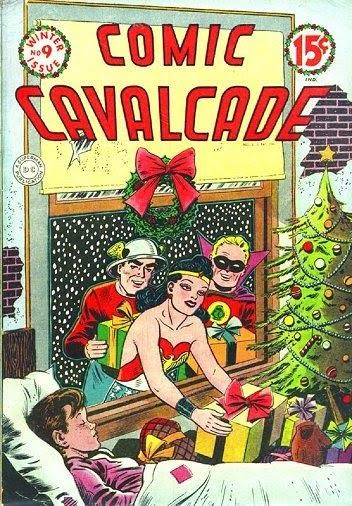
We here at Abnormal Use wish you and your family a very Merry Christmas. We may be cynical, but even we are not immune to those wistful moments of Christmas magic. Were you to send us a request to admit that Christmas is a splendid time of year full of fine sentiment and warm feelings, we could not in good faith deny it. But we’d probably throw in a token objection for vagueness just to preserve our street cred. Above, you’ll find the cover of Comic Cavalcade # 9, published way back in 1945 and featuring, once again, almost ancient versions of The Flash, Wonder Woman, and the Green Lantern. We’re a little distressed that those heroes appear to be breaking and entering a local home and usurping the duties traditionally reserved for Santa.
It’s Christmas Eve, and if you’re reading a products liability blog today, odds are you were the one associate or junior partner who couldn’t extricate him or herself from coming into the office today. We here at Abnormal Use would feel for you, but unfortunately for you, we wrote this post days ago and set it to automatically publish today before we headed off for the holidays.
By the way, depicted above is the cover of Christmas with the Super-Heroes #2, published in the late ’80s. Please note that Batman is staring intently at a teddy bear held by Green Lantern.
The question you have to ask yourself, though, is: Are you really going to do any billable work today, or are you going to play around on the Internet and read Christmas links?
We suggest the latter, and in that spirit, we present to you the following links:
We still dig 1947’s Miracle on 34th Street, which is both a Christmas and a courtroom movie. Law nerds that we are, we are happy to see that the Wikipedia entry for the film includes a section dedicated to the film’s legal inaccuracies, which we quote here: “In the book Reel Justice, the authors claim that Judge Harper could have dismissed the case early without the political repercussions he feared. In their theory, once the prosecutor rested his case immediately after Kris Kringle admitted in court simply that he believed he was Santa Claus, Judge Harper could have ruled that prosecution had forfeited its opportunity to prove that Kringle was dangerous (the basic point of such hearings; Kringle’s actual mental state itself being irrelevant), and ordered him immediately released. However, this high standard for involuntary commitment was not instituted until 1975 with the U.S. Supreme Court’s decision O’Connor v. Donaldson.” Indeed.
We hate those gooey holiday candies – peeps. So we direct you to the “100 Ways To Kill A Peep” blog which, sadly, is no longer being updated.
The news here in merry Greenville is that it may actually snow on Christmas day. However, we fully expect to publish each day next week, barring some unforeseen snowpocalypse.
As readers of this site are aware, we here at Abnormal Use occasionally publish interviews with law professors and practitioners on products liability and litigation. In 2010, we published a total of eleven such interviews. Today, we list them all and provide links back to them:
As 2010 draws to a close, we’d like to take this opportunity to thank the individuals listed above for being kind enough to grant the interviews. We think our site is all the better for it.
Now is the time that we, as consumers of media, are inundated with year end best-of lists. So, we here at Abnormal Use thought we would add to that cacophony and list for you our favorite twelve posts of this past year – which was also our first year. If you’ve followed us from the very beginning, you know that we’ve posted at least every business day this calendar year. Looking back over several hundred posts, it was difficult to choose only twelve. But, dear readers, the ones we enjoyed the most are linked for you below, along with their author and publication date.
The Not-So Deep End (Kevin Couch, January 22, 2010). Our very first foray into the realm of television reviews. The program we reviewed, “The Deep End,” did not last. In fact, both this blog and that show debuted in January of 2010. We outlived the show!
What Does Society Demand from a Chicken Sandwich? (Kevin Couch, February 3, 2010). Our first truly irreverent look at products liability litigation. We have since learned that any posts having to do with hot chicken (or hot coffee) garner great attention. (We were particularly pleased the chicken sandwich post earned this link from How Appealing and this one from Overlawyered, two of our favorite law blogs).
A Modest Proposal: Abolish Strict Liability (Phil Reeves, April 7, 2010). Our first editorial, in which site author Phil Reeves argued for the abolition of an old products doctrine. That’s right; we’re not afraid to have an opinion. Don’t tread on us.
Unsatisfying Snickers Bar Unreasonably Dangerous and Defective, Texas Court Holds (Jim Dedman, April 1, 2010). Our first hoax, perpetrated, of course, on April Fool’s Day. We were pleased to report that we actually did fool a few people, despite the many clues indicating that it was all in fun. “Reasonable degree of confectionery certainty,” indeed.
A Can of Tuna A Day, Keeps The Doctor Away? (Mary Giorgi, May 10, 2010). Someone who ate a can of tuna a day sued claiming damages for eating a can of tuna day. We had to comment. Really, we did.
Our First Milestone: 100 Posts (Stephanie Flynn, May 18, 2010). Our first arbitrary celebration of an arbitrary milestone. Pensive as we are, though, we couldn’t resist. Blogging is, after all, an introspective medium designed for self indulgent self reflection. That’s what we here do best!
Live from Litchfield Beach (Dan Eller, June 7, 2010). If you had any doubts, this post is clear and convincing evidence that we blog even when on vacation.
Bluejays and Mockingbirds (Mills Gallivan, July 6, 2010). Our boss – senior partner Mills Gallivan – paused to observe the anniversary of the publication of Harper Lee’s To Kill A Mockibird and reflect on what that means to the legal profession as a whole.
Wii Class Action Strikes Out: Hang on to Your Controller (Frances Zacher, October 12, 2010). People who inadvertently toss their Wii controllers at there televisions, thereby damaging them, attempt to certify themselves as a class. We comment thereupon.
Thanksgiving in 1810, 1910, and 2010 (Jim Dedman, November 22, 2010). We dug up a forgotten magazine article from a long forgotten magazine. Writing in 1910, the author – a lawyer, no less – looked back a hundred years and commented upon the many changes that had taken placed and briefly wondered at the world of 2010. We responded, and in the process, received so many links and hits that we broke all of our site traffic records.
Views of 2011 From 1931 (Jim Dedman, December 14, 2010). We comment upon the predictions contained in a series of editorials published in The New York Times in 1931. The paper of record asked that day’s visionaries what they thought they year 2011 would look like. Some were surprisingly accurate; others, not so much. It became our most linked post of the year, and we saw huge, huge traffic as a result.