






Facebook and Federal Courts: Mafia Wars Jurisprudence
Mafia Wars significantly marginalizes the social utility of Facebook. I confirmed most of my Facebook friends against my better judgment, only to later hide their status updates, because I don’t care about the fake fortune they have amassed, the ” jobs” they have completed, or the multiple assassination attempts they have survived. I have gone to New York, Las Vegas, Paris, and London. I don’t need to pretend to go there to establish a simulated criminal empire that serves to camouflage a deep sense of loneliness. Moreover, because all Facebook users are subject to Mafia Wars updates, the backlash against Mafia Wars has also risen to new levels, robbing me of the usual cachet I enjoy when I express disdain directed towards society. Mafia Wars, how big a judgment would it take to end this?
Mafia Wars (the “Game”) is one of Zynga’s most popular games in which users can start a Mafia family with their friends and compete to become the most powerful family. Zynga has made use of the service mark MAFIA WARS in commerce since September 2008, and of the trademark MAFIA WARS since April 2009. Zynga currently owns Trademark Application Serial No. 77772110 for the mark MAFIA WARS in International Classes 009 and 041. As of December 2009, the Game had over 7 million daily users.
When users sign up with Zynga to play the Game, they receive a certain amount of “Virtual Currency” that can be used to compete with other players. Players can increase their total number of “Virtual Currency” either by their play or by purchase from Zynga. Players use this “Virtual Currency” to purchase various virtual, in-Game digital items (“Virtual Goods”).
Users can additionally earn Virtual Goods by either doing “jobs” or playing the Game. Zynga allows users to use the “Virtual Currency” or Virtual Goods while playing the Game, but retains sole and exclusive ownership of them and of the source code that allows them to be used in the Game. Zynga has not authorized any third party to sell the “Virtual Currency” or Virtual Goods required to play the Game. Users are informed in the Terms of Service that they are prohibited from selling “Virtual Currency” or Virtual Goods for real-world money or for exchanging “Virtual Currency” or Virtual Goods for anything of value outside of the Game.
In the present action, Zynga has alleged claims against Defendants for the unauthorized sale of Zynga Virtual Goods through the Internet domain names MAFIAWARSDIRECT.COM, MWBLACKMARKET.COM, and MWFEXPRESS.COM. Through these domain names, Defendants sell Virtual Goods that users, playing the Game through the Providers’ websites and/or applications, can use to compete with other players who obtained their Virtual Goods directly from Zynga. Defendants use Zynga’s MAFIA WARS mark and similar variations of it in advertising and for selling Virtual Goods. Plaintiff has never authorized Defendants to use the MAFIA WARS mark, sell Virtual Goods for use in the Game, or transfer Virtual Goods that Defendants have “sold” to players through the Infringing Websites.
Zynga Game Network Inc. v. Williams, No. CV-10:01022, 2010 WL 2077191, at *1 (N.D. Cal. May 20, 2010).
Sigh. No injunction sought; of course, Zynga can’t sue to enjoin itself. Interestingly enough, this is the second federal opinion involving Mafia Wars, the first being Zynga Game Network, Inc. v. McEachern, No. 09-1557, 2009 WL 1108668, at *1 (N.D. Cal. April 24, 2009). In that case, Zynga sought a temporary restraining order against a former employee who had developed Mafia Wars but left the company to create his own game, Mob Underworld.
We write about frivolous lawsuits nearly every day. Isn’t there one vexatious litigant out there who can save my Facebook account from this game? Come on!
In the mean time, we’ll consult Wigmore on Mafia Wars to explore our options.
Ninth Circuit Affirms Exclusion of Two Experts in Products Case in Eight Paragraphs
We here at Abnormal Use adore concise, get-to-the point jurisprudence, which is why we pause today to reflect upon the Ninth Circuit’s recent eight paragraph memorandum opinion in Shalaby v. Newell Rubbermaind, Inc., No. 09-56331 (9th Cir. May 17, 2010) (unpublished) [PDF]. To reduce the disposition of a products liability action to eight paragraphs is sublime.
In that case, the Plaintiffs, apparently from California, filed a products liability action after Mr. Shalabay was allegedly injured “when a handheld, gas-powered torch that he had purchased from a Home Depot store exploded.” Ever so briefly and succinctly, the Ninth Circuit observed that expert testimony is required in products liability matters to establish causation when the theory is “beyond common experience,” and because the Plaintiffs’ two proffered experts had been properly excluded by the trial court, the Plaintiff had no case. Thus, the Ninth Circuit affirmed the ruling of the district court, which had initially excluded both experts.
The money paragraphs were:
The court excluded the testimony of one of those witnesses, Dr. Anderson, a metallurgy expert, as unreliable and irrelevant. To support his theory that a design defect in the torch caused the explosion, Dr. Anderson conducted two tests on exemplar torches to demonstrate the flaw. The district court concluded that because Dr. Anderson had performed only two non-standardized tests, on torches that may have been different from the one here at issue, and did not adequately explain the results of or discuss the possible rate of error for such tests, his testimony would be unreliable. It would also be unreliable because he did not address certain contradictory evidence. Finally, he did not present adequate evidence that the design flaw caused Shalaby’s injuries, rendering his testimony irrelevant.
The district court excluded the testimony of the other witness, Dr. Vredenburgh, because she was not a qualified expert and, even if she were, her testimony was unreliable and irrelevant. Dr. Vredenburgh’s field of expertise was not torches; she had some experience in the formulation of warning instructions for various devices. When asked whether a different or larger warning would have helped in Shalaby’s case, Dr. Vredenbugh testified that “I don’t know why [the torch] failed, so I don’t know that a warning would have helped.” She stated that she had never operated a handheld torch and had not seen one operated in seventeen years. She had not spoken to any users of handheld torches in many years, and she had incorrectly testified about how such a torch is used. Dr. Vredenburgh admitted that she did not collect any empirical data, did not conduct any testing, did not conduct any surveys, did not seek data from manufacturers, did not review any peer-reviewed literature, did not conduct any other kind of research prior to forming her opinion, and did not follow her own typical process for developing product warnings.
Sure, maybe the conclusion was so easily reached that it only merited an eight paragraph opinion. But it’s nice to see such a case given short shrift.
Celebrate Memorial Day

We here at Abnormal Use are observing Memorial Day today in honor and remembrance of all the men and women who have died serving the American military. Do you know the history of Memorial Day? Briefly, Memorial Day, originally called Decoration Day, was officially proclaimed on May 5, 1868 by General John Logan, national commander of the Grand Army of the Republic, as a time to honor those that gave their lives in the Civil War. After World War I, Americans honored those that died in all America’s wars on this day. In 1971, Congress declared Memorial Day an official federal holiday.
Many Americans celebrate this day by visiting memorials or attending family gatherings, including picnics, pool parties, and parades. If you are in fact heading to a pool party, take a look at the U.S. Consumer Product Safety Commission’s press release regarding its Pool and Safely campaign that was launched last week. This is campaign is a “first-of-its-kind national public education effort to reduce child drownings and non-fatal submersions, and entrapments in swimming pools and spas.” It will be interesting to see what directives come out of this campaign.
Whatever the case, the summer is now underway! Enjoy your day off.
Friday Links
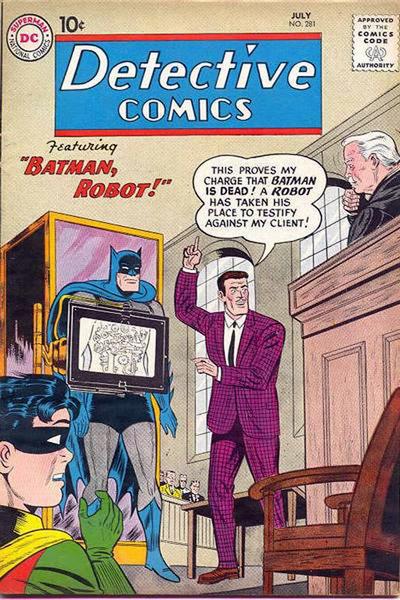
We think that there may be some junk science in the courtroom in the comic book cover depicted above, but unfortunately, Detective Comics #281 was published 33 years before Daubert. We’re not sure why Batman’s death is being litigated or why Robin is in the courtroom, but we would have advised some simple discovery requests on the Batman-as-robot issue, perhaps a request for admission along the lines of “Please admit whether you are a robot.” At least then a denial would have entitled the opponent to fees and costs.
South Carolina attorney J. Benjamin Stevens at The Mac Lawyer has this post, entitled “Top 10 Resources for Mac Junkies.” On a related note, the partners at our firm have still not supplied we few, we happy few, we band of bloggers with our own iPads.
Begins this New York Times article: “The singer and former Talking Heads frontman David Byrne has sued Gov. Charlie Crist of Florida, saying he used the Talking Heads’ song “Road to Nowhere” in a Senate campaign ad without permission.” We have nothing else to add to the news of this litigation, although it does provide us yet another opportunity to link to the fabled and extraordinary Fifth Circuit Talking Heads opinion.
James Parton has a post entitled “Obtaining Records from Facebook, LinkedIn, Google and Other Social Networking Websites and Internet Service Providers” at the DRI For the Defense blog. It’s worth a read, especially considering how challenging it is to actually obtain information from those types of entities in civil litigation.
Although it’s a bit out of our subject matter, we here at Abnormal Use are closely following the case of Justin Kurtz v. T&J Towing. Read more about it here. Based on the accounts of that dispute, how can you not be on Team Kurtz?
Jeffrey V. Mehalic at the West Virginia Business Litigation blog has this in-depth post on the recent Fourth Circuit opinion, In re: Abrams & Abrams, P.A., about which we blogged very briefly in last week’s edition of Friday Links.
As seen in the ABA Journal, a “new study finds that less attractive defendants fare worse in criminal cases when the jurors have an ‘experiential’ style of judging.” The author of the article, Debra Cassens Weiss, finds a nice way to say that “experiential” means not listening to the evidence and judging on legally irrelevant information. We would like to go on record that not all persons sporting a unibrow and English-style overbite are criminals. We would also like to see a study on how attractive lawyers fare versus less physically appealing advocates. Would you find for the ugly defendant represented by an objectively attractive counsel?
We are disappointed to learn that W. Lawrence Wescott of the Electronic Discovery Blog decided this week to end his blog. We enjoyed reading it.
The new South Carolina Business Law Blog celebrates its first two months of existence next week. Congratulations to them on that milestone, which is no small feat in the legal blogging world.
Another Plaintiffs’ Friendly Post?
See the indecency here, where Polson Enterprises, The Boating Information Company, complimented a previous post concerning a jury’s awarding $3.8 million to a teenager who was struck by a boat propeller when his friend backed over him in the water. I didn’t actually intend to suggest that boat propellers be redesigned to look something like an oscillating fan, which was essentially what Plaintiff’s counsel argued in that case, so perhaps I need to take a more definitive stand when I believe the Plaintiff’s argument is off base. And so while I pledge to do so in future posts, this is not one such topic. A plaintiff I actually could potentially support is one who takes on Miley Cyrus. Not so much because the tween “role model” allegedly gives lap dances in bars or always seems to be involved in some photo scandal, as those issues are outside the scope of this blog. This time, Miley is in the news for a recall of her jewelry line, which was sold exclusively at Wal-Mart stores, after test results showed the jewelry contained high levels of the toxic metal cadmium.
Although Wal-Mart initially continued to sell the jewelry, reportedly telling the Consumer Product Safety Commission that testing items already on store shelves would be too difficult, it eventually changed its approach, issuing a statement that it had pulled “the few products that did not” comply with its new testing regimen. Studies reportedly have shown that girls of the age of most Cyrus fans, ages 6 to 11, are at higher risk for absorbing more cadmium than other children or adults. In any event, the affected items have, at this point, been pulled from the shelves. Only time will tell if this causes future damage to the Miley Cyrus brand.
Stick a Fork in It
I’ve never driven a forklift, and I’ve also never been fortunate enough to have been injured at work. It would be nice to collect from the worker’s compensation carrier and then have the luxury of filing suit against some third-party. Tashee Parker was employed by Home Depot at one of its distribution centers. Mr. Parker was hurt when the forklift he was driving collided with a pallet jack, injuring his foot. The Supreme Court in Orange County, New York, in Parker v. Raymond Corp., No. 2005/7189, 2010 WL 1999529 (N.Y. Sup. Ct. May 17, 2010), recently terminated Mr. Parker’s case against the forklift manufacturer via summary judgment.
Parker alleged that the forklift had a design defect. What he didn’t know at the outset was that the forklift was “first developed by Raymond in the 1940s.” Also, the design and manufacture of the forklift are “subject to certain design and safety standards . . . which . . . have been incorporated into Federal regulations. . . . The subject forklift meets or exceeds all such requirements and standards.” If you are a plaintiff, it is not a good sign when the court points out that the equipment that you claim has a design defect has been around for more than 60 years and exceeds the necessary regulations. The forklift probably doesn’t have a design defect. Most likely. Someone probably would have found it before you, Mr. Johnny-come-lately plaintiff.
It comes as no surprise to most of us that plaintiffs regularly make fantastical arguments. Usually, these fantastical arguments succeed in defeating summary judgment, allowing the plaintiff to settle his lawsuit for more than it is worth. The New York Supreme Court did not buy what the plaintiff was selling. Plaintiff argued that the forklift should have been made with a “foot guard” to “facilitate the operator’s ability to safely remain within the confines of the compartment,” even though Plaintiff admitted at deposition that he was trained to remain in the operator’s compartment, and, had he done so, he would not have been injured. Moreover, the Plaintiff had his expert introduce a sham affidavit to defeat summary judgment, even though at the expert’s deposition “he was unable to recall any basis to conclude that the design of Defendant Raymond’s forklift violated any ANSI standard.” Summary judgment granted.
While no new groundbreaking law was announced in Parker, it’s always fun to read an opinion that rebuts ridiculosity at every point. More than likely, it would have been cheaper to pay Parker than to conduct discovery, get an expert, depose the other expert, and move for summary judgment. But Raymond decided to pay more and give Parker what he deserved. Raymond Corporation, we here at Abnormal Use salute you.
A Wrinkle in the Love Affair with Botox?
Usually, a $15 million dollar verdict tends to raise my eyebrows. Therefore, in light of the recent decision in Dr. Sharla Helton v. Allergan Inc., CJ-2009-2171, District Court, Oklahoma County, Oklahoma, it is a good thing that I still have the ability to do that. However, the Plaintiff in that case, Dr. Sharla Helton of Oklahoma City, did not have that ability, thanks to her wrinkle-smoothing Botox injections. Rendered on May 11, this sizable jury verdict came following a three-week trial against Allergan Inc., a Botox manufacturer, after the Plaintiff, who was 47 years old, claimed that she suffered years of pain and weakness after receiving Botox injections.
The jury found Allergan Inc. negligent because the label on the product did not include enough information about potential side effects. The Plaintiff blamed Botox for causing double vision, breathing difficulties and years of constant pain in her hands, arms and feet. She further claimed that the disabling side effects eventually led her to sell her medical practice and step down as the medical director for an Oklahoma City hospital. According to the Plaintiff, the verdict was the “first set in making sure the public is aware of the actual risks of Botox. It’s a stepping stone to protect the public from what the company is hiding.”
So, what is the company hiding you might ask about the dangers of Botox? Nevermind that the official scientific name for Botox – Botulinum Toxin Type A – actually contains the word “toxin.” It is a neurotoxic protein. Also nevermind that Botulinum toxin has been identified by the CDC (Centers for Disease Control & Prevention) as the most lethal substance known to man. Potential use of the toxin as a biological weapon has been explored since the early 1900s! Fortunately for us, the toxin just doesn’t have the stability and capacity to be disseminated by open air over a large area. And Botox is, of course, a variation of the word “Botulism,” which I would venture to guess would be more recognizable to the general public at large.
With that said, how could it possibly be foreseeable to the Plaintiff that there could be some risk to injecting Botox into the body? Don’t get me wrong. I am certainly not against Botox therapies, whether for cosmetic use or particularly for its more valuable use to the benefit of patients with muscle and nerve disorders. Maybe my lack of sympathy stems from the fact that the Plaintiff in this instance was actually a doctor (albeit not a cosmetic specialist, but an obstetrician and gynecologist) and presumably would have greater insight into the medical procedure that she selected or, at a minimum, the wherewithal and resources to avail herself of the risks. Or, maybe it was also because it was not the first, second, third or fourth injection over two years that caused the problem. It was the fifth injection that Plaintiff claims did the trick and gave her botulism.
It is interesting that this verdict in a cosmetic use case follows a successful defense win by Allergan Inc. in a case arising from the death of a 7 year-old girl, who suffered from cerebral palsey and used the injections to relax clenched limbs. This is but one example that the sympathy factor does not always win the day. In any event, we have not heard the last of litigation against Botox. At the time that the Plaintiff’s case went to trial, there were 14 plaintiffs standing in line behind her. Allergan has, of course, vowed to appeal. Whatever the ultimate outcome of this or other cases, for the meantime, I will stick to the Pearl Cream.
North Carolina Court of Appeals on Product Modification/Alteration
Last week, the North Carolina Court of Appeals analyzed the language of this statute which outlines the affirmative defense of modification or alteration of a product in Stark v. Ford Motor Co., No. COA09-286, 2010 WL 1959851 (N.C. Ct. App. May 18, 2010) [PDF]. In Stark, the case was originally filed in the name of all of the members of a family. The parents’ claims, along with the claims of one of the children, were dismissed pursuant to the defendant’s motion for summary judgment. Stark at *2. The only plaintiffs remaining in the case at the start of the trial were Cheyenne Stark (age 5 at the time of the accident) and her brother Cody Stark (age 9 at the time of the accident). Id. The minor plaintiffs were injured when their parents’ vehicle allegedly and unexpectedly accelerated while the mother was operating the vehicle in a parking lot. Id. The remaining plaintiffs’ theory was that their injuries were enhanced by an alleged design defect with the seat belts of the vehicle. Id.
The defendant asserted the affirmative defense of “Alteration or Modification of Product” available under N.C. Gen. Stat 99B-3. Specifically, the defendant argued that Cheyenne Stark had the shoulder belt behind her back at the time of the accident and thus the alleged design defect of “film spool” could not have been the cause of her injuries. Id. at *2. At the end of the trial, the jury returned a verdict finding the defendant “act[ed] unreasonably in designing the 1998 Ford Taurus and its component parts, proximately causing enhanced injury to Cheyenne Stark.” Id. at *3. However, the jury also found that Cheyenne’s enhanced injuries were caused by an alteration or modification of the vehicle. Id. Finally, the jury found that the defendant’s product did not cause the enhanced injury of the other minor plaintiff, Cody Stark. Id.
On appeal, the plaintiffs presented two arguments. First, since Cheyenne Stark was only 5 years old at the time of the accident, she was legally incapable of negligence and therefore unable to foresee that any modification or alteration could proximately cause her injury. Id. at *5. Second, the plaintiffs rebutted the defendant’s argument that Cheyenne’s parents modified the seat belt by putting the shoulder belt behind her back by relying on the statutory language that the modifier must be a party to the action. Id. at *6.
As to the plaintiff’s first argument, the court reasoned that the alteration or modification of a product must be the proximate cause of the injury in order for the defense to apply. As such, the court then engaged in a “foreseeability” analysis and pointed to longstanding North Carolina case law which held that children under the age of 7, as a matter of law, are incapable of negligence. Id. at *5. Thus, the court reasoned that under the appropriate standard of care for a child under the age of 7, the “…[d]efendant is unable, as a matter of law, to prove the requisite element of foreseeability inherent in the proximate cause portion of its N.C.G.S. 99B-3 defense.” Id. Since the defendant would be unable to establish proximate cause, the defense was unavailable as to any alleged modification or alteration performed by Cheyenne Stark herself.
With regard to the plaintiffs’ second argument, the court essentially applied the rules of statutory construction and held that “the plain language of N.C.G.S. 99B-3 states that he entity responsible for the modification or alteration of the product must be a party to the action in order for the defense to apply.” Id. at *7. The court recognized that the requirement that the modifier or alterer be a party to the case was an issue not previously determined by the courts in North Carolina. Therefore, the affirmative defense available under N.C. Gen. Stat. 99B-3 is only available if the one that modifies or alters the product is a party to the action. Which begs the question: was it really party time when the parents were kicked out the case shortly before the trial began? To be fair, hindsight is 20-20.
Friday Links
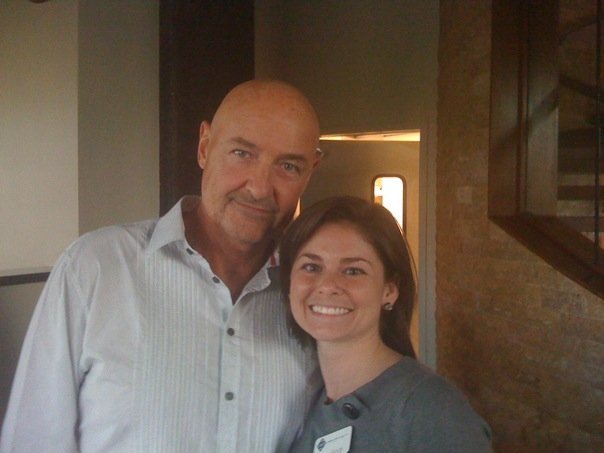
- We are quite saddened to report that the very final episode of TV’s “Lost” airs this coming Sunday. We here at Abnormal Use (particularly myself and contributor Mary Giorgi) are big fans of the show. In fact, we simply must mention that we once met the actor who plays Locke immediately after, of all things, a firm function. The picture above was taken by yours truly, just over a year ago, on May 12, 2009, right here in Greenville, South Carolina, at the Lazy Goat restaurant. Terry O’Quinn, who plays John Locke on “Lost,” was at the same restaurant, which was also playing host to a firm recruiting event. The picture, of course, features O’Quinn and Giorgi (who insists that I tell you that she is only wearing a name tag because it was a firm function). O’Quinn said at the time that he was in town to play golf. Here’s the best part: We met him the day before the Season 5 finale, “The Incident,” aired. How about that? Goodbye “Lost.” We will miss you.
- This week, our own Fourth Circuit released In re: Abrams & Abrams, P.A., No. 09-1283 (4th Cir. May 18, 2010), a very interesting opinion in which an individual was severely injured after his drunk friend ran over him in an automobile. Here’s what happened next: the insurance carrier for the friend’s employer denied coverage and refused to defend the friend. Thus, the friend had to defend himself in the ensuing lawsuit pro se, and eventually, he had a $75 million judgment entered against him when he failed to appear for trial. Ultimately, the insurance company was sued for bad faith. The insurance company later settled that matter for $18 million, but the district court would not approve the one-third contingency fee for the lawyers, awarding instead only 3 percent. The Fourth Circuit reversed, finding that the fee award was too low. Yikes. (You can find the official Findlaw.com case brief here.).
- We have often posted legal themed comic book covers on Fridays (although we’re not doing so today just so you’ll have something to look forward to). But get this: Last week, the Wall Street Journal Law Blog reported that DC Comics, which has long been in a dispute with the heirs of the creators of Superman, has now sued the attorney of those heirs, suggesting that he provoked his clients into, er, taking actions with which DC Comics apparently disagreed. Not sure how this one is going to pan out, but DC Comics is playing hardball. Actually, suing the attorney seems like something Lex Luthor might do.