Friday Links

Depicted above is the cover to America v. The Justice Society #2, published way back in the halcyon days of 1985. We don’t recall this series all too well, although Wikipedia tells us that the narrative was set in an alternate universe and centered around the fabled Justice Society being placed on trial for treason for crimes committed during World War II. (The alleged crimes were apparently brought to life after the discovery of the diary of Batman who, in that universe, had been murdered). Note the apparent bailiff in the foreground drawing his weapon as the The Spectre threatens to disrupt the proceedings. The judge, not wearing a robe, holds his gavel while pondering his options.

Jared Wade at the Risk Management Monitor has a post of interest entitled, “No One Knows If Texting While Driving Bans Have Prevented Car Crashes.” Sure, it makes sense that they might (assuming motorists follow the law), but apparently, after a lengthy study by the Governors Highway Safety Association, no one found evidence in support of the proposition.

In light of the unveiling of Google+ (Google’s attempt to compete directly with Facebook in the social networking realm, for those of you not yet in the kn0w), Denise Howell of the Bag and Baggage legal blog analyzes its terms of service (as well as those of Google’s Picasa service) in this helpful piece. She ultimate concludes: “I’m not personally put off by the license Google asks users to grant, but it could use some clarification and adjustment on the issues of third parties and promotional use.”

Adam Waytz at Slate asks: “Will Americans be able to adapt to the autonomous car?” Back in October of last year, we here at Abnormal Use addressed the driverless car problem and what happens when technology outpaces the law. See here for that apparently forward thinking piece.

Oh, my. The Austin American Statesman reports: “The University of Texas filed suit today against actor Ryan O’Neal in an effort to seize a portrait of Farrah Fawcett by Andy Warhol that the university says was bequeathed to UT by the late actress.” We’d love to see the depositions that might be taken in that lawsuit.

We here at Abnormal Use like to think we have no fear.  Apparently, however, the pressure of opposing viewpoints has scared us into being “fair and balanced.”  According to Plaintiff’s attorney Ronald Miller, Jr. of the Maryland Injury Lawyer Blog, his criticism of our recent Hot Coffee commentary resulted in our lack of praise for the Chamber of Commerce funded documentary, InJustice.  Maybe Miller is right and we did feel pressure to exhibit our best Fox News impersonation?  Or maybe we just felt the need to note the film’s obvious biases?  We will let you decide.

Film Review: Brian J. Kelly’s “InJustice” Documentary

Two weeks ago, we here at Abnormal Use offered our review of Plaintiff’s attorney Susan Saladoff‘s anti-tort reform documentary, Hot Coffee, which discussed, in part, the infamous Stella Liebeck McDonald’s hot coffee case.   We were critical of the film, chastising Saladoff for her editorial choices and potential lack of objectivity, particularly in light of her past as a trial lawyer and affiliation with numerous Plaintiff’s lawyers organizations.  Tonight, at 10/9 Central on the ReelzChannel, filmmaker Brian J. Kelly premieres his own documentary and analysis of the courts, InJustice. This project was funded in part by the U.S. Chamber of Commerce, one of Saladoff’s favorite targets in her own film.  Just as we warned you of Saladoff’s possible bias, so too must we advise you that Kelly’s documentary (which excoriates the legal system and the Plaintiff’s bar in particular) may not come from the most objective of sources.  Kelly was kind enough to grant us an interview regarding the film and its agenda.

InJustice purports to offer an in-depth look at the rise and fall of the so-called “kings of torts,” the wealthy and successful Plaintiff’s lawyers like Richard Scruggs, Melvyn Weiss, and William Lerach.  In so doing, Kelly seeks to illustrate the alleged faults of America’s litigation system.  Using interviews with lawyers, InJustice suggests that class-action attorneys have enriched themselves by perpetrating questionable asbestosis, silicosis, tobacco, and securities litigation, while their clients see little, if any, of the spoils.  The film also highlights how these kings of tort made their fortunes outside of the courtroom.  Specifically, the film digs up a quote by Scruggs, who apparently once remarked that the practice of law is a three-legged stool:  legal tactics, political pressure, and public relations.  The men used this hypothetical three-legged stool to perfection, pressuring corporate defendants into settling allegedly baseless claims without ever actually taking the cases to trial.  The men appeared invincible until their questionable tactics backfired on them.  InJustice closes with the story of how each man found himself facing his own judicial woes: judicial bribery (Scruggs), concealing illegal payments to clients (Lerach), and conspiring to improperly pay off plaintiffs (Weiss).

InJustice features interviews with defense lawyers who practiced with Scruggs, Weiss, and Lerach; however, the most compelling interview probably comes from attorney Charles Merkel, Jr., who described Scruggs’ use of the three-legged stool analogy.   Through these interviews, the film aims to demonstrate how well-trained plaintiff’s lawyers can manipulate the system and make millions of dollars without ever seeing the inside of the courtroom.  The story is intriguing and well-told; however, we here at Abnormal Use question whether these so-called kings of tort are a representative sample of the civil litigation system.

Like Hot Coffee before it, InJustice advances an agenda, and Kelly does so well.  Those who watch the documentary will likely be disgusted with the way the kings of tort are portrayed as manipulating the legal system for their own pecuniary gain.  Certainly, the extrajudicial tactics, coupled with the criminal consequences, of the film’s subjects may leave many viewers believing corporations are often the victims in trumped up class action lawsuits.  However, as noted above, InJustice is crippled by one major problem – films funded and promoted by special interests groups can never paint the whole picture or be relied upon as an objective account of a societal problem.

Unlike Saladoff, Kelly is not a lawyer.  Prior to making his new documentary, he made films about such things as the Blue Angels and the Cuban Missile Crisis. However, just like Saladoff, Kelly uses the documentary medium to promote his own opinions about the faults of the legal system. Like Saladoff before him, Kelly acknowledges that there are two sides to every story.  In an interview with Abnormal Use, Kelly insisted that he “tried to look at the other side that’s not typically covered.”  Unlike Hot Coffee, which Kelly believes is “based on opinion,” Kelly told us that with InJustice, he was looking at “right and wrong.”  In a sense, Kelly is correct – InJustice does focus on fully adjudicated cases and leaves much of the speculation up to the viewers themselves.  However, InJustice, like Hot Coffee, is an opinion piece, using stories of a few to draw categorical inferences on the system as a whole. In fact, it was Kelly own bad experience with the legal system that prompted his desire to make the film.  In a recent interview, Kelly told The Blog of Legal Times that he decided to pursue the project, in part, due lawsuit filed against him by a prior tenant.  Kelly prevailed in the suit, but only after amassing $80,000 in expenses defending against the plaintiff’s claims.

Not only does Kelly exhibit a potential bias against the legal system due to that suit, so too does the film’s principal sponsor, the U.S. Chamber of Commerce and its Institute for Legal Reform.  In our interview , Kelly noted that he initially pitched the film to cable network channels such as the Discovery Channel but received little interest.  A business associate in Washington, DC connected Kelly with the U.S. Chamber of Commerce, which ultimately invested in the project. Kelly insists that he accepted their support only upon the precondition that he would maintain editorial control.  Says Kelly: “We were able to work out a deal where they knew what we were out to do.  They really had to let us go and trust us to do what we set out to do.”  However, in the screener of the film we saw, the U.S. Chamber of Commerce is never specifically acknowledged as a producer or funding source in the film’s credits (although it is promoting the film and noting its support on its websites here and  here). Accordingly, it will be very difficult for InJustice to maintain its sense of independence and credibility, particularly in light of recent criticism by people like Saladoff who contend that the U.S. Chamber of Commerce is mounting a secret campaign to influence public opinion on the judicial system. In fact, InJustice may play right into their hands.

Indeed, we here at Abnormal Use were initially contacted about the film by a Washington, DC consulting firm, Hamilton Place Strategies.  On its website, Hamilton Place bills itself as a bipartisan policy and communications firm, an odd entity to be promoting a television documentary film.  The firm’s public policy advisory unit, HPS Insight, was founded by two alumni of the George W. Bush administration.  Further, that firm’s partners include members of President George W. Bush’s staff and advisers to Senator John McCain and Representative Paul Ryan.  If the firm has any members affiliated with the Democratic Party or more liberal groups, it was not readily apparent on the website.

We’re somewhat troubled by the arrival of two documentaries arriving with weeks of each other both attacking the judicial system from different perspectives. If Hot Coffee and InJustice were screened together, many viewers would probably leave the theater believing that the denizens of our judicial system – from the Plaintiffs lawyers suing corporations to the corporate defendants themselves – are corrupt and dominated by parties only out to protect their own self-interests by whatever means necessary. As officers of the court, we’re not sure that’s the best message to send, nor do we believe that the system is beyond repair (or even as disabled as Saladoff and Kelly contend).  Hot Coffee and InJustice both fail in one key aspect – they focus on exceptions rather than rules.  Saladoff’s selective presentation of the cases in Hot Coffee does not mean that tort reform is unnecessary, nor does Kelly’s highlighting of the ill-advised tactics of Scruggs and Weiss offer proof that all trial lawyers are somehow sinister and corrupt.  The cases presented in these two films are sensationalized exceptions, not the judicial norm.  In the end, though, InJustice is an opinion piece no better or worse than Hot Coffee.

Defense Verdict in Jamie Leigh Jones Case

Yesterday, a federal jury in Houston, Texas rejected Plaintiff Jamie Leigh Jones‘ claims against Halliburton subsidiary KBR that she was raped and fraudulently induced into entering into an employment contract with the company.  See Jones, et al, v. Halliburton Co.,  et al, 4:07-cv-02719 (S.D. Tex.). Jones sought damages against the company in the amount of $145 million, claiming that KBR created a hostile sexual work environment at her barracks in Iraq.

The Houston Chronicle reports:

Jurors in a federal courtroom on Friday rejected a former Conroe woman’s claims that she was drugged and raped by several Kellogg Brown & Root firefighters while working for the company in Iraq in 2005.

The jury also rejected Jamie Leigh Jones’ claims that the former Halliburton subsidiary committed fraud by “inducing her to enter into an employment contract.”

By answering “no” to those two questions, the jurors rendered the other 12 questions in the jury charge moot, bringing an end to the month-long trial of Jones’ lawsuit.

We mention this verdict today because the Jones lawsuit was prominently featured in Susan Saladoff’s recent documentary, Hot Coffee, which we reviewed previously here. Specifically, the film chronicled Jones’ inability to have her claims heard by a jury due a mandatory arbitration clause in her employment contract (although we here at Abnormal Use did not explore the Jones case in our review because our interest in the film was prompted primarily by its discussion of the Stella Liebeck McDonald’s hot coffee case).  In 2009, the Fifth Circuit ruled that Jones did have the right to have her case heard by a jury. See Jones v. Halliburton Co., 583 F.3d 228 (2009).

Friday Links

Above, you’ll find the cover of Wolff & Byrd, Counselors of the Macabre #4, published sometime in the mid-1990s before the series’ name was changed to Supernatural Law. Note the tagline: “Beware The Creatures of the Night – They Have Lawyers!”  We must confess a general unfamiliarity with this series and the characters who appear therein, though according to Wikipedia, they’ve been around since the 1970s. Who knew?

PHM at The Civil Procedure & Federal Courts Blog feels compelled to “put anything that includes the phrase ‘tort reform’ in quotation marks,” including The American Tort Reform Association. Sure, it’s an advocacy group, but we don’t put the Plaintiffs’ bar group, the “Association for Justice” in quotation marks because that’s what they’re actually called.  It’s like using the phrase “so called” when something is actually called that. Oh, well.

We don’t discuss constitutional law much here at Abnormal Use, but after learning of last week’s ruling in Brown v. Entertainment Merchants Association, in which the Supreme Court struck down a California state law restricting the rental or sale of violent video games to children, we may have at least one comment on the subject. Like most, our first thought was, “How many sitting Supreme Court justices have actually played a video game?” And then we skimmed the opinion. But today, we direct you to this article by friend of the blog and Pennsylvania lawyer Jay Hornack (a/k/a Panic Street Lawyer), who analyzes the ruling in far more detail.

We here at Abnormal Use have been called many things, but it’s been a while since someone said we were silly. Alas, Ronald V. Miller, Jr. at the Drug Recall Lawyer Blog did so last week, chiefly because he didn’t like our recent post calling for Reed Morgan, the Plaintiff’s lawyer in the Stella Liebeck McDonald’s hot coffee case, to release the transcript. Ouch! Oh, well. All we want to do is read the transcript! Is that so wrong? McDonald’s isn’t talking (nor have they done so much on this case since ’94), and the courts sure aren’t likely to have a 17 year old trial transcript. So, that leaves us with the the Plaintiff’s lawyers who represented Liebeck. Considering that many, many Plaintiffs’ lawyers spent much of last week praising Susan Saladoff’s “Hot Coffee” documentary and clamoring for the real “truth” behind the Liebeck case, we thought Liebeck’s lawyer might naturally want to serve that interest and release the transcript for posterity. What better way to expose the truth? But I guess that’s just silly. (In other news, the ABA Journal referenced some of our work on the hot coffee case, as well. You can see that piece here.).

Abnormal Use Makes Its Radio Debut

Yesterday, Abnormal Use became more than an awarding-winning legal blog.  We became an award-winning legal blog that was quoted on the radio.  That’s right, the radio!

On NPR’s “Here & Now,” the host used two of our former blog posts on the Stella Liebeck McDonald’s hot coffee case in an interview with Susan Saladoff.   Saladoff, as you might recall, is the former plaintiff’s attorney who has created the anti-tort reform documentary, Hot Coffee. You can listen to that interview here (Abnormal Use comes in around the 10:35 mark).

You can re-read the posts cited by the host here and here.

Abnormal Interviews: Asheville Singer-Songwriter Chuck Brodsky, Writer of “Talk To My Lawyer”

Remember a few months ago when we – along with our pals at the Drug and Device Law blog – compiled a list of all of the rock songs mentioning lawyers? It was during that time that we discovered Chuck Brodsky’s song, “Talk To My Lawyer,” which we enjoyed and included on our list. Brodsky‘s “Talk To My Lawyer” chronicles a series of relatively minor events and their potential as lawsuits if presented to the proper lawyer.  While we have grown weary of lawyer jokes over the years, we couldn’t help but chuckle when he heard Brodsky’s tune and its reference to the infamous Stella Liebeck McDonald’s hot coffee case. We soon learned that Mr. Brodsky lives in nearby Asheville, North Carolina, so we felt we had to contact him and request an interview about the genesis of the song. So, today, Abnormal Use once again continues its series, “Abnormal Interviews,” in which the site will conduct brief interviews with law professors, practitioners, and makers of legal themed popular culture.  Note: Brodsky will be performing live this Friday night at a CD release party at The Grey Eagle rock club in Asheville, North Carolina, and we suspect he may play “Talk To My Lawyer” at that show. Finally, for those who’ve not heard the song, though, here is a video of him singing that wonderful ode to litigiousness at the Shrewsbury Folk Festival. Watch it, and then read the interview which follows.

1)  What was your inspiration to write “Talk To My Lawyer”?

Well, at the time I wrote it many years ago, probably, if I had to guess, I’d say around 1990, give or take a couple of years. I think there were just a lot of frivolous lawsuits flying around at the time.  Maybe even the McDonald’s coffee case.  I can’t remember exactly because it was so long ago, but I think it was a way to have a laugh at it, treat it with irony.

2)  Did you ever want to be a lawyer?

I joke that I do.  When I’m on stage I often tell people that I wanted to be a lawyer but my parents talked me into being a folk singer.

3)  [Besides the McDonald’s case] were there any other cases in the news that inspired any of the verses?

Not any one that I can recall after all these years but you know . . . frivolous cases come up all the time.  There probably were several that were in the news at the time, maybe a couple.  Why not have a little bit of fun writing about them?

4)  Have you had any comments from lawyers about the song?

Yeah.  Lots, and they tend to really get a laugh out of it.  It’s pretty popular.  I’ve had law firms that have bought a copy of the CD with the song on it for all their partners and employees.  I’ve never had any lawyers that didn’t laugh.  Nobody has came up to me and has taken offense.  Never meant to be offensive.  Just a little bit of irony, little way we can laugh at ourselves.

5)  How would you describe your music both stylistically and lyrically?

Well, I think I pay a lot of attention to detail.  I think my music is rooted in traditional music. . . or Americana type singer-songwriter.  I think my lyrics all have something to say.  I don’t ever write a song that’s meaningless in my opinion.  I like to tell stories, but not all of my songs are story songs.  The ones that are tend to be about real people that inspire me to words that I feel are touching and might touch other people.  But I also have commentary in my songs about the world as it is and my feelings about it.  I feel like my songs are honest.  I try to be honest.  I try to address real issues, but not in a way that makes anybody feel excluded.  That’s really not what it’s about.  It’s about making everybody feel welcome and part of it.

6)  Are you excited about playing the Gray Eagle?

I’m very excited.  I live in Asheville, and I only play there a couple of times a year and this particular show will be a CD release for a brand new album [Subtotal Eclipse].  I’m very excited.

BONUS QUESTION:  What is your favorite song about lawyers or legal themes?

Mine.  I don’t really know of any others to be honest.  I said that half jokingly.  I really am not aware of any other songs.  Oh, Warren Zevon has a song, “Lawyers, Guns and Money.”

BIOGRAPHY: Chuck Brodsky is a singer-songwriter whose music has been influenced by the mountains of Western North Carolina and traditional folk.  His song, “Radio,” appeared in the feature film of the same name.  Brodsky, born in Philadelphia, Pennsylvania, now resides in Asheville, North Carolina.

Abnormal Interviews: Ted Frank of the Center for Class Action Fairness

Today, Abnormal Use continues its series, “Abnormal Interviews,” in which this site will conduct interviews with law professors, practitioners, and other commentators in the field. For the latest installment, we turn to the founder of the Center for Class Action Fairness and an Adjunct Fellow at the Manhattan Institute, Ted Frank. We have cited Mr. Frank often in connection with our work on the Stella Liebeck McDonald’s hot coffee case. He was kind enough to give us his thoughts on that famous case as well as his other projects. The interview is as follows:

1) What do you think is the most significant recent development in torts and product liability litigation?

It goes beyond tort and product-liability litigation to some extent, but the erosion of the preemption doctrine is of some concern. It’s ironic that, even as we see the federal government assert its authority over local affairs in legislation such as PPACA and cases like United States v. Arizona, we’re simultaneously seeing this administration insist that state court juries should exercise dominion over interstate commerce already fully regulated by the federal government. This seems precisely backwards.

2) The Wall Street Journal has a characterized you as a “leading tort reform advocate.” In your view, why is tort reform needed in our system, generally, and in product liability litigation, specifically?

I view tort reform as a means to an end, rather than an end in and of itself. I consider myself a consumer advocate, and it just so happens that the pendulum of the legal system has swung so far in favor of lawyers that consumers are being hurt, and tort reform is needed to restore balance. If ever the pendulum swings too far the other way, you’ll see me switch sides on these debates. As it is, if anyone asks me, I tell them I oppose collateral source reform, which just punishes individuals with the foresight to purchase insurance.

There are so many places where reform is needed. The judiciary and the bar aren’t doing enough to punish or deter fraudulent cases. We have very sensible rules that courts don’t second guess the good faith decisions of lawyers or prosecutors, or the exercise of business judgment by executives, but those rules are thrown out the window when it comes to second guessing the design decisions of engineers or the judgment calls of physicians, though there is every reason to believe that courts are even less likely to get those questions right, especially in hindsight. And uncapped noneconomic or punitive damages introduces an element of complete randomness into the system. Even when the system is considered to be “working,” the majority of the expense of the system goes to paying the administrative costs of the attorneys rather than to the putative victims: we wouldn’t tolerate that level of overhead in any other sector of the public or private economy. All of these features distort incentives, deter innovation, result in unjust punishment of the innocent, and hurt the economy and consumers in the long run.

3) Recently, we here at Abnormal Use have written several pieces regarding the Stella Liebeck hot coffee case in which we have cited some of the articles you have written on the subject. Why have you taken an interest in that litigation, and why is it important to dispel some of the “urban legends” that have arisen?

For twenty years I’ve had an interest in urban legends (I was friends with the Snopeses before there was a snopes.com), and several of them stem from the legal arena. One of my favorites involves the Baby Ruth bar: it’s a famous trivia answer that the candy bar was named after Grover Cleveland’s daughter, rather than the baseball player Babe Ruth. Snopes and I did some research in the 1990s, and concluded that the “Grover Cleveland’s daughter” story was almost certainly invented for purposes of trademark litigation against Babe Ruth, who had a competing candy bar.

The Stella Liebeck case was exactly the sort of thing that turns into an urban legend, and there are certainly a lot of inaccuracies that crept into the story as it went viral. The Liebeck case got politicized, however: it was an outrageous result and picked up as a poster child for tort reform, and, fascinatingly, the trial lawyer lobby, instead of reasonably saying “Look: the justice system is never going to be 100 percent correct, there have been a dozen hot coffee cases before this one where the courts got it right and threw it out, and you can’t make public policy based on a single anecdote just because the judge made a mistake here” decided to engage in a misinformation campaign to argue that the Liebeck case was both correct and an aspirational result for our tort system – and a disturbing number of law professors joined that cause. If you Google for the case, the vast majority of results are trial-lawyer sites filled with misstatements of the facts and laws. It’s gotten to the point that, in the majority of tort reform debates I participate in, it’s the trial lawyer who is the first to introduce the subject. I’ve been following the case and rebutting the misinformation on both sides since it first made the news, and it just so happens that the majority of misinformation is coming from the plaintiffs’ lawyer side these days. One of these days, I’ll lock myself in a room for a couple of weeks and write a law review article on the subject so there can be a one stop place for truthful information and arguments about the case.

I have a popular talk I give to law schools where I talk about the hot coffee case and a couple of other lawsuits against McDonald’s called “The Law of McDonald’s” and use that as the framework to talk about the two visions of tort law: personal responsibility versus deep pocket compensation of victims, and why I prefer the personal responsibility route.

4) As the founder of the Center for Class Action Fairness, you have sought to protect the interest of consumers in class action settlements. In your opinion, what needs to be done in order to balance the interest of consumers in class action settlements with the need for tort reform?

Assuming that the Supreme Court doesn’t do anything crazy in the Wal-Mart case, the law is, for the most part, in the right place, and it’s just a question of judges exercising their responsibility to apply it correctly – which is hard to do when the settling parties are making an ex parte presentation to the court, and good-faith objectors don’t have the financial incentive to hire a lawyer to make sure the court gets it right. That’s why I do the pro bono representation that I do: someone’s got to do it.

There are certainly some legislative tweaks possible to resolve some ambiguities in the law that class action lawyers have used to benefit themselves at the expense of consumers. I don’t think it’s a tort reform thing; it should be a bipartisan good government thing. Plaintiffs’ lawyers, as a group, should be supporting what I do, because class action lawyers like Milberg and like Kabateck Brown Kellner make them all look bad when they negotiate settlements that don’t do anything for the class but pay the lawyers millions.

BONUS QUESTION: What do you think is the most interesting depiction of products liability and/or class actions in popular culture, and why?

I have a toy figurine of Lionel Hutz on my bookshelf, but his only class action was the consumer fraud case against the makers of the film The Neverending Story. Larry Ribstein’s scholarship on why Hollywood so consistently gets these issues wrong explains why I find this question tough, but I enjoyed the first half of John Grisham’s The King of Torts for its depiction of a corrupt class action settlement that never would have survived Amchem scrutiny. I’m told I should read Gregg Easterbrook’s The Here and Now, which might well supplant Grisham if I ever get around to it. There’s also Michael Clayton, which takes me back to my days as a law-firm associate setting car bombs for adverse witnesses; it amuses me no end in the scene where the lawyer complains that the case had 85,000 documents and 100 motions. The problem with Grisham is that his books repeatedly have a critical plot point where somebody bribes a state court judge to decide a federal removal motion some way, and it just ruins the book for me when the author gets a federal jurisdiction question so wrong. They really should teach 28 USC § 1446 at the Iowa MFA program.

BIOGRAPHY: Ted Frank is an attorney licensed in Illinois, the District of Columbia, and California and a graduate of the the University of Chicago Law School. He served as the first director of the American Enterprise Institute Legal Center for the Public Interest and was an attorney for the McCain-Palin 2008 campaign. He is currently an Adjunct Fellow at the Manhattan Institute and runs the Center for Class Action Fairness, which he founded in 2009. He is a contributor to fellow legal blogs PointOfLaw and Overlawyered. You can follow him on Twitter here.

Friday Links

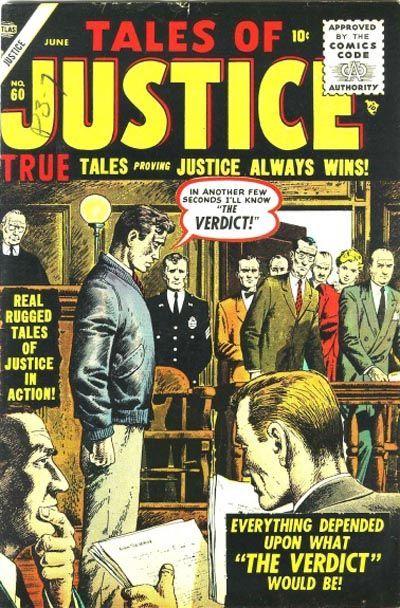
  • “In another few seconds, I’ll know ‘The Verdict,'” exclaims the apparent defendant featured on the hard boiled cover of Tales of Justice #60, published way back in June of 1956. The series, which billed itself as a compilation of “real rugged tales of justice in action,” does not appear to be the type of lighter superhero fare we typically feature on Friday Links. But there’s a tinge of optimism to the series, it seems, as the cover proclaims that it features “True tales proving that justice always wins!” That’s encouraging.
  • There’s a lawsuit over the Dr. Who villain Davros! (Hat tip: Media Law Prof Blog).
  • You might recall that in February we mentioned that our own Jim Dedman was doing some music blogging on the side for an Atlanta-based music website. He’s written a review of the new album by Jason Isbell and the 400 Unit, which hits stores soon. Check it out.
  • Last week, Eugene Volokh of The Volokh Conspiracy mentioned our recent April Fool’s Day post. As you may recall, we wrote about a fictitious court that held that the Star Wars prequels were unreasonably dangerous and defective as a matter of law. Wise jurisprudence, that. That said, we loved reading the comments to Eugene’s post.
  • Remember Cracked magazine? Not unlike Mad magazine, the juvenile humor themed Cracked, once a staple of newsstands in long ago days, has made a name for itself in the Internet age by creating lists of famous this or thats in popular culture. Well, this week, Christina H. at Cracked published a column entitled “6 Famous ‘Frivolous Lawsuit Stories That Are Total B.S.,” which includes the Stella Liebeck McDonald’s hot coffee case. All we can say is that Christina obviously didn’t read our FAQ on the case. However, we must confess a bit of jealousy that our friends at Overlawyered are cited in the piece.
  • Friend of the blog Ryan Steans of The Signal Watch blog recently visited London for the first time and marveled at the sense of history. Comparing England’s approach to history to America’s, he had this to say over at his blog:

    It strikes me that we in the vast, vast majority of the geography of the US do[es] not have memorials to those who died more than 200 years ago, and the further west one travels in the US, the briefer our sense of history as much more than an abstraction of something left behind somewhere else. A lack of living history, of being surrounded by those who’ve gone before (some winning, many not winning) may be what gives us an inflated sense of destiny, like a teenager who sees only a future as a rock star ahead of them when they pick up their first guitar and who can’t be bothered to learn more than the chords of their current favorite songs.

    And as hard fought as democracy has been here in the US, it was also the first step we took as a nation. Everything prior to the French-Indian Wars is buried in a sort of primordial soup of witch-hunts and Indian killing that we’d rather not discuss. In England, this period is just short of current events. You can see the change from one-thousand years of feudal clashes to the rise of democracy in the stones and monuments, and there’s something to that, I think. We’re a blip on the continuum, it seems to say, and what we do while we’re here is important, but it will also pass, and those who are remembered are remembered as either good or terrible souls, and history will look back on you with an audio tour that will speak frankly about your deeds as people walk on your grave.

    Very interesting.

The McDonald’s Broken Toilet Case

Plaintiffs certainly have high expectations for what McDonald’s should “know” in civil litigation these days. Back in the early 1990s, in the infamous Stella Liebeck McDonald’s hot coffee case, the plaintiff asserted that the fast food chain should have known that the beverage could cause serious harm to a person who did not appreciate the dangers that steaming hot drinks perched in laps could inflict. Now, just last week, an Illinois woman sued McDonald’s based on her claim that the restaurant should have known that a toilet located in its restroom was dangerous.

The Chicago Sun-Times reports that Plaintiff Cherry Hardie has filed a lawsuit against a Chicago-area McDonald’s after allegedly suffering injuries to her left arm and shoulder after the toilet upon which she sat broke underneath her. She has asked for damages exceeding $30,000.00 and claims to have suffered a “shock to her nervous system” and become disabled.

Now, if we were the lawyers taking this Plaintiff’s deposition, we would have a few interesting questions for her. First, we might ask why she thought it was okay to sit down in the first place, given the cleanliness of most fast food chain restaurant restrooms we’ve seen of late. Assumption of the risk, indeed. Next, we might ask what kind of notice she believed the restaurant may have had that a solid piece of commercial-grade porcelain might collapse. Finally, since Ms. Hardie claims she suffered severe, disabling personal injuries as a result of the mishap, we would ask about any prior personal injury suits. In fact, during our cursory online search for a copy of her complaint in this matter, we stumbled across this prior suit. Is it possible that the pro se Cherry Hardie in that prior Illinois lawsuit is the same woman now claiming to be victimized by the McDonald’s toilet? And what injuries was she claiming in this prior suit?

Cynical? Perhaps. But an important issue to explore nonetheless.

It’s Cheese and a Lawsuit Against The Mouse

The Mouse takes great umbrage that someone would complain of the cheese he graciously bestows upon us. The Mouse takes great pride in his cheese. But as you can see here, here, here, and here, multiple news outlets and blogs have picked up the story of a recent lawsuit filed against Disney for the ancient tort of injury by Nacho. Unfortunately, this case features a real injury. Four-year-old Isaiah Harris became hurt when he found himself about to fall (from an unsteady chair, of course), grabbed a tray of food for balance, and suffered an encounter with a “paper cup of scalding nacho cheese.” Of course, like all hot food and beverage proceedings, this lawsuit conjures up the spirit of Stella Liebeck, her hot coffee lawsuit, and its progeny that have been well chronicled. So in light of all of that, what is the real significance of this lawsuit?

First, it’s amazing to see the public reaction to these lawsuits. Scroll down through the comments to the news stories and blogs to see thoughts from those who have absolutely no sympathy for the child and blame everything on the parents. The commenting public now automatically equates a hot food lawsuit with frivolity, which, lawyers who followed the Liebeck case know is not always the case. Ms. Liebeck probably did very well for herself, settling her case on appeal after receiving a substantial jury verdict. Nevertheless, some part of the public thinks that hot food lawsuits are frivolous and remain unafraid to air their personal grievances. Whether this is attributable to a vague conception of a litigation tax on products, or some other archaic conception of pure contributory negligence, would be a fairly boring subject for a sociology paper.

Second, not that the lawyer would need this, but it is interesting that the public can issue spot in such cases. Scroll through the comments and see the number of people that remark upon the picture of Isaiah, the probability that a paper cup of cheese would land precisely on his mouth (where it looks like he tried to drink the cheese), and posit their own version of the facts. Website comments now double as free jury research. My own personal issue-spot: Why didn’t anyone handling this paper cup of cheese notice the purported temperature?

Third, and getting to the legal matters at hand, it’s not clear to me what the reasonable expectation of the consumer would be in a case involving nacho cheese. It’s not at all clear to me that the subject nacho topping was actually cheese. Does a consumer have a reasonable expectation that his or her nacho topping is actually cheese? It would be perfectly appropriate for the plaintiff’s parents to argue that they assumed that the topping was an unnaturally viscous liquid-at-room-temperature cheese-like substance. If it was cheese, then we will likely need to look for a cheese expert from the American Cheese Society and perhaps attend the Sonoma Valley Opportunities and Challenges Cheese Conference for further education on a consumer’s reasonable expectation of cheese temperature. There is no doubt that this lawsuit will appear on the conference agenda as the public fallout from injury by cheese is a serious topic to consider.

Fourth, while we often call out plaintiffs’ lawyers on the blog, the plaintiff’s attorney in this case, one Sean Cahill, seems to be a legitimate defense lawyer, who belongs to several defense-oriented organizations, at least according to his website. Perhaps Mr. Cahill is simply trying to beef up his cheese liability practice. Who knows? We’ll see if The Mouse pays something on this suit. Anyway, next time you go to Disney World, test the nachos.