Friday Links

Prior to this week, we were unaware that there is a Capcom video game called “Phoenix Wright Ace Attorney.” (Despite our obvious nerdiness, our video game knowledge is actually fairly limited, and the last video game cartridge we recall purchasing was “Mike Tyson’s Super Punch-Out!!” back in ’88). Whatever the case, the “Phoenix Wright” game has its own comic book spin-off.  Depicted above is the second issue of Phoenix Wright Ace Attorney, published not too long ago in 2009. We must thank one of our dear readers for alerting us to this title, which is in the news this week because of a live action movie in development to be directed by Takashi Miike. According to the Comics Alliance website, in the original video game, “[p]layers take the role of rookie defense lawyer Phoenix Wright in a system where you defend your clients by gathering clues and present evidence to reveal lies and contradictions in witness testimony.” We wonder if there are extra points for exceeding monthly billable hour requirements.

Over on Twitter, Stephen Colbert tweets a possible revision to the Federal Rules of Evidence: “If a witness doesn’t want to answer truthfully, I say he should have the option to take the dare instead.”  At the very least, we think that thought should be cited in the commentary to the rules.

Quote of the Week: “It’s refreshing to find a show that can demonstrate to litigation-happy America that it’s possible, even desirable, to amicably resolve disputes without going to court.” (Radley Balko, “Fairly Legal,” Reason, June 2011 issue). Balko, of course, is referring to the USA Network series starring Sarah Shahi, which debuted in January and which was recently renewed for a second season. Revisit our January interview with the show’s creator, Michael Sardo, here. Sadly, as we noted previously, Sardo is now out as showrunner on “Fairly Legal” and the show will now be administered by a new steward. (Hat Tip: Overlawyered).

Earlier this week, Brian Comer posted an update to his site on the South Carolina tort reform bill and punitive damages caps.

Friends of the blog James Daily and Ryan Davidson of The Law and the Multiverse blog (who we interviewed here back in March) have been invited to host an online CLE. We now know how we here will meet our hours this year.

The Four Loko DJ Action

We are pleased to announce that Selective Insurance Company of South Carolina was bold enough to write coverage for Phusion Projects, LLC, the company that formerly manufactured Four Loko as we once knew it.  Four Loko took all the hard work out of mixing alcohol and caffeine at the bar by combining the two in the  manufacturing process.  Yet Law 360 informs us Selective filed a DJ  action in Illinois to clarify that there are certain suits it will not defend, based on a defense that the policy was not in force when the “bodily injury” alleged in several lawsuits occurred.

There seems to be very little of interest (at least at first glance) in the declaratory judgment complaint other than what we have previously blogged about in a prior Four Loko related post.  Namely, Selective probably thought it was pretty safe (okay, somewhat safe) insuring this company since the beverage was merely a manufacturing of an aftermarket process.    Moreover, although a DJ is always a good idea, as it puts lawyers to work who were previously not occupied, it remains to be seen whether this DJ will be effective.  After all, Selective insured Phusion while it was manufacturing Four Loko and placing it in the stream of commerce.  The dates of bodily injury in these cases may not be determinative.  There certainly will have to be some scintillating discovery on dates of manufacture, lot numbers and dates of distribution before the lawyers reach the salacious details of surrounding the consumption of the Four Loko.

We don’t claim to be actuaries (Oh, that we had made that choice), but we would be interested to know from our legion of actuary readers how one would price products liability insurance for products such as Four Loko.  We imagine the underwriter would gather some documents and get some input from actuarial and legal departments and the following exchange takes place:

UW: So, what are the chances for a lawsuit coming into being here?  I mean, this seems to be a pretty safe product.  Caffeine.  Alcohol.  There’s some kind of tagline about “blackout in a can” that’s somewhat troubling though.

Actuarial: [Speaking unintelligible secret mathy language]

In-house Lawyer: [Wearing a polo shirt, chinos, and no socks] I would put our chances at being sued at greater than 90%.  Actuary, can you account for that in your pricing?

Actuarial: [Emitting a series of beeps]

In-house Lawyer: Don’t forget to account for the irresponsibility co-efficient of drunk young adults.

And eventually, a premium is settled upon that becomes a second-guessed business decision, and indirectly punishes innovation in the alcoholic energy drink market.  Perhaps this is a good thing.

TV Review: TNT’s “Franklin & Bash”

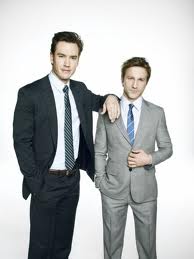
As noted in yesterday’s post on our recent interviews of Mark-Paul Gosselaar (of “Saved by the Bell” and “NYPD Blue” fame) and Breckin Meyer (Clueless and Can’t Hardly Wait), “Franklin & Bash” is a new legal dramedy in which the duo star as brash young lawyers who will do virtually anything for their clients.  The central premise of the show: these two young lawyers – fiercely independent and unorthodox – join a stuffy big firm in Los Angeles.  As you might imagine, the partners and associates at that big firm are not all appreciative of the new interlopers. We here at Abnormal Use obtained an advance screener of  the series’ pilot episode, which debuts tonight at 9/8 Central on TNT. Written by Bill Chais and Kevin Falls and directed by Jason Ensler, the pilot is whimsical and entertaining, though hardly an accurate depiction of the legal profession or life at a large law firm.

Jared Franklin (Meyer) is a quick-witted, scrappy lawyer who is perhaps trying to stand outside the shadow of his father, a well-known and apparently highly respected attorney.  Peter Bash (Gosselaar) is more of a charmer, both in his business and personal lives.  The pair’s firm might best be described as the type you’d see advertised on a bar’s bathroom-stall door (see video of their commercial–shot from a hot tub–here).  Within the first few minutes of the pilot, the ambulance-chasing duo score a client in a manner reminiscent of the “Seinfeld” episode featuring the heiress to the O’Henry! candybar fortune.  Here, a young male driver rear-ends another vehicle when he is distracted from the road by a mattress commercial, which plays on a jumbo screen near the roadway, featuring a lingerie-clad woman.  Just as Kramer and Jackie Chiles took on Sue Ellen Mischke, so, too, do Franklin and Bash take on the perpetrators of the racy mattress advertisement.

In that dispute, young Franklin and Bash find themselves facing the megafirm of Infeld Daniels. Their antics at that trial lead to the pair’s “big break” – they are offered jobs at the prestigious firm by senior partner Stanton Infeld, played by acclaimed actor Malcolm McDowell.  Both Franklin and Bash accept the offers, and so begins their “fish out of water” experience in the big, glossy litigation firm. Comedy ensues, or that’s the idea.

The show is enjoyable enough, with a number of light-hearted moments featuring the pair’s close, almost brotherly relationship.  It also offers some romantic-themed intrigue, with Bash, played by Gosselaar, still having trouble getting over an ex-girlfriend and fellow bar member, who appears to have moved on from their prior relationship.  There also promises to be some friction between the duo and Damien Karp, an Infeld Daniels attorney and the nephew of Stanton Infeld.  Karp, played by actor Reed Diamond, is suspicious of his new co-workers and unimpressed with his uncle’s decision to bring them on board at the firm.  He is positioned by the end of the pilot episode to be a nemesis of sorts to the main characters, particularly to the aggressive Jared Franklin.

There are some problems with the believability of the show, which includes scenes and dialogue far too quirky and eccentric to be convincing to viewers.  In one scene in particular, Gosselaar’s Bash is having a heart-to-heart conversation with a client in his hot tub.  Eventually, Bash stands up out of the hot tub–naked–to quickly scan the pages of a law book and pass it to his assistant, very seriously telling her to “Shepardize this case law.”  The scene comes off as a little awkward and a lot unrealistic.

As with any legal television show, there are some errors in the depiction of the law.  That is, of course, in addition to the naked hot-tubbing with a client.  For example, when Franklin and Bash begin work at Infeld Daniels, they uncover a plot by one of its lawyers to have an airline company place blame for a near accident on its pilot.  The legal issue?  Infeld Daniels represents both the pilot and the airline.  That would simply not happen in the real-life legal world, wherein the pilot and airline would be represented by separate counsel if the airline’s strategy was to blame its pilot.

In any event, for viewers who are willing to occasionally engage in a suspension of disbelief, the show offers an enjoyable glance into the lives of its two affable, fictional lawyers.  Its tone is similar to that of previous legal shows “Ally McBeal” or “Boston Legal,” which similarly offered equal parts interesting legal issues and quirky, yet endearing characters.  Don’t necessarily expect to laugh out loud, but be moderately entertained.

Abnormal Interviews: Mark-Paul Gosselaar and Breckin Meyer, Stars of New Legal Series “Franklin & Bash”

In anticipation of TNT’s upcoming legal dramedy “Franklin & Bash,” which premiers tomorrow night at 9 p.m. Eastern, we had the opportunity to fulfill a lifelong dream briefly interview the two stars of the show, Mark-Paul Gosselaar and Breckin Meyer (during a multi-party press conference, but still).  Gosselaar is famous, of course, for playing the iconic character of Zack Morris in “Saved by the Bell” and, more recently, for his role on “NYPD Blue.”  As for Meyer, you may recognize him as the  skateboarding high school student in Clueless or for his roles in Road Trip or Can’t Hardly Wait. So, once again, we here at Abnormal Use continue our series, “Abnormal Interviews,” in which we bring you interviews with practitioners, commentators, and, now, actors.

“Franklin & Bash” is a comedy featuring Gosselaar and Meyer as two small-time lawyers with big-time courtoom antics who are recruited by a powerful megafirm.  So begins their fish-out-of-water experience, which is the central premise of the show.  Both stars seem to be very exited about their new legal show, and for good reason. By their own accounts, they’re having fun filming the series, and as you’ll see from our review of the pilot episode tomorrow, the show offers its viewers an entertaining – though not necessarily realistic – glimpse into the lives of its fictional young lawyers.

As mentioned above, we were on a multi-party press conference call with Gosselaar, and then some time later, a separate multi-party call with Meyer. Accordingly, we were only able to ask each of them one question. Fortunately for you dear readers, we here at Abnormal Use are ace interviewers, and all we need is one question. Bearing in mind that caveat, the following is a full transcript of our exchange with Gosselaar, who plays attorney Peter Bash.

Simons:  Hey, Mark-Paul.

Gosselaar:  Hey, there.

Simons:  Our readership is made up primarily of lawyers, and I know that you’ve played lawyers in the past, but I wondered what, if anything, you did to prepare for this role.

Gosselaar:  I got a tan. That’s basically it. You know, I mean, I – you know, I’d had my legal fill when I did “Raising The Bar.”  Thankfully, you know, I was able to go with David Feige, who was the creator of that show, and my character was loosely based on him. You know, I went with him and was an intern at the Bronx Defenders for about a week and sort of got my legal, you know, insight during that week, and for the last two seasons. So no, there wasn’t much that I had to question.

But if I did have a question, one of our producers and writers, one of our head writers, Bill Chais, was a defense attorney and a lot of the stories that we deal with on the show are from his background. So, if we ever have questions we have people that we can go to, and that’s always important. And well, I think we’re pretty true to – I mean obviously it’s television, you take some liberties, but I think we’re pretty true to staying true to the sort of legal, call it, the legal frame.

During an earlier part of the call, Gosselaar also shared what makes “Franklin and Bash” different from all the other legal dramas viewers have seen before on the small-screen:

Gosselaar:  Well, I think — you know, we haven’t seen comedy in the courtroom in a while. I mean, “Boston Legal” is probably the last one, “Ally McBeal” is another one, “L.A. Law” was a brilliant legal drama with elements of comedy, so I think that’s what sets it apart from what’s currently on television, as well as sort of the relationship between the two guys.

You know, you go home with these characters at the end of the day, so I think that that’s a very important element that isn’t on television on your typical legal dramas at the moment.

Later that afternoon, we joined the press conference call with Breckin Meyer, who plays attorney Jared Franklin on the series.  Here’s a transcript of our interview with him:

Simons:  Hi, Breckin.

Meyer:  Hey, how’s it going?

Simons:  Good. Our readership is made up primarily of lawyers…

Meyer:  Okay.

Simons:  . . . I wonder if I were a client of Franklin and Bash, why would I want your character, Jared, to represent me?

Meyer:  Well, the good thing is with Franklin and Bash, you get both Franklin and Bash. . . .  Jared’s a kid who grew up with a silver spoon in his mouth. His father was a — still is a high powered litigator, and he rebelled against that by not wanting to be a lawyer, but eventually had to accept that it was his calling, but if he’s going to do it he’s going to do it on his own terms. And I think you’d definitely — you’d get lawyering like you hadn’t seen before. How about that?

Simons:  Okay. And your character’s been described as quick-witted and scrappy. Do you have anything to add to that description?

Meyer:  Really kind of almost off the chart remarkably good looking. That — I mean that’s not me, that what — I mean, that’s what I’ve heard. . . .Yes, so that’s how I’d describe it.

Turn back to Abnormal Use tomorrow for our official review of the pilot, which airs tomorrow night on TNT.


Memorial Day

We here at Abnormal Use and Gallivan, White, & Boyd, P.A. wish you a fine Memorial Day weekend. We pause today to reflect upon all of the sacrifices made by American servicemen and women and all they have done for the country, both in present times and years past. (By the way, depicted above is the cover of the first issue of The ‘Nam, published way back in 1986. The series was an effort by Marvel Comics to depict the reality of that war – a difficult task in light of the strictures of the Comics Code Authority at the time.).

Friday Links

With all the confusion about whether or not Superman is a state actor, we wonder whether or not he should be the one questioning an imprisoned Lois Lane in jail about her guilt or innocence in an apparent counterfeit license plate making scheme. Such is the dilemma posed on the cover of Superman’s Girlfriend Lois Lane #6, depicted above and published way back in 1959. Surely, though, with her knowledge of Superman and the Justice League, Lois could have found a more interesting – and more profitable – criminal enterprise than phony license plates. (Our favorite part: Note the stern face of the prison guard who is apparently glowering at the convict Lois.).

Earlier this year, we interviewed Hollywood showrunner Michael Sardo, the creator of USA’s dramady “Fairly Legal,” a show about a former lawyer turned mediator. Well, according to this post at Deadline Hollywood, it appears that the series is being creatively reworked for its upcoming second season and Sardo will no longer be as involved with the series. (Check out the full transcript of our interview with Sardo here.).

Over at The Business Law Prof Blog, Joshua P. Fershee pauses to reflect upon how some courts have referenced Bob Dylan’s lyrics in their opinions. Don’t forget: It was Dylan’s 70th birthday this past week. We can’t say we’ve ever encountered a court quoting Dylan lyrics, though again, we simply must direct you to the Fifth Circuit’s Talking Heads opinion from way back in 1987. (Oh, and for more Bob Dylan, since this recent blog piece from The New York Times ArtsBeat blog which revisits a 1966 interview with Dylan).

For fans of The Social Network film, Jim Pattilo has a post at the DRI Today blog entitled simply: “End of the Line for Winklevoss Twins in Facebook Appeal.”

Don’t forget: You can follow Abnormal Use on Twitter at @gwblawfirm. (In fact, check out our GWB 2.0 website for all of our social media endeavors as a blog and law firm.).

Wacky Warning Labels Finalists–A Commentary on the State of Affairs in Products Liability Law

Last week, we heard an NPR story about a Wacky Warning Label Contest put on by a man named Bob Dorigo Jones, a Senior Fellow at the Center for America.  According to its website, the Center for America’s mission is “to educate, motivate, and empower Americans to expand skills, entrepreneurship, prosperity and freedom.”

The contest works like this:  People submit entries for the product warning labels which “entertain[] and alarm[] the nation about the lawsuit-happy culture and the lengths to which companies must go to avoid lawsuits.”  People can venture online and vote for their favorites, and there are even cash prizes for the contest winners.  We here at Abnormal Use like the concept of this contest: highlighting the ridiculous lengths to which manufacturers must go to protect themselves from lawsuits, and to protect people from their own lack of common sense.

For instance, here is one of the finalists:

You can view all of this year’s finalists here.  The contest has been going on for fourteen years.  Some information about the 2010 contest can be found here.  The winners of the 2011 contest will be announced in June.  We can’t wait, and we’ll be sure to let you know which warning label wins.  In the meantime, we’d like to hear your thoughts about the most absurd warning labels you’ve encountered, either as a consumer or legal professional.

North Carolina Takes the Rare Hamburger Off the Menu

On The Discovery Channel’s Man vs. Wild, Bear Grylls travels to some of the globe’s most remote areas to demonstrate how a stranded traveler might survive.  Notable among Grylls’ survival techniques is his penchant to catch and eat snakes – raw.  Raw snake does not sound appetizing to our sophisticated palates, but allow me to commend Grylls for demonstrating the benefits of consuming meat in its most natural form.  While these animalistic methods might be useful on Man vs. Wild, North Carolina isn’t buying it.

Last week, our friends at Overlawyered alerted us to a law in North Carolina which makes serving rare or medium-rare hamburgers illegal.  According to this report from America Online, the North Carolina Division of Environmental Health requires that restaurants cook ground beef to an internal temperature of 155 degrees Fahrenheit.  The restriction, which does not apply to steaks, has been implemented to reduce the likelihood of Salmonella and Escherichia coli O157:H7.

While we admit that the sight of a bleeding piece of meat may actually be less appetizing than a live snake, we must question the necessity of the North Carolina regulation.  There is no fault in trying to protect the health and safety of your citizens, and there is no disputing the contamination concerns of ground beef.  However, it seems a little un-American to dictate how a hamburger is to served .  We need to check with Justice Scalia, but certainly the Framers of our Constitution intended free hamburger choice to be an inalienable right.

North Carolina has considered adopting the United States Food and Drug Administration standard which allows restaurants to serve rare and medium-rare hamburgers so long as a disclaimer is printed on the menus.  While we support giving individuals the choice of meat preparedness, by doing this, it appears that North Carolina is more concerned about restaurant liability than citizen health.  Apparently, the potential for food poisoning can be overlooked as long as you are aware that you are assuming the risk.

We here at Abnormal Use do not believe that Bear Grylls would recommend eating raw food on a regular basis when properly prepared options are available.  In the case of the hamburger, however, we do feel that Americans should have a choice.  If raw meat is good enough for Grylls, certainly a rare hamburger is good enough for North Carolinians.

Circle K Announces Agreement with 39 States to Curb Underage Tobacco Sales

Last week, it was announced that Circle K Stores, Inc. and Mac’s Convenience Stores LLC have reached an agreement with attorneys general for 39 states and the District of Columbia to cut-down on the sales of tobacco products to minors.  (See copy of the 22-page agreement here).  The agreement, which does not include South Carolina, encompasses approximately 4,000 convenience stores.  The agreement goes into effect on June 1, 2011.  Previous multi-state agreements have similarly been reached between states and convenience stores selling fuel under Conoco, BP, Exxon, Mobil, and Shell, among others, and with retail and pharmacy chains Walgreens, Rite Aid, CVS, WalMart, Kroger, and 7-Eleven.

The agreement, called the “Assurance of Voluntary Compliance” (AVC), provides that Circle K will adopt procedures intended to reduce the amount of marketing and sales of cigarettes to minors, and additional procedures designed to curb underage tobacco sales.  Terms of the agreement include:

1. Clerks must check the IDs of all persons who appear to be under the age of 30 to avoid illegal sales based on appearance;
2. In-store advertising of tobacco must be limited in ways intended to reduce the effect on young people, and outdoor advertising of tobacco must eliminated at stores within 500 feet of playgrounds or schools;
3. Employee training will focus on the mechanics of eliminating underage tobacco sales and on emphasizing the serious health issues that give rise to the legal efforts to restrict underage access to tobacco products;
4. Circle K will test itself on these safeguards by conducting “mystery shopper” compliance checks at 500 of its stores every 6 months;
5. Circle K will pay the attorneys general a total of $225,000 to be used for consumer education, public protection, or the implementation of programs to protect against tobacco abuse by minors.

Both the AVC agreement and the individual statements of the attorneys general (see here, for example) note that more than 2,000 children per day begin smoking cigarettes and that 1/3 of those will one day die from a tobacco-related disease.  It is estimated that 690 million packs of cigarettes are sold illegally to children in the United States per year.

Manufacturer of Rub Cream Wins Summary Judgment on Allegations of Diabetic Foot Injuries

Earlier this month, the U.S. District Court for the Northern District of Georgia considered the case of Kersey v. Dolgencorp LLC, No. 1:09-CV-898-RWS, 2011 WL 1670886 (N.D. Ga. May 3, 2011). The case involved a tube of Dollar General Maximum Strength Muscle Rub Cream, which was manufactured by defendant Faria and sold under the Dollar General brand. The Plaintiff brought suit against both Dollar General and Faria, alleging that the rub cream caused her to develop multiple diabetic ulcers secondary to chemical burns. Ms. Kersey had been diagnosed with diabetes in 1994, which caused her to have severe diabetic neuropathy in her feet. She had been using the rub cream since 2006 or 2007; these alleged injuries occurred in 2008.

The lawsuit alleged four causes of action against Faria and Dollar General, including (1) negligence, (2) strict liability, (3) breach of express warranty, and (4) breach of implied warranty. Both defendants moved for summary judgment. Plaintiff abandoned all of her claims against Dollar General, as well as the breach of warranty claims against Faria prior to the hearing on Defendants’ motion and, therefore, the court granted the Defendants’ summary judgment motions as to those claims.

The court discussed three claims alleged by Plaintiff in turn: design defect, manufacturing defect, and failure to warn. The court granted Faria’s summary judgment motion as to the design defect. First, it noted that Plaintiff had not even discussed the rub cream’s design, and because she had not presented any evidence of the product’s inherent risks, nor presented an alternative design. The court also noted that the rub cream had been tested by the Food and Drug Administration and determined its composition to be safe and effective.

The court also granted Faria’s motion for summary judgment based on the theory of the manufacturing defect. Plaintiff had not even had the product tested to back up any allegation she may have had that the particular tube of the rub cream was stronger or weaker than the standard formula. No genuine issue of material fact there.

Finally, the court considered the failure to warn claim. The warnings on the box containing the rub cream read as follows:

— For external use only.
— Use only as directed.
— Keep out of reach of children to avoid accidental poisoning.
— Discontinue use if excessive irritation o[f] the skin develops.
— Do not bandage tightly, apply to wounds or damaged skin or use with a
heating pad.
— If condition worsens, of if symptoms persist for more than 7 days or
clear-up and occur again within a few days, discontinue use of this product and
consult a doctor.
— If swallowed, get medical help or contact a Poison Control Center right
away.

The court made a number of findings before granting Faria’s motion for summary judgment on this theory. First, Plaintiff’s doctors stated only that Faria should have known that the rub cream would have been absorbed by the skin, not that this phenomenon would be injurious to diabetics. Second, this was the very first complaint that Faria had ever received about the product  after it had manufactured more than 8 million tubes of the cream. Finally, the court noted that Plaintiff had developed these injuries after using the cream and then putting on socks and shoes, which the court found to violate the warning on the box that advises against bandaging skin after using the product.

The final cautionary note can be found in the case’s only footnote, where the Court indicated without even being asked that Plaintiff’s case had “a strong proximate causation problem.” Indeed, Plaintiff had suffered diabetic-related foot injuries before and after this alleged incident, and had been using the product without incident for years before suffering these particular injuries. Plaintiff’s doctor also testified that he could not testify that, to a reasonable degree of medical certainty, that the complained-of injuries were caused by the rub cream at all.