Friday Links

We are very honored to note that yesterday we received two prestigious awards in the legal blogsophere. First, we were named by the ABA Journal to this year’s ABA Blawg 100.  We’re very pleased to be included in the Torts category with such blogging greats as Eric Turkewitz of the New York Personal Injury Law Blog, Walter Olson of Overlawyered, Bill Marler of Marler Blog, J. Russell Jackson of Jackson on Consumer Class Actions & Mass Torts, and Jim Beck, Steve McConnell, and Will Sasche of the Drug and Device Law Blog. As you may recall, we were also named to this list last year, and one year later, we couldn’t be happier to be recognized in this fashion once more.  It was a big day yesterday here at AU HQ.

But that’s not all. We also learned today that Abnormal Use has been named one of the Top 25 Torts Blogs by the LexisNexis Litigation Resource Community.  We are in some prestigious company among those nominees, as well, and we’re very pleased and honored to be included as a part of that list, as well. As we said, it was a big day.

We’ll talk a bit more about these honors in this coming Monday’s post, but we wanted to take this opportunity to thank all of you, our dear readers, for your support. We plan to give you all another year of this blogging thing in 2012, and we’re looking forward to doing so. Special thanks must go out to our contributors Steve Buckingham, Nick Farr, and Frances Zacher, as well as alumni Mary Giorgi and Laura Simons. We simply could not do this without them. If you follow the links to both the ABA Journal and Lexis Nexis Litigation Resource Community’s pages, you’ll see that both sites are calling for votes for your favorites of those listed.  We’d very much appreciate it if you would consider us for that additional honor.

Subject change: Apparently, there is a rapper named “Lawyer Mike.”  See here for a video.

Quote of the week: “I’m very disappointed in the fact that somebody riding their bike in February crashes on the ice and gets $100,000. It absolutely reminds me of the case involving the lady who ordered hot coffee at a McDonald’s and spilled it on her lap. That’s pretty much it. You know it’s hot coffee when you order it. And you know riding a bike at night, in winter, is a little dangerous,” John Cornish, the president of the Florence Park District said in this piece by David Erickson of The Missoulian on November 29.

Overlawyered’s Walter Olson To Speak in Greenville Next Week

Friend of the blog Walter Olson, the founder of the Overlawyered blog and a senior fellow at The Cato Institute, will be speaking right here in Greenville, South Carolina next week.

Walter will be giving a speech entitled “Law Schools and an Overlawyered America,” based in part on his new book, Schools for Misrule: Legal Academia and an Overlawyered America (Encounter Books, 2011). Prior to joining the Cato Institute, Walter was a senior fellow at the Manhattan Institute, and he has been a columnist for Great Britain’s Times Online as well as Reason. His writing appears regularly in such publications as The Wall Street Journal, The New York Times, and The New York Post.

Here are the specifics:

When: Wednesday, December 7, 2011, 12:00 p.m. to 1:00 p.m.

Location: Womble Carlyle Sandridge & Rice, PLLC, 550 South Main St, Suite 400, Greenville, SC 29601

Sponsored by the Greenville chapter of The Federalist Society, the event has been approved for 1.0 hour of CLE credit in South Carolina.  Admission is free for the event.

Burger Time: The burden of proof in Florida food poisoning cases

One would think that food poisoning, especially the serious E coli type, might not be that difficult to establish in litigation.  The plaintiff eats food, winds up shortly thereafter with difficult symptoms, rushes to the hospital for treatment, and to top it off, garners a diagnosis of E coli.  Relatively straightforward, right? Apparently, it’s not so simple in Florida.

In Colson v. Tampa Hotel-VEF IV Operator, Inc., 8:10-CV-9-T-30TBM, 2011 WL 5553840 (M.D. Fla. Nov. 15, 2011), the sole issue before the court on the defendant’s motion for summary judgment was causation.  Could the plaintiff, who claimed she contracted E coli after eating a tainted cheeseburger at a hotel, prove that the cheeseburger was, in fact, the culprit?

The answer: no. According to the Florida federal court, “[i]n food poisoning cases, while a plaintiff may establish causation by either direct or circumstantial evidence, courts have routinely found that a mere showing that a person became sick subsequent to eating food is insufficient.”  Instead, the plaintiff must provide some evidence that the food in question was actually contaminated or tainted, either through evidence of a food recall, evidence that others became sick after eating the same food, or that the food smelled or tasted funny at the time of consumpton.

So what did the Plaintiff argue in this case?  The court summarizes her case as follows:

Here, Plaintiff contends that she has presented sufficient evidence showing that she contracted E coli from consuming Defendants’ cheeseburger. First, she points out that she started to feel ill approximately twenty-two hours after consuming the burger, which is approximately within the accepted one to nine day incubation period for E coli. Second, Colson’s expert witness testified in his deposition that the cheeseburger was more likely than not the source from which Plaintiff contracted E coli. Asked to explain the basis of his opinion, Dr. Delaportas stated that since Colson “had a cheeseburger in the time frame of incubation, and that is more often the implicating food in these cases than not…I believe it’s more likely than not it was that cheeseburger. I cannot rule out other sources.” (Depo. Of Delaportes, 47-48). Based on this evidence, Plaintiff contends that she has presented sufficient evidence of causation in order to survive a motion for summary judgment.

The court didn’t buy it.

The plaintiff’s expert certainly didn’t help her out very much, testifying that while he believed that the cheeseburger caused her illness, he could not rule out other causes.  Thanks, doc.

In the end, without further proof of a causal link between the cheeseburger and the plaintiff’s E coli, the defendant’s motion for summary judgment was granted.

Victoria’s Secret Knows Collegiate Rivalries

Victoria’s Secret has created many products.  In the past, our personal favorite has always been the “Very Sexy for Him” men’s cologne line, obviously.  After discovering Victoria’s new collegiate apparel, however, we are rethinking our opinions.  The PINK Collegiate Collection features women’s t-shirts, sweats, and under-garments (of course) for many of your favorite colleges.

Even though we adore the entire collection, we hear that Victoria made a slight error in the design of the Michigan State line.

At first glance, the shirt looks completely normal.  Low cut design.  Vintage font.  What East Lansing co-ed would not love this shirt?  One with any knowledge of the Michigan-Michigan State rivalry, that’s who.   You see that “Hail to the Victors” logo?  That’s Michigan’s motto.  You know, Michigan State’s in-state rival?  Unless Victoria is trying to mock those in Ann Arbor, we imagine this was an error.  If it was intentional, then Victoria clearly doesn’t understand the landscape of collegiate rivalries.

Rivalries are intense.  Back in 2006, a South Carolina man killed his friend over the Clemson-South Carolina football game.  For most of us, rivalries aren’t life-or-death situations.  However, we can all agree that wearing the merchandise of an arch rival is the equivalent of a scarlet letter.

According to reports, Victoria’s Secret pulled the shirt from its web site within hours of notification of the mistake.  We only wish we knew how many uninformed MSU fans purchased the shirt before it was pulled.  We imagine the shirt will show up as a piece of memorabilia in an Ann Arbor sports bar.

A Reflection on Thanksgiving

We here at Abnormal Use hope that you and your family had a happy Thanksgiving. I certainly did. Turkey Day is my favorite holiday, and just like many others, this past one was great. There are many reasons why I love Thanksgiving. But one of the most important is that it gives me an opportunity to step back from my life, stop worrying about all the stuff that doesn’t matter (which is almost everything), and be appreciative for the few important blessings in my life. I don’t do that nearly as often as I should.

Now, you may be thinking that I have the same attitude toward Christmas, and therefore, that I’m looking forward to the next four weeks. You would be dead wrong. I approach Christmas the same way that I do Alabama football: I know it exists, and in theory, I have no problem with that; but I cannot stand the fans. They are loud. They are obnoxious. They run their mouths about how great it is all year long, regardless of whether it’s in season or not. And at the end of the day, it just brings out the worst in all of us.

Case in point: Black Friday, the “official” beginning of the Christmas season. (I put the word official in quotation marks because this is a lie. It’s outrageous, but Christmas music has been playing on the radio since November 1.)

For many folks, Black Friday begins on the preceding day, also known as Thanksgiving Thursday, by camping out in front of big box retailers. Just so you know, if you ever see me sleeping in front of a Wal-Mart, please, give me a dollar. I am not observing Black Friday. I am homeless and probably very hungry.  But back to the matter at hand.  At the stroke of midnight, the big boxes open their doors to become the Ellis Island for the tired, the poor, the huddling masses yearning to spend freely. For stuff they don’t need. For people who will not be appreciative.

This sounds perfectly awful. And yet, somehow each year, we find some way to make it even more perfectly awful. This year, the tool of choice for dragging humanity to a new low was pepper spray. In case you missed the news, let me run it back for you. It was Black Friday at a Wal-Mart in Los Angeles. As seen in this video, the store was packed from wall-to-wall with people. A stampede broke out near an Xbox display. As the herd of people began their charge, you can hear people start to scream and cry. This is because they — the twenty or so victims — had been pepper sprayed. Allegedly by a woman who is 36 to 38 years old, which scientifically, is old enough to know better. Over video games.

That is certifiably insane. But the crazy train doesn’t run out of track there. The prime suspect turned herself into police that night. After talking with her, they let her go. As of the time of this writing, it is not clear whether charges will be brought.

That is absolutely preposterous. Pepper spray has many intended, foreseeable, socially responsible uses, including (and pretty well limited to) providing personal protection from the threat of imminent violence and, when used by law enforcement, riot control. Using it as a competitive advantage to disable other shoppers is not an appropriate use, obviously. I hope to God we do not now live in a world where that will have to be added to the product as a warning.

For those of you who are devil’s advocates, perhaps you’re thinking to yourself that the perp (who we’ll call “Molly Mace”) felt like the crowd presented a danger to her safety, and therefore, she used the pepper spray for personal protection. Fat chance. The crowd was not there to threaten Molly Mace specifically. Consequently, if it were reasonably possible that she could have escaped the perceived threat to her safety by leaving, why shouldn’t she have? Was it really necessary that she discharge pepper spray into a crowd of people whose only crime was that they were at the same place for the exact same purpose as she was? And let’s not overlook a material fact here. The information available suggests that after Molly Mace pepper sprayed the crowd, she grabbed a few Xbox games, paid for them, and ran for the door. Is this the conduct of a woman who was really perceiving a threat to her safety, or the act of a determined bargain shopper trying to escape from the bowels of hell itself? The answer speaks for itself.

Regardless, Molly Mace’s actions are offensive to civility. They’re atrocious when you remember that she was probably buying Christmas gifts. Is there really a Christmas gift that is so important it is worth hurting someone else for? Of course not. It is alarming to consider that now, there are people among us who don’t share that sense of common decency, and that those folks are not punished for their wrongful conduct.

I know we’re technically into the Christmas season. But I’m not ready to let the Thanksgiving season slip away. In addition to being thankful for what we have, ladies and gentlemen, let’s also be thankful for what we had: a society that would be disgusted at the thought of deliberately causing violence to others at any time, but especially during the holidays; as well as a society that was not afraid to take those people who would so willingly do violence to each other and cut them off from the vine. Let’s also be thankful for hope, that what we had once will be ours again.

Friday Links

We here at Abnormal Use hope and trust that you had a splendid Thanksgiving yesterday. Today, though, is all about shopping, isn’t it? We understand that there are lots of sales and deals to be found. You’d best get to the store and buy holiday gifts (unless, of course, you’re already in line at the store reading this site on your mobile device, and in that case, we applaud you both on your commitment to consumerism and your dedication to our fair website). Oh, and that’s the cover of Ha Ha Comics #60 depicted above, published way, way back in 1948.

Speaking of the gift giving season, be certain to check out The Hytech Lawyer‘s “Holiday Gift Suggestions for the iPad Lawyer.”

Christie Foppiano of the North Carolina Law Blog offers a Thanksgiving themed piece entitled “Of Mashed Potatoes and Mediation,” in which she formulates “some questions that may be helpful in preparing your client for mediation.”

Another week, another news report on a hot coffee lawsuit.  The Telegraph reports about two potential hot coffee lawsuits soon to be filed in Melbourne, Australia.  Here’s the twist: The two potential Plaintiffs – both of whom were on airline flights at the time of the spill – claim that a flight attendant spilled hot coffee on them during the flights.  (One of the potential Plaintiffs was on a flight to Bali, the other on a flight from Hawaii to Australia).  These cases are, of course, different than the infamous Stella Liebeck McDonald’s Hot Coffee Case, wherein the Plaintiff spilled coffee on herself.

Happy Thanksgiving from Abnormal Use!

Happy Thanksgiving from the Abnormal Use law blog and Gallivan, White, & Boyd, P.A.!

Oh, and if you’ve not yet read it, please check out our “Thanksgiving in 1810, 1910, and 2010” blog we published this time last year.

Above you’ll find the cover of Treasure Chest of Fun and Fact #6, published way, way back in November of 1958. We couldn’t resist sharing it with you on this day.

(Finally, check out last year’s Thanksgiving Day post here for another Turkey Day themed comic book cover).

Yamaha Continues Successful Defense of Rhino Claims

The Yamaha Motor Corporation has caught a lot of flack recently over the lack of doors on its two-seater Rhino all-terrain vehicle.  After it made some safety modifications to the Rhino in 2007, Yamaha was hit with a number of lawsuits – 175 in California alone.  The national media caught wind of the lawsuits and came down pretty harsh.  In response, Yamaha created its own website, TruthAboutRhino.com, and a Rally Around Rhino widget to garner support for the ATV.  We don’t the know effectiveness of Yamaha’s use of the Interwebs, but something must have worked.  Yamaha prevailed in all but one of the lawsuits.  As to the one that got away?  Well, that one was recently reversed by an appellate court.

Earlier this month, in Yamaha Motor Corp. U.S.A. v. McTaggart, No. A11A1022 (Ga. Ct. App. Nov. 15, 2011), the Georgia Court of Appeals reversed and remanded the case to the trial court with direction to enter judgment granting Yamaha’s motion for a directed verdict.  In 2008, the plaintiff filed suit against Yamaha after he flipped his Rhino and suffered a severe laceration to his leg.  The complaint alleged that his injuries were caused by a latent stability defect and the absence of doors.  (The stability defect claims were abandoned four weeks before trial).  Following a trial, the jury found that the Rhino’s defective design proximately caused the plaintiff’s injuries and returned a verdict in his favor for $317,002.

On appeal, Yamaha argued that the undisputed evidence at trial demanded a finding that the plaintiff assumed the risk of his injuries.  At trial, the plaintiff testified that the Rhino was useful to him “because it had no door.”  When he purchased the ATV, he declined the dealership’s offer to install an after-market door because he preferred the open access.  Further, the plaintiff admitted that he had seen and understood the significance of keeping his legs inside the Rhino during a rollover.  When the salesman reviewed the warning stickers on the Rhino, the plaintiff admittedly laughed and said, “Well, man, common sense would tell you not to do that, right?”  Looking at the evidence as a whole, the Court found that the plaintiff had significant experience operating the Rhino and was clearly aware of the potential danger of injury to his limbs.

Yamaha may champion this decision on its Rhino website, but it should be noted that this decision tells us little, if anything, about the alleged defective design of the Rhino.  That issue was not on appeal.  We can see how some may view doors as a necessary component of a vehicle.  But let’s get real.  We aren’t talking about driving a DeLorean down the freeway.  We are talking about a Rhino – an all-terrain vehicle.  Ever heard of Jeep?  No doors necessary.

Regardless of the potential design defect, the Court of Appeals got this one right.  Buying a product specifically because it doesn’t have doors, then suing for the same reason seems illogical.  The plaintiff admittedly was fully aware of the risks – always a good sign when trying to formulate an assumption of risk defense.

Discovery Rule Applies Only To Discovery of Injuries, Not Manufacturer’s Identity, Says Tennessee Federal Court

It’s late November.  Time to start thinking about Thanksgiving!  I’m a Yankee.  I grew up in New York, and not the upstate, rugged, nature-loving part of the state.  No, I grew up near New York City, the concrete-loving, keep-trees-in-their-place part.  So, I don’t quite understand the joy, the pride, the utter elation that some in my adopted hometown of Greenville, South Carolina feel when they shoot and kill their own food, even if it is their Thanksgiving turkey.  Nope, I let Butterball do all the hard work for me.

The plaintiff in Willis v. Wal-Mart Stores, Inc., — F. Supp. 2d —, No. 1-09-0095, 2011 WL 4449647 (M.D. Tenn. Sept. 26, 2011),  however, is not like me.  Apparently, he liked to go out into the pre-dawn wilderness and bring home the bacon.  Or turkey.  Or venison.  Or whatever he was hunting when on November 26, 2008, the tree stand he was sitting in collapsed and he fell to the ground.

On November 24, 2009, he filed a complaint against Wal-Mart, which sold the tree stand, and John Doe manufacturer, alleging tortious misrepresentation, defective condition, negligence,  breach of warranties, failure to instruct, strict liability, failure to inspect, and failure to warn.  A few months later the complaint was amended to add defendant Hunter’s View, Ltd. as the named manufacturer.  On October 27, 2010, the plaintiffs were allowed to amend their complaint a second time, adding Ameristep Corporation and B&B Outdoors, Inc. as manufacturers of the tree stand.  Eventually, the plaintiffs admitted that Hunter’s View did not manufacture the stand.

The plaintiffs claim at one point their counsel contacted Wal-Mart in an attempt to determine the identity of the manufacturer, but Wal-Mart didn’t cooperate.  The plaintiffs did an Internet search and found Ameristep.  Eventually, the company did provide five names of tree stand manufacturers sold at the applicable time, of which Ameristep was one.

Both Ameristep and B&B filed summary judgment motions, alleging that the case against them was barred by Tennessee’s one year statute of limitations and arguing that the plaintiffs could have determined the correct manufacturer within the statute’s time frame.

As the Court notes, “under federal law, the statute [of limitations] begins to run when plaintiffs knew or should have known of the injury which forms the basis of their claims.”  However, as the parties acknowledged in this case, the discovery rule applies to the discovery of injuries.  What is less certain is whether or not the discovery rule applies to a plaintiff’s knowledge of the identity of the proper defendant, because a split of authority exists on this very point.

After considering two separate lines of cases, the Court in this case held that the discovery rule applies only to the discovery of injuries, not the discovery of the proper defendant’s identity.  Therefore, “absent fraudulent concealment or misrepresentation . . . the statute of limitations began to run on Plaintiffs’ claims when Plaintiffs discovered their injury, not when Plaintiffs correctly identified the manufacturer of the product.”  The Court also held that the plaintiffs had a duty to investigate more diligently the identity of the defendant, and failed to do so.  Based on this reasoning, the summary judgment motion of the two manufacturers was granted.

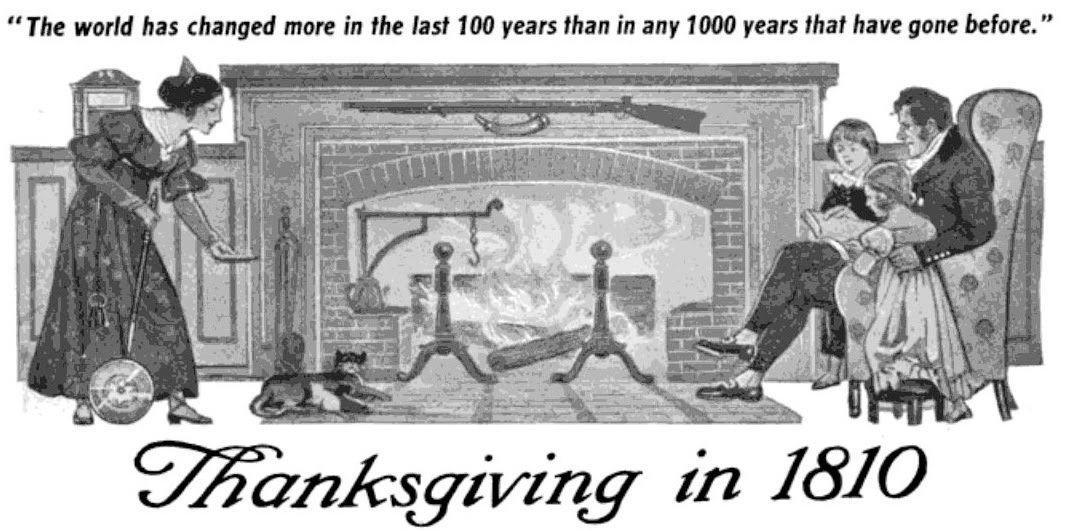
Thanksgiving in 1810, 1910, and 2011

Here we are again on the Monday before Thanksgiving.  We, like you, do not anticipate an immense amount of projects being completed this week.  After all, this is the time for football, turkey, pumpkin beer and tryptophan.  Although we usually do not wax sentimental here at Abnormal Use, on this occasion, we feel that we must direct you to last year’s Thanksgiving post entitled “Thanksgiving in 1810, 1910, and 2010.”  Back in 2010, we unearthed a century old magazine article in which the writer, a resident of 1910, looked back 100 years and marveled at the incredible social and technological change that occurred in the previous ten decades.  That writer also looked forward to 2010 and briefly speculated how we, as citizens of the 21st century, might look back at those who lived in his era 100 years before.   That article struck such a chord with us. So, today, we remind you of it once again and direct you back to it 101 years after its publication.

As we proceed through this week, looking forward to stuffing and cranberry sauce, we think of all the things that we are thankful for and wish you a happy Thanksgiving.